
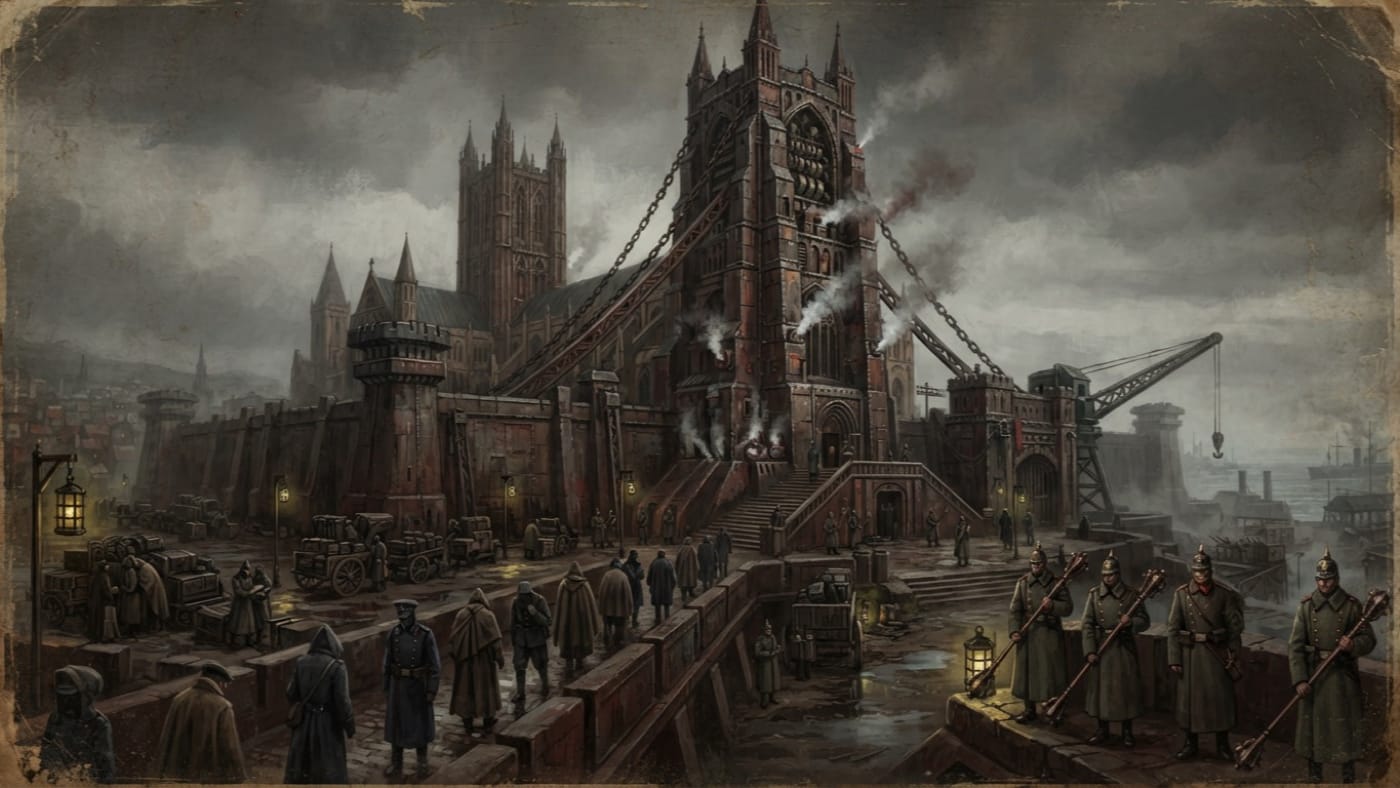
#On the Precinct and Its Authority
Canterbury Cathedral stands inland in Kent, behind the Dover shore, at the centre of the city whose roads, inns, courts and pilgrim tariffs I have already filed under Canterbury. This entry covers the stone itself: the precinct, the nave, the tower, the reliquaries, and the face the building lends to British money. The city is the Crown's seat. The cathedral is why that seat has never moved.
It is a living church. Hours are kept, the dead are tolled, oaths are sworn, and pilgrims are counted in and counted out again. It belongs to the British Crown, which holds Zone 0 as an allied co-belligerent that never signed the Concordat and has never asked to. A Synod legate may walk its public aisles. He may decide nothing in them. Strasbourg has learned, at the cost of several careers, that being admitted does not confer jurisdiction.
King-Warden Aldric III, Rex Custos, rules from Canterbury through the Table of Nine. The Archbishop keeps the cathedral as chief prelate of the Lantern Way. Continental clerks like to merge the two offices into one convenient villain. The British keep them separate and side by side, like a blade and its scabbard, and will not say which is which.
#On the Nave and the Oath Rooms
The nave is fortified and does not admit it. Its walls are as thick as worship requires and as thick as a siege requires, and nobody in Canterbury has bothered to say where one purpose stops. The British have never had the leisure to separate sanctuary from strongpoint.
The side chapels serve as oath rooms. A Warden's officer swears there. So does a harbour clerk. So does a man accused of short weight, who learns that perjury under Canterbury vaulting is punished differently from perjury in a Dover shed, though the statute reads the same in both. The confessional recesses are cut deep enough for privacy and shallow enough for a Ringer to step in. The choir-stalls face the altar in disciplined rows. Guards stood at the bell stairs during every office I attended. That was every office I was permitted to attend, which was fewer than I requested.
Worship and obligation share one floor. A Crown summons may be read after a psalm, and a Warden levy announced between the epistle and the alms. Continental liturgists call this vulgar. I called it efficient, then judged my own judgement vulgar, then wrote it down regardless, because the Ledger does not accept embarrassment as grounds for omission.
The throne and the Table belong to the Canterbury seat. The British have not told me where the King-Warden sits when the Wardens are summoned, or under which roof. I will not draw a floor plan from a feeling.
#On the Carillon and Its Servants
The great carillon is the cathedral's voice. The British trust it more than any voice that needs a mouth.
It is served by the Lantern-Ringers, and their mother-house is here. They are ordained bell-warriors in wool, and each carries a mace cast from the bronze of the bell he serves. Warden-priests ordain Ringers in parish towers across the island. The prized ordinations take place under this carillon, with the Archbishop hearing the oath. The novice swears to keep the hours, sound the alarms and toll the dead, and never to let silence into the tower unchallenged. He swears it with one hand on the bell and one on the mace. Training under the cathedral carillon is reported to take nine years. I have known Synod campanologists who would not last nine weeks of being right about pitch beside a man holding a club.
The bells keep Canterbury's hours and a good deal more. They mark the offices, the watches, the opening and closing of markets, the summons and the deaths. When the cathedral rings, Dover answers, the Chainworks answer Dover, and the ship bells of the Cathedral Ships answer through the fog. That chain of answers is part of why Strasbourg puts up with British observance on its own quays. Britain is governed partly by charter and partly by the interval between bells.
The Bureau of Bells has asked for the tuning tables seven times and received seven courteous refusals. An eighth request is in draft. The clerk preparing it already handles the file like a man rehearsing his own funeral. The peal itself is public, if heard from designated ground. The tables are private. So are the emergency sequences, and so is any British account of the sounds that foreign listeners report and Canterbury will not discuss. I record the refusal. I will not invent the answer it withholds. The Bureau's bell files hold enough fiction already.
#On Relics and Pilgrim Custody
Canterbury's custodians speak of the Martyr Step, the Black Rood, the Shore Bell Fragment and the Nine Lamps of the Watch. Those are their names for them. Canterbury has never told us who made the objects, whose step it is, which shore the bell came from, or when any of them arrived, and I will not answer those questions on its behalf. The Bureau of Relics wants grades and chains of custody. The cathedral offers feast days.
The public reliquaries are clean, lit and labelled. Ringers watch over them and rest their maces where pious hands can see them. Bones, bell fragments, sword hilts, cords and pieces of stone are kissed, sworn upon, carried down to keels and tied to clappers. British parish books report broken fevers, cracked bells ringing true and ships brought home. Those are reported effects. Our failure to inspect the objects proves only one thing, and it concerns us rather than the relics: we were kept outside the rail.
Foreign pilgrims land at Dover, walk the road marked with lantern posts, and enter under watch. They see enough to go home awed and too little to go home useful. Every wider permission rests with British authority, and nobody has explained whose signature stands behind the Warden's.
Beyond the pilgrim line the crypt routes continue, locked. The British neither map them nor deny them. British law also walls certain condemned dissenters up alive. The sources do not say whether the cathedral pronounces those sentences, confirms them or only consecrates them. Purity has sent me questionnaires on the point. I return them with the boxes empty and the margins full.
#On the Cathedral in Iron
Every Iron Crown carries this building to market. Its obverse shows Canterbury Cathedral and its reverse a sword driven into stone. The coin is struck under Crown warrant and Canterbury authority: two authorities behind one face. The British see no need to explain the arithmetic.
The cathedral mint is reported to stand in a side precinct, where the bells can be heard through the floor of the striking room. I did not see it, and no Synod officer has. That detail rests on report, not on anyone's visit. Keeping the image does not mean controlling the dies. I have read Tithes memoranda that assume the Archbishop strikes coin with his own hand. They read like confessions by men who have never held a British charter.
The Iron Crown predates the Crown of Grace by forty years. Eleven protests from the Bureau of Tithes have drawn eleven identical replies. The Synod does not recognise the coin. The Synod spends it. At Dover it buys chain, cordage and blessed rope. Across the water at the Chalk Redoubt of Calais it buys flour when the packet is late. In embassy accounts it settles debts Strasbourg would rather not have run up. Each purchase passes the cathedral's face over a counter and into a continental purse.
The cathedral does not own the Chainworks or run their forges. What links them is sovereignty and sacrament: one Crown writ, one Lantern rite, one network of bells and one coin. A coil of Dover rope is blessed under a rite approved at Canterbury. It is paid for in an Iron Crown stamped with Canterbury's face. It is hung under a bell whose Ringer may have sworn his oath beneath Canterbury's carillon. Nobody drew up a contract. The British did not need one.
The sword in stone is Britain's Arthurian claim made portable, sustained by oath, charter and use. Doctrine has spent a century calling it a legend. I give no ruling here on Arthur, on any reign or on any sword. I note only that the legend pays for nails.
#On the Present Condition
As of A.S. 201 the cathedral is British in every working part. British Ringers ring it, a British prelate keeps it, and British law defends it. Synod presence is limited to the permitted aisles, the public peal and the correspondence.
Bureau of Doctrine register, entries through A.S. 198: "Canterbury Cathedral — principal altar of Schismatic Heresy, Category Two."
Revised A.S. 199. The Lantern Way is now classified as Non-Standard Observance, Diplomatically Accommodated, under the pressure of convoy dependence. The altar has not moved. The grain convoys have.
Canterbury sent no thanks for the revision, having requested none. Legate-Prior Mertens, the Synod's ambassador resident in Canterbury, reported that the precinct received the notice without visible change. In Strasbourg, Lord-Warden Eccleston accepted it with the stillness of a man taking delivery of furniture he had not ordered. Neither man governs a stone of the cathedral. One reports on it and the other represents it, and Strasbourg confuses the two about once a quarter.
Mertens's dispatches continue, shorter than they used to be. The Bureau of Bells is copying out its eighth request. In the nave a harbour clerk swears to his weights, the Martyr Step takes another pilgrim's knee, and somewhere above the guarded stair the hour is struck on time.