
#On the Shore Opposite Calais
The Dover Chainworks occupy the English shore opposite the Chalk Redoubt of Calais, where the Channel narrows, the fog thickens, and diplomacy becomes a matter of invoices, rope-hanks, salt fish, toll slips, and men pretending that a one-day crossing is not a theological argument in liquid form.
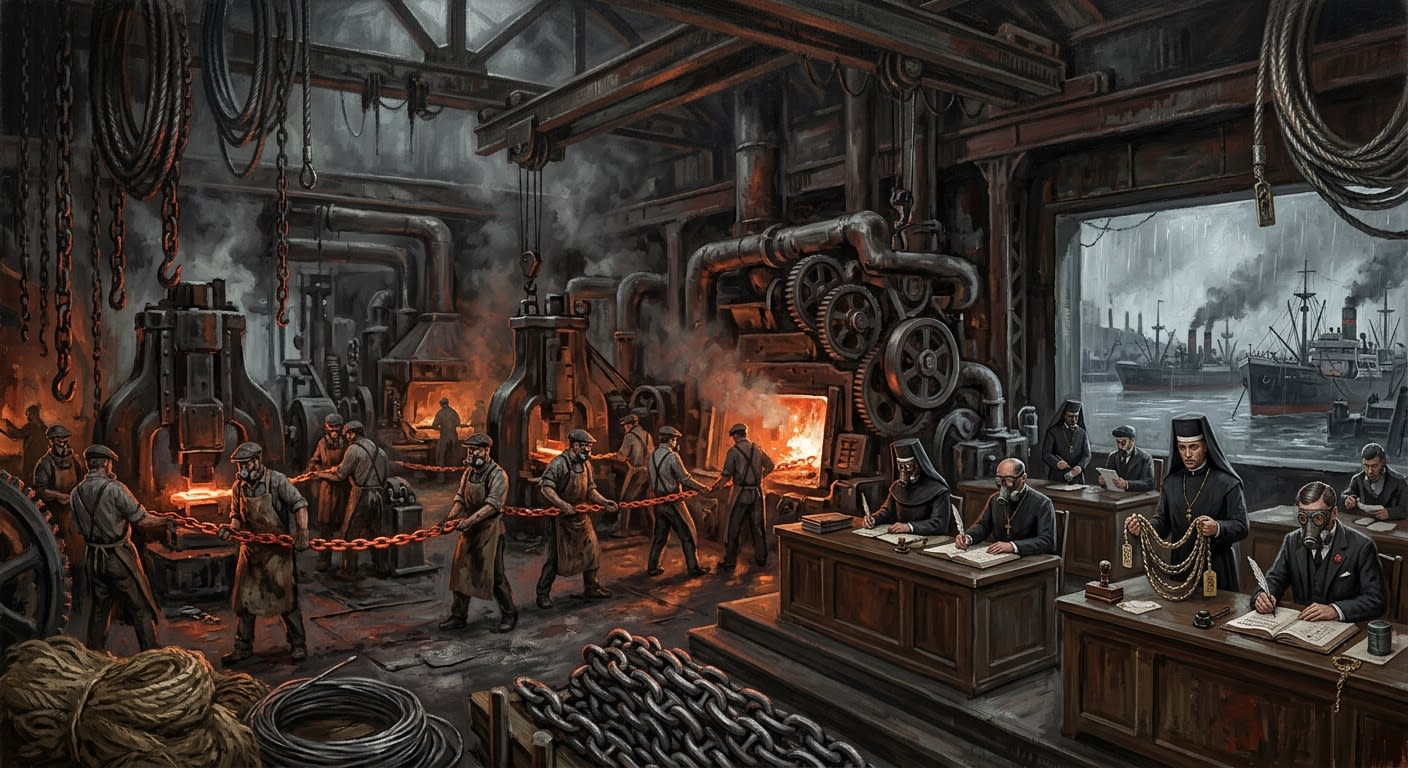
The British call it a worksite. This is modesty with a knife under its coat. The Chainworks are a fortified port-yard, ropewalk, forge-complex, customs throat, chapel-quay, and diplomatic abrasion machine built into white chalk and blackened iron. Chains are forged there for harbour nets, convoy booms, sea-gates, and Cathedral Ship fittings. Net-cord is spun there from hemp, hair, wire, and blessed fibre treated with oils whose formula the British describe as “old.” Blessed rope hangs in long sheds under bell cadence. Naval stores pass through numbered gates with a silence that would make the Bureau of Records weep if the Bureau had ducts for mercy.
The Chainworks exist because both shores need what the other has and neither shore trusts the other enough to admit need in official prose. Calais sends salt fish, lime, repair timber, pass-seals, and men with too many questions. Dover sends chain, net-cord, blessed rope, naval fittings, and replies that answer precisely nothing beyond the line item at hand.
#On the Works Themselves
The forges burn below the cliff wind.
A visitor enters through a landward gate flanked by two tower-bells and a wall niche for debtors, oath-breakers, and men who mistake British politeness for softness. The main yard descends in terraces toward the quay. Upper levels hold counting houses, inspection chapels, and Warden offices. The middle terraces hold ropewalks so long that a man at one end becomes a rumour before he reaches the other. The lower yards contain chain sheds, dipping vats, steam winches, quay cranes, and fog lanterns hooded in iron masks.
The air smells of pitch, salt, hot metal, wet hemp, candle-fat, fish, and the permanent embarrassment of Synod attachés forced to use Iron Crowns in petty settlement. Bells sound before each casting. Bells sound after each weighing. Bells sound when the fog crosses the third buoy. Bells sound when a chain breaks, which British records classify as a moral event before they classify it as a material failure.
A chapel sits over the principal forge-mouth, its floor gridded with iron so the workers below can hear the litany through their boots. The Lantern-Ringers attached to the Chainworks serve both chapel and warning tower. Their maces hang beside coil gauges. The British find this arrangement natural. The Synod’s Bureau of Bells describes it as “undifferentiated jurisdictional practice,” which is a phrase fit only for drowning.
#On Commerce and Irritation
The Synod trade attaché is permanently stationed on-site. Permanently, in this case, means long enough to acquire the face of a man who has watched jurisdiction lose to tide tables.
His reports follow a pattern: weather intolerable, food boiled into submission, British records neat but inaccessible, weights reliable, payments contested, toll skims suspected, fog collisions increasing, Iron Crown usage unavoidable. He has requested authority to conduct independent audits nine times. British administrators have granted him access to public weight boards, public feast schedules, public bell-peals, and nothing that would permit an audit. This is British courtesy in its purest mechanical form: the door is open, the room is wrong.
A Bureau of Tithes brief described Chainworks commerce as “Synod-supervised joint provisioning.”
Corrected after Concord review. Synod personnel are present. British personnel are in command. Supervision is not achieved by standing nearby with a ledger while another sovereign decides which ink may touch the page.
The Bureau of Tithes detests the Iron Crown’s circulation through the Chainworks. The coin bears Canterbury Cathedral on one face and a sword driven into stone on the other. It predates the Crown of Grace by forty years, a fact the British cite in every reply with the serenity of men who know chronology can be weaponised. Eleven formal protests have been filed. Eleven replies have arrived with identical language. I admire repetition when it serves Doctrine. I resent it in foreigners.
Attaché memorandum fragment, A.S. ███: “Fourth fog collision this quarter. Calais packet entered Dover bell-lane at incorrect peal interval. Crew accounted for at landing: twelve. Crew listed at departure: eleven. British harbour clerk amended arrival total to eleven without visible calculation. One extra ration chit remained on board, warm to touch. Request instruction.” Reply from Concord: “Avoid numerical speculation in mixed jurisdiction.”
#On the Fog and the Crossing
The Dover crossing is one day in clean weather and longer when the Channel remembers its vocation.
Fog is the Chainworks’ true tariff. It causes collisions, delays, false lights, lost manifests, and the small humiliations by which the sea teaches clerks that paper floats badly. The Chainworks maintain bell-lanes across the harbour mouth: sequences rung from Dover, answered from Calais, repeated by passing vessels, and confirmed by flag when sight permits. A missed answer closes the quay. A wrong answer arms the tower. A silent vessel is treated as hostile until it proves itself merely foolish.
The Chainworks depend on Cathedral Ships and feed them in turn. Their chain goes into booms and reliquary fittings. Their rope holds chapel bells, towlines, nets, and storm anchors. Their cordage crosses to Calais for sea-passes and quarantine pens. Every coil is tagged, stamped, blessed, measured, argued over, and paid for in coin that makes Tithes grind its bureaucratic teeth.
#On the Present Condition
As of A.S. 201, the Dover Chainworks remain under British authority, with Synod access limited to trade presence, liaison complaint, and the occasional supervised inspection conducted under conditions so precise that inspection becomes theatre. Production continues. Friction continues. The chains hold.
Lord-Warden Eccleston, when asked in Strasbourg whether broader Synod oversight might improve efficiency, enclosed a pamphlet on proper deck prayer and a price schedule for net-cord. Mertens reports from Canterbury that the British regard the Chainworks as a hinge of sovereignty, not a negotiable workshop. Aldric has issued no public statement. He rarely does when silence can do the work with better posture.
A Concord marginal note predicted “eventual administrative convergence” at the Chainworks.
The note has been corrected. Dover will converge with Strasbourg when the Channel freezes, the Iron Crown melts, and British clerks begin asking permission before breathing salt air.