
#On the Coin and Its Insult
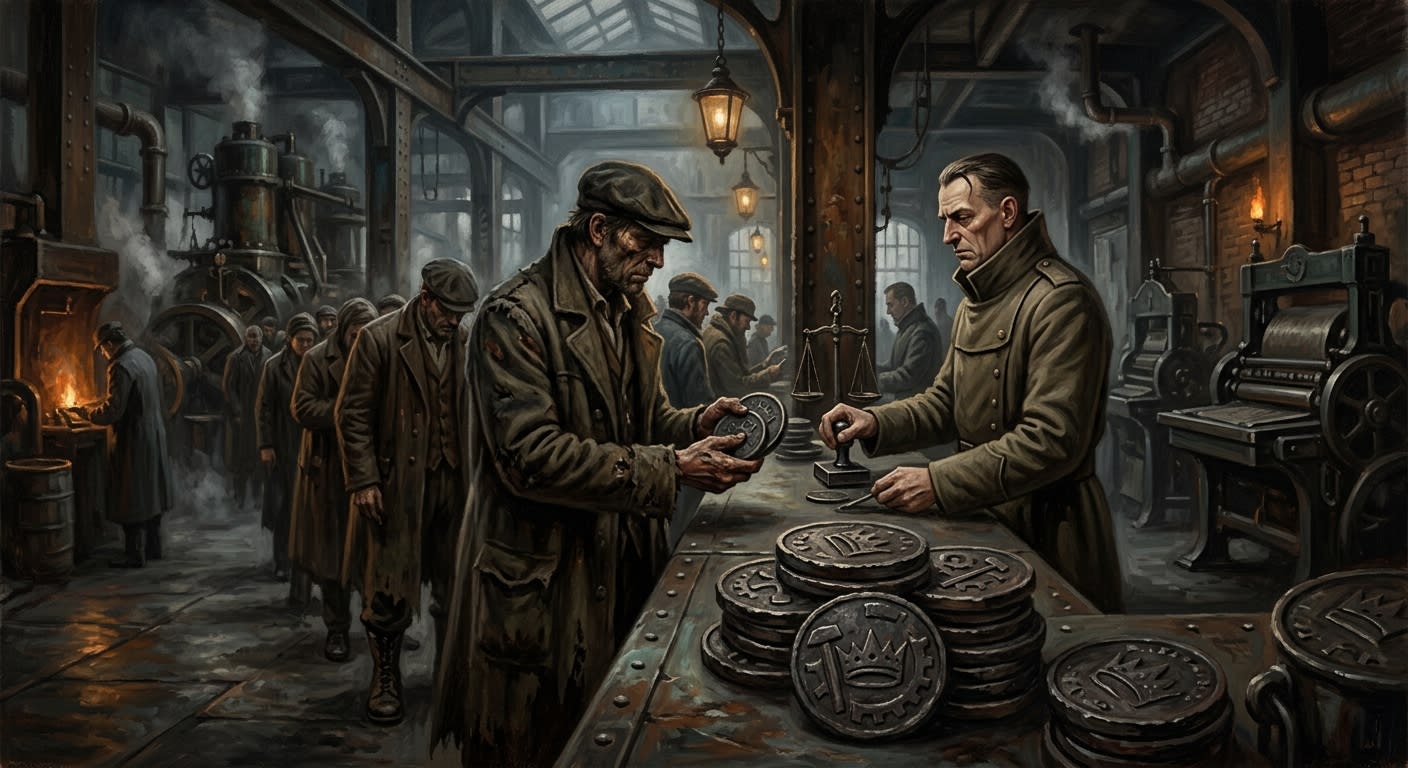
The Iron Crown is the coin of Britain: iron struck under Canterbury authority, stamped with Canterbury Cathedral on one face and a sword driven into stone on the other, circulated through ports, parishes, fleet-yards, Warden courts, pilgrim inns, and every joint commercial operation where the Bureau of Tithes arrives already angry.
It predates the Crown of Grace by forty years. Britain repeats this fact as if chronology were absolution. The Bureau of Tithes repeats its objections as if objection were jurisdiction. Both parties have elevated repetition into policy, which proves, if nothing else, that the Channel separates kindred lunacies.
The coin’s weight varies by issue and Warden mark, a practice Tithes calls intolerable and British merchants call recognisable by hand. Older issues from Canterbury bear a deeper cathedral stamp, the tower lines cut sharp enough to catch grime in the grooves. Dover mintings carry a smaller sea-mark near the rim. Northern issues, scarce in continental trade, carry hammer signs associated with the Table (Unregistered)’s old seats. Every Iron Crown is king’s coin. That sentence is the British monetary theory, the British legal theory, and the British answer to almost every assessor sent across the water.
#On the Crown of Grace and the Failure of Comparison
The Crown of Grace is the Synod’s holy money, stamped iron consecrated at the mint, marked with the sigil of the Synod, weighed, blessed, tracked, audited, and entered into ledgers that function as minor chapels for men whose souls have shrivelled into arithmetic. Its value rests on the will of the Synod. Its circulation is confession by other means. To cheat in Crown is theft and blasphemy, which saves the courts time by allowing two punishments to wear one hat.
The Iron Crown does not seek consecration from Strasbourg. It does not pass through Synod ash-test, song-test, or silence-test. It does not kneel in the Palatine Counting House before an altar-scale whose pans are never empty. It enters continental hands at Dover, at convoy ports, in embassy settlement, in sailor taverns, in pilgrim exchange, and in those embarrassing little moments when necessity outruns doctrine and doctrine pretends it chose the route.
A Tithes memorandum described the Iron Crown as “unblessed iron tender, presumed spiritually inert.”
Corrected after Dover chaplaincy reports. The coin carries British oath-law, Warden recognition, and enough practical authority to buy rope that keeps Synod grain afloat. Tithes may deny the blessing. It cannot deny the receipt.
The comparison offends both systems. To the Synod, money is sanctified obedience rendered portable. To Britain, money is sovereign trust beaten into iron and accepted because the King-Warden’s courts will honour it with jail, seizure, or rope. We bless coin to make value holy. They punish refusal until value becomes obvious. Aesthetic preference aside, the market notices the second method.
#On the Eleven Protests
The Bureau of Tithes has filed eleven formal protests against Iron Crown usage in joint commercial operations. Each protest cites non-Synod tender intrusion, audit obstruction, irregular sacramental status, disputed weights, unlicensed royal imagery, and the grave inconvenience of British solvency. Each reply has arrived from Canterbury in the same wording.
The British reply states that the Iron Crown predates the Crown of Grace by forty years; that king’s coin remains legal where the King-Warden’s writ runs; that mixed ports operate by treaty clause; that Synod personnel may convert at posted rates; that no alteration is required.
No alteration is required. Four words, and an entire Bureau hissing like a censer dropped in dishwater.
Tithes has proposed countermeasures. Mandatory conversion tables. Quay-side weighing chapels. Stamp surcharges. Penitential tariffs. A ban on Iron Crown petty settlement inside Synod-designated storage yards at Dover, an admirable phrase until one remembers Dover is British and phrases do not arrest dockmen. Concord has rejected the harsher proposals. War has rejected anything that slows chain, rope, grain, or convoy schedules. Doctrine has advised patience, a virtue easiest recommended by offices not paid in disputed coin.
#On Circulation and Contagion
The Iron Crown circulates where British authority touches necessity.
At Dover, Synod attachés use it for food, lodging, dock fees, copy fees, rope samples, ferry charges, and bribes they later classify as “expedited hospitality.” At Calais, it passes among sailors, fishmongers, salvage men, toll clerks, and women who know exactly which foreign coin buys flour when the supply packet is late. In Strasbourg, the British embassy spends it sparingly and with exquisite cruelty, usually in contexts where refusal would breach diplomatic courtesy.
Bureau of Tithes Incident Report, A.S. ███: During audit of a Calais dock tavern, assessor found sixteen Iron Crowns nailed beneath the bar in a circle around one Crown of Grace. Proprietor claimed “sailor custom.” Coins were removed. By morning, the nail-holes had rusted into script resembling the Canterbury refusal letter. Three words legible: “older,” “legal,” “where.” Further analysis sealed under Concord objection.
The danger is less demonic contamination than administrative imitation. A coin that moves without Synod blessing teaches the hand a small treason before the mind has time to object. The clerk accepts it “only this once.” The harbourman keeps it because the British quartermaster will take it at face. The widow saves two for passage. The pilgrim carries one home and calls it a curiosity. The Bureau calls such movement leakage. Britain calls it trade.
A Purity circular warned that possession of Iron Crowns might constitute Category Three foreign devotional contamination.
Withdrawn after War noted that half the western convoy office had handled the coins during paid settlement. The revised circular advises reporting “unusual accumulations.” No number defines unusual. Tithes wanted three. Concord wanted fifty. War wanted silence.
#On Counterfeit, Weight, and the Arthurian Lie
Counterfeiting Iron Crowns is difficult, unrewarding, and occasionally fatal.
The metal is ordinary enough. The stamp is not. Canterbury dies cut the cathedral face with tiny asymmetries known to British wardens and to no Synod office despite several expensive attempts at acquisition. The sword-in-stone reverse carries a line of old law around the rim, abbreviated differently by issue. False coins ring wrong under a Lantern-Ringer’s tap. Some crack. Some sweat red rust. One counterfeit batch in A.S. 198 turned black in the purse of a Dover toll clerk, who summoned a priest, two constables, and a boy with a broom. British efficiency at its most humiliating: even their superstition has procedure.
The sword-in-stone is the insult beneath the insult. It places Arthurian legitimacy in the hand of every fishwife and rope-broker. It says the Crown’s authority is older than Strasbourg, older than the Concordat, older than the clerks now objecting to it in triplicate. It says value descends through myth ratified by use, not through Synod stamp. This is bad theology and excellent coinage.
#On the Present Toleration
As of A.S. 201, the Iron Crown remains non-recognised and tolerated, which is Bureau language for “we hate it and still take it when the quay-master insists.” It circulates in joint ports, embassy accounts, Channel settlements, and the small economies of men who work near British stores. The eleventh protest remains unanswered in substance because the first answer was substance enough.
Mertens reports that Canterbury considers the matter closed. Eccleston behaves as if closure were a climate in which he was born. Aldric has not dignified the protests with public address. The Bureau of Tithes prepares a twelfth memorandum. There are mills in Hell less repetitive.