
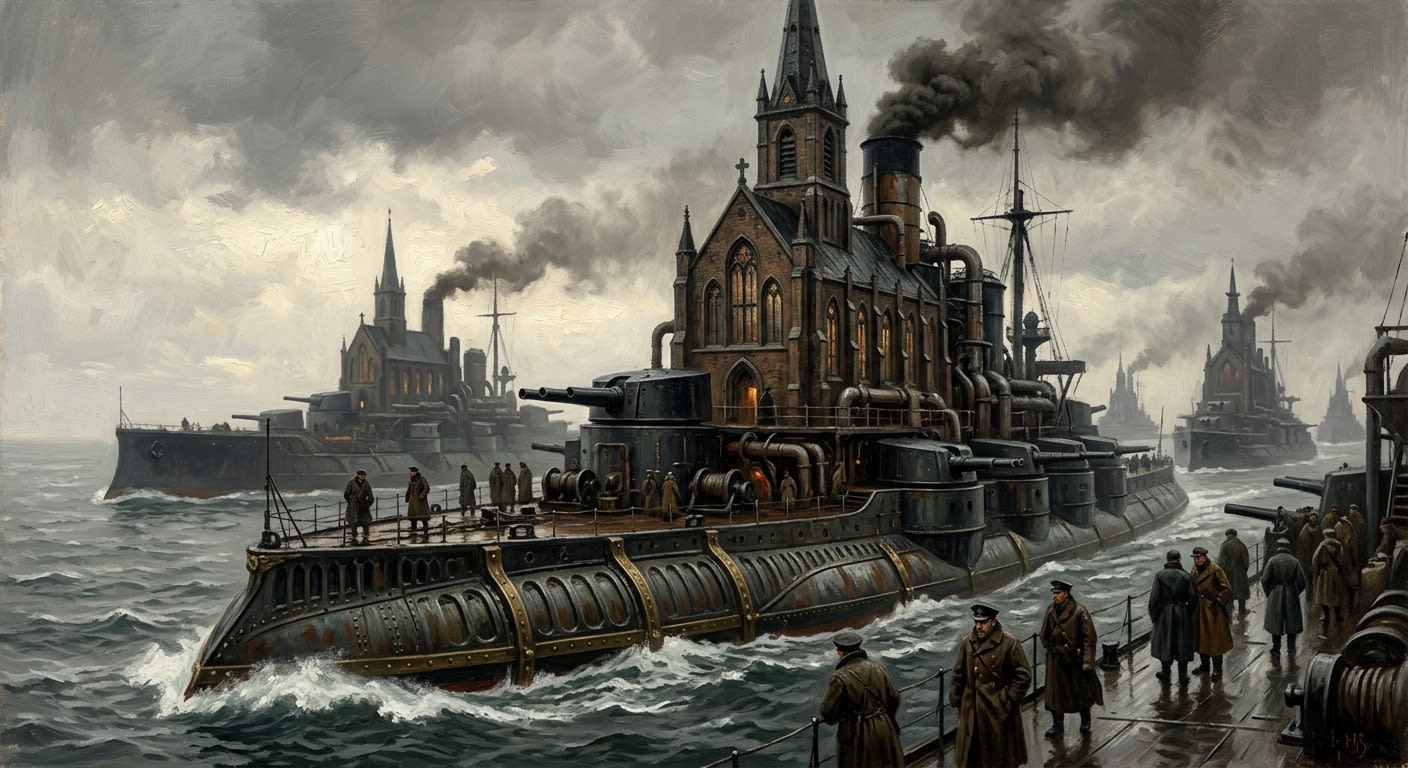
#On Their Hulls and Their Offence to Reason
Cathedral Ships are British warships with consecrated chapels amidships, bell-towers above the quarterdeck, guns along the batteries, rams at the prow, and reliquaries sealed into the keel where a continental engineer would expect ballast, rot, and a lawsuit.
They are parish, battery, shrine, courtroom, and threat carried on salt water. Each hull sails under the British Crown, answers to the Royal Fleet, and serves the Channel with the infuriating competence of an institution that has never filled out a Synod requisition form in its life. The Bureau of War counts them among roughly three hundred British warships. The Bureau of Engineering counts them among its professional humiliations. The Bureau of Doctrine counts them only when forced.
The ships vary in displacement, armament, age, and local devotion. The oldest are timber and iron hybrids, refitted until no original plank remains and yet referred to by British sailors as “she who remembers Hastings (Unregistered),” which is either naval sentiment or chronological heresy. The newest come out of the western yards (Unregistered) with armoured belts, screw propulsion, auxiliary sail for vow-days, and chapel foundations laid before the keel is fully blessed. Every class shares the same structure: chapel amidships, bell-height over command, reliquary-keel below the waterline, and a crew drilled to treat liturgy as damage control.
#On the Reliquary Keel
The reliquary keel is the problem.
A Cathedral Ship’s keel contains relic matter sealed into a long iron-and-oak reliquary running from foremast step to sternpost. British sources describe it as a line of witness beneath the vessel, which is a phrase with enough piety to conceal a great deal of engineering. The relics vary by ship. Martyr bone, saint teeth, scraps of tower bell clapper, dust from Canterbury crypt stones, cord from drowned priests, and, in at least one documented case, a sword-hilt associated with an Arthurian saint whom the Bureau of Relics refuses to recognise because recognition would require reading British paperwork without snorting.
The keel makes the hull resistant to sorcerous attack. That is the field fact. Hex-fire crawls along the planking and dies at the waterline. Fog-things strike the hull and shear away as if meeting a confession they cannot answer. Rots fail to spread past sacramental seams. Splinter wounds close under bell cadence more often than physics permits, and when physics complains the British ring louder.
The Bureau of Engineering has attempted reproduction for eleven years. It has produced three cracked test-keels, one barge that listed permanently toward Canterbury, fourteen papers on “maritime sacral stress distribution,” and no working Cathedral Ship. The British have offered sympathy, tea, and no diagrams.
Engineering memorandum E-44 described Cathedral Ship hull resistance as “replicable pending adequate relic sample control.”
Corrected after the third test-keel split during dry blessing. Adequate sample control did not impede the work. The obstacle was that the British know something about joining wood, iron, relic, vow, and water that our engineers cannot reduce to parts without killing the thing they meant to study.
#On the Chapel Amidships
The chapel is set amidships because the British possess, beneath their barbarism, a tolerable instinct for balance. The altar rests where roll and pitch meet with least violence. The nave is narrow. The pews are bolted. The saints are strapped in during heavy weather. Candles burn in gimballed housings. The confessional screen folds against a bulkhead when guns are run out. The organ, where present, is small, salt-corroded, and more stubborn than most Synod deacons.
The crew prays there before action. The wounded are carried there after action. Discipline is read from the altar steps. Mutineers, pirates, rescued pilgrims, foreign observers, and sailors who have spoken too casually about the fog are brought there to hear judgment. A Cathedral Ship’s chapel is the ship’s conscience and, when necessary, its gallows.
The Lantern-Ringers serve the chapel bells, alarm bells, and bell-masts. At sea they become a peculiar breed of armed sacristan, sleeping near the tower ladder, eating with the gunners, and carrying bell-bronze maces that make boarding actions shorter and uglier. Their bell schedules are withheld from the Bureau of Bells, which continues asking with the mournful optimism of a clerk courting a locked vault.
Extract from Channel Escort After-Action, A.S. ███: “Fog contact at second watch. Forward lookout reported lanterns below the surface, moving against tide. Cathedral Ship <em>Saint Gawain-in-Chains</em> (Unregistered) rang full alarm without captain’s order. Three Synod grain barges reported hearing their own names in the bell sequence. Two barges corrected course. Third failed to respond and entered ███████████████. At dawn, Gawain’s keel reliquary registered heat sufficient to blister paint from within. British captain classified incident as ‘answered.’”
#On the Bell-Tower and the Fog
The bell-tower above the quarterdeck is both command instrument and act of insolence toward the sea.
Continental vessels keep bells for watch and warning. Cathedral Ships raise towers. Not masts hung with bells, though the bell-masts matter; towers, built into the stern structure or quarterdeck platform, braced against recoil, wind, and the perverse humour of Channel weather. When a Cathedral Ship moves through fog, the bells sound before the prow becomes visible. Men at Calais know the British by tone long before signal lamps confirm flag.
The fog behaves differently around them. I dislike writing that sentence because it is the sort of thing that invites a century of scholarly fraud, but the reports agree. Channel fog curls from the bell line. Compass deviations settle inside the sound cone. Men who hear voices from dead ports report the voices muffled when the bell-mast tolls. The Scandinavians call the water-grey by one name, the Calais garrison by another, and the British call it weather, which is their word for everything they have decided to outlive.
A bell-tower is a target. The British know this. They armour the base, shield the stair, station Ringers with maces and pistols at the landings, and treat any enemy effort to silence the tower as confirmation that the tower is doing its work. Several Cathedral Ships bear scars where artillery struck the tower and failed to still the bell. Sailors describe these marks with the tenderness other men reserve for children.
#On Convoys and Dependency
The Synod depends on Cathedral Ships. The Synod dislikes sentences in which dependency appears without being disguised as cooperation, so I have written it plainly for the pleasure of imagining the censor’s face.
British escorts protect grain, coal, pilgrims, chains, net-cord, medical stores, diplomatic cargo, and the more fragile category called dignity across the western approaches (Unregistered). Their patrols from Dover Strait to the Bay of Biscay have prevented piracy, anomaly loss, fog-diversion, and maritime phenomena the Bureau of Shadows admires too much to describe. The Dover Chainworks supplies chain, blessed rope, and naval cordage under British authority, while Synod attachés stand nearby with notebooks and the exhausted expressions of men watching usefulness occur outside jurisdiction.
A Bureau of Doctrine position paper described British convoy assistance as “auxiliary maritime support.”
Corrected in the sealed War annex. Loss of British convoy cooperation would reduce western grain throughput by a classified fraction large enough to make theology hungry. Doctrine may call the assistance auxiliary. Stomachs would call it primary.
This dependency shaped the A.S. 199 reclassification of the Lantern Way from Schismatic Heresy, Category Two, to Non-Standard Observance, Diplomatically Accommodated. The theological argument remained unchanged. The grain manifests did not. Grain possesses a persuasive faculty denied to theologians.
#On the Synod’s Envy
The Synod envies the Cathedral Ships with a passion bordering on devotion.
The Vigil Arks are our answer, and they are magnificent: airborne reliquary-cathedrals, hymn platforms above the line, a proof that the Synod can make grandeur fly when the relic cooperates and the weather signs the proper forms. We have two operational Arks. The British have hundreds of ships, and the relevant number, when one is hungry and fog presses the convoy, is the count of hulls.
Engineering wants the keel. Bells wants the tower. War wants the convoy doctrine. Rites wants the shipboard chapel order. Relics wants to inspect the sealed matter and has been refused with such firm politeness that several Relics functionaries mistook the refusal for a preliminary welcome. Doctrine wants a classification in which Cathedral Ships are impressive without implying British legitimacy. No such classification exists. We will invent one by winter.
The British understand our envy. They do not exploit it crudely. Lord-Warden Eccleston answers specification requests with pamphlets on deck prayer. King-Warden Aldric III permits convoy cooperation and withholds diagrams. Mertens reports the facts. Strasbourg files the reports and grows more devoutly irritated.