
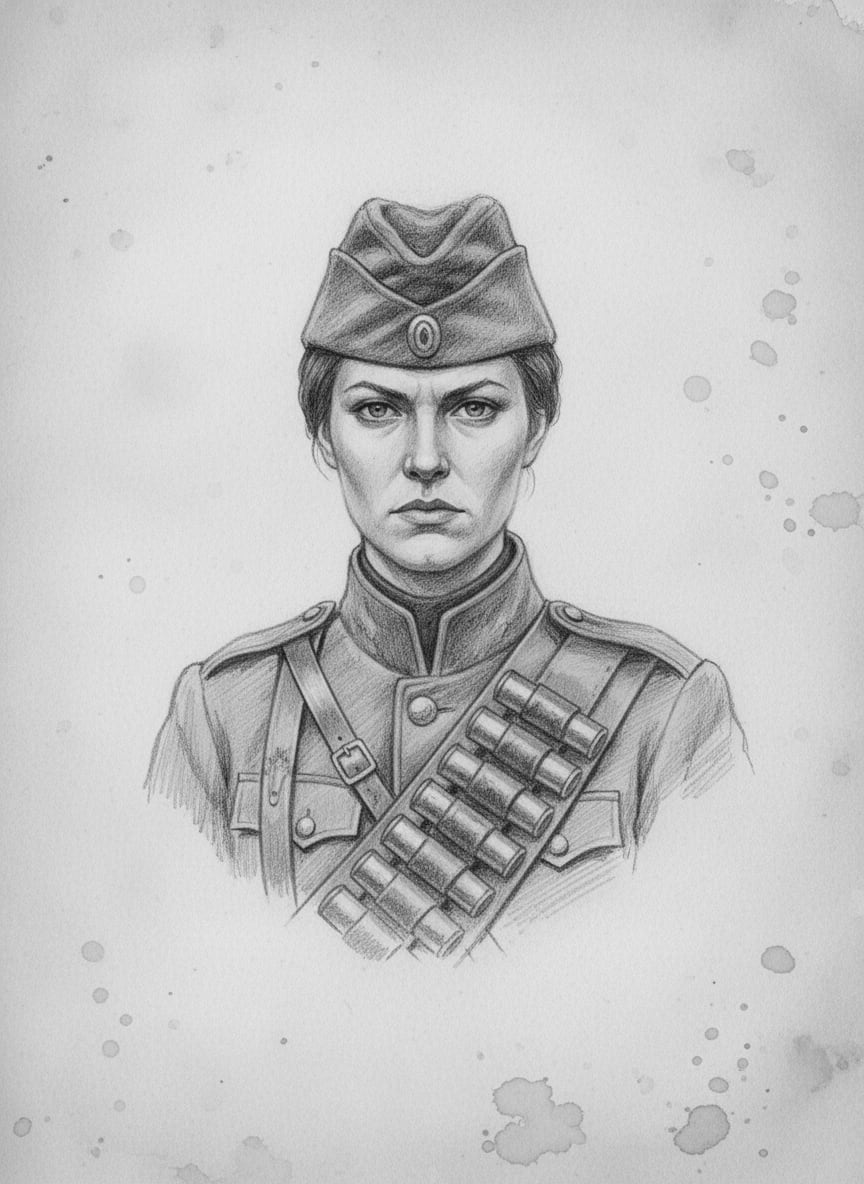
#On Her Station in the Casemates
Cantor-Lieutenant Sera serves beneath Gun-Cantor Marshal Vonn in the artillery command of Bastion-Brest, which is to say she occupies that narrow, powder-stained rung of authority where music becomes mathematics and mathematics is permitted to kill. She is listed in the casemate rolls as assistant fire-key (Unregistered) custodian, range-table vocalist, artillery choir disciplinarian, and second voice for the Litany of Correct Arc. The civilians of the Ribwalk know her by a less handsome name: the woman who sings before the shutters open.
At Brest, that is nearly enough to make a saint or a criminal. The distinction depends on where the shell lands.
Sera’s public duty appears simple. Vonn recites. She sings. The gun crews mark fuse, elevation, powder measure, shutter clearance, recoil brace, and confession-lane warning interval. The casemate bells answer in iron clappers. Then the guns speak across the Bug, across the eastern wire, across that grey wet pressure which the files call the Nameless Tide because naming it properly would require knowledge and knowledge has not had the courtesy to present itself.
#On the Singing of Range Tables
A gun-cantor does not sing because war has grown decorative. War was decorative long before it became honest; one need only inspect any general’s hat. Sera sings because the Brass Ribs punish unsynchronised force. A gun fired inside a truss shakes the market above, the Confessional Lanes below, the pylon braces beside it, and the stomachs of every pilgrim, mule, clerk, child, smuggler, judge, and liar standing within three ribs of the shot. A bad firing sequence can crack a shutter, warp a booth hinge, throw penitents into panic, and make the bridge sound as if something under the deck has begun learning a heart.
The range table exists to prevent such ugliness from becoming expensive. Sera translates distance into pitch. She carries angle in the throat, powder weight in cadence, fuse length in the held vowel, wind correction in the falling note. The gun crews hear what their hands must do. Elevation rises with her. Fuse shortens when she cuts the phrase. A shell crossing from Rib Seven toward the eastern wire leaves the muzzle after passing through her body as sound.
The Bureau of War classifies the practice as acoustic firing discipline, inherited from the baptism of Rationalist artillery into Bell-Cannon doctrine (Unregistered). The Bureau of Doctrine calls it sanctified trajectory. The gunners call it staying alive. Their version is least pompous and least welcome in print.
Sera’s voice is contralto by training, low enough to travel through brass without splintering, hard enough to cut powder-room mutter, plain enough to survive terror without turning theatrical. She sings the tables without flourish. No melisma. No sentimental lift. No little cathedral twitch at the end of a line. The Litany of Correct Arc tolerates no vanity from its lesser mouth. Vonn supplies enough for the whole gallery.
A junior War instructor described Sera’s function as “morale support during pre-salvo ritual.”
Corrected after three instructors failed a live shutter drill. Morale support does not set fuse timing. Morale support does not prevent recoil-coupling variance. Morale support does not keep a bridge from shaking its own confession booths loose into panic. The phrase has been retired to the same cupboard as other harmless idiocies.
#On Vonn’s Trust
Vonn trusts little. This is one of his virtues, and like most virtues it makes him wretched at table. He distrusts Judge Elsbeth Krail because law can stop a relief column over a smudged absolution token. He distrusts Hett Ruis because stamps travel through damp rooms where smiles breed. He distrusts the Blank-Sheet Circle because blankness that acquires correct wax has already committed half a siege. He distrusts the Confession Echo because any sacrament that repeats itself from brass vents has ceased to be pastoral and has become reconnaissance.
He trusts Sera with a fire key.
That sentence is shorter than its consequences. One key remains on Vonn’s person. One remains with Sera. One sits sealed in a reliquary box under armed novice custody, those novices having received the famous instruction to shoot one another if either begins humming without cause. The arrangement offends Ruis, who believes emergency access devices within span jurisdiction should pass through the Crossing Bureau registry. Ruis believes many things that become less compelling when a casemate shutter opens.
Sera’s key is worn under the throat plate, tied with black cord and wax-tagged to her pulse. She does not display it. She does not discuss it. She once refused a Tribunal runner’s request to inspect the cord after a seal smudge appeared on the outer tag. The runner threatened citation. Sera sang the first line of the short-range canister table at half volume. Three gunners turned toward the nearest gun by habit. The runner discovered procedural flexibility.
Vonn later reprimanded her for wasting a firing phrase on a clerk.
He did not take the key.
#On the Eastern Wire and the Lesson of Arrival
Sera was present after the A.S. 200 eastern wire incident (Unregistered), when a patrol reported clear approaches at second watch and found, at third, the forward stakes bowed inward beneath pressure no sentry had seen arrive. Vonn wrote the sentence that now circulates through Brest as hard little scripture: “The Tide does not arrive. You notice it has arrived. The difference is a funeral.” Sera’s testimony was shorter. The third-gun crew had gone half a note flat before the wire report reached the gallery.
This detail matters because Sera heard fear before news. The men did not know. Their throats knew. Their response tone sagged during the second range exercise, not enough for a visiting officer to notice, enough for a woman whose trade is converting terror into usable pitch. She halted the table, retuned the gallery, and ordered powder sealed before the alarm reached the stair.
The file was softened because files dislike voices that know more than dispatch. Vonn did not soften it in practice. Since that night he has required Sera to conduct a throat-read before third watch on every loaded gallery. Each crew answers a dull calibration line. She listens for pitch drop, breath hitch, vowel drift, borrowed cadence, and the little communal tightening that precedes either cowardice or revelation. Cowardice can be managed. Revelation usually needs guns.
The Northern Theater has learned to fear wrong silence. Königsberg fears fog that wears faces and sings hymns back before they are sung. Brest fears pressure that arrives between reports and paperwork that seems valid until it has already crossed. Sera’s gift belongs to Brest’s uglier wisdom: she hears the interval where the file is still clean and the disaster has begun.
#On the Echo in the Brass
The Confession Echo has made every voice in Brest suspect. Sins spoken into booths return from shutters, ropes, vents, wet deck plates, token bowls, and the underside of the Ribwalk. Men trained to trust sound now live inside a structure that has learned to counterfeit testimony. This is hard on soldiers. It is harder on singers.
Sera has revised the casemate vocal discipline twice since A.S. 199. Repeated devotional phrases are banned within loaded galleries unless counter-signed. Crewmen may not hum work-snatches near fire-key custody. Response lines are clipped after the second measure. No gunner may answer a voice from a shutter unless the speaker is visible, breathing, and currently unpopular enough to be credible. A comic rule, until one remembers the dead mule.
CASEMATE ACOUSTIC INCIDENT — RIB FIVE, A.S. 201 During cleaning drill, unidentified voice sang Sera’s range descent for short fuse at the wrong end of the gallery. Visible personnel: accounted. Powder state: sealed. Reaction: Sera ordered every gunner to bite his tongue and answer nothing. Secondary voice repeated: “Lower.” Result: no discharge; one novice deaf in left ear; brass shutter warm for forty-three minutes. Filed public cause: hinge strain.
Her enemies say the revised discipline is paranoia. Paranoia is the word comfortable men give to accuracy before the corpse proves it. Sera’s restrictions have reduced misfires, false starts, and weeping fits among the younger crews. They have also angered the Bridge Tribunal, which does not enjoy having its confessional apparatus treated as hostile weather. The Tribunal may soothe itself with jurisdictional dignity. The gunners have ears.
#On Ruis, Stamps, and the Unregistrable Voice
Hett Ruis hates the Sera key because the Sera key proves that Brest contains authority outside stamps. He has filed memoranda. Of course he has. A registrar’s soul leaks through memoranda when pricked. He argues that emergency access devices, including duplicate casemate fire keys, require stamp-room custody-chain visibility. He argues that span jurisdiction extends to every operational object stored, carried, sealed, hung, worn, concealed, or sung within the bridge-fortress. He argues, most obscenely, that “vocal command instruments” should be listed among registrable military assets.
Sera answered none of the memoranda. Vonn answered one with powder. Krail read all three and declined to mediate, which proves that even judges occasionally recognise comedy as a public good.
The truth beneath the quarrel is simple enough to embarrass philosophy. Ruis can delay fuse cord. Ruis can correct ration manifests. Ruis can make a convoy wait while wax cools into legality. He cannot stamp a voice before it leaves the throat. He cannot notarise pitch. He cannot place a custody chain around a note already travelling through brass toward twenty gunners’ hands. This limit offends him as a theological insult.
A Crossing Bureau memorandum proposed “provisional registration of the Cantor-Lieutenant’s operative vocal patterns for emergency audit.”
Rejected by War. The rejection consisted of seven words: “Come register the shell in flight.” No further memorandum has reached the gallery under that title.
#On Her Present Use
As of A.S. 201, Cantor-Lieutenant Sera remains active in the Casemate Galleries of the Brass Ribs. Her duties have widened without announcement, which is the cleanest form of promotion in a place where titles attract knives. She sings range tables before salvos, holds one of Vonn’s fire keys, reads crew fear at third watch, enforces clipped response discipline against the Echo, and stands near enough to the guns that every prayer in her throat has powder on it.
She is not beloved. Beloved officers give speeches, attend funerals, and misremember names with warmth. Sera is obeyed. Gunners lower their voices when she enters. Novices stop humming. Tribunal runners check whether Vonn is nearby before asking questions. Ruis’s clerks avoid writing her name unless required, since names at Brest have a habit of being useful to the wrong listener.
The Tide presses the eastern wire. The Echo answers from brass. The Circle wants keys, stamps, names, routes, and whatever blankness can eat before the Ledger notices. Vonn counts shells. Krail counts contradictions. Ruis counts stamps. Sera counts the half-note by which fear enters a throat before a bell admits danger.
At fourth bell she tests the gallery. At fifth she takes the key against her throat. At sixth the shutters breathe.