
#On the Office and Its Licence
The Cantor-Scribe is the most exact hand the Bureau of Orison and Song owns, and the least celebrated. The Hymnal Directorate employs them to transcribe approved stanzas onto distribution sheets. From those sheets the Church learns what to sing at dawn, at the graveside, at curfew, at the gallows, at the furnace and at the Line. Field officers of the Bureau of Orison, which is the same institution under its shorter name, rarely mention them. Nobody praises the gutter for carrying the rain.
A Cantor-Scribe composes nothing. The licence permits reading, copying, comparing, witnessing and signing. It gives no right to improve a note, relieve a breath, or decide that a pause has outlived its usefulness. That right belongs to the Plate. The Plate belongs to the Bureau, and the Bureau belongs, on paper, to Heaven.
What the licence does confer is legitimacy. A hymn sheet without the scribe's signature is paper with ideas. With it, the same paper becomes law that can be sung.
#On the Plate, the Witness, and the Copy
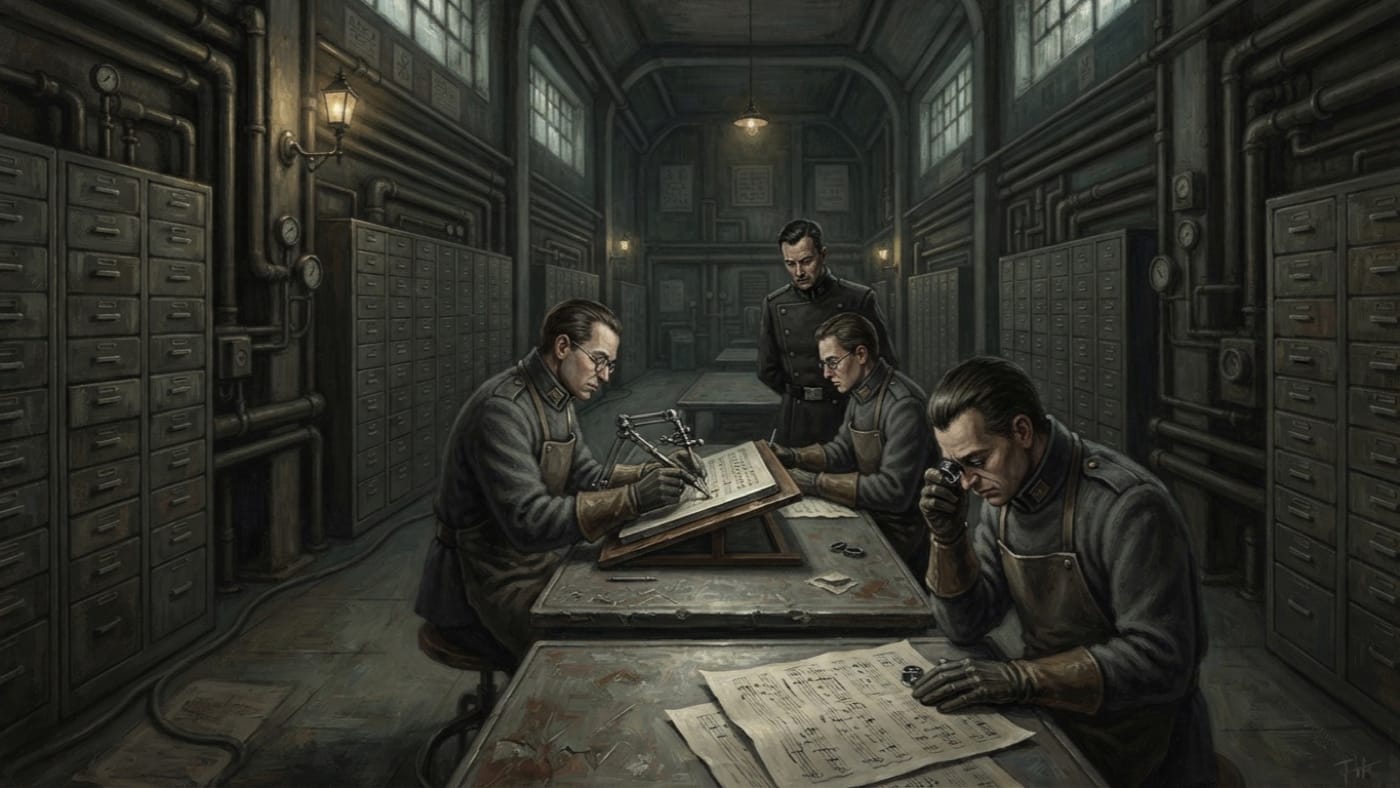
The work is done in the Vault of Tuning, in the north range of the Cloister of Calibrated Breath at Strasbourg. The room is cold. The Master Hymnal Plates lie in steel drawers beneath linen, beeswax seals and custody ribbons. Each drawer is sorted by class: parish, war, industrial calibration, broadcast, penitential, Mercy, execution, and one marked Restricted, which Cantor-Scribes learn to walk past without turning their heads.
Before a drawer opens, the paperwork must arrive in order. It needs Orison seals, a countersignature from the Bureau of Doctrine, and a custody clerk sent by the Bureau of Records to watch everyone else watching. A Provost searches hands, cuffs and mouth. The scribe hums a baseline tone on entering so that the throat can be compared on leaving. A stolen breath mark travels as easily in memory as in a sleeve, and Orison would rather examine the larynx than trust the conscience.
Then the linen is folded back. Gloves go on. The scribe's breath is turned aside, because common breath may not warm the steel. One Cantor-Scribe reads the engraved notation mark by mark. A second checks each element against the steel: interval, pause, syllable weight, stress, measure and approved silence. Silence is notated. A rest on a Plate is as much an order as a note, and the Bureau treats an unmarked gap as an invitation to the wrong guest.
The copy comes down in stages. The Plate yields a master rubbing, made only under witness. The master rubbing yields distribution sheets, and these are the Cantor-Scribe's principal labour. Distribution sheets then breed in the provinces: local hymnbooks, choir slips, barracks cards, transmission packets and furnace stanzas. Each stage takes a seal, and each seal claims descent from the steel.
That descent is the copy's only authority. A barracks card at the Line has never seen the Plate. It obeys because the sheet before it obeyed, back to a drawer in Strasbourg and two gloved readers who agreed on where a breath fell.
Cantor-Scribes are trained to see deviation at a glance: a note a hair too low, a breath mark too generous, a comma kind enough to invite interpretation. The training does not wear off. The trained eye becomes an affliction.
#On the Uses of an Approved Stanza
The sheets leave Strasbourg for every room where the Church requires a voice to behave. Parish devotion, funeral responses, curfew prayers, punishment drones, the Orison Hour, military hymnody and industrial calibration all begin as somebody's careful transcription in a cold room.
The Cantor-Scribe's jurisdiction ends at the seal. Hymnal Auditors carry rubbings into parishes and barracks to inspect what the copies have become. Stanza Marshals prosecute whatever the Auditors find. Orison Signal Engineers push the approved cadence through saint-dust and copper. Calibration choirs sing it over cooling metal. The scribe does none of these things and answers for all of them, because the first signature in the chain is the easiest one to find.
Now and then their hands are admitted to the making of a score as well as its copying. The joint Mercy-Orison committee behind the Dormition Canticle, approved in A.S. 134, counted three Orison Cantor-Scribes among its members. The record gives no names and does not say which bar each one defended. Four bars came out of it. The orphans have been asleep, or pretending to be, ever since.
#On Essen and the Distribution of Error
At Essen-of-Hymnsteel the distribution sheet stops being devotion and becomes metallurgy. Descendants of the Industrial Calibration Plates are sung in the Hall of Measures while Hymnsteel cools, and the cooling grain keeps the song. Bell-cannon throats, hymn-drive housings and reliquary rivets leave the city carrying that obedience toward the Sagittal Line.
Ledger Row records every stage. Its batch folios name the stanza plate, the choir, the pour, the inspector and the destination. The Row copies, countersigns and binds them, and so it reproduces the musical chain alongside the industrial one. Copies of copies, all sealed, all lawful.
Here a breath mark acquires mass. Add one where the Plate commands sustain and the error can travel from a Records table to the choir platform, from the platform into the pour, and from the pour into a gun throat. The throat passes proof and splits under fire weeks or months later. Not every slip ends that way. Some produce sour singing and nothing worse. The Bureau cannot know in advance which kind it has, so it treats every mark as capable of killing a gun crew.
The horror of the arrangement is administrative. When the throat fails, every office involved holds a correct receipt. The Hall sang what it was given. Ledger Row filed what it was shown. The Cantor-Scribe signed a sheet that matched a sheet. Liability travels back along the seals until it finds a hand, and the hand nearest the steel belongs to the Cantor-Scribe.
#On Correction, Contamination, and the Acoustic Seal
The Mirror Choir understood the copy chain better than many of the Bureau's own officers. Its cells have no need to breach the Vault. They need an approved sheet, a trained hand and a moment between audits. They work with an altered syllable, a quarter-tone, a moved breath mark or a lengthened sustain. Copied in the correct hand under the correct seal, the variant carries the Plate's full authority.
The dangerous variants are the good ones. Mirror Choir alterations have been found to keep the metre, ease difficult transitions and spare the singers strain. In certain pours they have yielded hymnsteel of unusual purity before the delayed failures arrived. Put a Cantor-Scribe in front of such a sheet. The trained eye sees the deviation at once. The same eye sees that, in narrow technical terms, the deviation is an improvement. The licence forbids that thought from reaching the pen. Unauthorized correction is prosecuted whatever its musical merit, and the Bureau does not grade heresy on beauty.
The Bureau has always known that its own scribes were the likeliest way in. For a season its circulars said otherwise.
Bureau circulars confined Mirror Choir recruitment to refugee agitators, condemned labour and criminal elements.
Corrected A.S. 201. Since that year began, Ledger Row has removed three licensed Cantor-Scribes, one Orison Provost clerk and a Records copyist under acoustic seal. Licensed hands are also hands.
The removals are documented, and the procedure was thorough enough to be noticed: muffled bells, dental inspection, wagon wheels wrapped in felt. What came after appears in no file open to me. No names have been published, no confessions entered and no convictions certified. Removal under acoustic seal shows that Orison wanted these persons silent and elsewhere. Guilt would be a separate document, and nobody has shown it to me.
Then there is the Alto With No Name. Witnesses have given contradictory descriptions of the Mirror Choir's suspected leader, and one of them names a former Cantor-Scribe from Strasbourg. Others describe a woman, a man, a child, a ruined singer, and a deaf worker who conducts by touch. The Strasbourg account has no better claim to the truth than the child does. It has still done its work in the Cloister. Every scribe in the Vault now knows that the Bureau's most wanted heretic may once, in one witness's telling, have worn the same gloves.
The Choir calls the hand that changes a sheet its Discord Scribe. Purity would find it convenient to treat that title and Cantor-Scribe as one office. The record keeps them separate.
#On the Present Custody
As of A.S. 201, the Bureau's public position is that the Master Hymnal Plates are secure in their drawers and that every breach so far has entered through the copies, never the steel. Cantor-Scribes still read in pairs. Custody clerks still watch. Provosts still sniff cuffs. There are too few Hymnal Auditors for the number of sheets now leaving Strasbourg, and every sheet they cannot inspect goes out on the scribe's signature alone.
The Bureau's remedy is more witnesses, more seals and more searches. That means more trust placed in the very people it has begun carrying away in felt-wheeled wagons. There is no other arrangement available. Orison cannot copy a hymn without trained hands, and it cannot train a hand without teaching it to recognise a better note.