
#On the Authority of the Manual
"Sing it true, or it fails." — Motto of the Chrismole Crown, cast in iron above the nave
Every engine on the Sagittal Line that burns Brast fuel is, at one remove, burning a book. The Chrismole Distillation Manual is currently in force under the designation Seventh Revision. It governs the Chrismole Furnaces of Brast from the moment feedstock enters a kiln to the moment a sealed drum leaves the Manifest Court. It tells the furnace crews when. It tells the choir what to sing. It tells the clerks where to write. An artilleryman could reasonably ask it one question: why does any of this produce a fuel that fires true? Since A.S. 187 the manual's answer has been scrupulous, official and polite.
The manual comes from Brast's earliest furnaces, and I can only infer how. In A.S. 68 a logistics officer of the war administration requisitioned a rail junction in the Heartlands fringe and began making fuel. That administration was later styled the Bureau of War, a name its clerks applied backward with their usual confidence. By A.S. 72 the doctrinal authority had sent a Cantor and fourteen choir-technicians to sing over the condensers, and the product took its name. Brast's charter was filed that same year. It was ratified in A.S. 90, when the Concordat of Strasbourg gave the Synod its formal constitution and gave the Holy Bureaus their present names.
Within a generation, a work-song sung beside a pressure bell becomes a schedule. Once the schedule is copied out and sealed, it is law. The Ledger does not say when the first such copy was bound, by whom or under what title, and I will not invent it. A Seventh Revision implies six predecessors. It does not introduce them.
What the manual is, I can state plainly. It is technical scripture: a working sequence, protected by a sacred classification that forbids anyone to treat it as a guess. Ordnance clerks call such songs calibration specifications. The furnace feeders call it the hymn. Both are right, and the manual has spent its whole life refusing to choose between them.
#On the Seven-Stage Measure
"The furnace does not care whether you believe. It cares whether you sing." — Choirmaster-Calibration Ilyra Kest, recorded testimony, A.S. 199
The manual divides each cycle into seven stages and hangs each one on a pressure bell. The bells belong to the Ordnance Bureau and the stages to the manual. The people standing between them belong to whoever is shouting loudest that shift.
At the first bell the primary kilns of the Chrismole Crown take their charge. There are seventeen kilns, vaulted in fire-brick and set in a half-circle around the central distillation nave. Into them go peat, coal, rendered tallow and the restricted component the Distillers' Compact calls the substrate. That word is all the manual's readers are given, and it is all you will be given here. Steam lifts the volatile fractions into the condenser lines, which run through the Still-Canals. There the canal water cools the pipe, and the air turns sweet and solvent and stays that way. Soot settles on everything that does not move, and on most things that do.
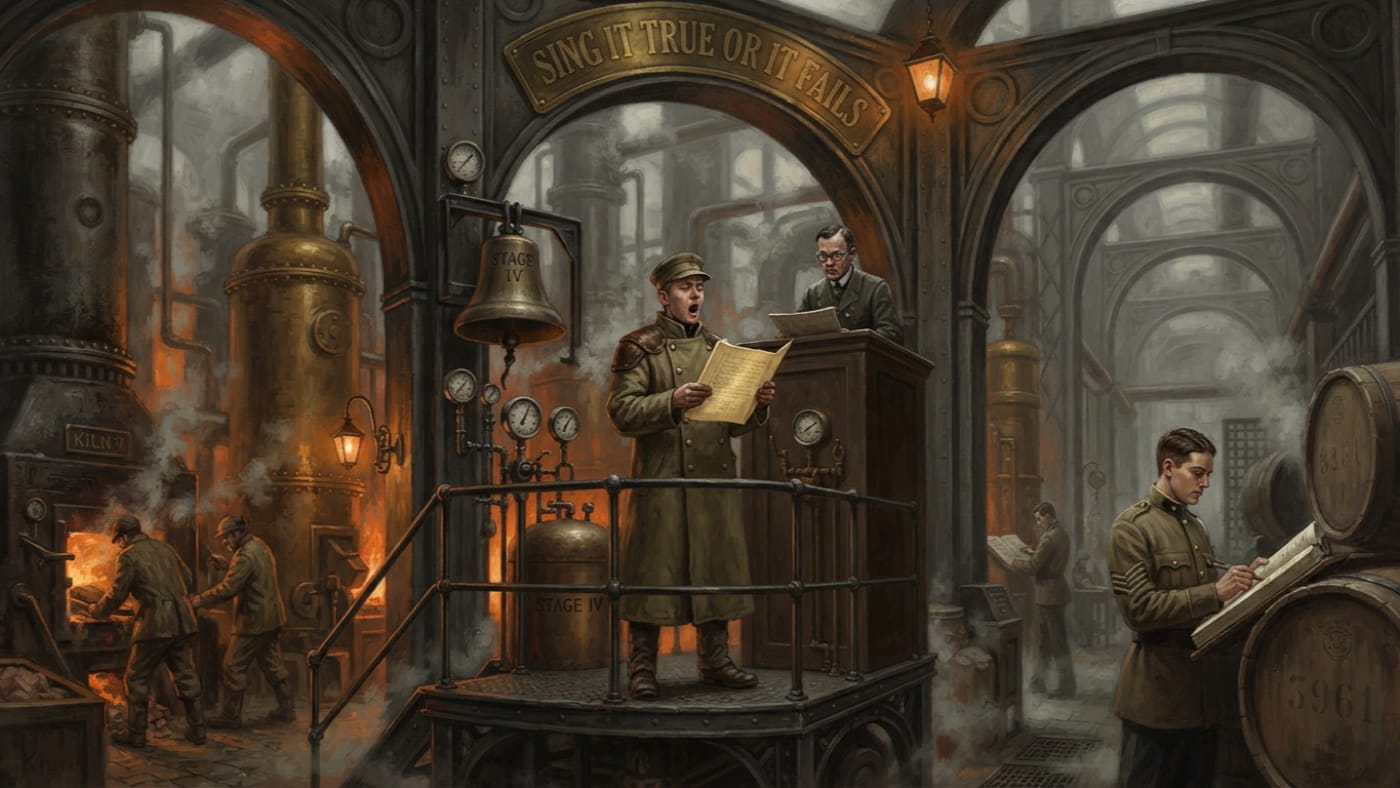
At the fourth bell the condensate reaches the sanctification nave. A rotating shift of the Calibration Choir stands before brass gauges whose needles shiver with the vibration of the pipework. The air is thick with hot oil, incense and the taste of scorched pennies. The shift sings the distillation hymn, fourteen stanzas long, and its tempo must match the rate of condensation to within three beats per minute. Three beats is very little. A tired throat drifts that far in a single verse.
At the seventh bell the finished chrismole is decanted into sealed drums. Each drum is marked with a wax prayer that can be traced by scent across three provinces. Each drum also receives a serial number in the Manifest Court's ledger. The Bureau of Records follows that number from Brast to whatever breech or boiler-plate the fuel eventually feeds, at Bastion-Constantinople or anywhere else the Line is hungry.
The second, third, fifth and sixth bells exist, and they ring. I have no record fit to cite for what the manual prescribes under them, and I will not fill the gap with soot.
#On the Hands, Throats and Ledgers
Three authorities hold the manual open at once, and each one holds a different page.
Choirmaster-Calibration Ilyra Kest commands the Calibration Choir from the Gauge Ward. Her choir-technicians number three hundred and twelve. Each is licensed by the Bureau of Doctrine and oath-collared by the Ordnance Bureau. To them the manual is a hymn sheet with the force of canon. Where calibration hymns count as scripture, an unauthorised verse is an offence, and a sanctioned sheet is the difference between a craftsman and a heretic. When the boiler sulks, a coerced singer who held a lawful sheet at least has the law on their side. A singer who improvised has only the boiler.
In Brast, the throat is the instrument, and throats in Brast spend their working lives in fume.
Guildmaster Pex Ruln's Distillers' Compact controls the filters and the still recipes. To the Compact, the manual is a sequence that sits on top of clean filters and sound feedstock. The hymn is sung over whatever the filters let through. A choir can sing every stanza within tolerance through a clogged filter and still obey the manual perfectly. The fuel will not know the difference, and the gun will not care.
Commander-Auditor Sorn Vale governs the Manifest Court. For Vale the manual ends at the seventh bell and begins again at the serial number. Vale's audit authority extends to summary execution for fuel diversion, and it has been exercised. A drum that leaves the Crown properly sung but improperly entered is a crime in Vale's court. A drum that was improperly sung but properly entered is somebody else's problem until it reaches a gun.
Above all three sits the Furnace Chapterhouse of Saint-Combust. It holds local ritual authority and the right to be consulted on what any of this means.
So a failure in Brast is a jurisdictional dispute with soot on it. The Choir says feedstock. The Compact says singing. The clerks say custody. The Chapterhouse says sin. All of them quote the manual, and nobody has yet found the page that settles the argument.
#On the Correction of A.S. 187
"If the cannon lies, someone lied first — find the liar and the barrel will behave." — Brast proverb
For most of its working life the manual explained itself in a single confident sentence. That sentence said the hymn's sacred properties sanctified the fuel through divine resonance. It committed a cause, a mechanism and a verb to paper under seal.
In A.S. 187 the Bureau of Doctrine withdrew it.
ERRATUM — Bureau of Doctrine, Filed A.S. 187 Chrismole Distillation Manual (Seventh Revision). Withdrawn: "the hymn's sacred properties sanctify the fuel through divine resonance." Approved: "the hymn's properties, which are sacred, interact with the fuel through mechanisms that are doctrinally sufficient." Procedure unaltered. Sacred classification retained. The Bureau of Alchemical Standards was asked to investigate and declined.
Read the two sentences side by side, and read them slowly. The Bureau has.
In the first sentence the hymn sanctifies. In the second, its properties interact. The sacredness has been moved into a subordinate clause, where it can be kept without having to do anything, and the mechanism is described as sufficient for doctrine. The erratum gives no reason for the change. I will not supply one.
Note also what did not move. The correction did not move a single bell. It did not strike a stanza or loosen the three-beat tolerance by so much as a breath. The furnace crews charge the same kilns at the same bell. The Choir sings the same fourteen stanzas over the same condensate. The clerks enter the same serials. The procedure kept its seal, and only the explanation was handed back.
Then there is the refusal. Since A.S. 72 it has been on record that the oil from the condensers is chemically identical to its unsung predecessor. The Bureau of Records certified it doctrinally distinct anyway, and the front-line commanders, who care about ignition temperature, did not argue. Chemical identity proves nothing either way about the singing. Boilers sulk. Gauges answer. Crews who skip a stanza report consequences. The office best placed to compare these observations with the material was invited to do so, and it declined in writing.
So the Church holds a sequence that works, a classification that forbids anyone to doubt it, and an explanation now worded so that it cannot be wrong. Whether the Creator attends the fourth bell is not a question the Seventh Revision asks. It has been corrected so that it never needs to.
#On Its Present Application
In A.S. 199 a battery at Bastion-Przemyśl, firing Brast chrismole, put four rounds into a friendly rail junction. Eleven people died and a supply train was crippled. The Ordnance Bureau blamed sabotage. The Calibration Choir blamed degraded feedstock. The Distillers' Compact blamed the Choir. The manual governed every stage those drums passed through, and nobody accused it. Nobody ever does. The inquiry continues.
As of A.S. 201 Brast stands at Amber, revised from Green in A.S. 199. Since the spring, seven drums have been missing from the Manifest Court's sealed inventory. Each was sung, sealed, prayed over in wax and entered by serial, and each is gone. Vale's sweeps through the Boiler Commons and the Slag Market have produced arrests and confessions, but no drums. The manual's custody ends at the ledger line. The drums have gone somewhere past it.
The Calibration Choir also reports a new syllable in the furnace harmonics during the night roar. No choir-technician has sung it, and no hymnal contains it. Choirmaster Kest has recorded it on a wax cylinder and locked the cylinder in a Bureau-sealed vault. She has not said what it sounds like. The manual was written for fourteen stanzas sung by licensed throats. Whatever is adding to them has no licence.
Inquisitor-Mechanic Lux Thane Mire has been dispatched from Strasbourg. The date of arrival is not yet known. Mire will find the Seventh Revision in force: sacred, corrected, its procedure intact, and its explanation sufficient for doctrine. Whether it is sufficient for anything else falls outside the remit of this Codex. Mire's title suggests that someone in Strasbourg has begun to doubt it.