
#On the Name and the Coast
Dalmatia is a name the Ledger inherited and never troubled to return. It survives from the maps of the dead calendar. It turns up on harbour deeds, on bills of lading that cross from Venice, and in the mouths of fishermen who would not know a provincial boundary if one were nailed to the mast. What this office holds is a coast: harbour rolls, tariff benches and parish fonts. It has never been sent a governor, a capital or a census figure, and it will not draw them from imagination. The coast is enough to be getting on with.
The ground is a hard white shelf of limestone pressed against the Adriatic, cut into coves, islands and short steep valleys. Stone towns grip their harbours below the cliffs. Watch chapels look down on water crowded with fishing boats, courier skiffs and quarantine launches. They share it the way three canons share one choir-stall, with elbows out and psalters open. Behind the shelf the country climbs into the Croatian highlands, whose ridges and cave-chapels have a different temperament and a separate entry. Croatia claims the littoral by association. This entry leaves the question of sovereignty exactly where Croatia left it, which is on the floor.
The war map gives the Dalmatian coast to Zone 3, the forward heartlands that stage supply. The water off that coast belongs to Zone 7, the southern maritime corridor. A Dalmatian fisherman therefore sleeps in one zone and works in another, and he is assessed in both. The Bureau of War regards this as a filing inconvenience. The fisherman regards it as Tuesday.
#On the Harbours That Supply the Line
Dalmatia earns its place in the Ledger twice, once at the quay and once at the muster rail. The quay comes first because it pays first.
Venice controls the sea lane between Italy and the Dalmatian coast. It bargains over that lane with the piety of a cathedral chapter disputing a thumb-bone. Across it come powder, grain, rope and cartridge paper, in the lighters and cutters that Venetian yards build and Venetian pilots steer. The yards and the pilots belong to Venice. Dalmatian harbourmasters have more than once suggested that Venetian competence be counted as a regional resource. Each time they have been told to unload their own boats.
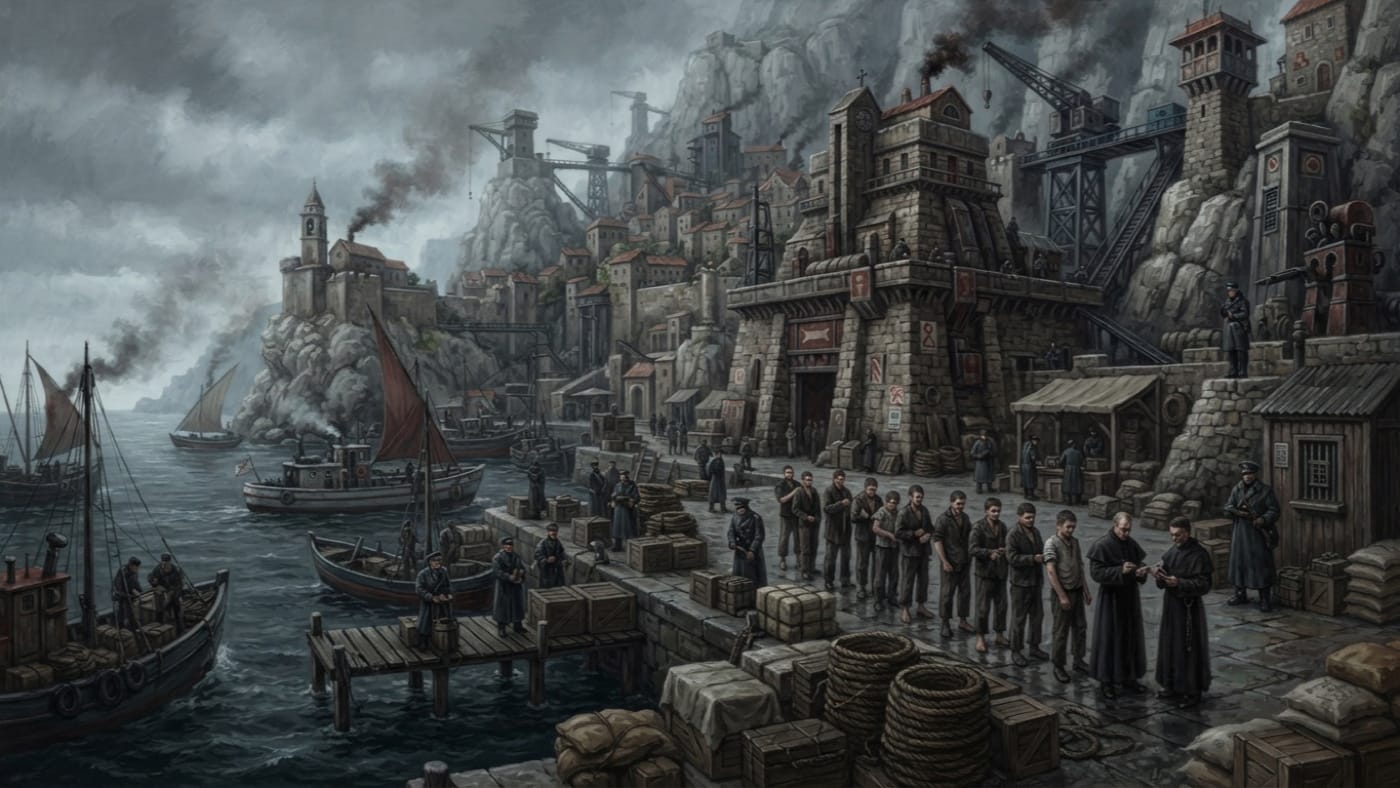
They unload them, and the unloading is both the coast's gift and its sentence. Every landing has a customs bench, a vinegar shed, a confession board and a clerk whose seal-press is still warm. Men carry coils of tarred rope up the steps on their shoulders. Sealed bales wait in rows under canvas for inspection. Pilgrims wait beside the bales and are inspected with the same eye, and now and then with the same hook. The southern corridor draws part of what feeds Irongate, Shipka and Constantinople, at the lower end of the Sagittal Line, from these harbours. I say part. Not every bale bound south passes through a Dalmatian cove, whatever the coves tell their creditors.
Near Ragusa the coast arms itself. The Saffron Bastion holds a deep harbour under cliff batteries, and quarantine piers that never quite dry. Its intake office decides whether each pilgrim is a soul to be received or a fever to be isolated. It is a secondary coastal installation and no eighth anchor of the Line, though its garrison will argue the point after the second bottle. Saffron licenses its lanterns by code and files its dockside lures with the harbour office. Those are Saffron's conditions. The smaller harbours up the coast keep their own bells, their own fevers and their own drownings. I decline to export Saffron's paperwork to coves that have not earned it.
"Clean southern water under reliable Synodal protection." — older pilgrimage handbill, Adriatic crossings
Already retracted in the Adriatic Coast entry. Retracted here a second time for Dalmatian readers, none of whom believed it. The water is salt. The protection is conditional. Cleanliness is a status granted after inspection, payment and confession.
#On the Sons Taken Inland
The quay explains why the coast is useful. The muster rail explains why it is quiet.
When the First Continental Levy fell in A.S. 110, the muster accounts recorded fishermen's sons from the Dalmatian coast. They arrived beside farm-hands from Aquitaine and vintners' boys from Burgundy, with salt still in the cracks of their hands and a feel for weather that the Bureau of War judged irrelevant. Ninety-one years later the Continental Levy still takes them. A coast that sends rope east sends boys east as well, and only the rope is invoiced.
The arithmetic is the continental arithmetic: one son in ten, assessed by household and corrected by province. The Bureau of Records takes the names from parish rolls kept in harbour chapels, where the font stands so near the water that some entries have run. Purity enforces compliance, and Doctrine sanctions the instrument. The Bureau of Conscription was constituted in A.S. 112 to bring order to the first muster's chaos, and it processes what the parishes yield. War receives the result. Refusal is classified as apostasy. A family that hides a boy in a fishing hold has committed heresy with a bilge.
Assessment follows the general form. Height, bodily condition, dental fitness and confession all go on the record. Teeth matter because cartridge paper is torn with the teeth, and a coast that lives on dried fish raises sons with an excellent bite. The Levy Assessor marks each wrist with the Triune Knot in ink that holds for nine days. A boy who runs for the boats carries the accusation on his own skin, and every harbour has a clerk who can read a wrist at twenty paces.
Then the coast lets him go. Conscription sorts by its own taxonomy of height, number and assignment, and his region falls off him like a discarded label. This office knows of no Dalmatian regiment, and War has never wanted one. Feudal Europe drowned in local loyalties. The Synod prefers numbered men. In the wider training system, the catechism-barracks and the Baptism of Mud finish what the muster began. The boy who could read a squall in the colour of the water learns to read the drum instead. His feet forget the deck and his hands forget the net. His letters home arrive corrected for morale, smelling of a barracks that smells of no sea at all.
The household learns an arithmetic of its own. A fishing boat needs a crew, and the crew is a family with one son fewer. Women, old men and boys not yet of age mend the nets. The harbour accounts were always kept by the women, and they now carry a column nobody labels. I record no figures for it. Records has published none, and I will not improve the Ledger's honesty by inventing grief in round numbers.
#On the Earlier Flight
Dalmatia had sent a man inland long before the Levy had a decree.
Brother Tomislav of Split was a half-blind Franciscan. In the years after the Sundering of 1 November A.S. 45, he carried the Reliquary of Saint Isidore out of the burning Dalmatian monastery of Saint Alexios. The monastery's exact site and its founding have not been established, and neither has his road. A few scattered intake lines and an unsent letter to a sister in Zadar do not make an itinerary, whatever the pilgrim printers sell. The end of the road is recorded. In spring A.S. 48 a retreating rearguard of clergy, civilians and broken soldiers stood on Kalnik Ridge. The seventeen relics in his casket ignited together, and the attacking host recoiled.
That rearguard was no Levy. The formal instrument lay sixty-two years in the future, and no Bureau of Conscription stood behind anyone on that ridge. Tomislav remains Venerable (Provisional), and his death is still disputed. The coast he left never saw the light. Now it sends its sons inland on paper.
#On the Present Register
In A.S. 201 the Dalmatian coast is loyal, useful and wet. Its harbours unload Venetian hulls before dawn and load the southern convoys after it. The watch chapels ring for boats returning and for boats overdue, and the ringers have learned to tell which peal is wanted from the faces on the quay. Passage along the coast depends on fever, on paperwork, and on whatever the water is doing beneath the piers. The fishing goes on, and so does the assessment.
Since A.S. 110 the Ledger has required four things of Dalmatia: rope, salt, harbour labour and the tenth son. The coast supplies all four. Its people would like it understood that only three of them were for sale.