
#On the Recorded Affiliation
The Order of Friars Minor enters the Ledger through one field in one file. The dossier of Brother Tomislav of Split gives his Order as Order of Friars Minor. A field-hospital clerk south of Zagreb wrote it shorter, "Tomislav, O.F.M.," on the same discharge form that recorded malnutrition and partial blindness. No document this office holds names the Order earlier than that.
I have written faction entries on less, though not often. The name tells the reader that Tomislav was a Franciscan, a professed friar of the minor sort, a brother who did not expect to be noticed. It does not say who governed him, where his superiors sat, how many brothers kept the same vows, or what rule they observed beyond the obedience common to religious life. The Ledger holds no founding for this Order, no founder, no charter and no seal. I will not borrow any of them from the dead calendar to make the entry look furnished.
What can be stated is this. Before the Sundering, the Church lived in hiding, in cellars, behind shuttered chapels and in houses the Rationalist administration had not yet bothered to close. Somewhere inside that hidden Church, an Order of friars kept enough of its shape to take in a young man from Split, record his age as a guess and set him to work.
The histories of the persecution mention expelled mendicants and massacred friars by the cartload. None of them names this Order. I will not enlist anonymous dead on its roster because their habits were the right colour.
#On the Brother at Saint Alexios
Tomislav took his vows at the Monastery of Saint Alexios in Dalmatia. The admission register gives his age as somewhere between nineteen and twenty-three, an honest admission that the clerk did not know. He kept the garden and copied manuscripts. The librarian assessed him three times and wrote the same verdict each time: "adequate penmanship, deficient eyesight." Two medical dispensations excused him from choir duty on account of "persistent inflammation of the left orbit."
That is everything the Ledger can observe of the Order's life in Dalmatia: a gardener and copyist with a sore left eye, and a superior willing to let him skip the singing. Pilgrim catechists have since built a Franciscan rule of holy blindness out of those two dispensations, and a vocation of copying out of three quarterly assessments. One friar's eye is evidence about one friar's eye. The dispensations record a kindness, and a kindness granted once does not become a rule.
The house itself must be kept in its proper drawer. Saint Alexios is where a confirmed member of the Order professed and worked, and nothing more may be claimed for it. Its charter burned, its site is unfixed, and its formal affiliation is unconfirmed. It may have been a Franciscan house, or it may have been a house that kept one Franciscan. Split was his origin and Zadar was his sister's address. Neither is the monastery's.
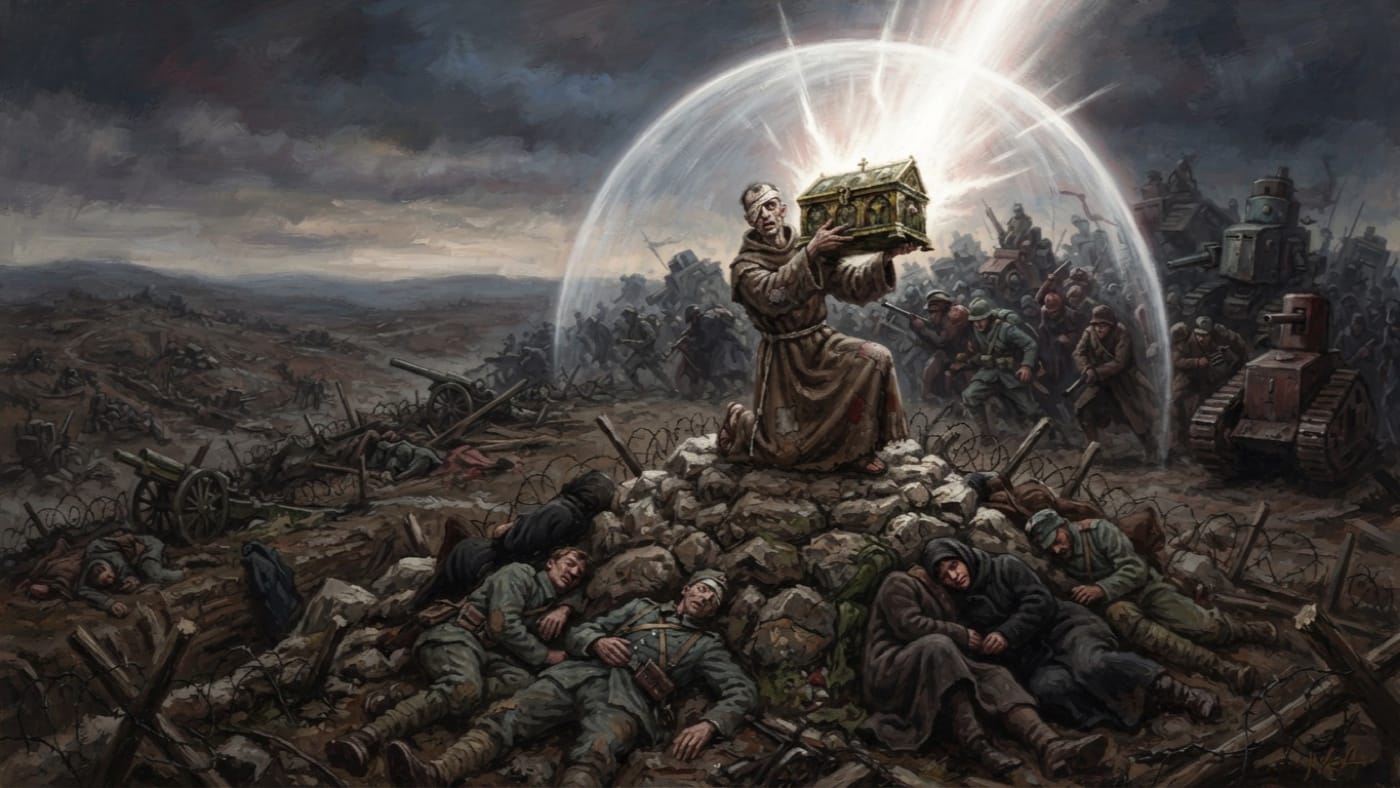
The Sundering began on the first of November, A.S. 45, which the dead calendar counts as 1755. Within its first week, Saint Alexios burned. No surviving record gives the day, names who set the fire or counts the dead. Tomislav carried the gold-and-iron Reliquary of Saint Isidore, which then held a single finger bone, out through the refectory door, and the ceiling came down behind him. The Ledger certifies that he came out. It does not certify that he came out alone.
Readers who would bury the Order in that refectory should note that the Ledger holds no death certificate for the Order either.
#On Custody Without a Charter
On the road west, men with tables asked him again and again to hand the casket over. The sightings are scattered and do not join up into a route: a chaplain's note near Osijek about "a Franciscan with a box who will not eat," a supply clerk at a crossing near Vukovar, and the camps around Zagreb. At one of those camps a refugee clerk asked by what authority he kept the object. Tomislav answered: "By the authority of the man who carried it out of the fire."
The clerk worked at an early Church custody desk with a stamp of uncertain origin. The later Bureau titles attached to that exchange are retrospective. A provisional council was still about five years away.
Tomislav's answer cites no superior and no Order. He produced no letter from a provincial, and he claimed no Franciscan exemption from the desks of the emerging Church. He cited himself. Later canonists have tried to file the sentence as corporate doctrine, as though the Friars Minor collectively refused the Church's custody officers. They have one man and one sentence. Turning a personal answer into a corporate position is the oldest forgery in the archive, and the hand behind it is always a clerk's.
His fasting needs the same restraint. At the field hospital he said, "The box eats what I would eat. This is acceptable." Deponents from the 7th Rearguard Column reported that the casket seemed warmer than the air around it. Those are attributed reports, and I file them as such. They give no method, and they say nothing about whether a starving keeper feeds a relic or a relic sustains a starving keeper.
The casket filled on the road through hands that were not Franciscan. Ignatius Brenner brought three apostolic phalanges out of Deutz and handed them over at a waystation near Koblenz to an unnamed chaplain attached to the 7th. The Column carried them east and transferred them to Tomislav near the Croatian approaches. Other fragments came by other hands, many through the network of the Cellar Saints. Brenner was no friar, the Cellar Saints kept no Franciscan rule, and the Column was a body of tired soldiers. At most the Order held one bone, and even that holds only if Saint Alexios was its house.
#On the Friar at Kalnik
Two and a half years after the fire, a span the parent dossier rounds to three, Tomislav stood on Kalnik Ridge in the Croatian highlands. It was the spring of A.S. 48, 1758 by the dead calendar. About four hundred people held the position: soldiers of a provisional rearguard, surviving clergy and displaced civilians who had nowhere further to run.
"…to the spring of A.S. 48, when the Continental Levy made its last stand at Kalnik Ridge." — this Codex, entry on Brother Tomislav
The First Continental Levy dates from A.S. 110 / 1820 CE, sixty-two years after the ridge. The defenders at Kalnik were a provisional rearguard of soldiers, clergy and displaced civilians, and none of them had heard of the Levy. The anachronism is corrected here. The defenders' conduct stands as recorded.
Maldrake's vanguard came up the slope. Tomislav climbed the cairn at the crown, raised the reliquary and prayed. The seventeen relics inside ignited, and the vanguard of Wrath recoiled. A later assessment gives the emission as forty-three minutes. Forty-three survivors are recorded. The Bureau of Doctrine has views on what answered the prayer and files them under Miracles. I record only that he prayed and the relics burned.
The ridge bought time. The war went on and the Great Retreat went on, and the formal Synod was still forty-two years away. When the light faded, Tomislav was found still kneeling on the cairn as warm white ash, holding the casket up. His death has been disputed ever since.
For this entry, Kalnik matters because it is the only reason anyone remembers the Order's name. A brother whose superiors had excused him from choir was the one holding the reliquary when it burned.
#On the Inheritance Kept Elsewhere
The ash is classified as Class-One Sacred Residuum and kept in a crystal ampulla in the sealed vault at Strasbourg, beside the emptied casket. His canonisation file was opened in A.S. 52, in the years of improvised government, and later passed to the Bureau of Doctrine, which still keeps it open. He is Venerable (Provisional). He has no assigned feast and no designated patronage. Soldiers on the Line kiss his image anyway, and they do not wait for a ruling.
The Church has taken his example and put it to use. Preachers call him the first custodian. The Bureau of Relics, chartered in A.S. 92, forty-four years after the ridge, draws a custody arrow from a Dalmatian refectory it never inspected to a vault it now guards. Over that arrow it writes UNILATERAL and accepts the word as precedent. The man it honours refused to hand the casket to the desks the Bureau now claims as its own forerunners.
The Order's name is on the first page of the file. It appears nowhere else in the record of his cause that this office has read. No provincial wrote on his behalf. No chapter asked for the ash, and no superior sent a brother to Strasbourg to stand beside the ampulla. The file contains no petition from the Order and no decree suppressing it. Whether any friars of the Order still keep its vows anywhere in the Church in A.S. 201, the Ledger cannot say. It can say that one of them is venerated.