
#On the City That Floats Beneath Authority
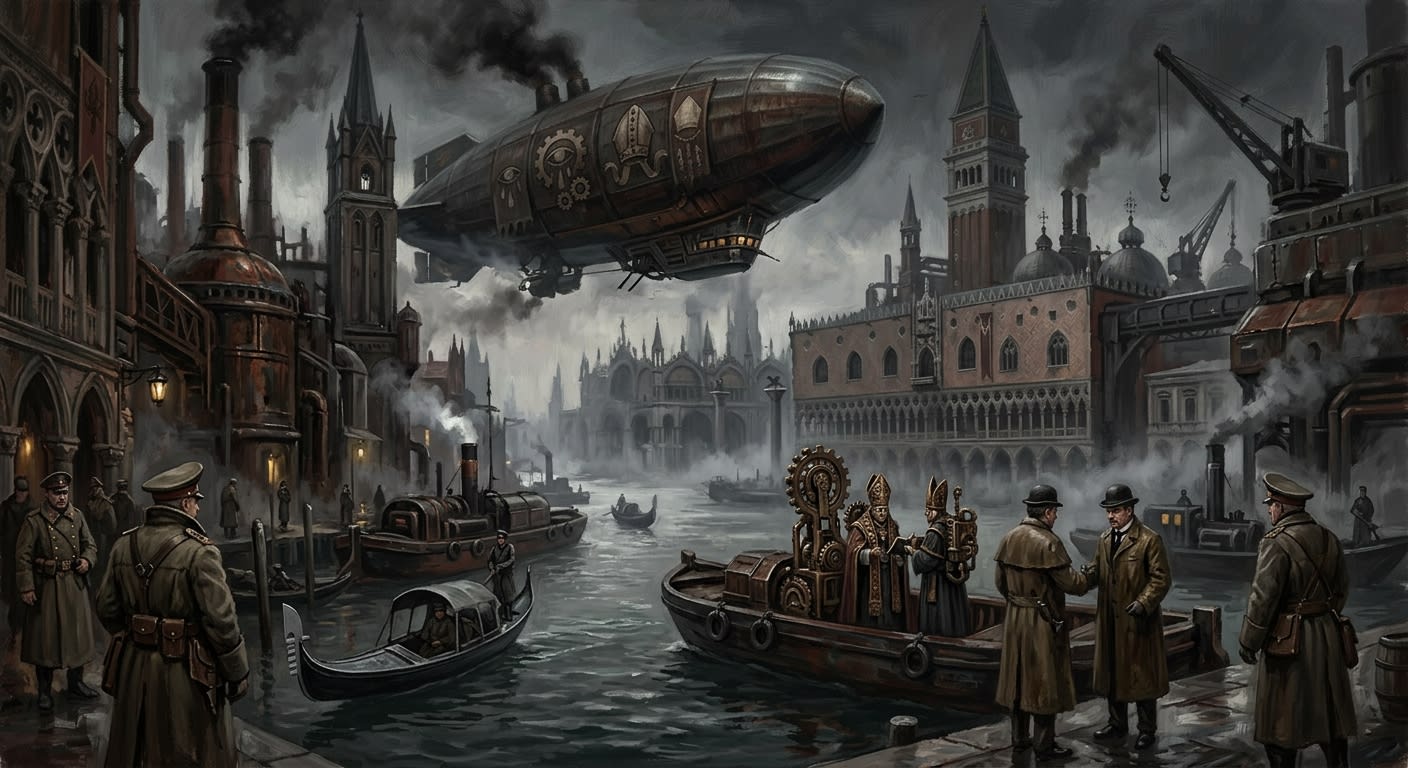
Venice is the Synod’s Adriatic argument against certainty: four hundred thousand souls in Zone 2/7, standing on piles, prayer, salt, bribery, old stone, and the watery insolence of a city whose streets refuse ordinary marching order. It controls the sea lane between Italy and Dalmatia, feeds the southern corridor by vessel, lighter, ledger, and gondola, and remains critical to the supply chain toward Irongate, Shipka, and Constantinople.
The city is obedient. Observe the word carefully. Venice pays, tolls, records, bows, files, escorts, salutes, and produces beautiful copies of every humiliating form sent from Strasbourg. It also mislays inspectors in side canals, interprets docking commands as tidal poetry, and treats Bureau jurisdiction as a damp garment to be worn only while the official is looking.
Its churches toll the proper hours. Its lagoon-vaults keep Records archives drier than many inland courts. Its merchants speak Synodal obedience in a voice polished smooth by eight centuries of selling obedience to buyers with poor memories. Its shipyards do not rival Genoa in punctuality or Marseille in holy noise, but Venice owns the shallow approach, the Dalmatian hinge, the small vessel, the concealed channel, the pilot who knows which sandbank is real and which has been entered on the map to discourage competitors.
#On the Lagoon and the Bureau’s Soggy Hand
Venice’s geography is not scenery. It is an administrative weapon. The lagoon breaks straight intention into channels, mudbanks, mirror-water, bridge shadows, quay mouths, side landings, warehouse courts, parish islands, silted convent stairs, rope sheds, customs sheds, fish markets, and little legal pockets in which a man may wait three hours and become someone else by second bell.
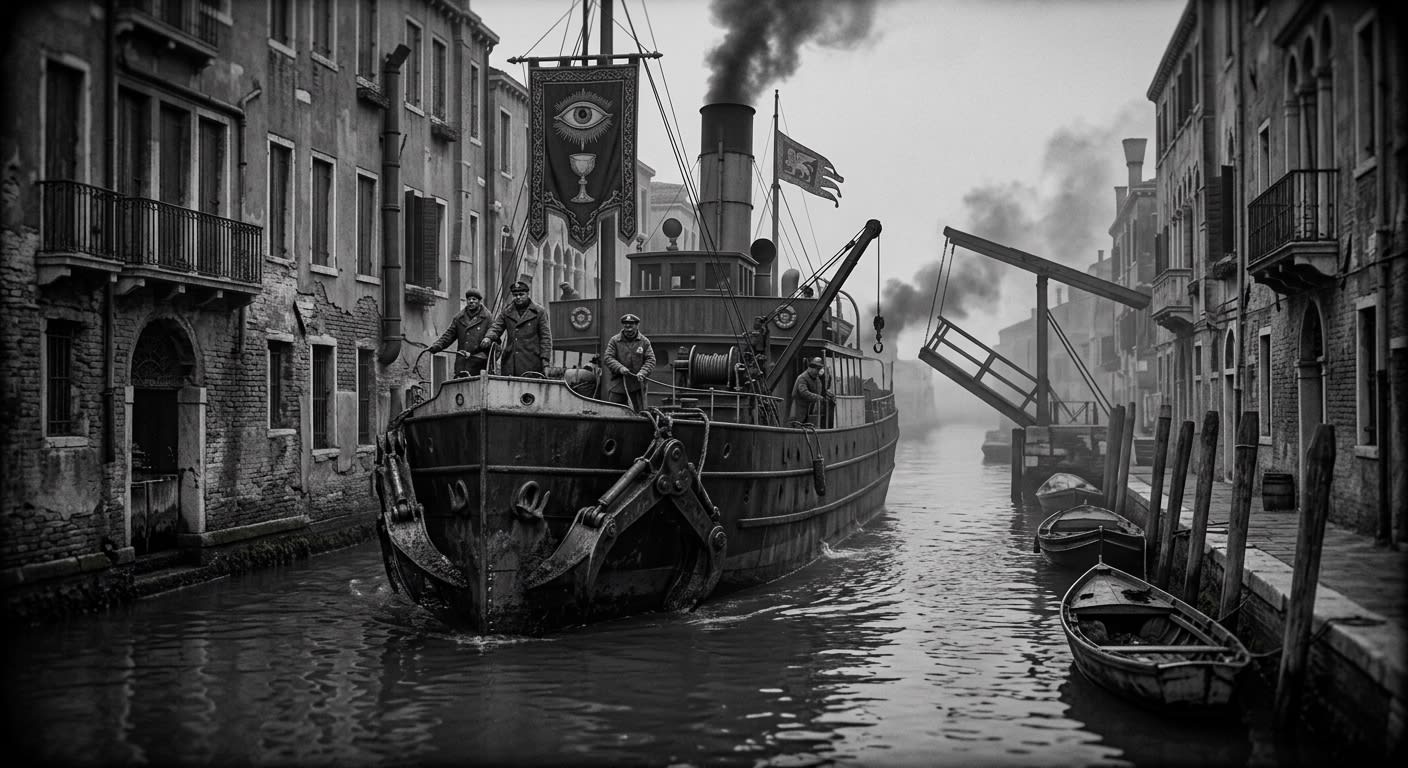
A land city may be occupied by entering the gate, holding the square, seizing the treasury, and issuing orders to frightened clerks. Venice requires tide tables. It requires pilots whose grandfathers lied to emperors. It requires boats narrow enough for the smaller cuts, clerks immune to damp, guards willing to stand on wet stone without developing philosophy, and surveyors prepared to learn that a quay measured yesterday has shifted by dawn under the combined influence of silt, current, and municipal spite.
The Bureau of Records established the lagoon-vault archive because paper in Venice, perversely, can survive better below guarded salt-air than in half the Heartland offices where rats sit on family charters like minor nobles. The vaults occupy raised foundations near the old mercantile courts, with iron grilles, double-water doors, counterweight tables, drying rooms, salt-glass lamps, and clerks whose first professional oath is to distinguish damp from tampering.
The vaults hold convoy clearances, Dalmatian tariff registers, disputed island titles, pilot oaths, repair bonds, captured smuggling manifests, and the sealed quarrels of families whose ancestors were already cheating before the Synod learned to spell Standardization. Precedent Curators work there in rooms built to exclude weather, conversation, and sudden decency. They maintain port-court variants for Venice, Genoa, Marseille, Thessaloniki, and Hamburg, because commerce is a disease that spreads through citations.
#On Submission After the Concordat
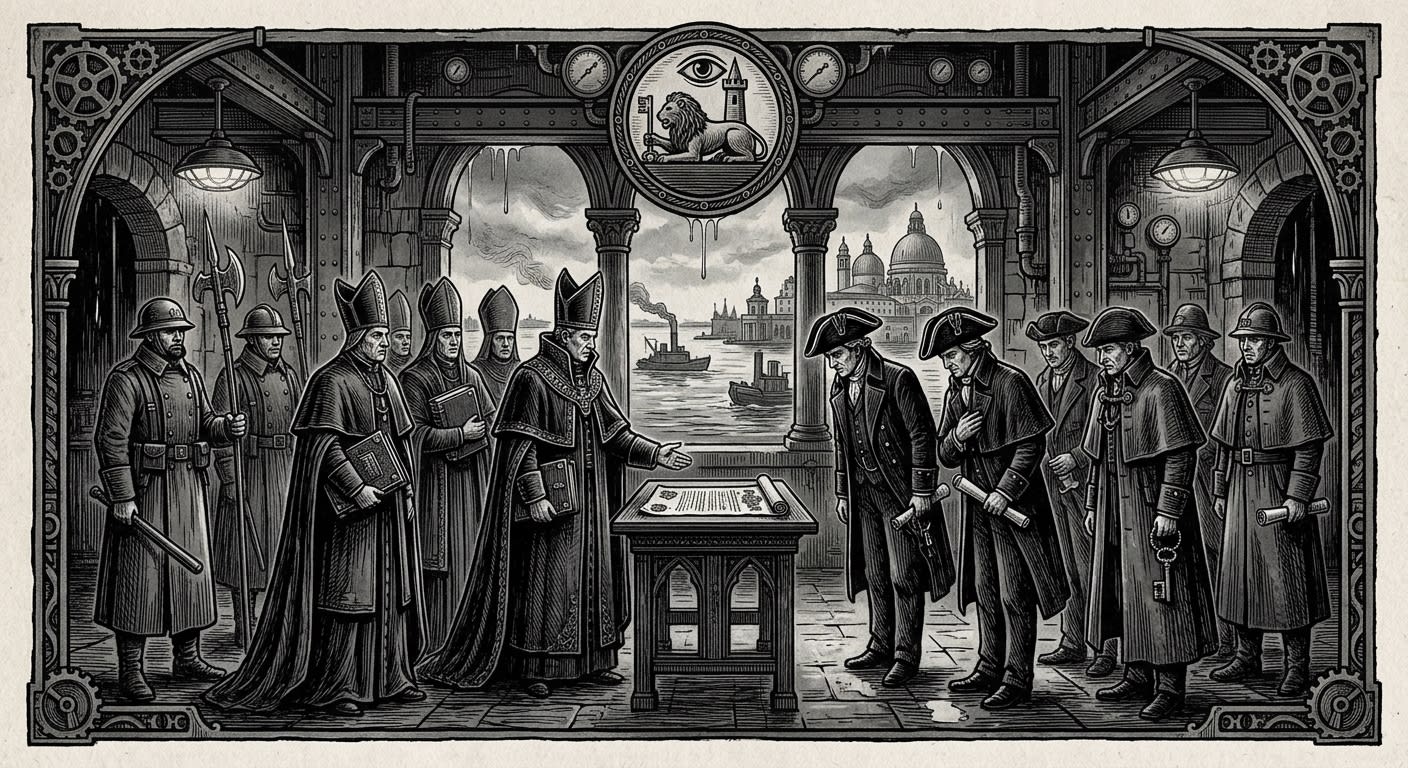
Venice entered the Synodal order the way a skilled cardsharp enters confession: late, perfumed, technically sincere, and holding three exits. The Concordat of Strasbourg in A.S. 90 gave the Bureaus their language for continental obedience. Venice gave them copies of older treaties, harbour rights, guild privileges, parish exemptions, pilot customs, Arsenal (Unregistered) balances, and devotional inventories so numerous that the first Strasbourg reviewer asked whether the city had submitted law or sediment.
The decisive pressure came through war supply. The southern corridor needed Adriatic carriage. Dalmatian coasts needed watched passage. Constantinople needed munitions, lime, timber, chapel glass, bell metal, brine, lamp oil, sailors, surgeons, and every kind of small ugly object without which heroic defence becomes an expensive silence. Venice could move what roads could not. Venice could move it in shallow water, in fog, under partial moon, between islands, around official schedules, and under seals whose wording made refusal look like ingratitude.
Earlier administrative pamphlets described Venice as “fully absorbed into Synodal maritime command after Concordat compliance.”
Corrected. Venice was bound, taxed, inspected, and licensed. Absorption implies a swallowed thing. Venice remains lodged in the throat.
The city conceded banners, offices, registries, and audit rooms. It surrendered enough sovereignty to remain useful and retained enough custom to make every future order a negotiation. This is the Venetian genius: no rebellion dramatic enough to invite artillery, no obedience clean enough to become precedent against itself.
The Bureau of War wanted an arsenal. Records wanted vaults. Tithes wanted harbour assessment. Pilgrimage wanted disciplined embarkation. Purity wanted lists. Venice offered all five, each in a different office, each reachable by a different boat, each closed for a different saint’s day.
#On the Arsenal, the Lighters, and the Southern Lane
Venice’s Arsenal is less a yard than a habit of making wood obey. It builds and repairs the smaller vessels that grander ports disdain until a grander port needs them. Shallow-draft lighters, lagoon escorts, Dalmatian cutters, stores barges, chain boats, fever skiffs, survey launches, signal craft, and pious little coffin boats all slide from Venetian hands with a neatness that enrages men who prefer large machinery because large machinery is easier to praise.
Genoa builds contract hulls and lends money against their ribs. Marseille handles pilgrim fleets and theatrical departure. Venice makes the transfer survive the last hundred miles of awkward water. A convoy may leave Liguria with immaculate paperwork and arrive at the Adriatic needing pilots, shoal craft, spare rope, hidden berths, and a man who knows which island priest will bless munitions after curfew for a fee disguised as candle restitution.
The southern lane depends on this unromantic competence. Timber from the north, metals from the central corridor, grain from obedient fields, medical stores from inland ports, relic crates under double seal, and punishment shipments whose contents nobody mentions at dinner all pass through the Adriatic sequence. Venice does not own every route. It owns enough bottlenecks that ownership becomes less important than consent.
The Arsenal priests bless keels with salt, ash, and old oil. Shipwrights spit three times before seating a sternpost because the lagoon dislikes dry ceremony. Records condemns the spitting, records the blessing, and accepts the vessel. A state at war learns tolerance in the presence of usable craft.
#On the Gauge War’s Wet Exception
The Gauge War of A.S. 96 to A.S. 136 embarrassed every office that believed rail could be made obedient by wishing harder in triplicate. One thousand four hundred thirty-five millimetres became imperial measure after forty years of starvation, transfer, relaying, and men crushed beneath the correction of local pride. Trains now move under one measure toward the Line from Hamburg, Munich, Warsaw, Vienna, Budapest, Marseille, Genoa, and Venice.
Venice accepted the standard inland and laughed at it at the water’s edge.
This was not defiance, as city advocates explained while billing by the hour. Rail gauge governs rail. Lagoon transport governs lagoon transport. The last yards from warehouse to lighter, lighter to arsenal basin, basin to shallow convoy, convoy to Dalmatian cut, and cut to military landing cannot be solved by a gauge rod, unless the rod floats, rows, lies to a harbourmaster, and knows how to avoid a sandbank marked on no public chart.
Bureau of Engineering Circular 136-G declared Venetian transfer irregularities “post-standardization residues to be eliminated.”
Clarified after three failed inspections, two grounded barges, and one Engineering assessor rescued from waist-deep mud by men he had just fined. Venetian lagoon transfers are now “local maritime continuities under harmonised reporting.” The mud kept its opinion.
The city’s railheads became compromise organs. Standard measure enters on iron. Cargo breaks into boat measure: crates reweighed, seals inspected, barge manifests issued, pilot oaths refreshed, tide windows priced, and delay renamed tidal necessity. The Guild of Rails hates this because the hammer loses authority where water begins. Venetian pilots hate the Guild back on principle, although one suspects many of them enjoy the paperwork more than their insults admit.
#On the Seal-Forgers’ Winter
The Seal-Forgers’ Winter of A.S. 145 struck Venice in the place where it feels pain most acutely: the archive tray. Counterfeit seal-rings moved through eastern port markets, caravan exchanges, tariff chapels, Marseille, Genoa, Venice, and the forward depots. Wax became suspect. Authority had to be held under lamp like a corpse.
At Venice, lagoon-vault clerks sealed an entire run of convoy papers into quarantine because counterfeit seal-wax might have touched archival trays. The phrase might have froze three channels, delayed two Dalmatian supply packets, and gave five Manifest Litigants enough work to buy houses they later described as modest. The Venetian response was swift, profitable, and mildly treasonous in tone: they turned doubt into a service.
Seal autopsy tables appeared in port-court annexes: black cloth, angled lamp, Registry plate, wax knife, pin caliper, witness slate. Manifest Litigants petitioned for comparison rights. Precedent Curators preserved every ruling, variant, objection, bevel angle, and profitable ambiguity. Masks and Seals retained sovereignty. Commerce retained the fee schedule. Venice retained the habit of asking whether any document, even one issued by a Bureau, might require local inspection before touching local trays.
The Winter taught the city that seal panic and lagoon geography are natural allies. A suspect document can be quarantined on an island. A disputed cargo can wait in a water court. A clerk can decline release until bevel comparison, resin testing, tide witness, and Curatorial citation return from offices all technically open and practically unreachable before the tide changes.
LAGOON-VAULT QUARANTINE EXTRACT — A.S. 145 Run: convoy papers, Dalmatian transfer, thirty-two sheets. Cause: possible counterfeit seal-wax contact. Inspection result: twenty-nine genuine; two inconclusive; one sheet bearing impression from a ring not yet cut. Disposition: ███████████████████████████████ Curator note: “Do not dry by chapel heat.”
#On Families, Parishes, and Wet Sovereignty
Venice’s old families no longer call themselves sovereign houses. They call themselves custodial lineages, maritime charities, bridge trusts, parish patrons, pilot-endowment boards, and Arsenal creditors. Language changes. Money remains seated.
Their palaces stand with wet foundations and dry account books. The lower floors smell of salt, mould, incense, and expensive concealment. The upper rooms keep portraits of men who once defied princes and now appear, in family catechism, as early practitioners of subsidiarity. The Bureau tolerates these paintings because canvas is cheaper to ignore than bloodlines are to prosecute.
Parishes matter more in Venice than auditors like to admit. A parish knows which bridge is passable, which widow stores oars, which boy runs messages over roofs, which priest keeps contraband dry behind altar stone, which saint-day procession will make a street impossible for guards, and which family debt hides behind a votive lamp. Purity can seize a man. It cannot arrest a tide, a parish whisper, and a funeral route in the same afternoon without borrowing boats from the suspects.
The city’s wet sovereignty persists in such small refusals. A permit is correct but the tide is wrong. A command is urgent but the pilot is at confession. A seal is valid but the tray is under quarantine. A cargo is cleared but the bridge procession has priority by ancient custom copied in A.S. 92 and, curse the diligence of it, Synodically registered.
#On the Present Condition
As of A.S. 201, Venice remains loyal, wealthy, damp, useful, evasive, and under-measured by every instrument except invoice. The Bureau of War needs its lighters. Records needs its lagoon-vaults. Commerce needs its port court variants. Tithes needs its harbour dues and hates the work required to collect them. Purity maintains stations and learns, every season, that lanterns reflect badly on water.
The Arsenal works. The pilots bargain. The lagoon-vault clerks dry papers with the care of relic nurses. Precedent Curators keep the Venetian variants alive in the Thirty-Seal Index. Rail arrives by standard measure and exits by local water. Genoa smiles with creditor’s teeth. Marseille bellows from the west. Venice writes polite replies, folds them into expensive paper, and sends them by a route that will arrive exactly late enough to preserve advantage.
The Synod owns Venice by writ. Venice obeys by tide. Between those propositions lies a lagoon full of boats, clauses, saints, pilots, bribes, archives, and fish that no one has yet successfully audited.