
#On the Name and the Ground
Croatia has an entry in this Codex because a Franciscan died there, and because clerks dislike a link that leads nowhere. Either reason would do. The Bureau of Records will only admit the second one in writing.
The name is inherited. It has survived from the maps of the dead calendar the way a parish name survives its demolished church, on deeds, in depositions and in the mouths of carters who have never seen a border stone and would not salute one. This office records no Croatian crown, no capital and no census. No Sin-General holds the whole of it in fee. The Ledger records ground, and the ground here divides cleanly into two countries that happen to share a word.
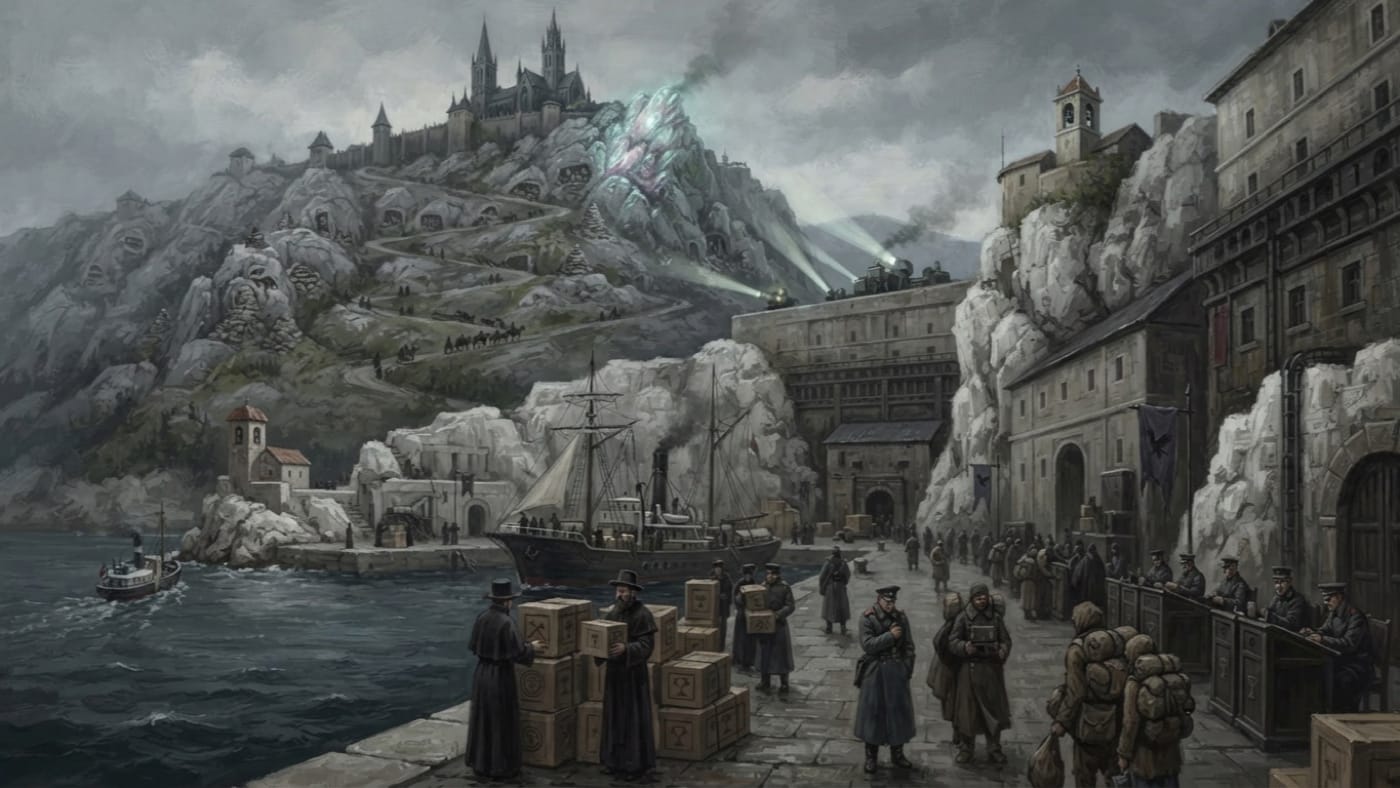
The first is the highland interior. Its limestone ridges are grey as old wax, with thorn scrub in the clefts and cave mouths blackened by centuries of lamp soot. Its roads climb by switchback, because nothing in that country agrees to be climbed directly. The second is the Dalmatian littoral, a hard white shelf of stone towns pressed against the Adriatic. Its harbours face west toward Venice and the Church's supply ledgers. Highland and coast trade salt, rope and recruits. They do not trade temperaments.
The war map places the Dalmatian approaches in Zone 3, among the forward heartlands that stage supply, and puts the waters beyond them in Zone 7, the southern maritime corridor. Croatia therefore belongs to two zones and to neither. The Bureau of War considers this an administrative defect. The inhabitants consider it weather.
#On the Roads After the Sundering
The Sundering broke on 1 November A.S. 45, and the Balkans did not fall in one piece. Neither did their people. They came north and west in carts, on foot and in boats hugging the coast, carrying whatever the fire had left them. The Church had only just come out of hiding. It had no Synod, which would not exist until A.S. 90, and no Bureaus worth the name. It had field clergy, frightened quartermasters and intake clerks with more ink than authority.
Brother Tomislav of Split came out of Dalmatia. He was a half-blind friar of the Order of Friars Minor, and he had carried the gold-and-iron Reliquary of Saint Isidore out of the burning monastery of Saint Alexios. His dossier records the rescue. It does not give the monastery's founding, its exact site or the monk's year of birth. I decline to supply them from imagination, which is the only archive that never burns.
A handful of scraps is all that remains of his road. There is a chaplain's report near Osijek and a supply clerk's line at a river crossing near Vukovar. There are an intake form and a hospital discharge from camps near Zagreb and south of it. There is a letter to a sister in Zadar that was never sent. Joined with a ruler, these make an itinerary. Read honestly, they make a scatter. They show how far the displacement reached, across the Drava and Danube crossings, the Sava camps and the coast at once, and every line of it was written by men who were themselves retreating.
The camps took him in, and in time the rearguard of the Continental Levy absorbed him. By the time that rearguard turned at bay, the casket held more than Isidore. Other hands had brought fragments that the Cellar Saints had kept through the years of persecution. Among them were the Apostolic Phalanges, which reached him through a military chaplain and the 7th Rearguard Column near the Croatian approaches. By the battle's own count, the casket held seventeen sacred objects.
#On Kalnik and the Rearguard
Kalnik is a limestone ridge in the northern highlands. Its caves were turned into chapels long ago, where shepherds and hidden clergy kept their worship and their relics out of reach during the Atheist Wars. The rearguard reached it in the spring of A.S. 48, which is 1758 by the dead calendar; the day itself went unrecorded. The caves held lamps and the slopes held refugee cairns. Neither had been built for war.
About four hundred stood there: fragments of the Levy's rearguard, clergy and conscripted civilians. They had no effective artillery and no reliable supply line. Against them came the Wrathforged vanguard of Maldrake, whose furnaces lie far to the south and east in Thrace and the Serbian valleys. The vanguard brought what Wrath always brings: heat, slag, fused metal, and bodies remade into weapons.
Tomislav raised the reliquary. The seventeen objects inside it ignited together. The light was literal, and hot enough to fuse the ridge-stone into glass. The attacking host recoiled. The broader lore says Wrath himself recoiled with it. I enter that as recorded. I do not pretend the Church had a clerk standing close enough to measure the flinch.
The full account of the stand belongs to its own entry. The forty-three surviving depositions are the only survivor count this office will defend. When the light ended, Tomislav knelt on the ridge as warm white ash. His death is still disputed in his dossier, and his standing is Venerable (Provisional). In time his ash went into custody at Strasbourg, and a Dalmatian monk became a line in a northern vault's inventory. Whatever the seventeen objects suffered, not all of them ceased to exist: the Phalanges survived and were later put on display. The quarrel over the inventory can stay in the vault where it began.
What Kalnik changed was confidence. The rearguard had believed relics were things you hid in cellars. On the ridge it learned that a relic could be raised against an army and the army would give ground. Every reliquary later carried to a wall descends from that lesson, and so does every bell hung on a bastion in expectation. The Synod that later claimed the lesson was not on the ridge. It arrived forty-two years afterward, with seals, and it has been taking possession of the sacrifice ever since.
"What happened next broke the war in half." — this Codex, entry on Brother Tomislav
Correction: Kalnik bought time and preserved a rearguard. It did not end the Great Retreat, which is dated A.S. 48–65 as a named period, beginning in the year of the stand itself. The flight had been under way since the Sundering. Maldrake was not destroyed and the Balkans were not recovered. The Sagittal Line became defensible, and still incomplete, only around A.S. 65–68. Pilgrim sermons keep the popular version, where it does less harm.
#On the Coast That Supplies the War
The Dalmatian coast never saw Kalnik's light. It has lived off the war ever since, and I mean that as a description of its trade. Its stone towns grip harbours below the cliffs. Watch-chapels look down on coves where fishing boats, courier skiffs and quarantine launches share the same cramped water. Dalmatian men march in the Levy. Dalmatian women mend the nets, salt the catch and keep the harbour accounts the men would get wrong.
Along the Adriatic Coast the traffic runs both ways. Powder, grain, rope and cartridge paper cross from Venice, which bargains over the sea lane to Dalmatia the way a cathedral chapter bargains for a relic: piously, and with counsel present. Pilgrims come over with the cargo, bound for the shrines inland. The Church tithes both.
Near Ragusa stands the Saffron Bastion. It is a secondary coastal installation and not an eighth primary bastion, whatever its garrison claims after the second bottle. It has a deep harbour, cliff batteries trained on the approaches, quarantine piers, and salt-stained masonry that has never once been dry. Light is licensed there. Lantern signals follow an approved code, and a shutter opened out of sequence earns a fine, a cell, or a fall into the harbour that the record will later describe as devotional. Every bale crossing the quay carries a cargo seal. Every pilgrim waits in intake while a clerk decides whether to receive a soul or isolate a fever.
The fever is real. Brine fever passes along the piers. The water under them is dangerous in ways the harbour office files as "lures": lamps glimmering below the surface, and voices calling up in the tone of a drowned brother. Passage is conditional. Supply moves and pilgrimage moves, and both move under a quarantine flag.
#On the Present Register
In A.S. 201, Kalnik is a belt of armed shrines along the old cave-chapel ridge. Ossuaries are mortared into the slope. Ammunition lies under altars sealed with blessed wax. The confessionals have murder-holes facing the valleys. The pilgrims' road and the supply road are the same road, and the same mule carries candles up one morning and cartridges the next. Soldiers kiss the fused glass at the crown, and penitents' sleeves keep it polished. Pilgrims report kneeling shadows inside the glass and bells at dawn that no hand rings. The Bureau of Relics has classified these reports and certified no cause. The Bureau of Pilgrimage sells candles, prayer cards and vials of ridge dust at a margin the tithe office finds devout.
On the coast, the harbours stay loyal and profitable, and the hulls keep arriving. This entry will not record who governs which highland town this year, or under what flag. Croatia gives the Church a ridge to pray on, a coast to unload at and men to march. The Ledger requires nothing further of it, and has never once refrained from asking.