
#On the Ground
The Croatian highlands enter this Codex as an inherited phrase, the kind a clerk copies from a dead map because the living maps disagree. No boundary stone marks where they begin. No office has surveyed where they end. The Ledger knows them through one ridge, and that ridge is Kalnik.
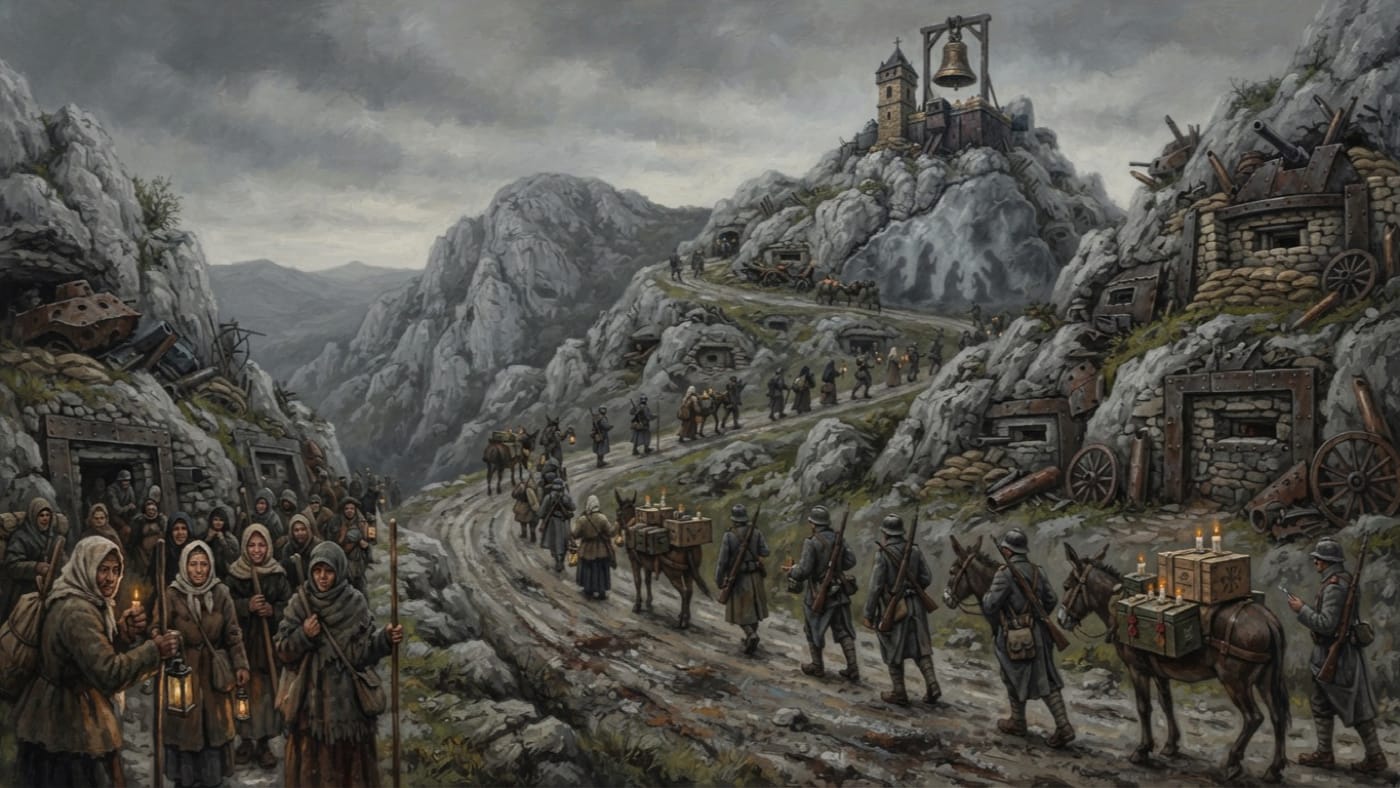
Kalnik is limestone, grey as candle stubs left too long in a damp sacristy, and split by clefts where the thorn scrub grows thick enough to hold a dropped rosary for a generation. Ash lies in the hollows. The cave mouths along its flank are black with the soot of lamps older than any office that now taxes them. Refugee cairns stand on its shoulders, raised by people who had no time to dig. The approaches wind. Nothing on that ridge agrees to be climbed in a straight line, and the mules understand this better than the engineers do.
I describe Kalnik, and only Kalnik. Other uplands in Croatia may be gentler or crueller. Pilgrims who claim that every hill between the Drava and the sea resembles the holy ridge are selling something, usually candles. The highland interior has nothing in common with the Dalmatian littoral except a name. The coast's white harbour towns face west and live by cargo seals. The coast unloads the war. The interior climbs it.
One road does most of the climbing. Pilgrims walk it and supply columns grind up it. At the steepest turns they share the ruts, the switchbacks and the same patient curses.
#On the Caves Before the Stand
The cave chapels have no founding date, and I will not give them one. A beginning that leaves no paperwork belongs to the hymn-writers. What the record holds is how the caves were used. During the Atheist Wars, shepherds and hidden clergy kept their worship in those hollows. To find a lamp worth confiscating, a prefect's census officer would have had to climb half a morning in good boots. Relics went into the rock wrapped in oilcloth, and psalms were said low. The Cellar Saints of the lowland towns had root cellars and false-bottomed carts. The highlands had altitude, and no Rationalist ordinance ever managed to repeal that.
Then the Sundering broke on 1 November A.S. 45, and the caves took on a second purpose. The flight from the south and east came up the winding roads in carts and on foot. A chapel hollowed out to hide one priest found itself sheltering forty strangers, two goats and somebody's dying grandmother. The cairns multiplied. Wounded men lay where the shepherds had knelt.
No Bureau governed any of this. The Church had come out of hiding with field chaplains, frightened quartermasters and clerks whose authority they had made up on the spot. Its interim council would not sit until about A.S. 50, and the formal Synod would not exist until A.S. 90. The men who handed out cave space and ration scraps on Kalnik held no office this Codex can name. They held a ladle and a list.
#On Kalnik's Recorded Fire
In the spring of A.S. 48 (1758 by the dead calendar; the day went unrecorded), the rearguard of the Continental Levy reached the ridge in fragments, with clergy and conscripted civilians among them. There were about four hundred, an estimate that no muster roll cleanly supports. Against them came the Wrathforged vanguard of Maldrake, and the battlefield registry also names Charnel host elements. Wrath's furnaces lie far to the south and east, in Thrace and the Serbian valleys. His vanguard brought the heat along.
The ground decided how the ridge would be defended. The caves covered the wounded and the relics. The winding approaches made the attackers climb in the open. The cairn at the crown gave a half-blind Franciscan somewhere to stand.
Brother Tomislav, the friar from Split, raised the gold-and-iron Reliquary of Saint Isidore. The seventeen relics inside it ignited, and the attacking host recoiled. The received account holds that Wrath himself recoiled with it, and I enter that account as received. The engagement in full belongs to its own entry, and I decline to fight it twice.
A geographer is concerned with what the fire left behind. It burned the shadows of kneeling men into the limestone, and it fused the ridge-stone near the crown into glass, now cloudy, hard and cold. Pilgrims swear they see figures in it, and bones. That is their testimony, and it is recorded here as theirs. Tomislav remained on the cairn as warm white ash. His death is still disputed and his standing is Venerable (Provisional), which is how the Church says it has not finished reading the file. Forty-three depositions survived the day, and that is the only survivor figure this office will defend.
The retreating columns learned on that ridge that a relic could be raised against an army and the army would give ground. Men who had buried reliquaries under the baggage in their carts began carrying them at the head of the column.
"Kalnik ended the Retreat." — older catechism wording, repeated in earlier entries of this Codex
Corrected. Kalnik bought time and let the rearguard withdraw. As a named period, the Great Retreat runs from A.S. 48 to 65, and the flight itself had begun at the Sundering. Maldrake was not destroyed. The Sagittal Line became defensible only around A.S. 65–68, and even then it was incomplete.
#On the Armed Shrines
Sanctity draws traffic, and traffic draws the quartermaster. Over years nobody dated, the cave chapels became sanctuaries, the sanctuaries became ossuaries and the ossuaries became walls. Bones from the field went into the masonry. So did banners too scorched to fly and weapons too broken to issue: bayonets snapped at the socket, a split carriage wheel, barrels burst by heat. A pilgrim praying in one of the older chapels kneels with his back against a regiment.
By the present register, Kalnik is a belt of armed shrines. Murder-holes pierce the confessionals toward the valleys, so a penitent on one side of the screen may hear a rifle being cleared on the other. Ammunition lies hidden beneath the altars, every cache sealed in blessed wax. A sacristan who breaks a seal without a written chit answers to two offices at once and is forgiven by neither. Soldiers kneel beside pilgrims, and rifles lean against reliquary walls. Nobody on the ridge bothers to sort the worshippers from the garrison, because the garrison also prays and the worshippers are often conscripted.
The road carries both. Military mule convoys and pilgrim caravans climb the same switchbacks, and in winter the passes kill both with perfect impartiality. Some caravans come up from as far as Thessaloniki, whose pilots have long escorted the shrine traffic. Raiders along the way do not ask to see a pilgrim's licence. The licences matter anyway, because songs and banners carried onto the ridge require them.
At the crown, pilgrims kiss the fused glass until their sleeves have polished it. Further down the slope, the Bureau of Pilgrimage sells votive candles, prayer cards and vials of ridge dust, and counts the proceeds with the tenderness of a widow counting a dowry. Two traditions belong to the public record. Bells are reported at dawn, heard across the camps, with no ringer to be seen. Shadows are reported kneeling inside the ridge-glass. The Bureau of Relics has classified both reports and certified no cause for either. Pilgrims also speak of a Book of the Ridge in which every dawn peal writes a name. That is a belief. No office holds such a book. I have asked.
#On the Bell and the Present Register
Pilgrims confuse two objects, and the confusion pays well. The Reliquary Tomislav raised in A.S. 48 is a gold-and-iron casket. The Bell of Saint Isidore is cracked bronze, a mobile relic-bell that travels on a black-silk gun-carriage under armed writ. Its traditions tie it to the ridge: a shard of ridge-glass, filings from the reliquary hinge, and a pinch of white ash that the Bureau will not name. Three accounts dispute its origin, and its chronology is disputed along with it. It does not live on Kalnik. It has no permanent residence anywhere. Any shrine-keeper who tells you the Bell belongs to the highlands is about to sell you a print of it.
Its peal has a price, and the price was paid elsewhere. Debrecen carries the Isidoran debit, twenty years of lifespan in aggregate, spread across its households. Highland families owe none of it. The sanctity is local, and the bill was sent to Hungary.
This entry records Kalnik as it stands in A.S. 201, because the Codex's dated descriptions of the ridge describe that condition. The year marks the register. It founds nothing and attests no fresh survey. The shrines' construction remains undated, and the Ledger can live with that.
The mules still climb. Candles go up, and so do cartridges. The pilgrims come down lighter by the price of a vial.