
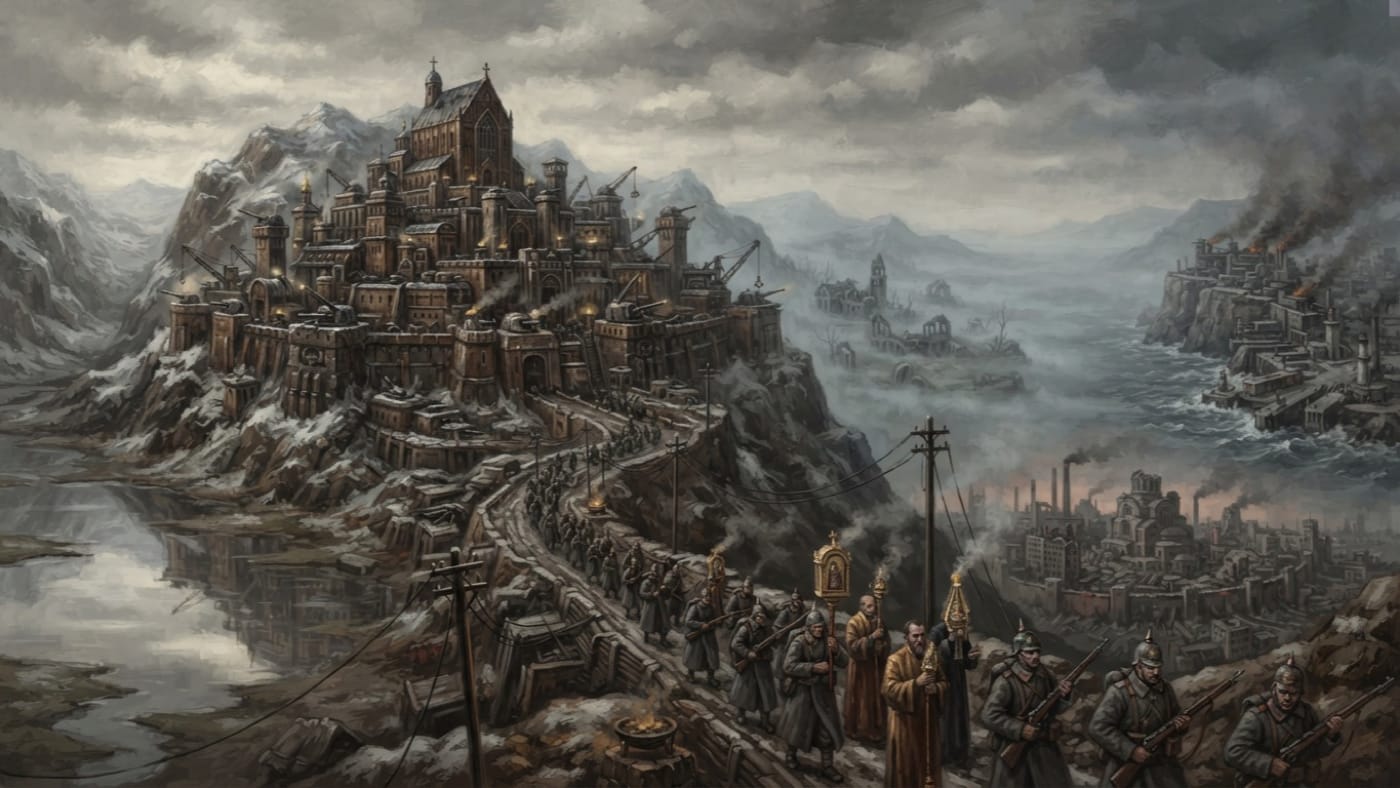
Bulgaria is entered in the Church's books three ways at once, and the Bureau has never managed to agree on which one to print. The country appears on customs forms and in the hymns old women sing in Sofia. It also labels a stretch of every southern War map, where the Church holds it in three places and contests or concedes the remainder. A name costs nothing to keep. Keeping the ground under it costs a great deal more.
#On the Country and the Passage
The geography is short. The Danube lowlands lie to the north. The Balkan Mountains cross the country from west to east, and beyond them lie Thrace, the Bosphorus and the end of the continent. The Bureau of War's registry lists the Shipka Pass as the single viable military passage through those mountains from the lowlands toward Thrace and Constantinople. Goatherds will tell you of other crossings. The Bureau does not dispute that goats exist. It disputes whether a gun-train or a relief column can follow them, and the goats have never filed an objection.
The Great Retreat lists Bulgaria among Hungary, Serbia, Romania and the broken Balkans as a geography of abandonment. That shorthand is accurate about the roads of the Retreat. About the present it is careless. Today the name covers a fortress, a city, a harbour, a drowned approach and a great deal of country that obeys other masters.
#On the Westward Roads
The Balkans failed before they fell. In A.S. 38, during the Eastern Silence, Balkan villages stopped answering their correspondence. Caravans left on schedule and never arrived. Refugees came west with stories of churches blackened overnight and fog that swallowed whole valleys. The Rationalist councils answered with a quarantine proclamation and the word "plague." No separate obituary was written for Bulgaria. It was simply more unanswered post from a region that had gone quiet.
On the first of November, A.S. 45, came the Sundering, and the silence became traffic.
The Bureau dates the Great Retreat from A.S. 48 to A.S. 65. The Bulgarian roads did not wait for that span. Families were leaving the mountain valleys within weeks of the Sundering, years before any office existed to give their walking a name. Retrospective periods are a convenience for archivists. The carts never knew they belonged to one.
The roads' cargo can still be listed, because the lists outlasted the people. There were ox-carts with a door-plank nailed in for a missing wheel. There were monastery relic-cases strapped to mules, holding the bones of local saints that no Strasbourg register has ever confirmed. There were sodden parish books, grandfathers in wheelbarrows, and children carrying younger children. Houses were left with their shutters nailed shut, as though nails were a form of lease. Behind the carts walked a rearguard of militia with fowling pieces, soldiers whose regiments had dissolved around them, and priests who had learned that a raised reliquary bought minutes, and that minutes bought a ford.
The parent account describes the pressures in continental terms, and I keep them in those terms. Maldrake's fire pressed the rearguards. Morwen's spite-sicknesses entered the camps. Kargath's hunger followed the columns through stripped barns. Records has no ledger proving which general harried which Bulgarian valley on which day, and I decline to invent one. Famine needed no attribution to kill. Dysentery signed nothing.
#On the Country Beyond the Returns
Ask a War cartographer where the Church's Bulgaria ends. You will receive a pencil line, an apology, and a request that you quote neither.
Two Sin-Generals' domains touch the old country, and neither has a surveyed border. The dedicated files on Morwen place her Mirror Waste in lands that were once Bulgaria and parts of Romania, the country of old monasteries and mountain fortresses. The ground there has gone glass-smooth beneath a sky that is not there. A walker sees himself from every angle, and every reflection is slightly wrong. One is taller. One is smiling when he is not. Her empty villages keep their markets and churches and families, all wearing faces borrowed from someone else. Her principal front is at Bastion-Irongate and the Danube approaches. That tells you where she fights. It does not tell you where her mirrors stop.
Syrion, the Languid Dreamer, holds the Bulgarian highlands, the Balkan Mountains and the Aegean approaches in time-fog. His country does not reflect. It waits. Stillness Fields drift across it, so a meadow crossed in an hour may release the traveller a week later. Roads stretch beneath the marching foot. Preserved villages stand with meals still on the tables and their people motionless in the streets, breathing and unreachable. At the edge of the fog the Patient Army has stood since the Sundering, and it moves only when the fog moves.
Records cannot say where the glass ends and the fog begins. A given valley may belong to one general, to the other, or to some arrangement between them that no scout has come back to describe. Ordinary maps fail because the ground will not hold still for them. Muster rolls fail for a worse reason. A patrol comes back complete by headcount, and the clerk must still decide whether the man who answered to a name is the man who left.
#On What Remains Held
Three places keep Bulgaria in the Church's books by something better than nostalgia.
Bastion-Shipka holds the pass. It is one of the seven bastions of the Sagittal Line, in Zone 4, southern sector, and it sits on the spine between Irongate over the Danube gorge and Constantinople at the Bosphorus. Whoever holds Shipka holds the final approach to the Bosphorus. The Bureau of War says so in every budget submission, and on this one point the budget is telling the truth.
Its opponent by locked assignment is Syrion, and Syrion does not storm. He waits on the pass. The garrison rotates every four months, because longer tours produce men who can no longer count the days. No bastion on the Line carries more Bellwardens, who ring the hours so that the hours remain real. Sentries nail their boots to the parapet rather than sleepwalk over the wire. At Shipka a soldier fears sitting down more than he fears dying.
Shipka Marsh lies east of the fortress, a drowned corridor running toward Syrion's Vales of Stagnance. It holds reed road, floodgates and stilt-hamlets, and pump-houses where engineers mutter half-litanies at machinery that has learned to listen. The marsh is an approach to the fortress. The fortress itself stands in the mountains. Older files confuse the two. I have corrected them with the patience of a man who is paid either way.
Sofia stands in the southern corridor between the Irongate and Shipka sectors. The Balkan campaigns left it partly ruined, it is heavily fortified, and after its reduction it holds roughly two hundred thousand people. Any sermon calling Bulgaria empty must first explain to Sofia's quartermasters whom they have been feeding. It is the last significant city before the final approach to the Bosphorus. It knows it is expendable, and it resents the fact with a civic thoroughness I find almost Synodal.
Varna, the Ashen Redoubt, stands on cliffs above the western Black Sea in Zone 4/5. It is a fortress and tariff harbour of gun galleries, tariff chapels, quarantine hooks and bone-kilns. Its harbour-master would prefer otherwise, but it is a secondary coastal installation and not an eighth bastion. Kargath's hunger presses on it from the sea lanes and Maldrake's ash falls on it from Thrace. The registry lists it as held, useful and compromised. I would be glad to see those three words carved over its gate.
The valleys that once carried Bulgarians west now carry rations, shot, Bellwardens and relief drafts east. The roads are the same, the direction is reversed, and the paperwork is better. In the Retreat a column survived by moving. At Shipka a garrison survives by refusing to stop.
The Lore Book's account of the war places the trenches "from the Carpathian Gates south through Thrace to the Aegean shore, their western anchor the fortress-city of Bastion-Lorraine."
Corrected. The Sagittal Line runs north to south, from Königsberg on the Baltic to Constantinople at the Bosphorus. Constantinople, formerly styled Lorraine, is its southern anchor. Bulgaria lies along the southern spine. The western world begins well to the west of anywhere a Bulgarian sentry has been allowed to walk.
#On the Present Condition
As of A.S. 201, the present year, Bulgaria is entered under three conditions at once. Bastion-Shipka, Sofia, Varna and the supply roads between them are held, for as long as the bells are kept. The marsh approaches, the coastal lanes and the foothills are contested; there the fog advances by inches and withdraws by days. The Mirror Waste, the fog-bound highlands, and whatever lies between them that nobody has measured twice with the same result are fallen.
No Bulgarian crown survives to petition for any of it, and no restoration office has been chartered. The Bureau of War holds a pass. Records holds a population column. Doctrine holds the word "temporarily," and it takes care to keep the word in good repair.