
#On the Angle That Works After Curfew
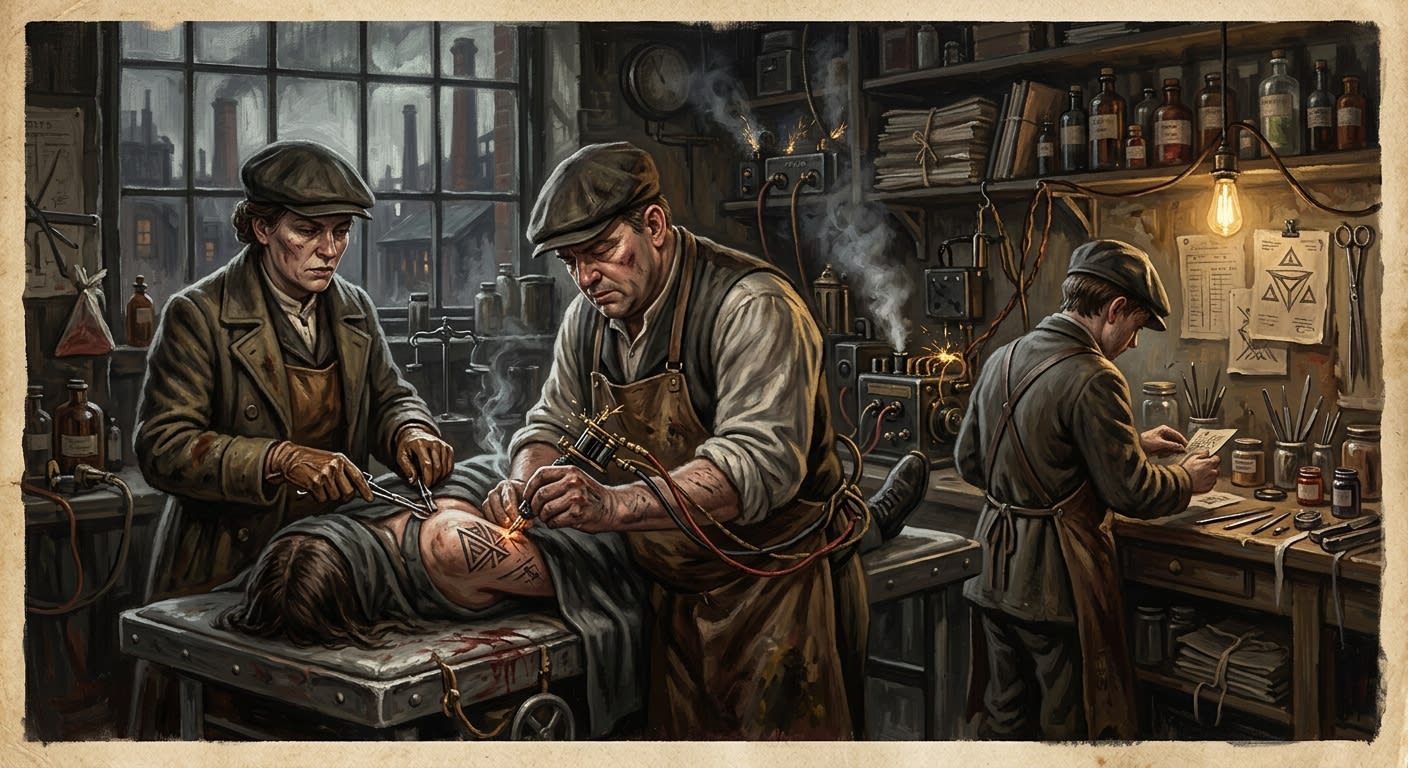
The Shadow Angle crews are what happens when a state declares the body to be a document and then acts surprised when forgers learn anatomy. They are unlicensed Brand-Smiths, cellar surgeons, deserter's friends, widows' enemies, ward-boys grown sharp, failed Frame-Hands, dismissed Quick Burners, and licensed men with evening debts whose hands remain steady after the chapel locks. They operate wherever a lawful triangle has become intolerable.
The Bureau of Heraldry calls them counterfeiters. The Bureau of Purity calls them heretics against proof itself. The citizens call them quietly, through cousins, laundresses, corpse-cart drivers, soup-yard clerks, and children who know which alley smells of vinegar, soot, and old screams.
Their trade is illicit classification. Identity upgrades for deserters who need civilian wrists. Mark downgrades for condemned men seeking to pass as penitent. False guild tri-marks for workers crossing zone boundaries without sponsorship. Counter-brands that scramble a hated sign into a clerical ambiguity. Unbrandings, when the client is rich, desperate, stupid, or already half dead. The Shadow Angle sells the state back to those whom the state has priced out of legitimacy.
#On Their Origin in Lawful Heat
No one founded the Shadow Angle. That is how one recognises a profession the Synod deserves. It seeped from the cracks between decree and hunger.
Before the Compulsory Marking Decree of A.S. 113, branding had already moved from inquisitorial spectacle into Heraldry's tidy little dominion of frames, swatch plates, witness seals, and serialised irons. The Paper Plague of A.S. 112 gave Heraldry its winning sentence: paper could be stolen, flesh could be made to testify. Forward checkpoints demanded bodily tri-marks. The Brand-Smith Corps tripled, which is to say the ledger grew faster than competence.
A new law creates a new hunger. A mark that opens a gate can be sold. A mark that bars work can be softened. A mark that drags a boy to the levy can be shifted toward civilian if his mother has silver and no remaining respect for lawful process. By A.S. 114, the first cellar frames were already being cut from stolen chapel brass. By A.S. 119, after the Angle Riots proved that lawful irons could lie with lethal authority, the Shadow Angle ceased being merely criminal and became persuasive.
The earliest crews were not gangs in the theatrical sense. They were small arrangements of useful sinners: one dismissed Frame-Hand, one runner with chapel access, one salve-woman, one clerk capable of borrowing witness tags without asking the tag's opinion, and one muscleman stationed at the stair to discourage clients from revising their invoice mid-scream. Later came the organised shops in Constantinople warrens, Shipka trench sheds, and the sour back courts of Brest, where rain hides poor work and the flat country teaches every fugitive that a gate is a verdict.
Earlier Heraldry notices described Shadow Angle crews as “external criminal infiltration of an otherwise sealed profession.”
Corrected for internal use. The crews emerged from Brand-Smith practice itself: dismissed assistants, bribed witnesses, stolen tools, mercy work pushed past licence, and field expedients made profitable. The profession cast the shadow. The alley merely received it.
#On Their Instruments and Rites
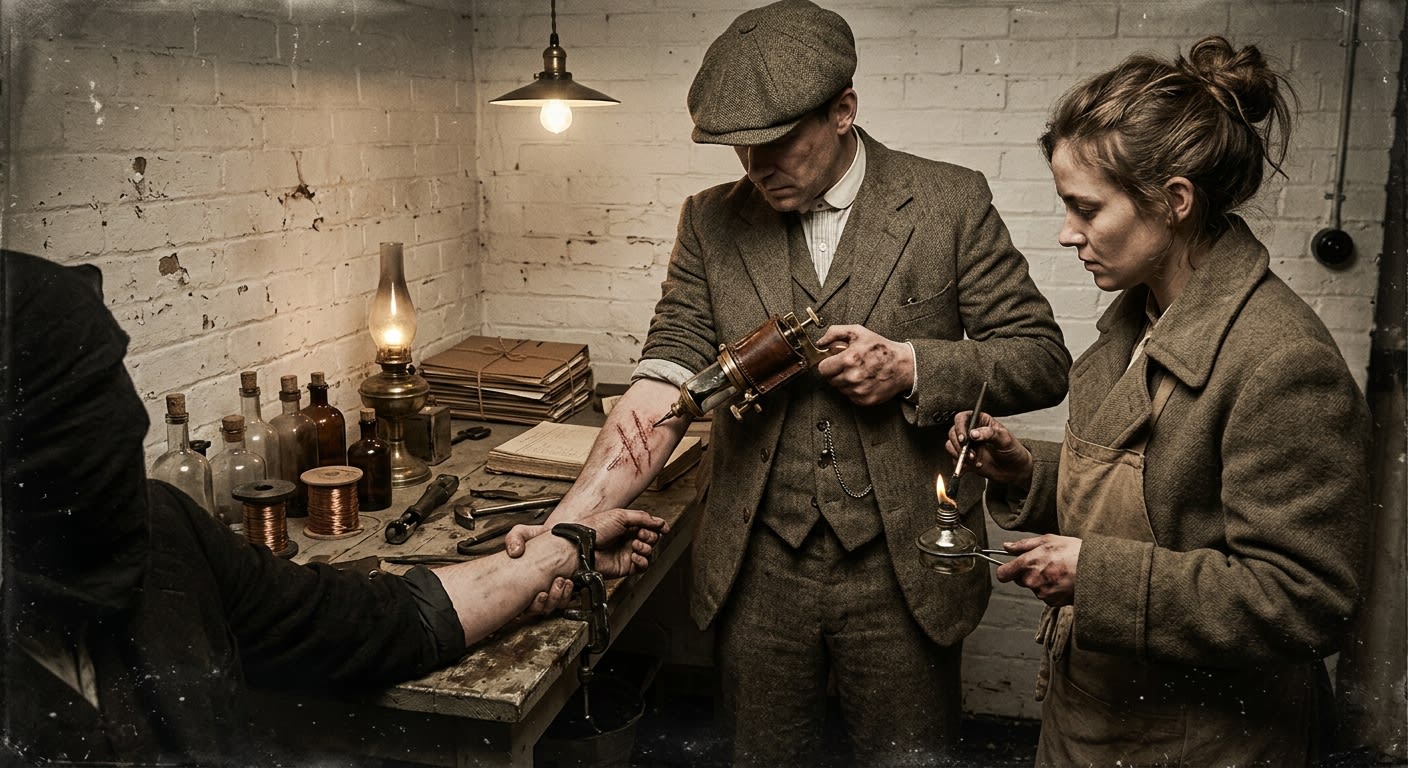
The Shadow Angle works with inferior tools and superior necessity. Licensed Brand-Smiths possess issued triangle brands, calibrated frames, swatch plates, witness seals, cleansing kits, prayer cards, and Record plates. Shadow crews possess filed-down irons, chapel rejects, counterfeit scar dyes, angle-jigs, stolen tags, acid cloth, memory-eraser tonics of doubtful composition, and enough nerve to perform heraldic surgery under a laundry floor while Purity patrol boots cross the street above.
A proper Shadow job begins with contradiction. The client presents a body whose legal text has become dangerous: condemned, penitent, ward, levy, guildless, over-sentenced, wrongly marked, correctly marked, or loved by someone willing to commit sacrilege. The crew reads the existing scar under three lamps: tallow, blue spirit, and slit-light through a brass gauge. If the mark is fresh, they wait. If the mark is old, they scrape. If the mark has drifted, they send the client away or sell him to Purity, depending on appetite.
There are four common operations.
The upgrade moves a person upward in usefulness: deserter to civilian, ward to apprentice, guildless labourer to sponsored worker, penitent to tolerable parish nuisance. It uses overlay strokes, scar dye, and witness-tag laundering. It survives at gates where guards are tired, lamps are poor, or the client's bribe has reached the desk before the client does.
The downgrade moves danger downward: condemned to penitent, second-category heretic to first, levy-marked son to civilian with a fever exemption worked into the corner. Downgrades demand more craft because the eye expects severity to leave a scar. Too clean a mercy condemns itself.
The counter-brand destroys legibility without removing the mark. It adds heat across the existing triangle until the original geometry reads as injury, industrial burn, gang sign, devotional scar, or the common misery of a body that has lived too close to a furnace. Counter-branding is fast. It leaves ugliness. Ugliness, in poor districts, passes inspection more readily than beauty.
The unbranding is the sacrament of fools. Acid, knife-work, abrasion, grafting, or a slow sequence of burns meant to erase the state's alphabet from the skin. Heraldry calls it impossible because Heraldry cannot bear the thought that proof can be peeled. Purity calls it immurement. Shadow crews call it expensive.
CONFISCATED WORKROOM INVENTORY — COLOGNE BACK COURT, A.S. 188 Unregistered frames: █ Counterfeit witness tags: ██ Acid cloths in wax tubes: █████ Children's ward-mark templates: █ Ledger names recovered from floor ash: ███████████ Client remains in lime barrel: █ Disposition of crew: sealed alive, eastern wall, no plaque
#On the Buyers
No one hires the Shadow Angle for pleasure. This is a rare mercy in a continent otherwise rich in hobbyists of damnation.
Deserters come first. A military tri-mark on the wrist is a leash that tightens at every gate. A deserter needs civilian passage, guild work, a pilgrim misroute, anything that does not send him back to the trench captain whose ledger still has a hole shaped like his name. The Shadow Angle gives him a wrist plausible enough to reach the next district. Plausible is the holiest word in criminal heraldry.
Condemned men come with relatives. The condemned himself is usually chained, watched, or too broken to bargain. His wife, brother, mother, lover, creditor, or debtor brings the coin and the body at night if the body can be borrowed from custody. A downgrade from condemned to penitent may buy two roads, one ferry, and a week of breath. It may also buy discovery, reclassification, and an immured family line. The invoice mentions none of this.
Workers come when hunger outruns sponsorship. A false guild tri-mark opens a factory gate, a dock chain, a ration allotment, a bed in a licensed dormitory. Whole crews have crossed from Warsaw staging yards to Brest repair districts under borrowed angles. Some return with wages. Some return in barrels. Some never return, which is administratively identical until their mothers learn otherwise.
Wards come because childhood under Bureau custody is ownership with hymns. A ward-triangle on the inner forearm marks the body as property of Mercy until reclassification or death. Shadow crews shave age, soften custody, recut the triangle toward apprenticeship. The better crews charge less for children. The worse crews charge more.
Heretics come last, in both frequency and wisdom. Re-symboling a doctrinal mark into a private sign is dangerous even by alley standards. Some sects request forbidden shapes: broken knots, fourth points, open triangles, mirrored brands meant to answer the Form 14-G rumours of moving marks. The Shadow Angle crews that accept this work are rich, hunted, and brief.
#On the Bureau's Useful Outrage
The Bureau does not tolerate Shadow Angle crews. It raids them, condemns them, immures them, publishes exemplary notices, seizes irons, audits witnesses, interrogates salve-women, and speaks of purity with the fragrant indignation of a butcher denouncing blood.
The Bureau also benefits from them.
Policy with its collar loosened.
Shadow crews absorb demand the official system cannot satisfy without admitting the system over-marks, over-sentences, misclassifies, drafts too eagerly, punishes too broadly, and prices legitimacy like a luxury spice. They create informant channels. They reveal deserter routes. They identify families willing to purchase false standing. They test weaknesses in checkpoint inspection. They supply Purity with raids when Purity needs a public correction. They supply Heraldry with excuses for stricter tool custody. They supply Records with new forms, and Records, poor glutton, is grateful.
Public Purity broadsides claim every discovered Shadow Angle crew is dismantled root and branch.
Clarified. Crews are dismantled where visible, unprotected, politically inconvenient, insufficiently useful, or unlucky. Useful channels are monitored until they ripen. The Bureau does not uproot a weed growing informant fruit.
There are districts where a crew survives for years because a Purity lieutenant receives names from it. There are checkpoint captains who pretend not to see a certain dye because false civilians can be arrested later with better evidence. There are Heraldry inspectors who purchase illegal samples for comparison and forget to file the purchase. There are Records clerks who launder witness tags and then help prosecute the laundering. The Synod's left hand does know what the right hand is doing. It invoices the right hand under another office.
#On Shadow Doctrine and Professional Pride
Shadow Angle crews mock the licensed chapels and imitate them with obscene devotion. They have their own sayings, their own gestures, their own little fraud-liturgies whispered while the iron heats. “The body remembers what paper forgets,” says Heraldry. “Then teach the body a new memory,” says the alley. “Three points, one truth,” says the swatch plate. “Three points, any truth,” says the cellar.
A crew chief is usually called a Shade-Smith, though titles vary by city. The cutter handles old scars. The burner applies heat. The tag-man supplies paperwork. The lamp-child holds the slit-light and learns early not to flinch. The door keeps the door. Everyone gets paid before the salve.
They respect precision because survival demands it. A sloppy illegal mark dies quickly and takes the client with it. Good crews study official swatch plates, steal retired manuals, bribe chapel sweepers for ash impressions, and keep rubbings of checkpoint tendencies by district. Brest guards prefer wrist location. Constantinople guards distrust too-clean pilgrim marks. Shipka guards fear marks that appear aged beyond their filing date. Irongate guards, after A.S. 119, stare at angle more than class.
Their great fear is drift. A false mark that moves after application is either demonic interference, bad chemistry, living guilt, or a client sweating acid through terror. None of these improves business. Crews abandon moving marks, sell moving marks, burn moving marks off, or pray over them with whatever half-remembered doctrine survived childhood. The Bureau finds those prayers especially offensive. It dislikes competition in fraudulent certainty.
#On the Present Condition
As of A.S. 201, Heraldry estimates roughly eight hundred unlicensed Brand-Smith practitioners across Zones 1 through 5. This number is a lantern held in fog. It excludes apprentices, runners, lamp-children, tag-launderers, salve-women, client-brokers, corpse-porters, bribed guards, and the licensed chapel men whose night work is filed under exhaustion, illness, or regrettable charity.
The dens concentrate near gates and need: Constantinople warrens, Shipka lower sheds, Brest levy roads, Irongate scar quarters, Strasbourg's poorer intake streets, Warsaw staging yards, and those excellent little towns whose official maps show only a chapel, a ration arch, and a cemetery while their cellars contain enough industry to embarrass Commerce. Shadow Angle does not require grandeur. It requires heat, secrecy, debt, and a door that opens from the inside.
The profession's enemies are many. Licensed Chapels despise it for profaning geometry. Quick Burners despise it for stealing clients while pretending to be artists. Mercy Branders despise it because illegal downgrading makes their own quiet mercy look criminal, which of course it is. Purity despises it aloud. Heraldry despises it in memoranda. The people despise it until they need it. Then they knock softly.
The third missing brand-iron from A.S. 200 remains unaccounted for under a Bureau of Shadows seal. Heraldry is not permitted to read the file. Shadow Angle songs in Constantinople claim the iron has already crossed three bastions and burns a class no swatch plate names. This is tavern filth, certainly. Tavern filth has an unbecoming habit of arriving early to the truth.