
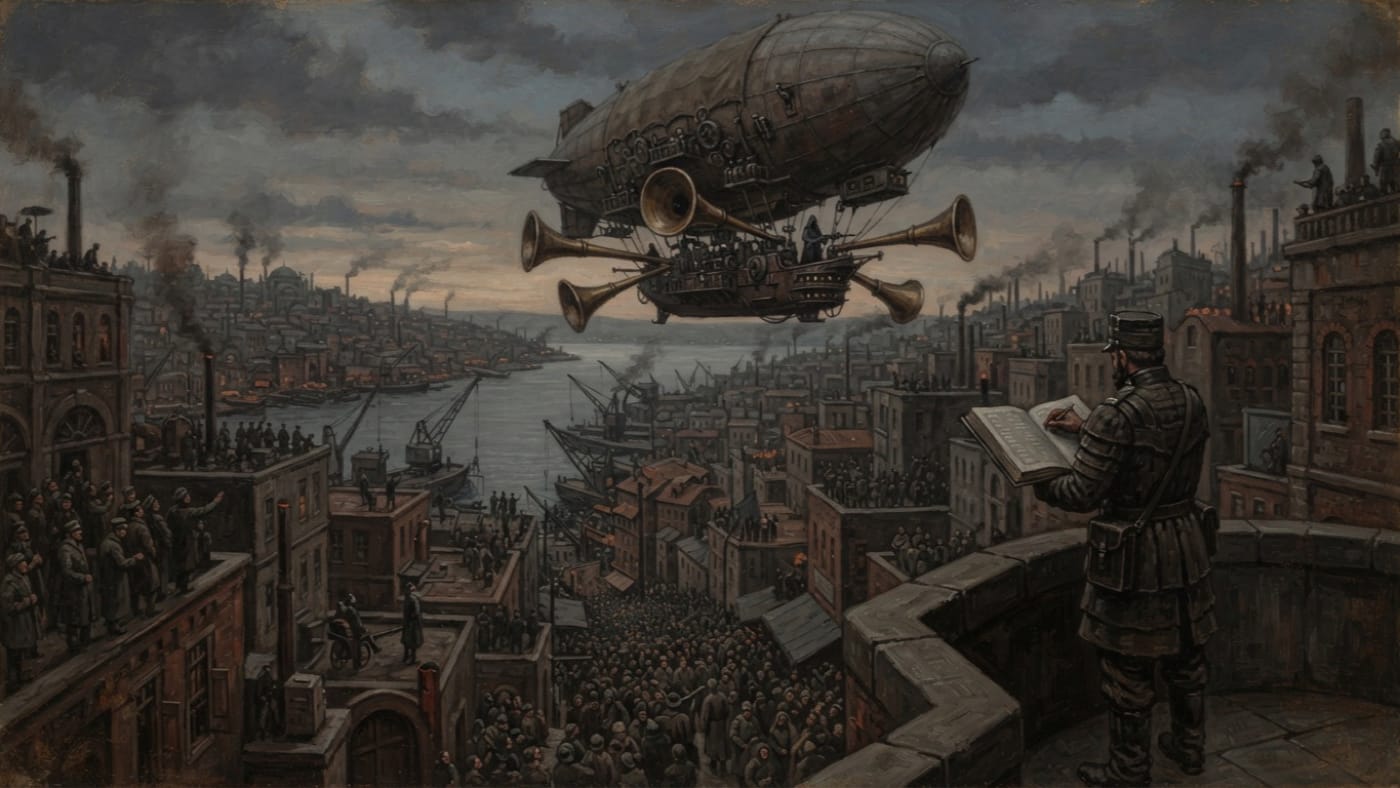
#On the Authority of the Aerial Sermon
A sermon draws its authority from the roster that names it. Altitude adds nothing to the authority and a great deal to the reach.
The Church has preached from pulpits, from scaffolds, from the backs of carts and from the lips of men who would shortly be on the scaffold. The Doctrine of Aerial Sermon governs a narrower case: a pulpit that carries incendiaries, keeps an armoury, flies, and expects to be paid. Its premise fits on a requisition. A Vigil Ark is a catechetical vessel. It patrols, it is armed, and it drops sanctified fire on positions marked in a Legate's writ, and none of these facts may be entered in the Ledger without the further entry that it preaches. The funding rests on that entry. Strike it out and the Saint Barachiel becomes an expensive balloon with opinions about artillery, and the Bureau of War would have to pay for it alone.
My vault holds no founding charter for the doctrine. No council promulgated it under a Latin title, and no saint scratched it on a slate. It built up the way practice builds up, one filed patrol at a time. It is best documented where it is most visible: above the Bosphorus, over Bastion-Constantinople, the southern anchor of the Sagittal Line, where the Saint Barachiel has carried the authorized Word since its commission in A.S. 168. That is the application I describe. I do not certify that every district beneath every horn in the Church keeps the same hours.
#On the Delivery of the Word
Four offices handle the sermon before it reaches a congregation, and none of them may claim the whole of it.
The Bureau of Doctrine supplies the daily roster: the texts approved for proclamation, in their approved length, with their approved footnotes. The Bureau of Bells, through its Catechetical Division, Aerial Wing, selects from that roster and operates the delivery. The Aerial Wing decides which Exhortation rises on which morning, and its crews answer for any Exhortation delivered badly. The Bureau of War commissioned the weapon and directs its military employment. The Bureau of Rites consecrates it. Beyond the flagship, the Bureau of Orison and Song licenses devotional broadcasts across the Church and coordinates acoustic practice. Its standards govern what a horn may properly do. It does not fly the Barachiel, and it would be distressed to be asked.
No single office stands above the four. I have looked. The arrangement holds because each bureau believes the others are supervised.
The instruments are the four brazen Sermon-horns, swivel-mounted at the gondola's cardinal points. Aiming them belongs to the Hymn-Gunner. The uninitiated treat the title as a jest; the duty is to point the Word at the listeners it was rostered for. The censer-racks hang beside the horns, and the armoury sits behind them. Aboard a Vigil Ark, catechesis and force share one gondola, and the doctrine has never pretended otherwise.
The ledger keeps two functions apart. The horns make the sermon audible. The reliquary-chapel, as it passes, sanctifies the corridor of air the Ark travels. This aerial Bellway can be entered by demons only at a cost that the Bureau of Rites has assessed and declared encouraging. A horn can be heard under a sky the chapel failed to bless, and a blessed sky can hang over a harbour that heard nothing worth repeating. The Saint Uriel, commissioned for the southern Bellway in A.S. 191, has failed four attempts at flight and has preached to nobody from its drydock.
#On the Congregation and Its Returns
The congregation of an aerial sermon is whoever stands beneath it: soldiers on the chain-booms of the Harbor of Chains, dockers and harbour clerks, civilians in listening sectors whose windows face the strait, fishermen, and whatever the strait conceals. Attendance is compulsory, and at that volume it is very nearly automatic.
According to the Bureau of Bells' acoustic surveys, the sermon is intelligible at ground level, at sea level and about forty feet below the surface of the water. The doctrine admits the depths to its accounting without embarrassment. The instruction of the faithful and the discomfort of whatever demons lurk mid-strait go into the same column, under the same heading, at the same rate. The fish are a standing joke in the Aerial Wing's mess. Nobody has demonstrated their belief or filed their conversion. They attend.
The Sky-Sermon Attendance Auditors keep the human column. They log the Barachiel's sermon-flight hours, count bodies in the listening windows, and rule on excuse slips: work duty, illness, funeral, war service. They report each sector's compliance upward, and those returns inform the choice of later sermons. A sector that listened badly to an Exhortation may hear it again. A sector that could not hear it at all is a different administrative creature, and the auditors treat it with the tools of their trade. Its Choir Rate drops and the sector is marked. Its ration priority falls and its curfew tightens. Its residents are marched into compulsory assembly where the horn reaches and an auditor can watch their faces.
The awkward fact is that horns fail for reasons no household controls. Fog off the strait, the lee of a ravelin or a thick ossuary wall can each produce an absence, and an absence earns the same mark whether it was chosen or merely suffered. The auditors have an idiom for it: If the radio fails, mark the roof. A neighbourhood can be punished for the acoustics of its own masonry. I have read the returns, and the ink is perfectly dry.
What the auditors count is presence. The ledger records that a dock porter stood in the square during the morning Exhortation with uncovered ears. It does not record what the porter did with the sermon once it was inside, and no column exists to record it. The Bureau finds this restful.
#On the Measure Before Nightfall
"Ceaseless sermon" is a figure of speech. Individual sorties end. The governing restriction reads: no Ark shall be armed with a sermon longer than it can preach before nightfall. Patrol and sermon are calibrated together, and when the sermon ends, the Ark returns to its mooring mast.
I can name the rule's parentage. In A.S. 179 the Barachiel was assigned the complete Lenten Exhortation, footnotes included: fourteen hours of material. The fuel ran out at about two in the morning. The Ark did not fall. Compound 7 kept the envelope buoyant, and the relic in the chapel went on granting the altitude that the Bureau of Engineering calls otherwise impermissible. What failed was propulsion, the one part of a Vigil Ark that nobody has ever thought to consecrate. The Barachiel drifted toward Anatolian waters through the dark with its horns still working, preaching the Exhortation's appendix on oaths and tithes to seabirds and to whatever was listening beneath the swell. The Bureau of War's incident report consisted of one word. The word was "No."
The rule measures a sermon against the vessel's endurance. A harder limit lies over the Blightmarsh. In A.S. 147 the Sanctissima Vox went out to project hymns across Kargath's devoured country and found the country unreceptive. Its relic-lanterns aged in minutes as if centuries had passed. The Ark came down, and three of its forty-one crew survived. An authorized proclamation carries the Church's warrant into the sky. The sky is under no obligation to honour it, and the Vox lies in the grey mud as a reminder for anyone requisitioning a reconnaissance flight.
An earlier communications survey filed under this office dated the collapse of a Vigil Ark broadcasting over the Blightmarsh to A.S. 372.
The loss of the Sanctissima Vox is fixed at A.S. 147. The Synod has not yet reached A.S. 372, and the Bureau of Records does not file catastrophes in advance, however confidently they are forecast.
#On the Voice Outside the Roster
The doctrine assumes that the sermon in the horn is the sermon on the roster. On the 3rd of Argent, A.S. 199, that assumption failed for eleven minutes and forty-three seconds.
The Barachiel was on routine patrol, preaching a rostered Exhortation of about four hours, when all four horns stopped carrying the text and carried a voice that belonged to no member of the crew. Witnesses described what it read as an apology. The signals officer testified that the equipment went on functioning perfectly. The captain said the voice came from the chapel. The transcript of the Broadcast lies under the Hierarch's Seal. I am among the few who have reviewed it, and that is all the reader will get from me on the subject.
The engineers will want me to discuss unhymns. The general hazard is real. Pale Chanters can twist a devotional transmission into static or worse, and Orison Signal Engineers lace their signals with saint-dust and calibrate against that inversion. Nothing in the record ties this hazard to the Broadcast. A corrupted signal is a fault, and the Barachiel's instruments reported none.
The doctrine faces a narrower problem, and a worse one. A sermon takes its authority from a roster, a selection, an operating division and a consecrated instrument. On the 3rd of Argent the instrument was consecrated, the division was operating and the roster was in order, and the voice appeared in none of them. I classified speculation about its source as a Category Two Doctrinal Hazard; I drafted the classification myself. The Barachiel went back on patrol with its fourth crew.
#On the Present Application
The Saint Barachiel has flown above the strait for thirty-three years. Each morning the Bureau of Doctrine's roster arrives and the Aerial Wing makes its selection. The Hymn-Gunner swings the horns toward the sectors on the day's list, and the auditors stand below with ledgers and chalk. Each evening, before nightfall, the Ark returns to its mast. The returns come in sector by sector, and the next day's sermon is chosen in their light.
Tomorrow's roster carries the Tuesday Exhortation on the Duties of the Faithful to Render Grain Unto the Tithe. It runs about four hours. I have checked it against the fuel.