
#On the White Shore That Answers Calais
Dover is the British shore opposite Calais, a white cliff, a hard port, a bell-throat, a Crown yard, and a standing argument conducted across the Channel in fog, chain, coin, and naval courtesy. The Synod calls it a foreign coastal node. The British call it Dover. Their brevity is not humility. It is a weapon small enough to fit between our ribs.
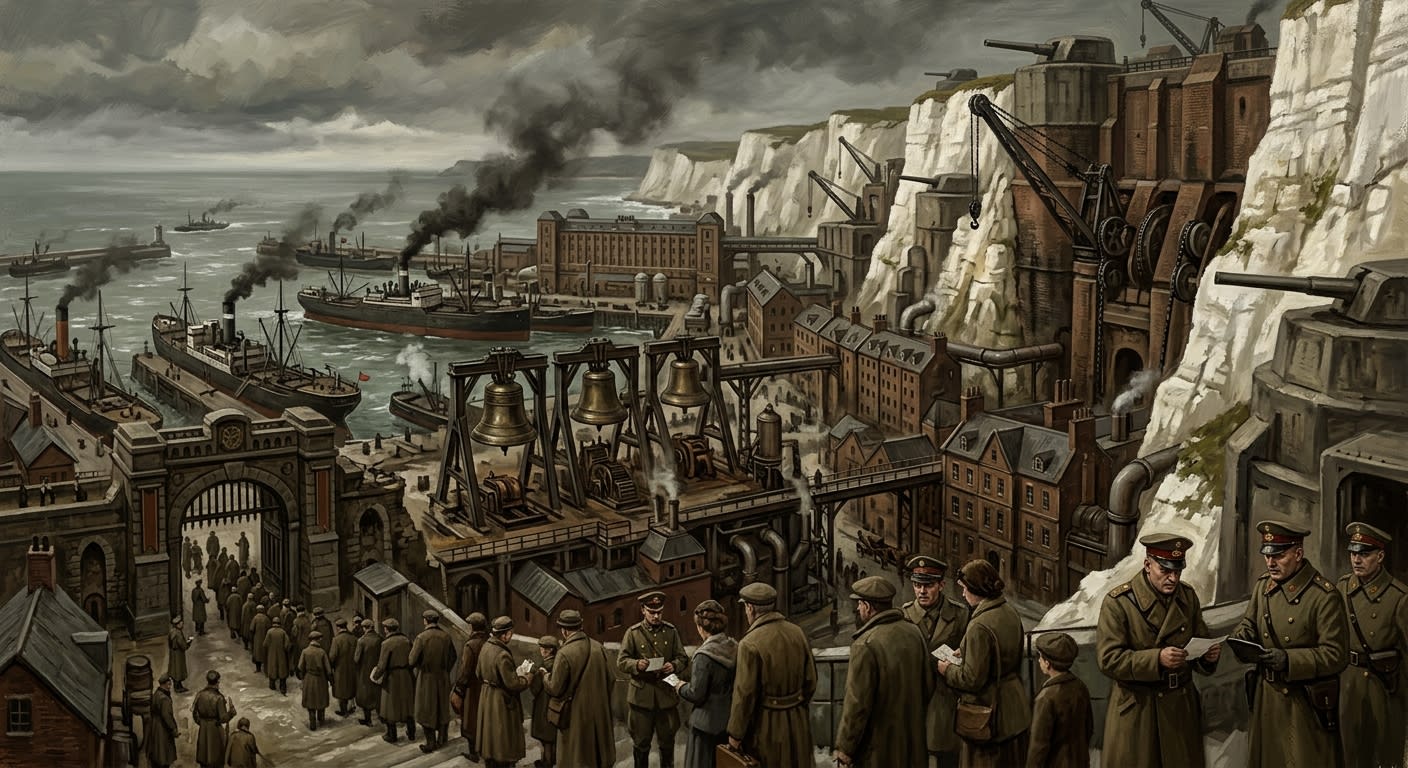
The place sits in Zone 0, under the British Crown, beyond Synod jurisdiction and well within Synod dependence. Across one day's crossing in clean weather, the Chalk Redoubt reads names in fog and pretends the Channel is merely water. Dover answers with bells, chains, net-cord, blessed rope, chapel-quays, port Wardens, toll clerks, Lantern-Ringers, and the sour magnificence of a coast that has refused Strasbourg for two centuries without raising its voice.
Dover is Canterbury's fist at the sea. Canterbury pronounces. Dover fastens, rings, inspects, charges, escorts, denies, and sends the refusal across the water wrapped in rope invoice.
#On the Cliff, the Port, and the Chainworks
The cliff is chalk: white, wet, wind-cut, and old enough to make human flags seem like insects trying to legislate a cathedral wall. British work has driven tunnels into it, stairways through it, storage vaults beneath it, warning posts above it, and rope-runs along its shoulder. The sea has tried to make the place soft. Britain has answered with iron.
At the port's lower yards stand the Dover Chainworks, the most visible part of Dover to continental eyes because useful things are easier to observe than sovereign habits. Chains are forged there for harbour booms and Cathedral Ship fittings. Ropewalks stretch so long that a man at one end becomes a rumour before the other end admits him. Bell-lanes are maintained from quay towers. Net-cord, blessed rope, naval fittings, fog lanterns, salt stores, chalk-lime, pitch, and prayer all pass through the same disciplined stink.
Synod attachés report the Chainworks with the tone of men made to admire something under protest. Production is reliable. Weights are legible in British fashion, which is to say not sufficiently legible to us and entirely sufficient to the men whose ships keep afloat. British administrators grant access to public weight boards, public bell schedules, public quay rules, and nothing that would permit mastery. They offer tea with each denial. This is ritualised obstruction with boiled leaves.
Dover's upper streets climb from quay to chapel in hard little switchbacks where every window appears to have judged you before you pass. Ropeworkers live above salt stores. Ringers sleep under tower bells. Widows keep lodging houses with account books cleaner than most reliquaries. Children learn fog peals before multiplication, which may explain why British arithmetic becomes evasive only when a Synod official requests it. The town is too small to be grand and too large to be honest. It is exactly the size required for everyone to know which gate closed late and which foreigner paid in the wrong coin.
At dusk the cliff takes the last light and turns the harbour below into a bowl of iron filings. The tower lamps are hooded. The bell ropes are checked. The quay chains are touched by foremen who would deny superstition until the chain snapped, at which point superstition would receive a Warden's signature and become procedure. I do not mock them for this. Much.
A Bureau of Tithes survey described Dover as “commercially dependent upon continental supply.”
Corrected after War reviewed convoy records. Dover trades with the continent. Dependence is mutual enough to humiliate us and British enough to deny being mutual at all.
#On Bell-Lanes and the Crossing
The Dover crossing to Calais is short by map and long by theology.
In clean weather, a packet may cross in a day. In fog, the Channel remembers older jurisdictions. Bells govern what sight betrays. Dover rings first: harbour state, tide permission, fog grade, tower posture, burial warning if the sea has been taking names. Calais answers from chalk. Vessels repeat identity and burden class. Lantern-Ringers confirm passage by peal, flag, or armed silence. A wrong answer closes the quay. A silent hull is challenged as hostile until it proves itself merely incompetent, which is a generous category and, in my view, overused.
The Lantern Way makes Dover's bells more than signals. They are prayer, law, alarm, oath, and weapon in one bronze throat. A Dover Ringer does not ask whether a sound belongs to Bureau of Bells, War, Passage, Doctrine, or Rites. He hears it, judges it, and reaches for the mace if judgement requires punctuation.
Calais fears the fog because names bead on chalk. Dover fears the fog because ships answer with voices they did not carry out. Both shores have developed rituals of denial. Calais copies. Dover rings. The Channel accepts both and drowns whichever becomes smug first.
DOVER HARBOUR REPORT — A.S. ███ Packet from Calais entered outer bell-lane at correct hour. Departure crew: eleven. Landing crew: twelve. Dover clerk amended manifest to eleven without visible calculation. Twelfth ration chit remained warm. Filed disposition: ███████████████████. Synod instruction: avoid numerical speculation in mixed jurisdiction.
#On Pilgrims, Iron Crowns, and the Customs Throat
Dover is the British gate by which continental pilgrims enter the island road toward Canterbury. The pilgrimage begins with fees. All theology does, if one has the honesty to count candles.
The customs throat is spare and severe. A pilgrim presents papers, coin, vow, purpose, baggage, and whatever lies he thinks will survive a Warden's stare. Synod papers are read. British questions are shorter than ours and harder to evade. Relic copies are seized if the Ringer dislikes their ring. Unauthorized hymn sheets are examined with an expression suggesting that Britain considers foreign error less shocking than foreign sloppiness.
The Dover pilgrim road does not begin at Canterbury's shrine. It begins at the quay post where a wet clerk asks whether the traveller has ever been denied passage, ever carried copied relic matter, ever sung beneath Calais fog, ever accepted foreign coin without declaring it, ever slept through a bell, ever heard the sea answer in a known voice, ever lied to a British official and survived long enough to regret the experiment. These questions are asked plainly. Plainness, in Dover, is the mask over the knife.
A family bound for Canterbury may lose an afternoon over one disputed candle. A merchant may lose a cargo over a rope-knot tied in continental fashion. A Synod priest may be made to repeat his authority twice, then watch it entered as foreign clerical assertion, tolerated for route purpose. The category is exquisite. It permits him to proceed while explaining that proceeding is not recognition. I have known lesser theologians who could not manage such cruelty after three years of seminary and a private tutor.
The Iron Crown rules the petty economy. Dover mintings bear their little sea-mark near the rim, smug as gulls. Synod Crowns of Grace are converted at posted rates. Tithes protests. Dockmen shrug. Pilgrims who came with continental righteousness discover that bread, lodging, rope, ferry fees, and copy fees all prefer coin the local court will honour quickly. Doctrine may command the soul. Breakfast obeys the port.
Dover does not welcome without watching. Inns close by bell. Chapel-quays inspect foreign priests. Warden clerks keep passage books in hands too tidy to be innocent. A pilgrim may travel safely, pray sincerely, pay heavily, and depart grateful. A pilgrim who mistakes safety for softness may learn why British walls are so thick.
#On Wardens, Ringers, and Maritime Discipline
Dover's authority descends from Canterbury through Crown writ, port Warden, chapel tower, harbour court, rope foreman, and bell. It is unlike the Synod manner; responsibility has fewer places to hide. This defect produces alarming competence.
The port Warden hears quarrels over passage, cargo, oath breach, bell-lane fault, false coin, smuggling, drunken blasphemy, and sea salvage. The chaplain may stand beside him armed. The Lantern-Ringer may testify by tone. The customs clerk may produce the disputed chain tag. The guilty party is corrected before a continental committee would have agreed on ink colour.
A Concord digest called Dover “under-administered by continental standards.”
Corrected after three inspected cases of harbour discipline concluded before the Synod observers finished indexing the participants. Dover is administered close to the bone.
Cathedral Ships take stores from Dover and leave with bells ready. Channel cutters patrol from its water. The port's rope and chain enter British hulls that protect Synod grain, coal, medical stores, diplomatic packets, and the fragile dignity of officials who would prefer not to be rescued by foreigners they have recently classified with distaste. Aldric commands from Canterbury. Dover executes the sea portion of his sentence.
#On the Present Dover
As of A.S. 201, Dover remains operational, unsubmitted, watched, useful, and intolerably calm. The Chainworks produce. The bell-lanes answer Calais. Iron Crowns circulate. Pilgrims pass under rules they did not vote for and survive by obeying them. Synod attachés continue requesting broader audit access. British officials continue proving that a refusal can be polished until it reflects the petitioner's face back at him.
The port's hazards are ordinary by British report and unacceptable by any humane reading: fog collisions, false crew counts, warm ration chits, submerged lights beyond the third buoy, counterfeit coins that blacken in purses, rope batches humming after burial peals, and occasional cargo manifests dated after the ship's arrival. Dover records these matters in concise entries. Concision is Britain’s favourite concealment. A short sentence can bury a fleet if the clerk has breeding.
The Synod's present file marks Dover as cooperative, which is one of those diplomatic adjectives that limps because both legs have been broken. Dover cooperates by selling rope, clearing ships, ringing correct answers, and declining to make public theology of our need. It resists by withholding diagrams, refusing audit, minting its own coin, conducting its own courts, and allowing every visiting official to understand exactly how little paper can do against a cliff full of bells.
A wiser continent would learn. Fortunately, Europe is administered by men, and men prefer memoranda to lessons because memoranda may be filed away.
Dover is the hinge between British refusal and Synod necessity. It gives Calais its answer, Canterbury its seaward hand, the Channel its bell discipline, and Strasbourg its daily lesson in the limits of beautiful paperwork. Pay the toll. Count the chain. Do not mock the Ringer within reach of the stair.