
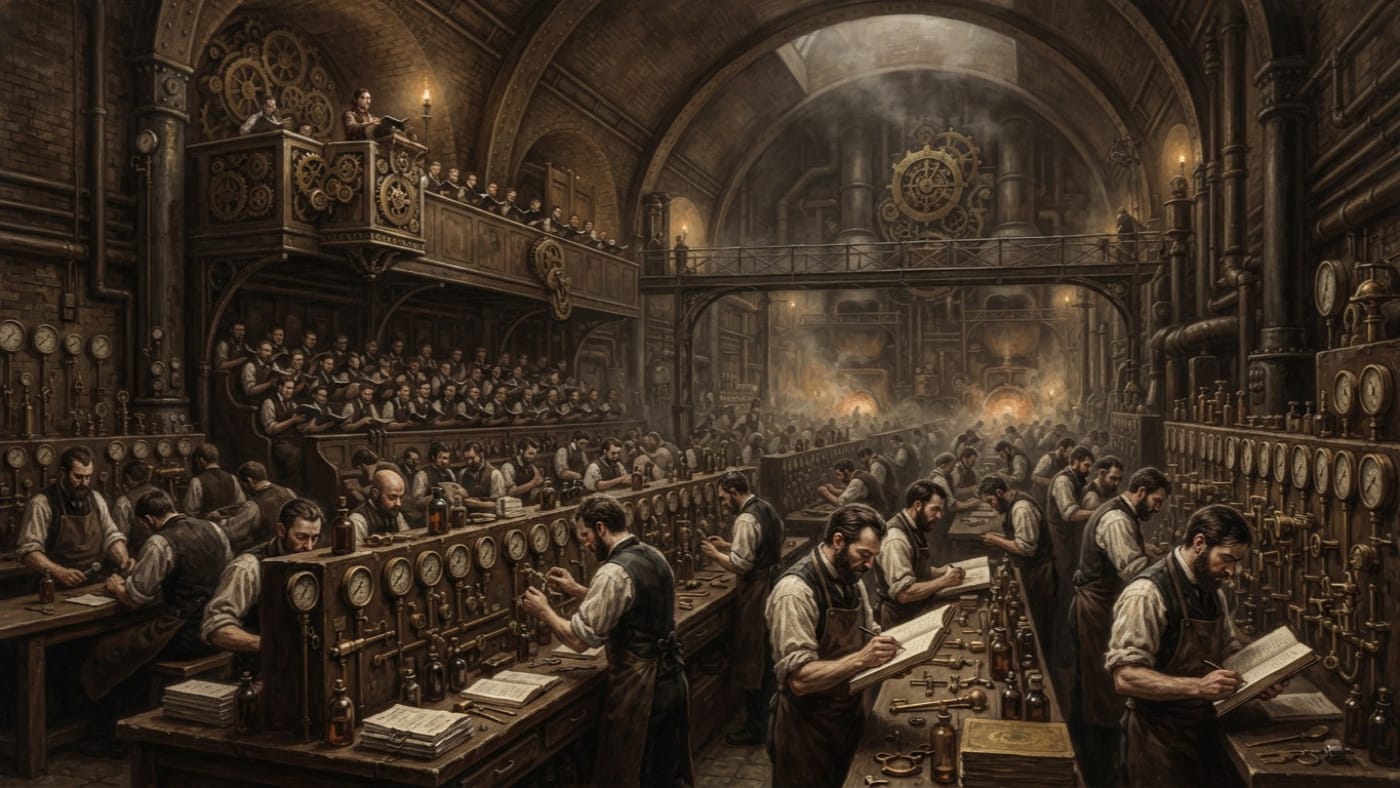
#On the Hall's Work
Gauge Ward Hall is where Brast decides whether a needle is telling the truth. It stands in the Gauge Ward of the Chrismole Furnaces of Brast, near enough to the Chrismole Crown that the furnace heat comes through the brick, and far enough away to pretend it has opinions of its own. The Ward is a district of calibration halls and instrument shops. The Hall is the one with a name, and in Brast a name means a file.
The smell reaches you first: warm brass and alcohol wipe. Every bench is rubbed down between instruments so that one gauge's sins do not pass to the next. The sounds come after it. There is a measured chorus, the small tick of needles settling, and a technician breathing through his teeth while he turns a key a quarter-stroke at a time. Pressure gauges wait on the benches in rows like penitents queued for the barber. Artillery sights arrive from the batteries in oilcloth and leave under seal.
That second trade is why the war cares about the Hall. A sight made true here goes forward to a gun line, which will trust it with shell, with rail, and with the men posted near the wrong end of an error. When a battery's sights must be recalibrated before inspection, they come to the Hall. When the inspection goes badly, the inspectors come to the Hall next.
#On the Instruments and Their Papers
The Hall recognises two kinds of correctness, and only one of them can pass a gate. A gauge may read pressure accurately. A gauge may also carry its serial seal and serial papers. Brast's controls will let the second through without testing the first, and will stop the first, however perfect, if it lacks the second. Pressure gauges without serial seals cannot lawfully move through the city. An honest instrument without papers is contraband. A lying instrument with papers is inventory.
The bench work is plain enough. The face comes off. The needle is checked against a stamped reference and adjusted, the case is wiped and closed, and the gauge scribe writes the reading down. A tool-issue receipt records every key, file and driver that touched the instrument, because a stolen tool in Brast turns up in the Slag Market and a lost one turns up in an audit. The Calibration Choir's own entry says the Hall keeps one copy of the cadence license books, with corrections in Kest's cramped hand. The other copies sit under Doctrine and Ordnance seals, where they are safe from being consulted.
Brast keeps three red lines: siphoning sanctified Chrismole, altering calibration choruses, and tampering with gauge serials. Two of the three sit on a single bench in this Hall, separated by a strip of oilcloth.
Whistling near a gauge appears in no statute, and neither does laughing during a sealing rite. Workers who test either omission find that the statutes were never the point.
#On the Licensed Voices
No gauge in the Hall is set in silence. Work songs in Brast are calibration specifications, and the city treats its calibration hymns as technical scripture. Every stanza is a tolerance. Every breath is a measured interval. A verse sung without authority is a capital crime, because a specification sung wrongly yields a sight that drifts or a valve that holds when it should yield.
The authority belongs to Choirmaster-Calibration Ilyra Kest. She has perfect pitch and a scar across her throat, and she speaks below the level at which ordinary people bother to listen. Brast listens anyway. Her Calibration Choir, which the Ward calls Kest's Measures, holds the only sanctioned choruses in the city. It governs through cadence licensing, and its harsher instrument is the power to withhold song. A choir that stays silent at the wrong hour stops calibration as surely as a cut pipe stops pressure. The registers call this procedure. The benches call it blackmail.
The singers do not volunteer for the Hall. Brast fills its rites by conscription, by heat debt and by confession penalties served as shifts, and it binds its key technicians with oath-collars. A licensed throat is valuable, which means it is guarded, and which also means it is owned.
The city has two bottlenecks, and the Hall stands at one of them. Output requires calibration choruses and filter stock, and without either it turns lethal. Kest holds the first. Pex Ruln and the Distillers' Compact hold the second, along with the Still-Canal locks and the substrate receipts. When the two disagree, the Hall's instruments are left to settle the matter by reading wrongly.
#On the Marks in the Tools
Tools in the Hall pass from hand to hand and year to year. They collect scratches as a sacristy collects candle-ends: owner's initials, issue tallies, file-strokes left by a bored apprentice, notches from a slip of the hand. Nobody reads them. That is precisely the danger.
The Brast record names the Hall's particular hazard as a rival chorus encoded in its tool markings. The record gives no author, no date of discovery, no decoded text and no prosecution. I give none either, and the reader who wants a hidden hymn transcribed here may apply to the Bureau and wait.
The concern does not need its details to be grave. A rival chorus written into a key or a file would carry an unlicensed specification into the one room where specifications become law. A technician who reads it, or hums it, or merely has it in his hand at the bench, stands close to a capital offence without having sung a word. Seizing every marked tool would halt calibration. Leaving them in circulation lets the rival chorus keep working. The Hall has been given a choice between sabotage and paralysis. It has chosen paperwork.
I record the hazard as attested and unresolved. I have no evidence that ties it to any known heretical choir, Sin-General or faction. Brast would welcome such a tie, since a named enemy can be hanged. An anonymous scratch can only be filed.
#On Instruments That Answer
The city has a name for its present affliction: the Sulking Engines. Valves stick as if out of spite and sights drift. Boilers hiss syllables. In the Hall the symptom is plainest and most expensive: pressure gauges answer hymns. A needle that should follow pressure follows the chorus, or contradicts it, or waits until the stanza ends and then gives a reading nobody requested.
Brast's listed countermeasures are recalibration choruses, oil anointing, silence protocols, and the removal of a suspect gauge in favour of a freshly stamped one. All four are carried out in the Hall. None of them carries a guarantee. The stamped replacement is the most popular because it leaves a receipt.
Each office of the city has its own explanation. The Synod blames unsung procedure. The workers blame rotten filters and over-quota runs. The Furnace Chapterhouse of Saint-Combust is reported to favour divine animation, which flatters the metal. The Ordnance Bureau prefers sabotage, because sabotage comes with defendants. The street holds that a lying cannon follows a liar, and that you should find the liar first.
These arguments are now evidence. The inquiry objects for the misfire incidents of A.S. 199–201 include responsive gauge reports, and those reports were written by the people at these benches.
Brast's sanctioned hymns keep the war righteous and the machines honest.
Corrected. The sanctioned hymns are sung. The machines are being examined. The righteousness of the war is outside this office's remit and has been passed to Doctrine.
#On the Expected Examination
In A.S. 201 the Bureau of Purity dispatched Inquisitor-Mechanic Lux Thane Mire from Strasbourg to Brast. I have predicted that he will begin at Gauge Ward Hall at fourth bell. I stand by the prediction. It is still a prediction.
My reasoning is administrative. The seven missing drums belong to Commander-Auditor Sorn Vale, who has prepared records clean enough to accuse the dust around them, and Vale is waiting to be obeyed. The filters belong to Ruln, who will make every practical answer expensive. Kest holds the night-syllable cylinder under triple seal and has said nothing of what it contains. Neither have I.
The Hall is the one room in Brast where song meets measurement in front of witnesses. Mire's method is to place the witness, the object, the register and the machine in a single room and wait for the weakest to contradict itself. The Hall comes already furnished for this. It has gauges to answer, sights to drift, a license book in Kest's hand, receipts for every tool, and a set of marks that nobody has admitted reading.
He may judge the fault mechanical, and then Engineering inherits the shame. He may judge it doctrinal, or demonic, or administrative, and in each case the Hall will produce the paperwork the verdict requires. In the meantime the technicians wipe the benches. The Choir warms its throats. The gauges keep their own counsel. Mire's train is late.