
#On the Chamber Beneath the Arch
"The map is not the war. The map is the part of the war that can be sealed."
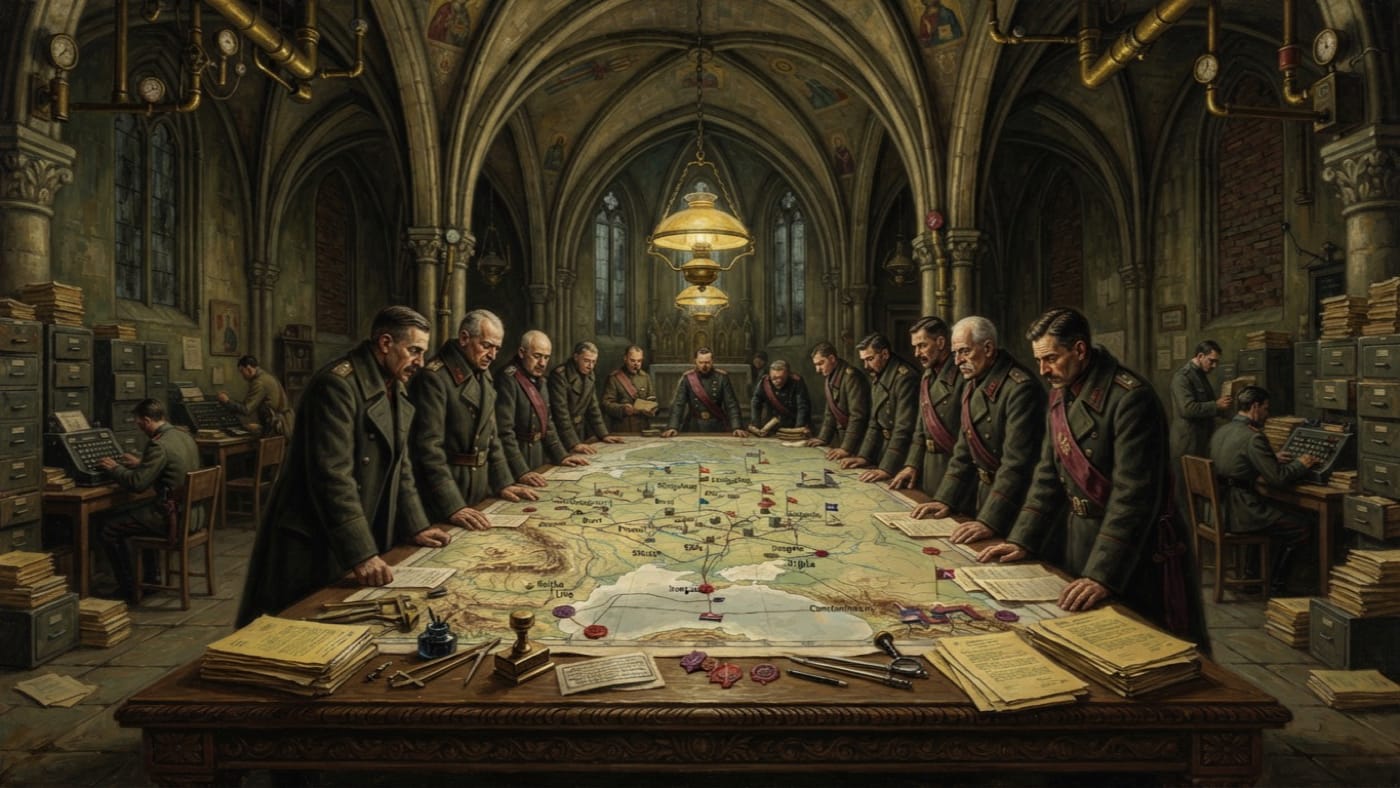
Beneath the Arch of Campaigns, in the northern quarter of Strasbourg, the Bureau of War keeps a chapel where no Mass is said. The Grand Strategy Chamber has kept its Gothic ribs and its vaulted hush. Where a congregation once knelt, officers in greatcoats now stand, because nobody has ever drawn up a campaign on his knees. The map table has taken over the altar's work. The Bureau sees no demotion in this. A chapel brings the faithful before the will of the Creator. This one brings the will of the Synod before the frontier, and War's theologians have certified the two errands as similar enough to share a roof.
The frontier is a long way off. Strasbourg lies deep in the western heartland, behind the provinces, behind the forward staging grounds and behind every trench the Line possesses. The nearest bastion is farther from this table than many of the men standing at it have ever travelled. That is the design. The Chamber sits where shells do not fall, so that the men who decide where shells shall fall can do it with dry paper and steady hands.
#On Vienna and the Permanent Office
Vienna, A.S. 95. The feudal levies meant to relieve it came late, came short or came with terms. The garrison survived, and the Synod remembered. Ten years later, in A.S. 105, the Charter of Crimson Ink gave the Faith a Bureau to raise, equip, drill and theologically supervise forces of its own. No lord's mood would stand between a wall and its defenders again.
A permanent army needs a permanent room where it can be imagined. That is all the Charter strictly implies, and it is more than Records will say about this room. When the chapel's stones were laid, when the last Mass was sung under them, when the first campaign map was unrolled over the place of the altar: the Bureau of Records declines to date any of it, and I decline to invent dates for Records' convenience. The Chamber is old enough to have forgotten its saint and young enough to need the Bureau that fills it. Both conditions are certified.
This Codex's entry on the Bureau of War holds that the Council of Cologne ratified the Charter of Crimson Ink after Vienna.
Corrected. The Charter was sealed in A.S. 105. The first Council of Cologne sat in A.S. 27 and the later Council in A.S. 100. Neither could ratify a charter not yet written. No replacement ratification is supplied, because none is on file. The responsible clerk has been reassigned to duties that require him to count only things that exist.
#On the Campaign Map
The map is the Chamber's reason for being and its only permanent congregant. It shows the Sagittal Line as Strasbourg prefers to see it: a north–south spine some two thousand miles long, laid along the ground the Creator raised for defence. The Masurian Lakes, the Bug, the Carpathian passes, the Iron Gates, the Balkan range, the Bosphorus. Seven anchors hold it. Read from the Baltic down, they are Königsberg, Brest, Przemyśl, Sibiu, Irongate, Shipka and Constantinople. West of the spine lies the safe country, where the levy is raised and the bread is baked. East of it lies the Enemy, drawn with fewer details, since the Enemy files no returns.
Everything else on the table is a question War is bound to answer. How many men stand at each anchor, and how many more the Continental Levy owes. Where they will be moved, and by which roads. What they will eat and what they will fire, and whether the powder and the flour will arrive in the same month. What objective they march toward, and whether it has been declared holy in time for the march. The Bureau raises, supplies, trains and supervises. In the Chamber those duties are laid flat side by side, so they can be compared and found to disagree.
The map knows exactly what it is told. Field commanders, provincial quartermasters and the Bureau's own intermediaries send their returns on paper, and the paper is as old as the road it came along. A trench lost this morning at Shipka stays held on the table until a courier says otherwise. The officers know it. They are competent men, as the Bureau measures competence, which is to say they never confuse the map with the ground in their written work. The Bureau's doctrine does not treat the delay as a fault in the map. The delay is the time during which the Line may go on being what Strasbourg believes it to be.
#On the Officers and the Seals
"Faith provides the flame; War bears the sword." (motto of the Bureau)
The men around the table wear War's crimson sash, cut from pilgrim banners that were carried along the long roads to Strasbourg and then consecrated. A strategist here leans over the frontier with the prayers of strangers knotted across his chest. When he spills ink on them, as strategists do, the Bureau calls it a second consecration and sends for a fresh sash.
Command belongs to the Warden-General, an office filled by rotating appointment. I give the title and withhold the name. The office outlasts the men who hold it, and the map obeys the office. Below it serve the ranks War has made its own. The Vexillators carry the standards of the grand campaigns. The Tribune-Chaplains lead prayer and assault in the same breath. The Litany-Engineers time their charges to the metre of a hymn. Not every rank keeps a desk in Strasbourg, and the Chamber does not pretend otherwise. Their names arrive on returns. Their deeds arrive later.
Competence alone gets no officer to this table. Every rank needs certification from the Bureau of Doctrine. The man who calculates a march has also sat his catechism, so the Bureau can say with a straight face that its arithmetic is orthodox.
Once composed, the plan is still only a draft. No campaign plan circulates without the seals of Doctrine and Purity, so the Chamber writes for two readers: the frontier, which has to carry the plan out, and the seal-bearers, who have to find nothing in it worth burning. In my reading of the files, a prudent officer learns early to call a withdrawal a consolidation of the faithful and a flank march a procession by another route. If the plan succeeds, the seals are vindicated. If it fails, the field commander is blamed. The seals are never at risk, and a seal exists for exactly that.
#On the Reports That Return
Orders leave the capital eastward through the Bureau's intermediaries. What comes back west is scripture.
War writes its after-action reports as devotional narratives, and in the Chamber Strasbourg meets its planned campaigns again, now in their sanctified form. The routing of Wrath's Horde at Belgrade went into the record as the Miracle of the Danube's Turning. The Subjugation of Seville went in as "a procession of cleansing." The Night of the Three Bridges, when the Vexillators of Strasbourg forced the Danube in a single charge, was declared a miracle of locomotion. The Bureau holds that the men who crossed were carried by Providence and not by their own legs.
The officers at the table do not need to believe these narratives to use them. They need the numbers inside. A sanctified report counts its dead precisely, in its own way: first it counts them, then it sorts them, and some are reclassified. Records has defended one such revision as "a more careful accounting of the distinction between casualties and martyrdoms." A martyr is a loss that has been approved. A casualty is a loss still awaiting approval.
This shapes the strategy. A regiment's strength on the map comes from reports that have passed through the hands of chaplains, clerks and certifying seals, and every one of them had an interest in the result. A clever officer reads past the apparitions to the ration returns. A cleverer one keeps note of the apparitions too, because a campaign that produced three saints is easier to fund a second time.
#On the Present Condition
Survey of A.S. 201. The Chamber is in use. The Levy still supplies the men and Records still numbers them. Doctrine and Purity still seal the plans that spend them. The officers still stand under the old vaulting and move the frontier about on paper, while the frontier itself, hundreds of leagues to the east, does as it likes. The chapel was built for contemplating things that cannot be seen, and it has never stopped serving that purpose.