

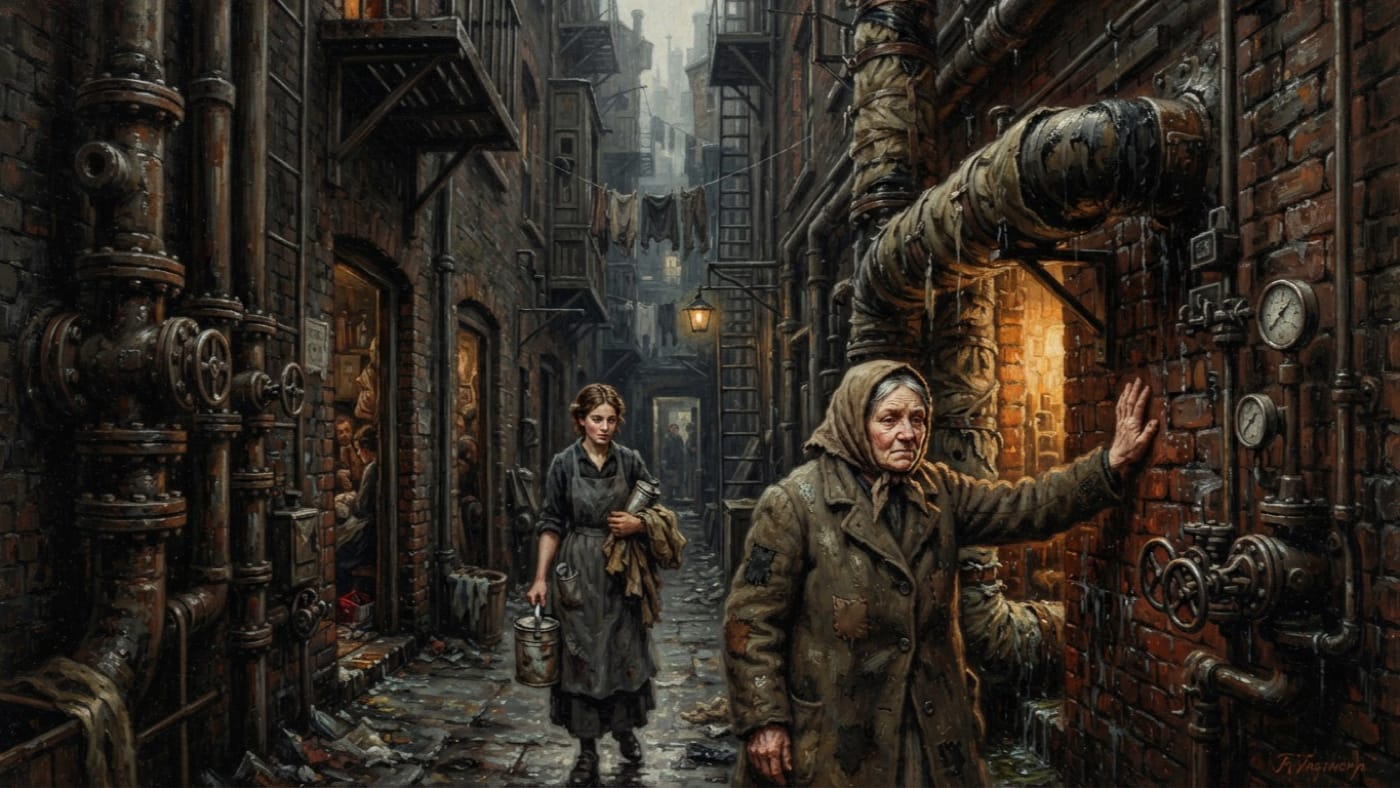
#On Pipes and Proximity
The Still-Alleys of Brast are the passages where a condenser line, routed by engineers, ends up lived in by the poor. Nobody filed whether the pipes or the houses came first, and each side now claims to have been there earlier. What this survey can certify is distance. In these passages the condenser trunks run close enough to occupied brick that a woman can lay her palm on her own back wall and feel sanctified fuel moving on the other side: hot, sealed, bound east, and not hers.
The whole place comes down to that closeness. A Still-Alley is any narrow way between tenements, workshops and laundries where the furnace pipework passes within arm's reach of people who have too few warm chits. The brick sweats oil. Pipe brackets hum in the mortar, and alley mothers claim their children sleep badly anywhere quiet. The air smells of sweet solvent over wet ash, and that smell gets into bread, hair and the pages of prayer books.
The provincial reader must keep the alleys apart from the Still-Canals. The canals are the condenser channels, lock runs and filter galleries south of the Crown, where Compact water sits under Compact keys. The alleys are dry, as far as anything in Brast is dry, and no charter covers them. They have no ward seal, no warden, no perimeter on file at Records, no census and no founding legend worth the ink. Ordnance lists them under pipe maintenance. The people who live there call it the part of the city where the walls are warm on the wrong side.
Nor should the visitor confuse them with a cold alley, which in Brast slang means an unheated street used for punishment. A cold alley is the opposite of a Still-Alley. Now and then it is also where a Still-Alley tenant ends up.
#On the Lower Map
There is no gate into the Still-Alleys, because they have none. You reach them sideways: through underpipe tunnels, along roof crawlways that follow the pipe bridges, through laundry yards whose chimneys share brick with a condenser elbow, across service passages that Ordnance stopped locking once the locks began disappearing, and up the back approaches to the Slag Market, where tools are bought and stolen heat is sold. Where an alley drops toward the canal under-locks, goods sometimes go by skiff when the furnace roar is loud enough to cover the oars. Most of the trade, though, moves on foot and on backs.
The crews call the whole arrangement the lower map. Records has no copy. Ordnance has three, and none of them is accurate. I decline to add a fourth. A map of the Still-Alleys goes out of date at the next audit, and the man found carrying one becomes the reason it changes.
The real map is kept in the body. It is knowing which bracket has worked loose, which stair the provosts won't climb in wet weather, which wall goes cold an hour before the line it hides, and which child can be trusted to run the roofs after third bell. This knowledge passes from parent to child, and burns, falls and confessions take it away. Its value never appears in any ledger.
The city's clock governs the alleys more strictly than any warden could. The dawn pressure bell starts the runs. The midday gauge checks bring line auditors. The evening rail dispatch draws provosts toward the yards. The night roar of the furnaces covers everything. If a tap is drilled too early, someone sees it. If it is drilled too late, the line has cooled and gives back only a sweet dribble and a fresh scar in the iron. During the roar, a hammer can't be heard three doors away.
#On Heat Bought Twice
Ordnance prints the warm chits and the shift-foremen hand them out. A chit buys an hour beside a heat pipe. In the Still-Alleys the pipe is already beside you, and that is the insult. A tenant pays chits to sit near official warmth while lying every night against a wall the same warmth passes through. If the chits run out, the tenant takes on heat debt, and that debt is paid in overtime, in informing or in confession. In this way the alley pays for heat twice: once to the office, in paper and obedience, and once to the crews, in coin, spoons or silence.
The Warmth Thieves draw their technicians from these passages. It makes sense. Nobody knows a line better than someone who has listened to it through a pillow for eleven winters. The tools are small. A brass worm drills the line. A rag clamp, dipped in ash paste, stops the bleed. A tallow-lined bladder carries the take under a coat. A vinegar mask keeps the solvent from turning the thief's eyes into fountains while the work is still unfinished. The goods themselves are fuel, steam, pressure, hot residue, and the useful minute in a guarded schedule.
The customers are anyone the allotment reaches last. A household buys one bladder for a hard frost and pays with a wedding spoon. A kitchen in the Boiler Commons keeps its broth hot past ration hour. A ward of the Ash-Hospice Sisters gets a wrapped warm brick that three orderlies will swear under oath they never bought. A foreman with bad books buys illicit pressure to make quota. A provost warms his own barracks with stolen chrismole and then arrests a boy for carrying lamp heat in a cabbage basket.
The alleys also produce profiteers, and the survey records them with the same pen. Brokers hold a family's chit book against its debts. Seal lifters sell to whoever pays most, the front included. Some taps feed the dispatch delays of the Rail-Manifest Quarter, and that heat never reaches a child at all. Some households, once their chits are gone, turn to black diesel, which burns hot, stinks of the pit and does damage to the lungs that no Sister can reverse. Prices follow frost, audit and coughing, and no posted tariff survives a week.
The bodies keep the account. Burns take the shape of brackets. Ash lung shows up before a child's second teeth. Men fall from pipe bridges at night. A clumsy tap can blister a whole wall, and the family behind it pays for the thief's lack of skill.
#On Those Who Own the Flow
Pex Ruln does not rule the Still-Alleys. Through the Distillers' Compact he controls the condenser filters, the Still-Canal locks and the substrate receipts, which means he owns the conditions of alley life without owning one doorway in it. When he closes a lock, pressure shifts in pipes three passages away. His filter-cleaning schedule tells a crew when a line will run hot. He despises the alley tappers as vulgar plagiarists of his methods, and his men break fingers when a line has been wounded stupidly. His guild also buys back filter fragments that it couldn't admit to needing through the proper channels, and it shelters as well as betrays, all under the name of maintenance. Holding both positions costs him nothing.
Sorn Vale reaches the alleys through the Manifest Court, which holds audit authority and the power of summary execution for fuel diversion. He works through gates, dispatch controls, provosts and informants. A Vale audit in the Still-Alleys runs on a known pattern: the bell sounds, bladders go into ash pits, children climb to the roofs, and seal presses become chopping boards. The provosts always find enough sin to justify their wages. The hour of the audit gets sold beforehand by men close to his office. He knows it, and he hangs whichever of them he catches.
Ilyra Kest is the least interested of the three in fuel. As Cantor of the Calibration Choir, her concern is calibration measures leaking out. Quiet hymns pass through the alleys as valve phrases scratched on slate, tap patterns, and breath marks folded into paper like devotional charms. Most are frauds, and the rest are ordinary fragments. Some sellers claim to be offering the restricted night-syllable, whose recording is sealed in Vault Brast-4 and does not come up for sale whatever a slate-man swears over his tin cup. Her listeners stand at soup benches, price rubbish, and listen.
#On the Present Pressure
The misfire of A.S. 199 at Bastion-Przemyśl left Brast suspicious, and that suspicion is still in the city's breath. The filter mesh has worn faster ever since. The lines run more irregularly. A wall that used to cool on schedule now cools when it pleases, and a technician who learned the old rhythm gets burned by the new one. None of this proves a crime by anyone living in the alleys. It has made them more dangerous places to work.
In spring A.S. 201, seven sealed drums of finished chrismole disappeared from Manifest Court inventory. That led to fourteen arrests and three confessions. No drums have been recovered. Responsibility is unresolved, and this survey leaves it that way. It is my own judgement, which the Court has not adopted, that no single alley crew could have carried seven drums through the lower map without turning every under-lock into a witness. The alleys may have supplied a route, a seal or a minute. They may have supplied nothing except people to blame. Since the loss, informants have multiplied, crews refuse new partners unless someone vouches for them by blood or a shared arrest, and the children run higher.
The Codex entry on the Chrismole Furnaces of Brast describes the Warmth Thieves of the Still-Alleys as "a cartel that the Bureau of Shadows has documented in three separate dossiers."
Corrected. "Cartel" is the Bureau of Shadows' filing label. The alleys hold dispersed crews with no master, no treasury and no common oath. A cartel can be beheaded, but the Still-Alleys don't have a single head to cut off.
Mire has been dispatched from Strasbourg and is expected. The alleys are getting ready the way guilty districts do. Brass worms are buried under hearthstones, bladders are folded into laundry, and the loud sinners are being coached to take the blame. The pipes keep running past the bedrooms.