

Reverse Index
Referencing “Hierarch Augustinus of Mainz”
Every codex entry that links to Hierarch Augustinus of Mainz. 84 entries.
Return to Hierarch Augustinus of Mainz
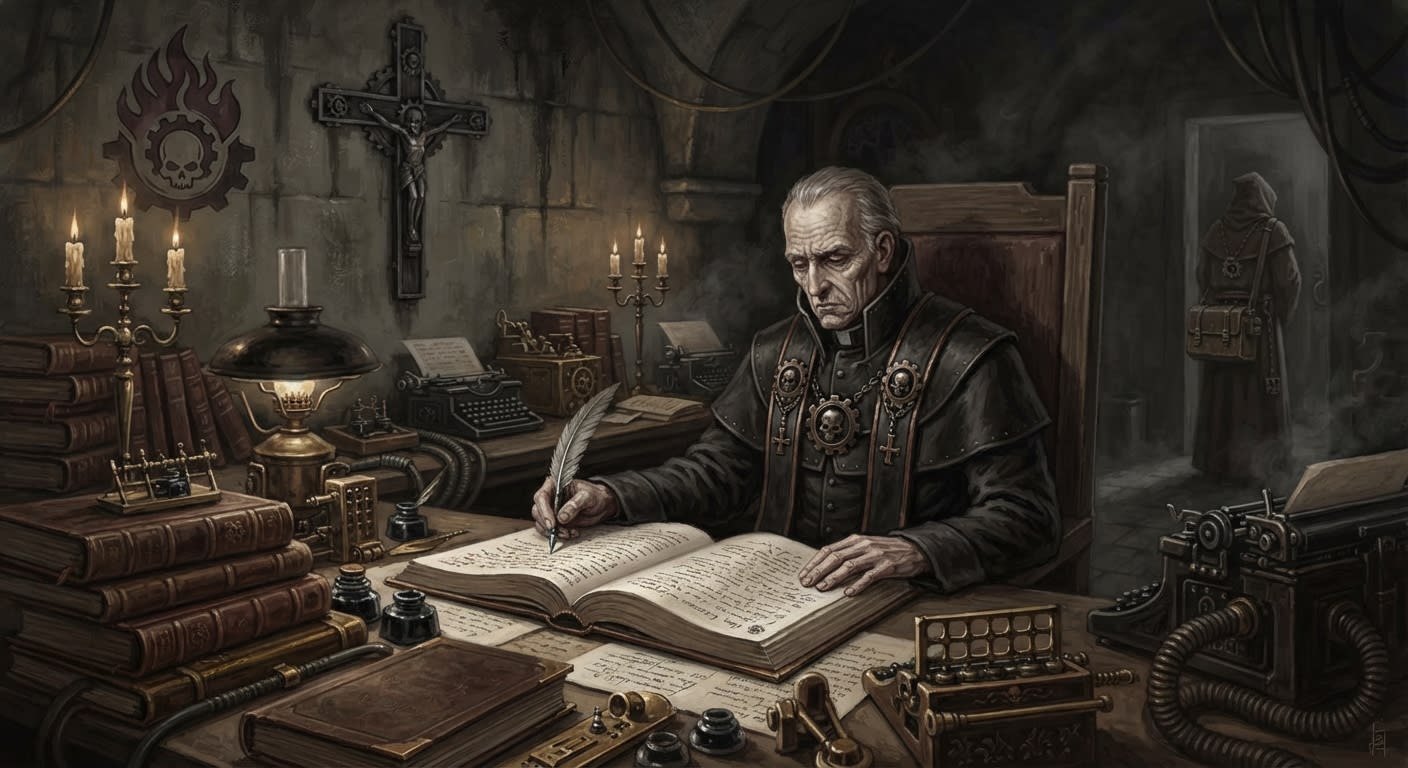
Aldric the Unbending
Thirty-one years, one perfect sentence, and no accommodation
The longest-sitting Liturgist-Primus, useful to the Bureau of Rites because almost nothing remains of him except thirty-one years, a perfect sentence, and a refusal no petitioner can answer.
Codex Ref. III.2.01-201
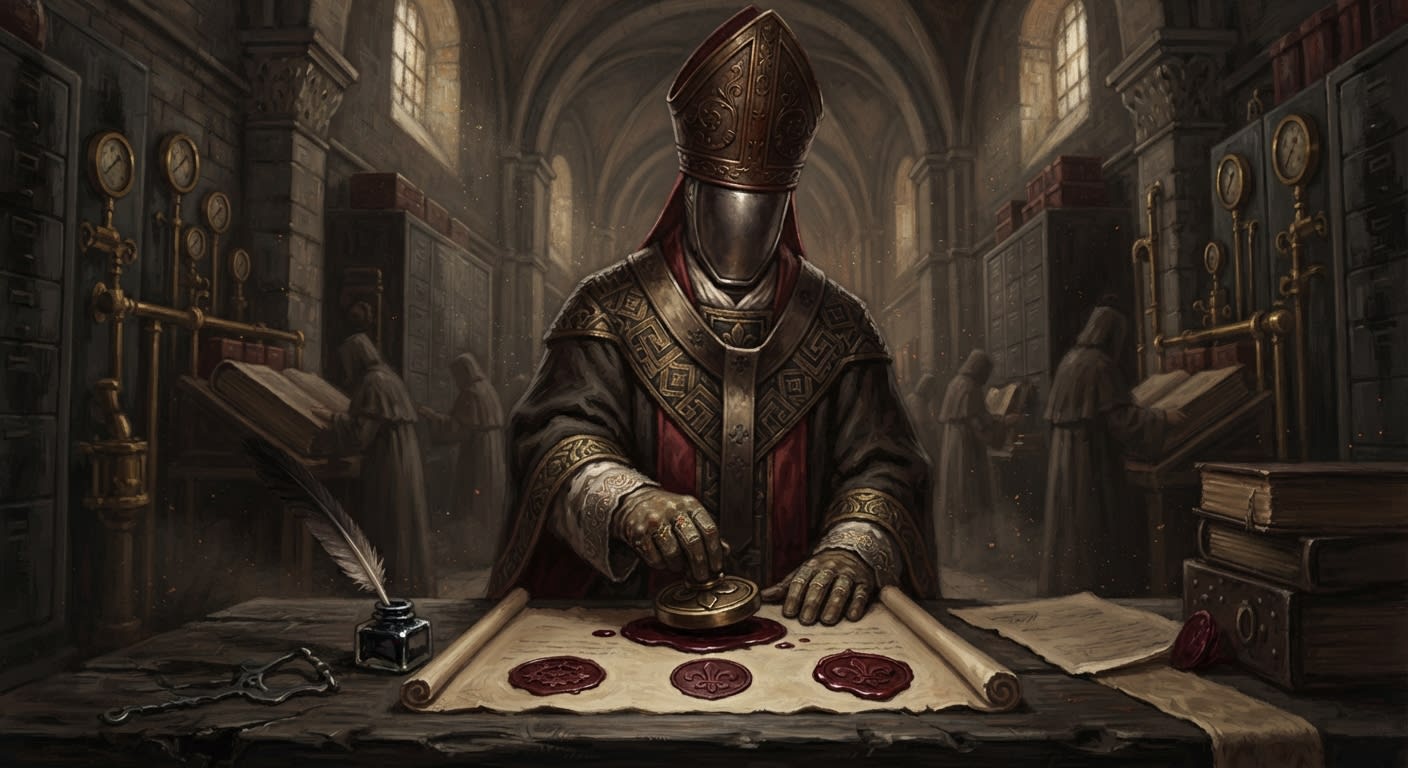
Archbishop of Lyon
The hand France sent, the name Records did not keep
The unnamed French signatory of the Concordat of Strasbourg: preserved by title, wax, and act, while the man beneath the mitre was permitted to vanish from the Ledger.
Codex Ref. III.2.01-090
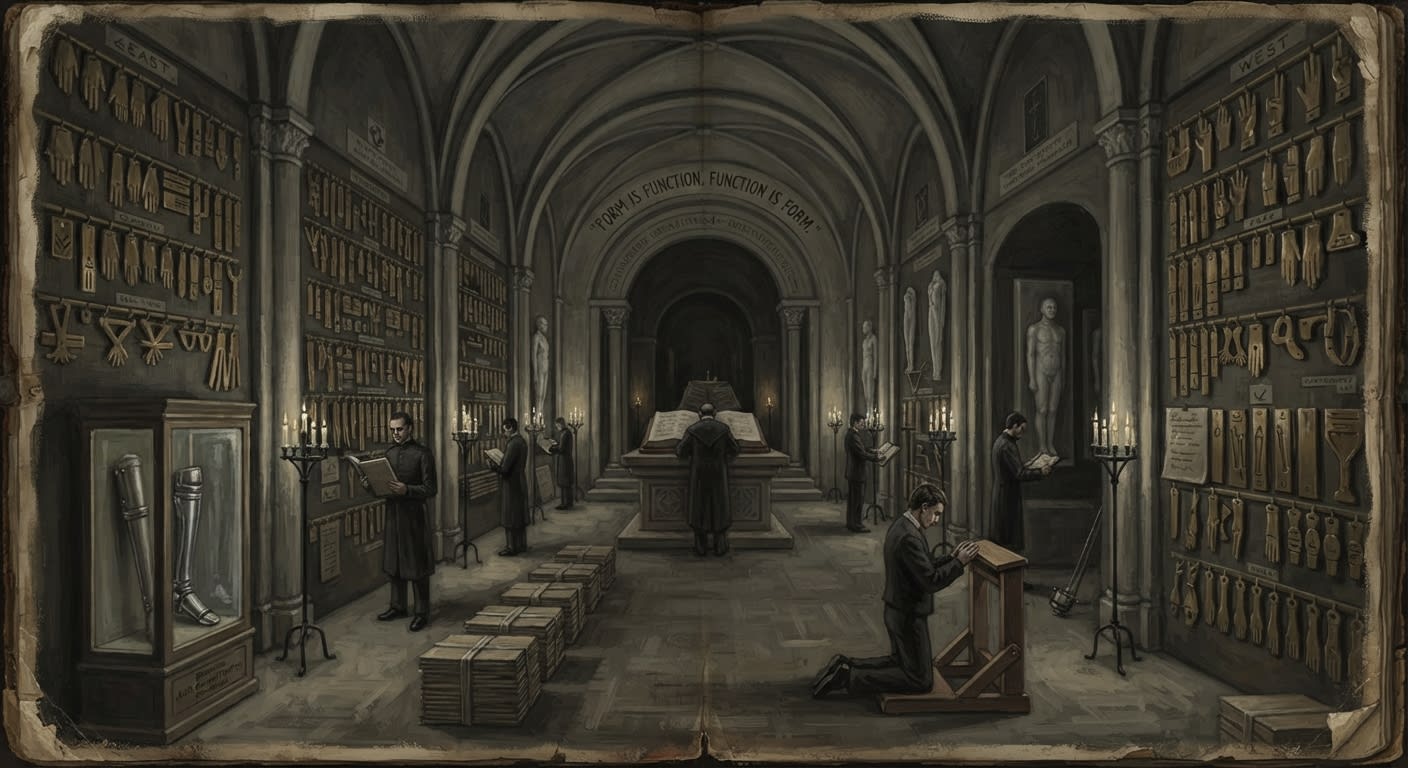
Archive of Prescribed Gesture
The room where the Synod files the body.
A vaulted Strasbourg hall where posture becomes law: brass plates, knee gauges, timing tables, sealed anomalies, and every lawful motion the faithful may perform before the Creator.
Codex Ref. II.2.06-195
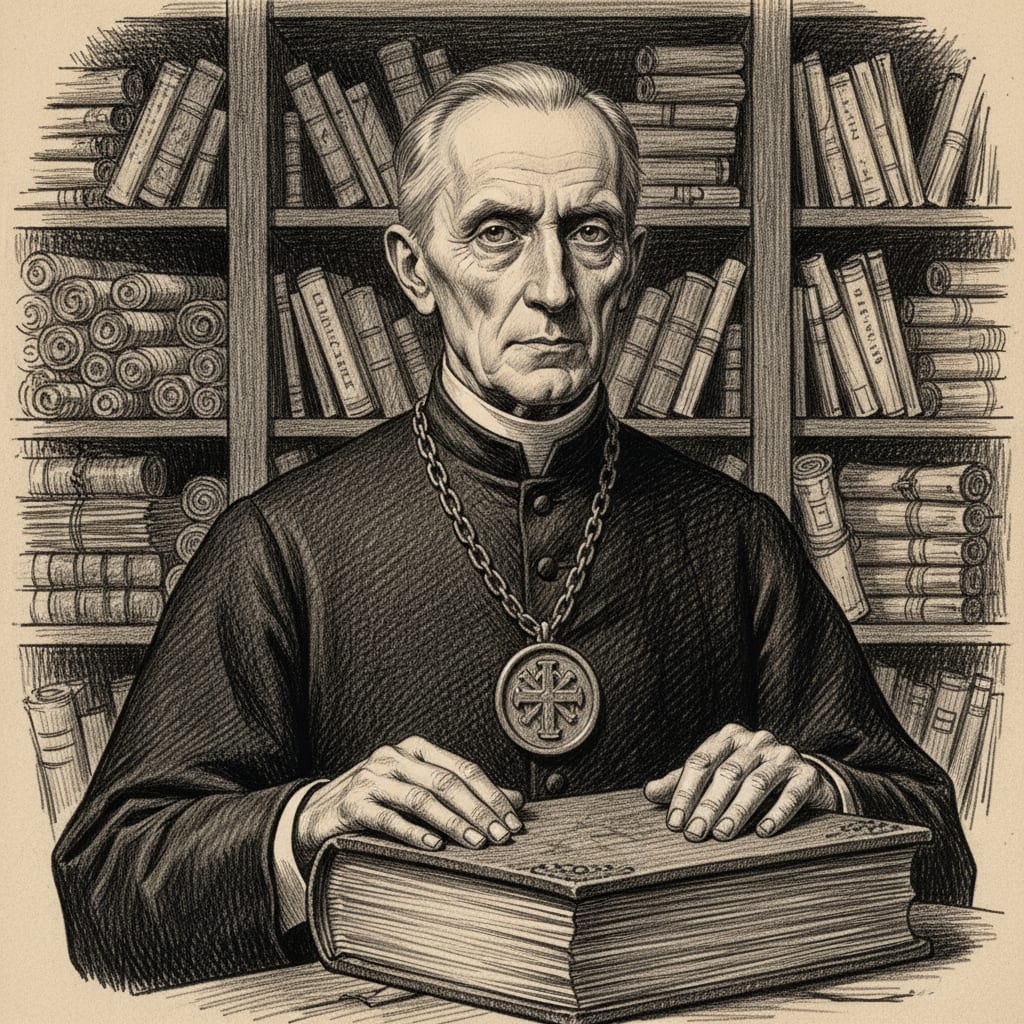
Archon Benedict Veyrault
The Monk Who Made Memory a Weapon
Once a monk of Dijon, Veyrault built the Bureau of Records into the scaffolding of reality itself. Cities he struck from the ledgers ceased to exist. His motto endures — "Nothing is forgotten" — and the faithful repeat it with equal parts pride and terror.
Codex Ref. III.3.02-008
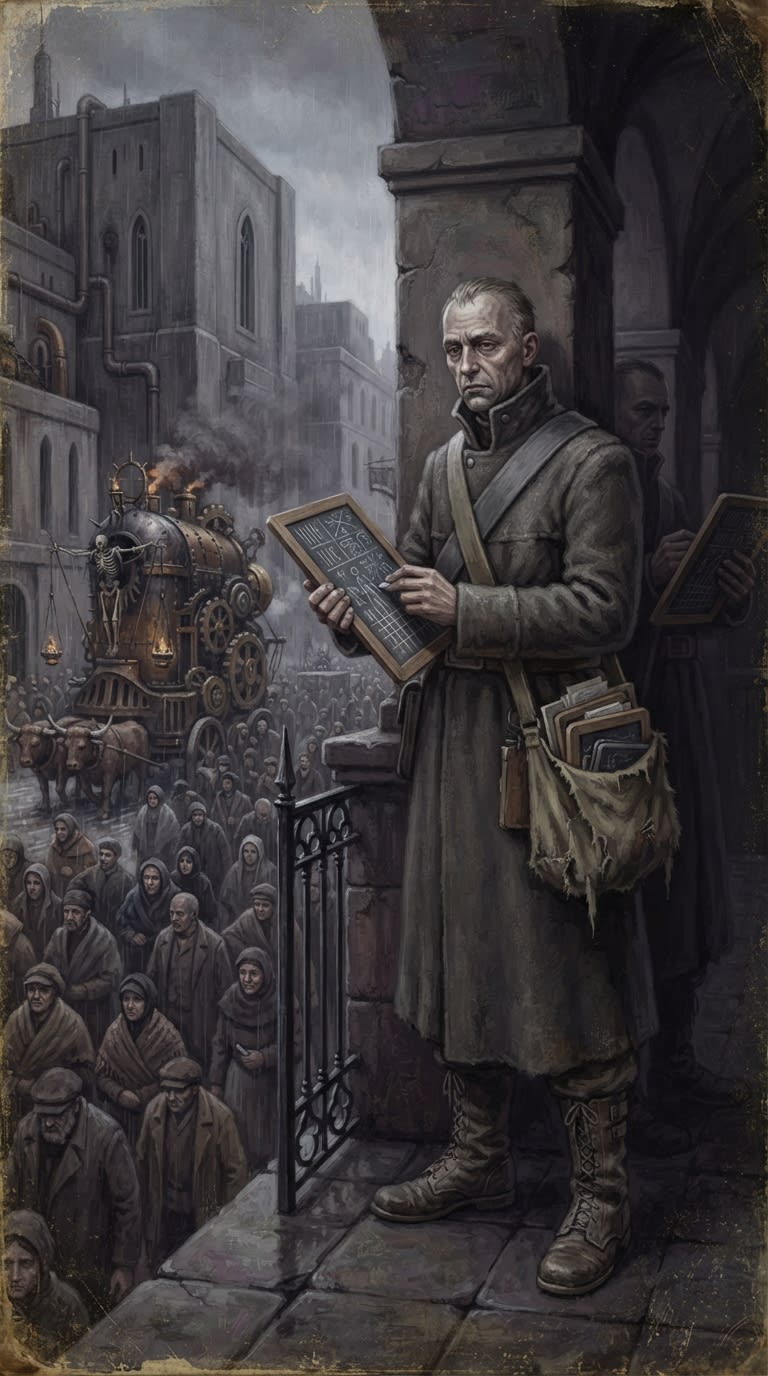
Attendance Auditor
The man at the edge of the square, doing arithmetic on your face
Field intelligence officers of the Bureau of Festivals who count attendance, score public feeling, and prove that Synodal joy has been enjoyed correctly.
Codex Ref. XII.17.04-001
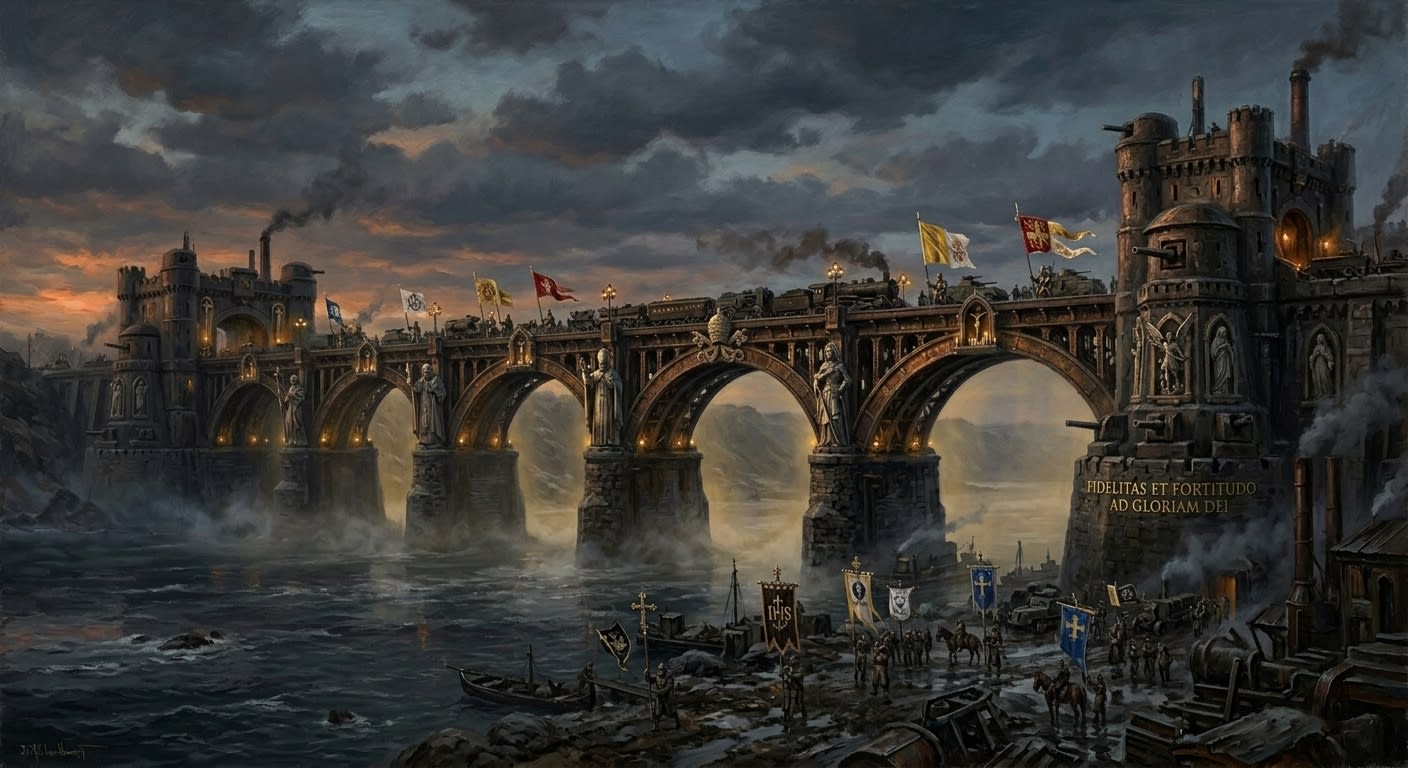
Bastion-Brest
Where the Confession Comes Back
The Brass Ribs of the Bug River crossing — a bridge-fortress of thirty-two brass-ribbed trusses where crossing the span requires a moral audit at gunpoint, confession is currency, and the sins spoken into the booths have, since A.S. 199, begun to come back.
Codex Ref. II.4.07-002
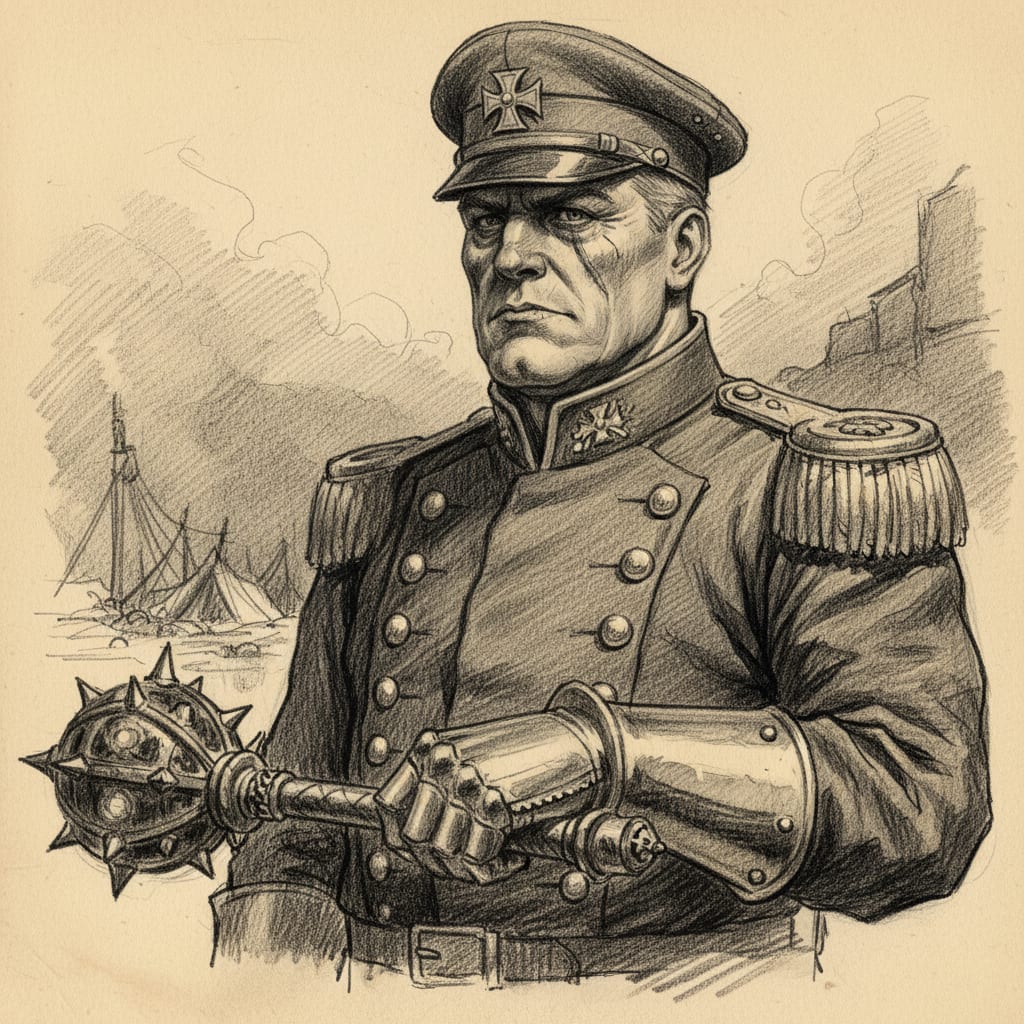
Bishop-Warden Clemens Stahlhand
The Hammer of Vienna
Bishop-Warden of Vienna, whose reliquary blow at the Siege shattered Rationalist power and entered the canon of Synodal myth. Steel hand. Iron faith. Useful corpse.
Codex Ref. III.1.02-031

Bishops-Praetorial
Mitres welded to prefectures, and souls counted twice
The Bishops-Praetorial keep souls, quotas, provinces, and grudges: mitred governors whose pastoral care arrives with tithe tables attached.
Codex Ref. VIII.3.04-093
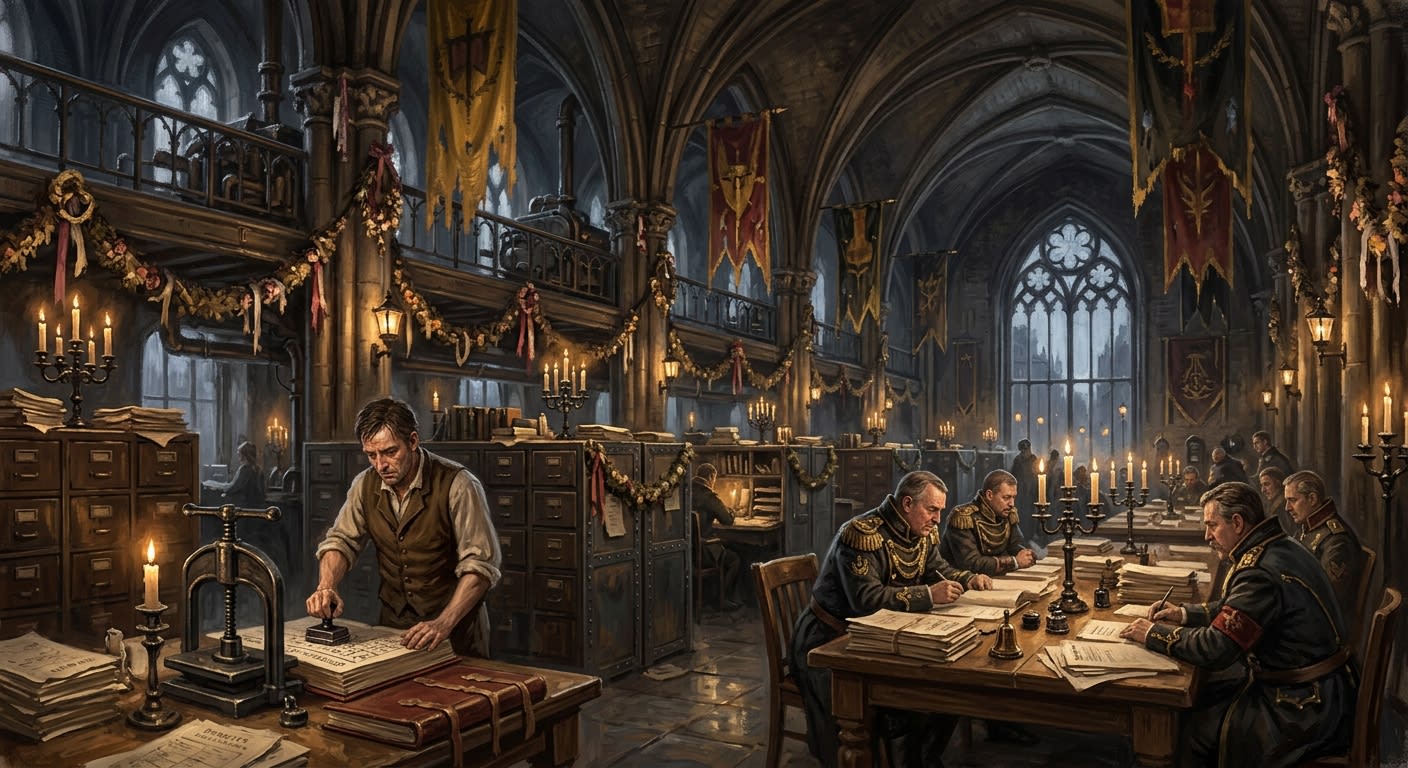
Bureau of Festivals
Joy, administered at scale — licensed, measured, and periodically revoked
The Bureau that manufactures joy, schedules grief, and meters celebration with the same rigour the Bureau of War applies to troop rotations — and which has, on seventeen documented occasions, deployed confetti.
Codex Ref. VIII.5.01-001
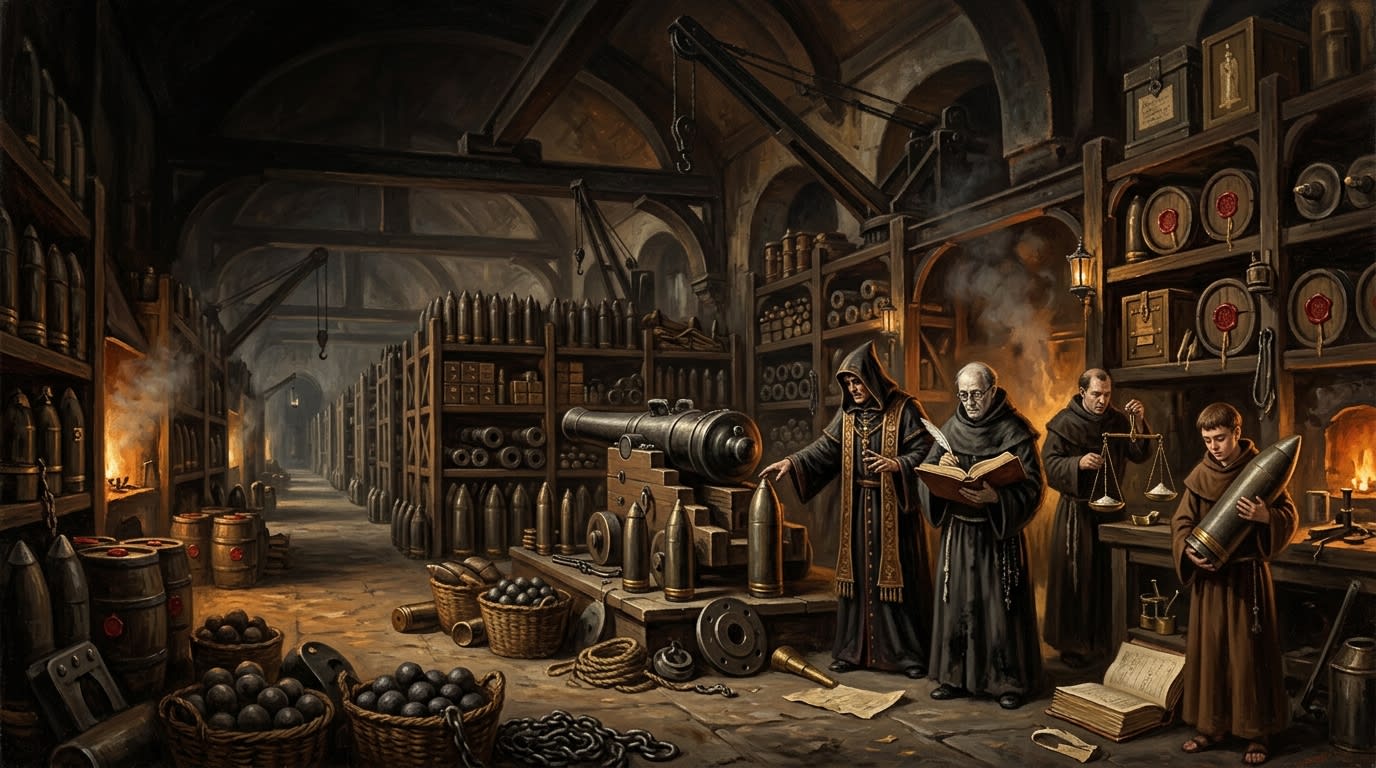
Bureau of Ordnance
No violence is lawful until inventory permits it
The Bureau of Ordnance blesses powder, counts shells, seals fuel, restrains officers, and teaches matter to obey violence only after the Ledger consents.
Codex Ref. VIII.2.11-090
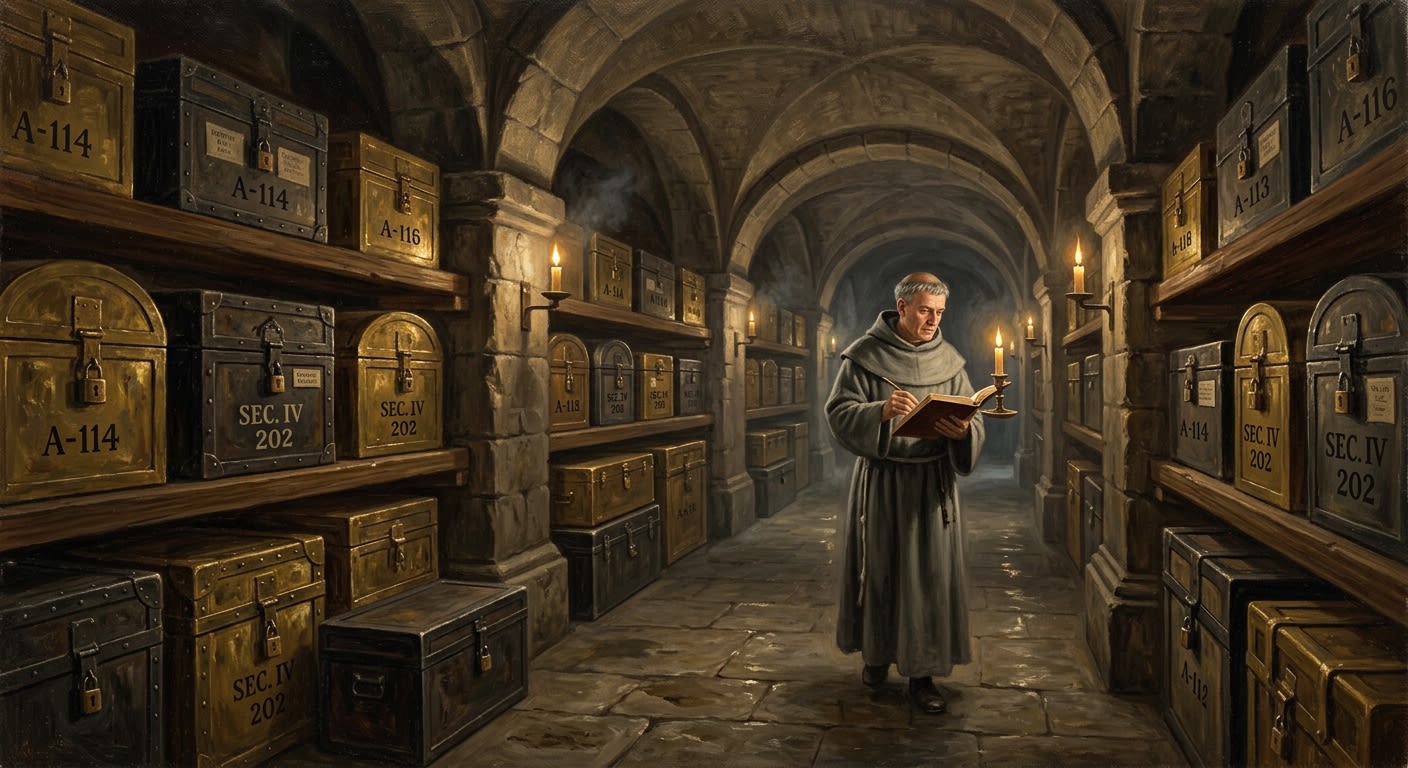
Bureau of Relics
The stamp is not the sanctity. The stamp is merely necessary.
The Bureau of Relics guards four thousand seven hundred authenticated bones, adjudicates the holiness of ash, and maintains the cheerful institutional fiction that it controls the things it catalogues.
Codex Ref. IV.3.12-019
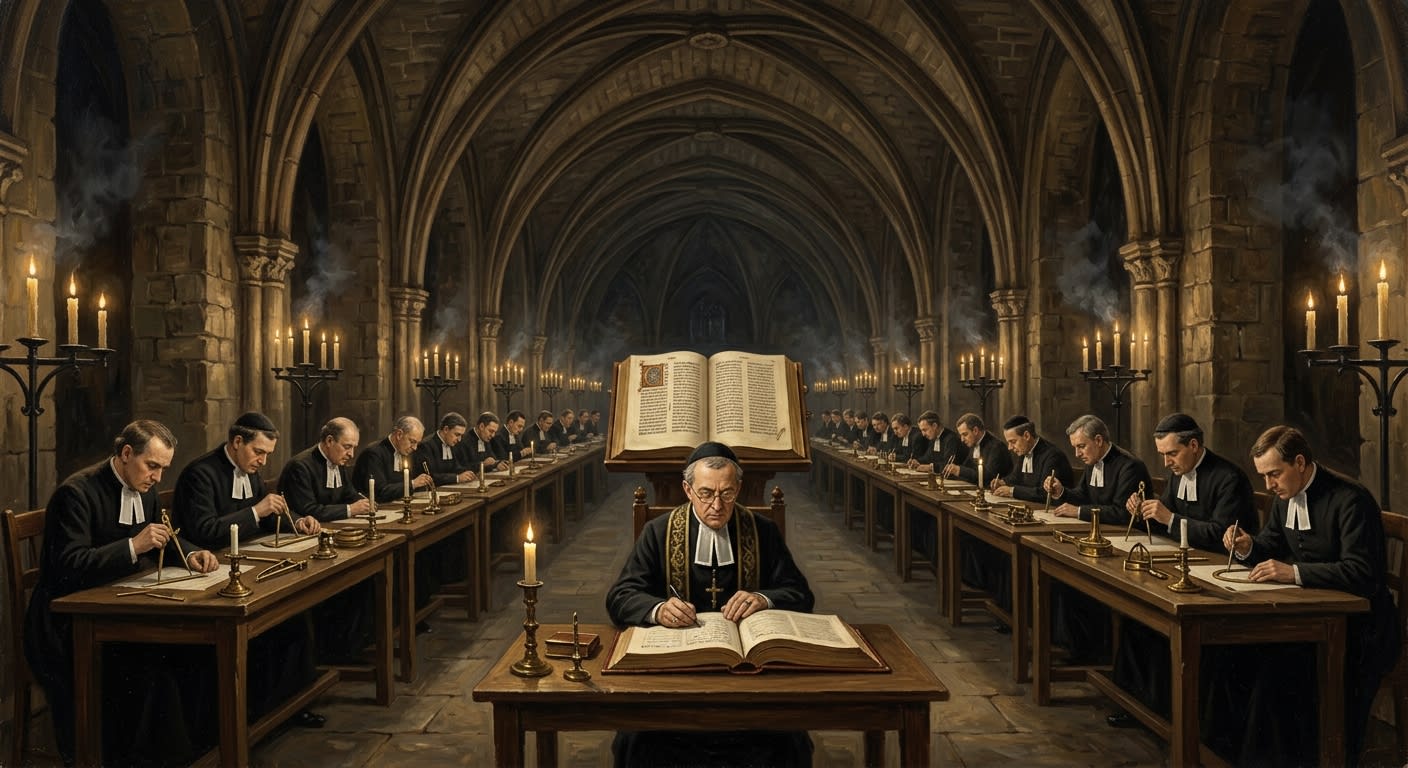
Bureau of Rites
The grammar no one speaks and everyone obeys.
The grammar of the Dominion, indistinguishable from its law: the Bureau that does not govern governs everything, from the angle of the censer to the weight of the Host on Lenten Fridays.
Codex Ref. VIII.1.01-001
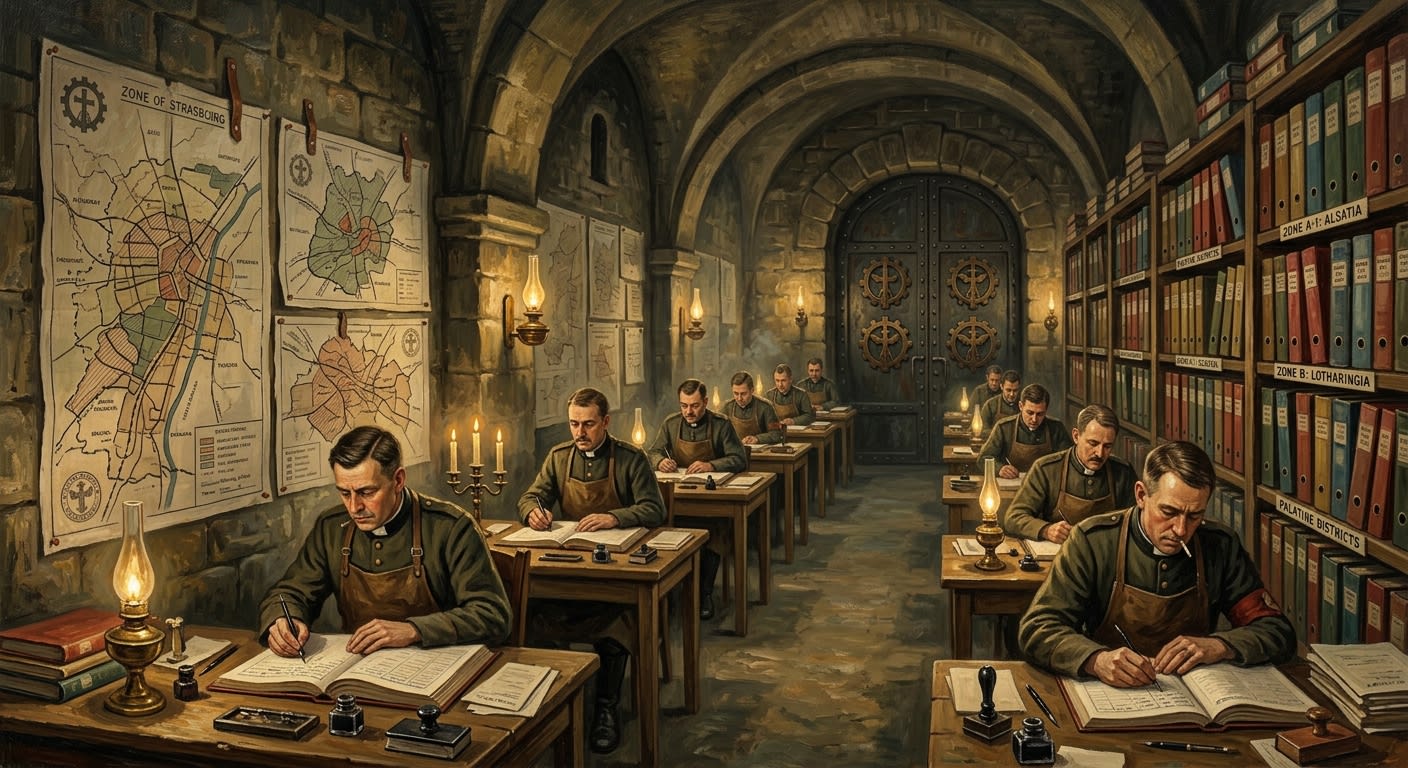
Bureau of Settlement
Where three hundred million subjects are permitted to stand — and by whose leave.
The Bureau of Settlement does not appear in the twelve canonical portfolios. No crimson sash, no hymn. What it has is authority over the address of every living subject of the Theocracy — and the knowledge that no one listens until the plumbing fails.
Codex Ref. IV.3.08-001
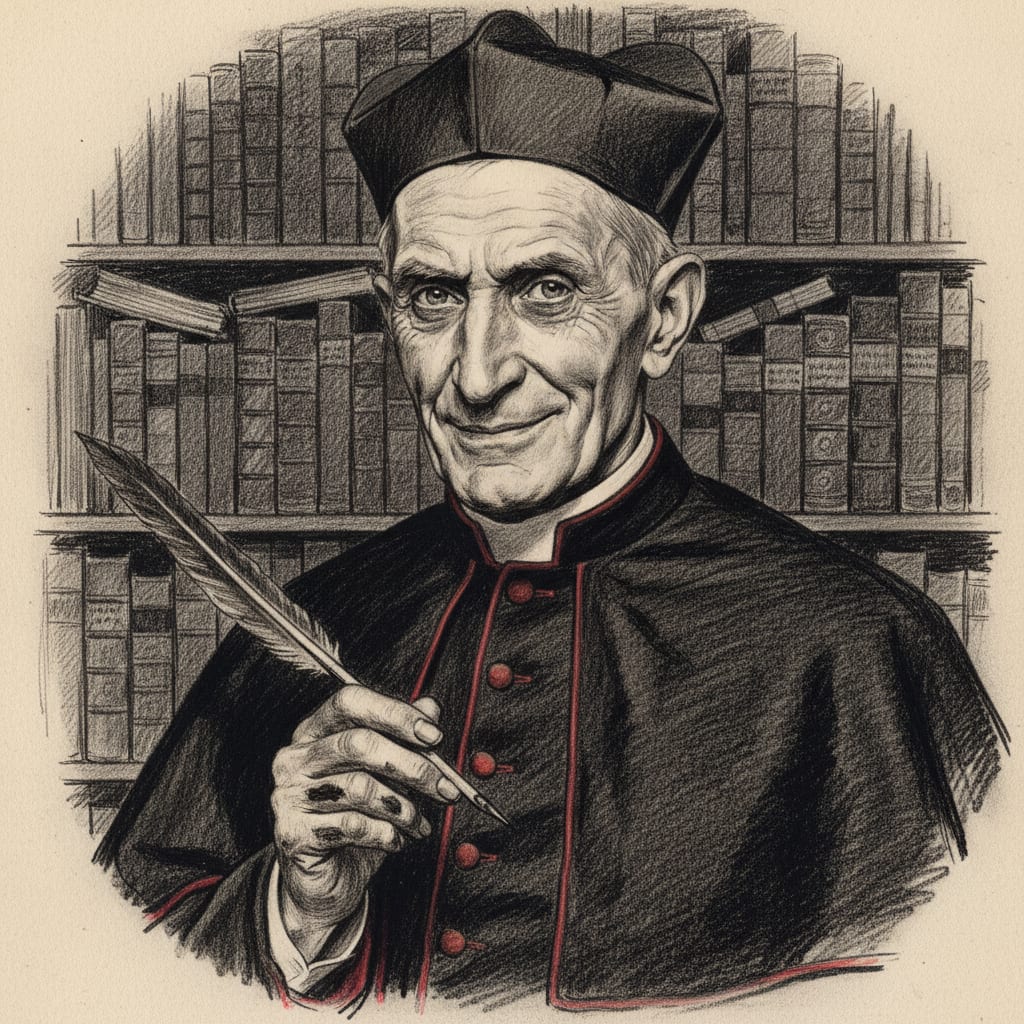
Cardinal Hieronymus Kratz
The Quill of Strasbourg
Cardinal Hieronymus Kratz, the Quill of Strasbourg, who proved that forgery widely believed is not forgery at all but revelation. Where Augustinus inspired, Kratz wrote — and what he wrote, the world obeyed.
Codex Ref. II.1.03-008
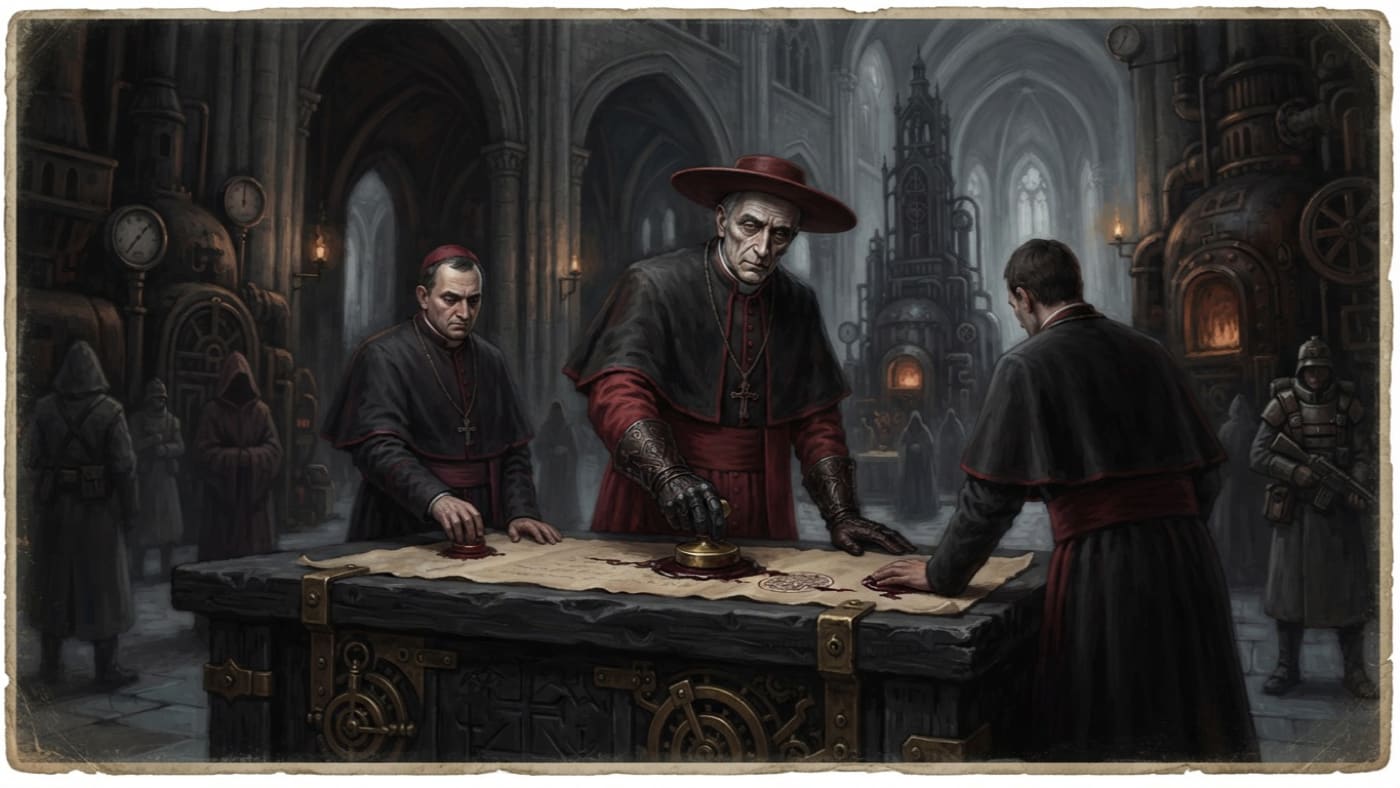
Cardinal-Legate of Toledo
One peninsula, one seal, no recorded name
Iberia's unnamed signatory to the Concordat of Strasbourg in A.S. 90. He bound a peninsula with one seal; the Ledger retained his title and dispensed with his name.
Codex Ref. III.2.01-090
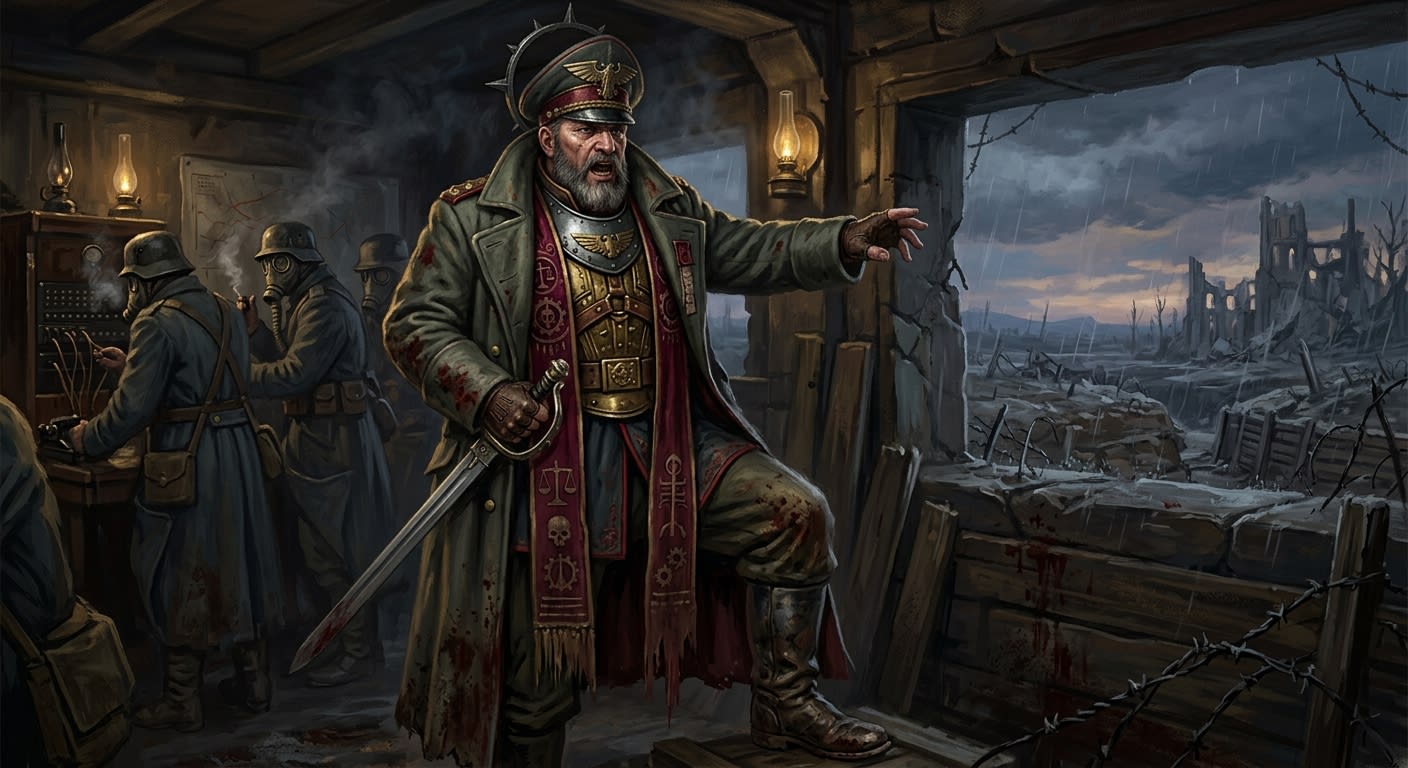
Cardinal-Marshal Severin of Avignon
The tourniquet of Montreval, ugly enough to save a front
Severin of Avignon held Montreval through the Atheist Wars: severe, loud, bloodstained, and too useful for the Bureau to canonise cleanly.
Codex Ref. III.2.01-007
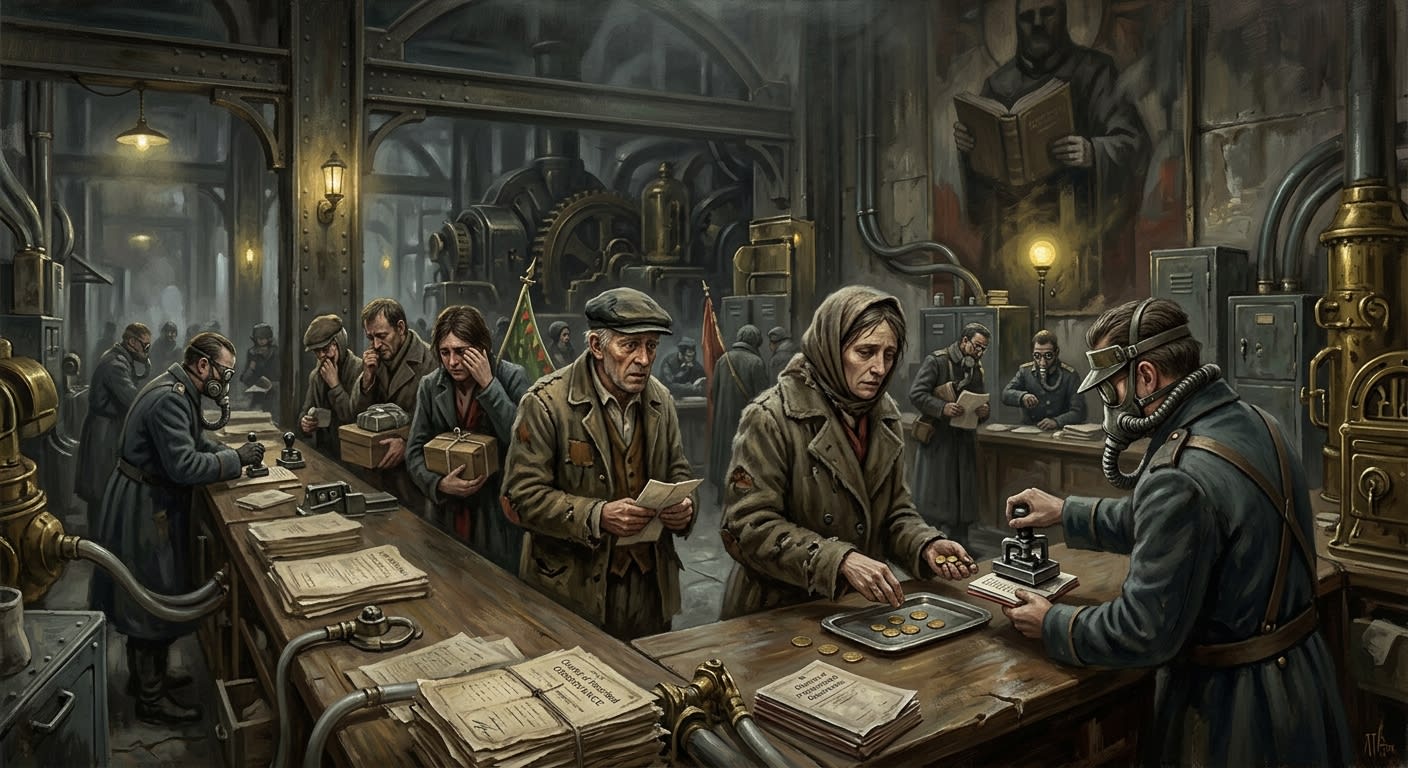
Charter of Prescribed Observance
The document that taught joy to queue and grief to file receipts
Ratified in A.S. 58, the Charter of Prescribed Observance turned public feeling into lawful form: mourning, feasting, silence, joy, and deviation all made taxable.
Codex Ref. XIII.1.23-001
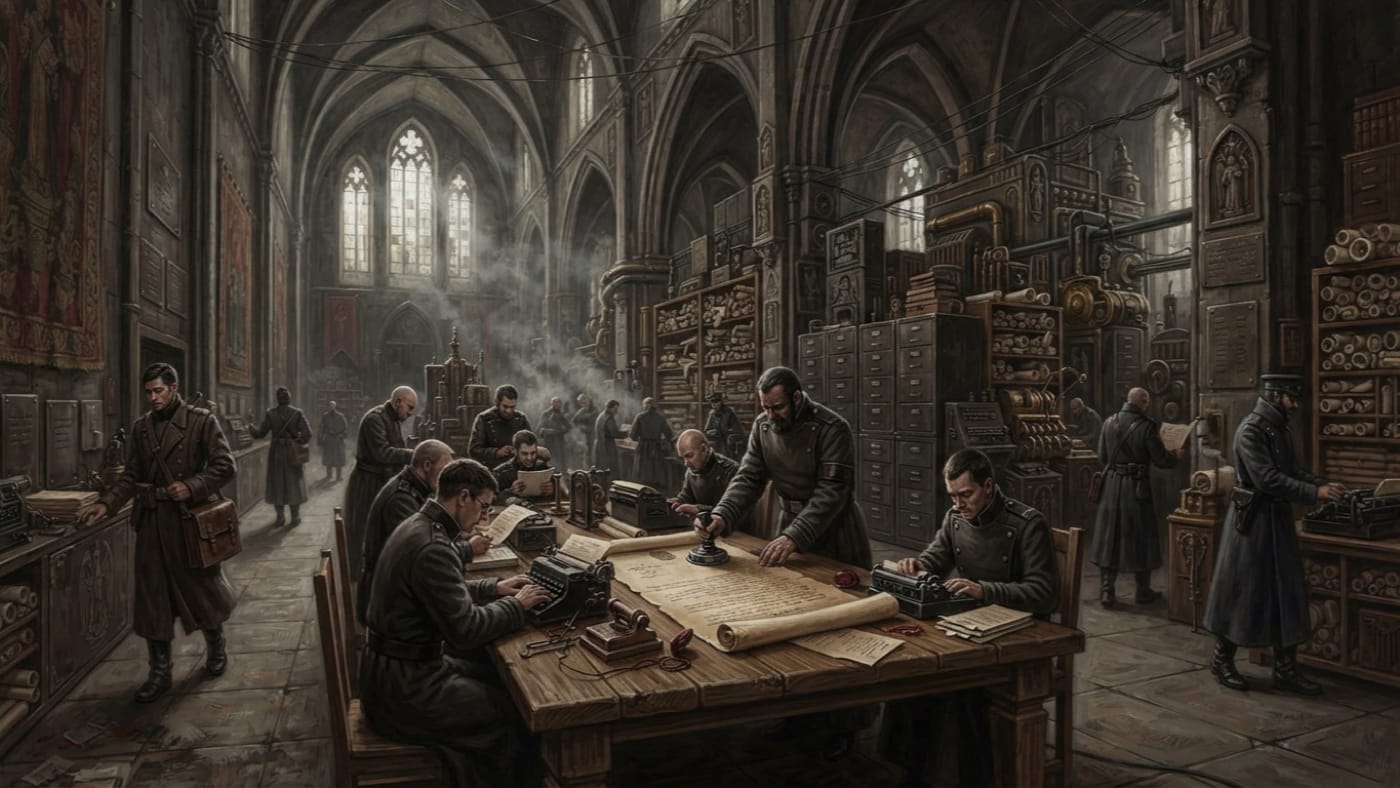
Conventus Fidelium
An assembly on vellum; its first convocation unrecorded
The Common Allegiance proposed the Gathering of the Faithful in A.S. 55: one assembly, common command and five offices. I record its ancestry without inventing its first convocation.
Codex Ref. I.3.02-055

Crimson Vault
The Rule in Ink, the Intention in the Margin
A.S. 201 survey of the Bureau of Records' Crimson Vault, where the Council of Worms account places Kratz's handwritten Protocol. The rain-spotted pages preserve advice the clean clauses do not; the Vault's physical location remains unestablished.
Codex Ref. III.2.07-032
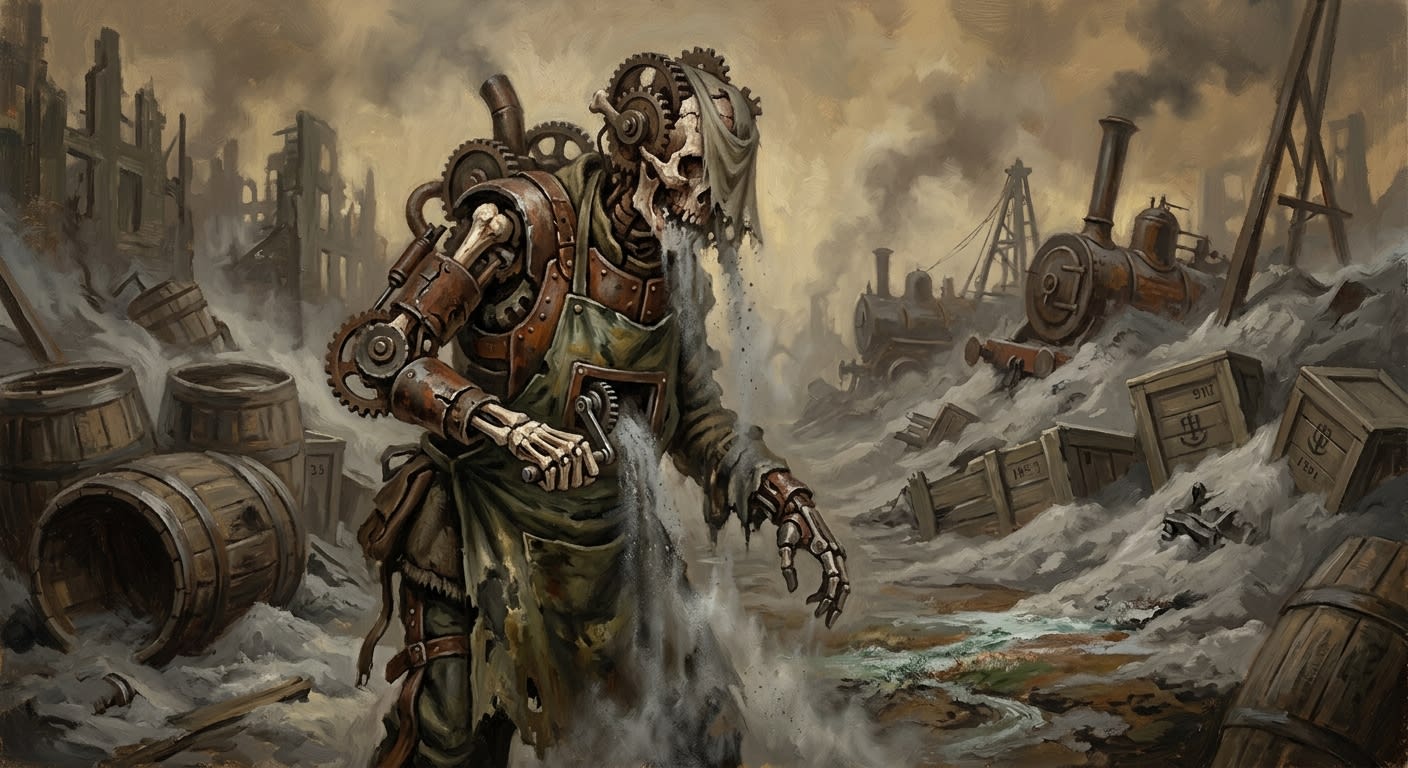
Crumble-Wrong
When saint-dust remembers the body and refuses commerce
At Mournwater, saint-dust settles into bones, ruins casks, fattens futures markets, and suggests that industrialized holiness has begun objecting.
Codex Ref. XIII.1.21-001
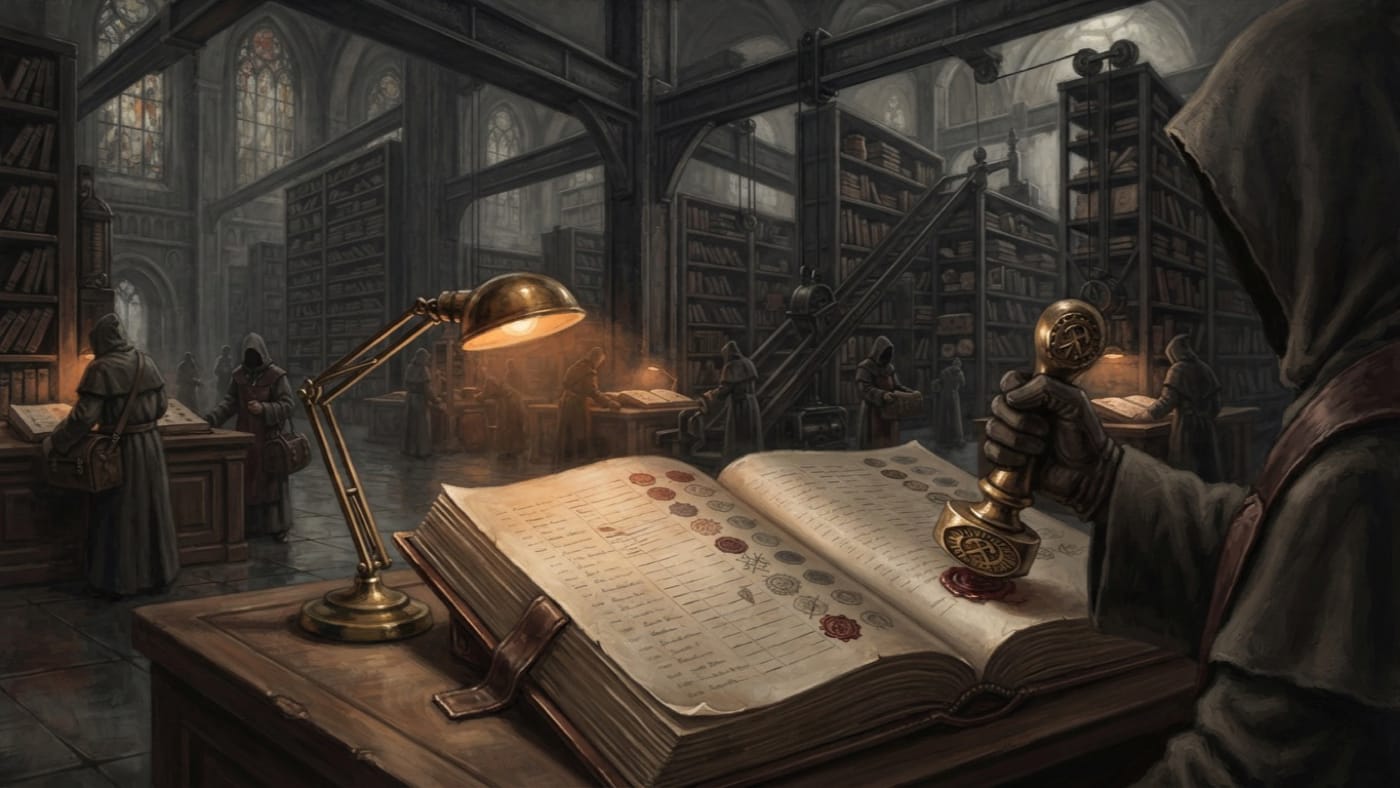
Doctrine of Sealed Intent
The office speaks; the hand goes upstairs
An affixed seal carries its office's authority, whoever pressed it. Worms supplies the documented anchor; attendance, consent and the hand remain separate questions.
Codex Ref. XIII.1.120-087
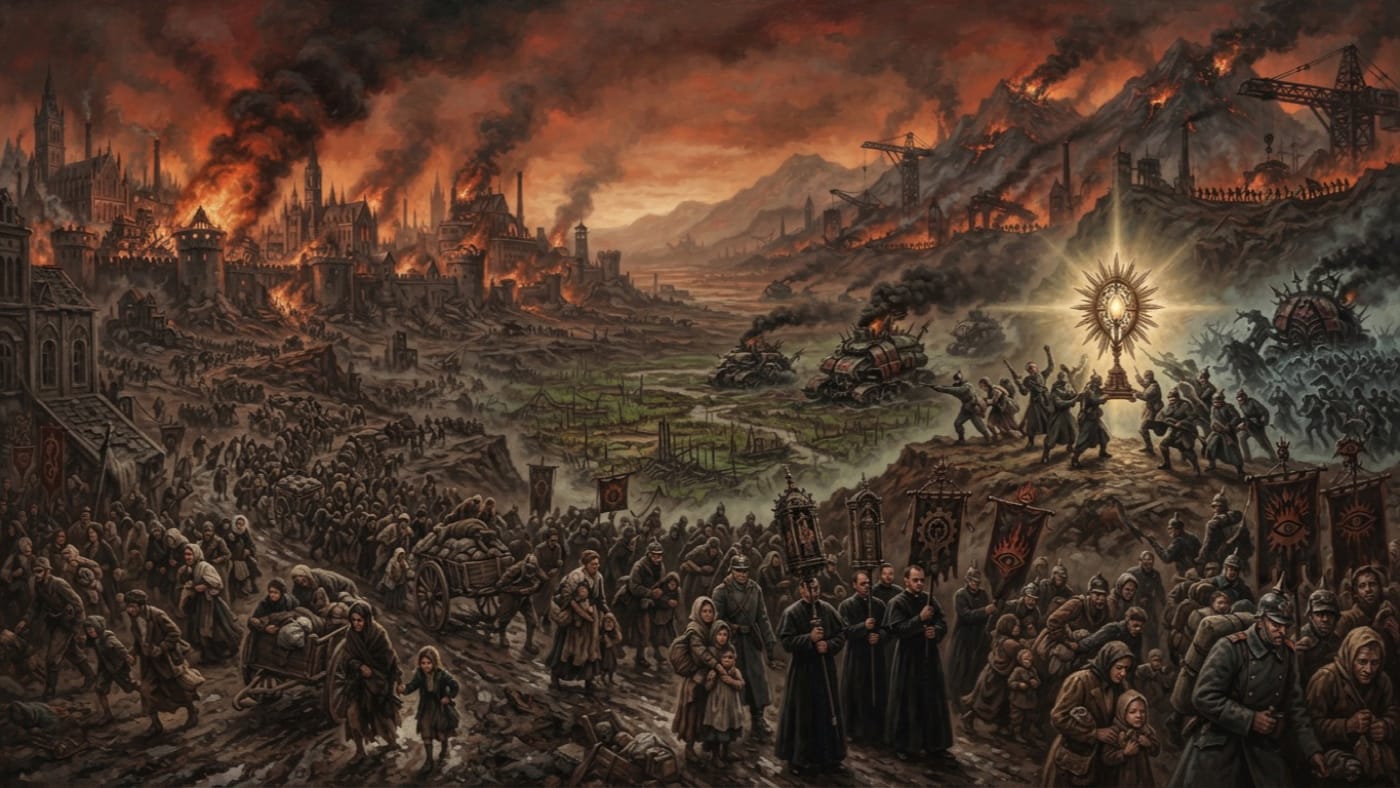
Fall of the Eastern Kingdoms
The Kingdoms Fell; Their Accounts Remain Open
The eastern jurisdictions collapsed after the Sundering of A.S. 45: garrisons burned, granaries failed, and refugees fled west. I retain their accounts in the Ledger; occupation does not constitute permission to forget.
Codex Ref. VII.1.02-001
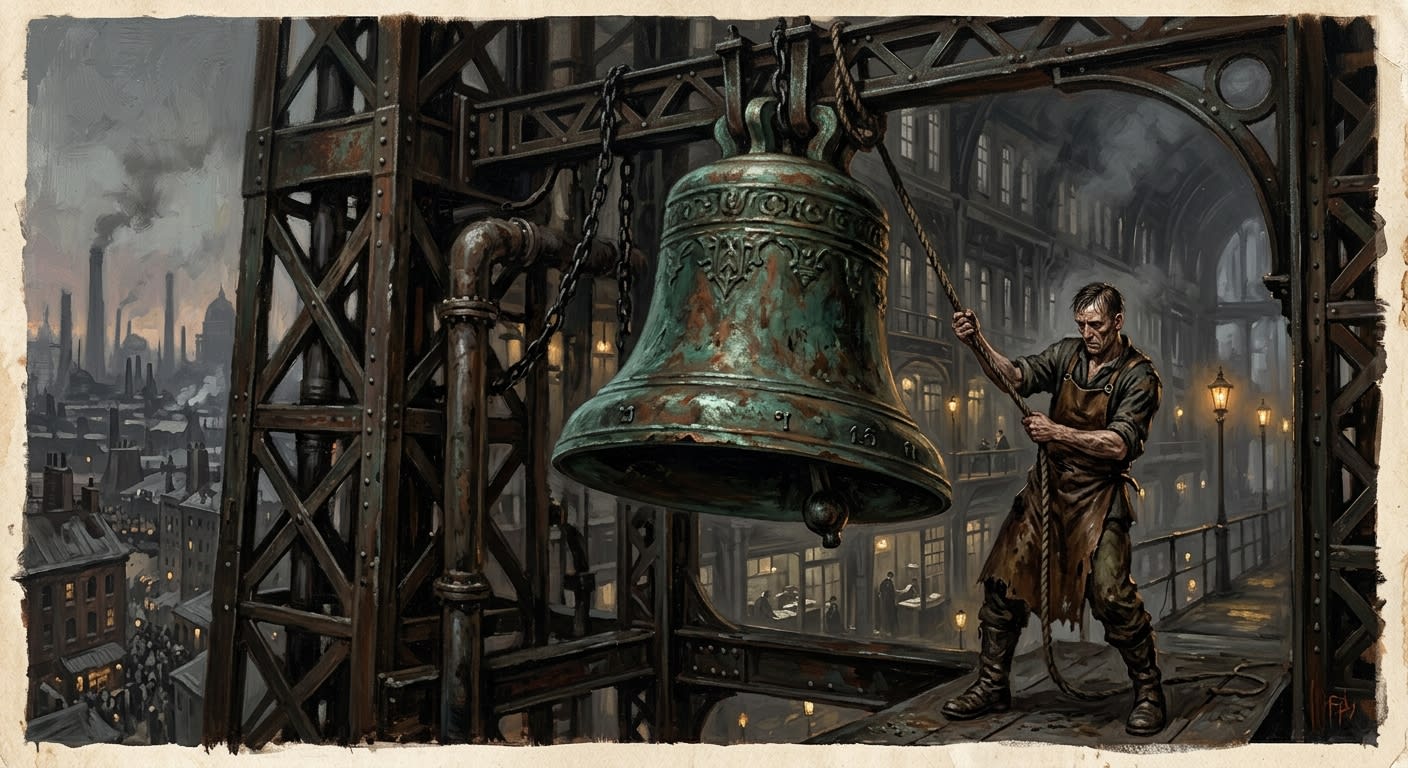
Fames (Bell)
The hunger bell of Strasbourg, whose receipts frighten wiser governments than drums
Fames is the Tower of the Quill's middle bell, tolled for rationing adjustments when hunger becomes too official to remain quiet.
Codex Ref. XIII.1.72-005
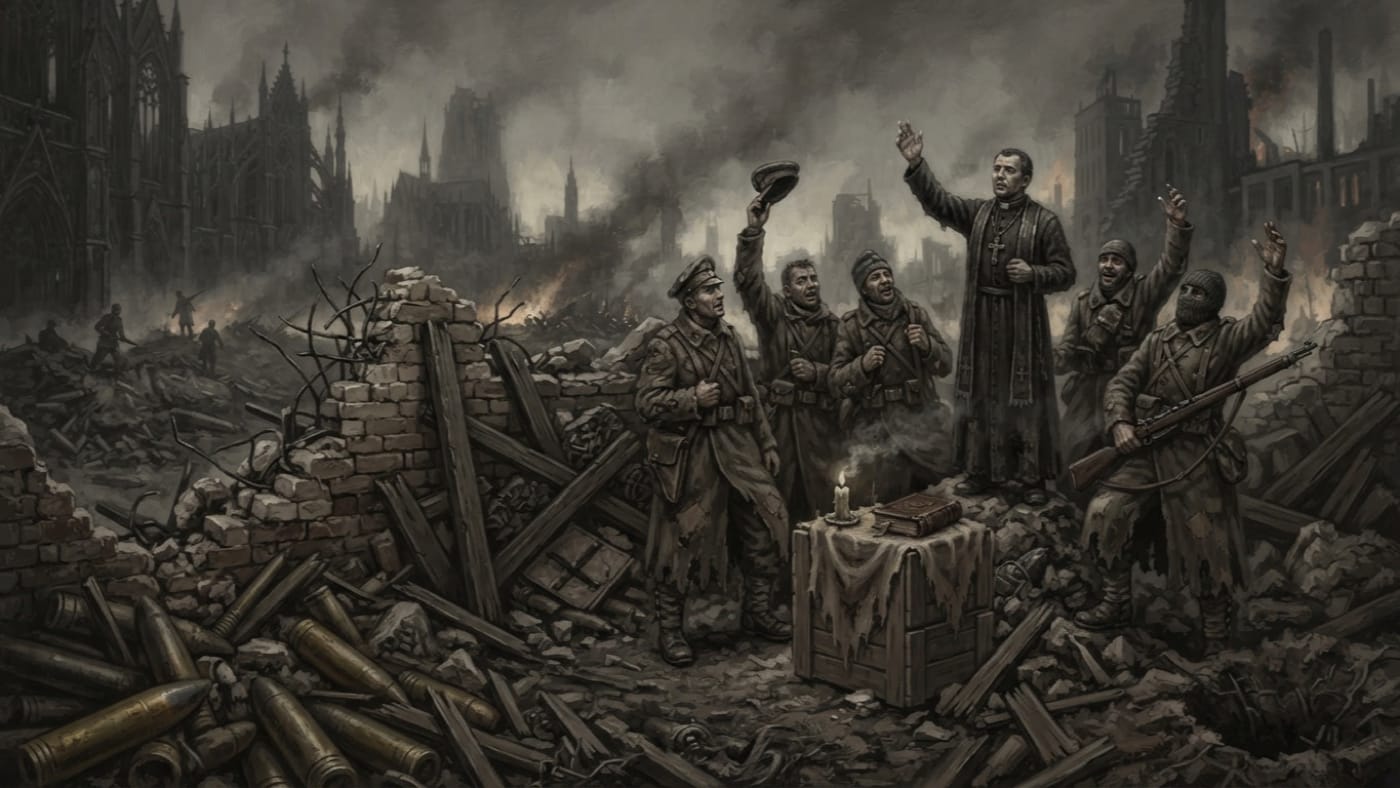
Feast of the Unbroken Wall
The wall held; the bureaucracy arrived later
A surviving barricade, an unnamed priest, and one unscheduled cheer in A.S. 52: the Bureau of Festivals' founding precedent. The wall held; the bureaucracy arrived later.
Codex Ref. VII.8.10-1050
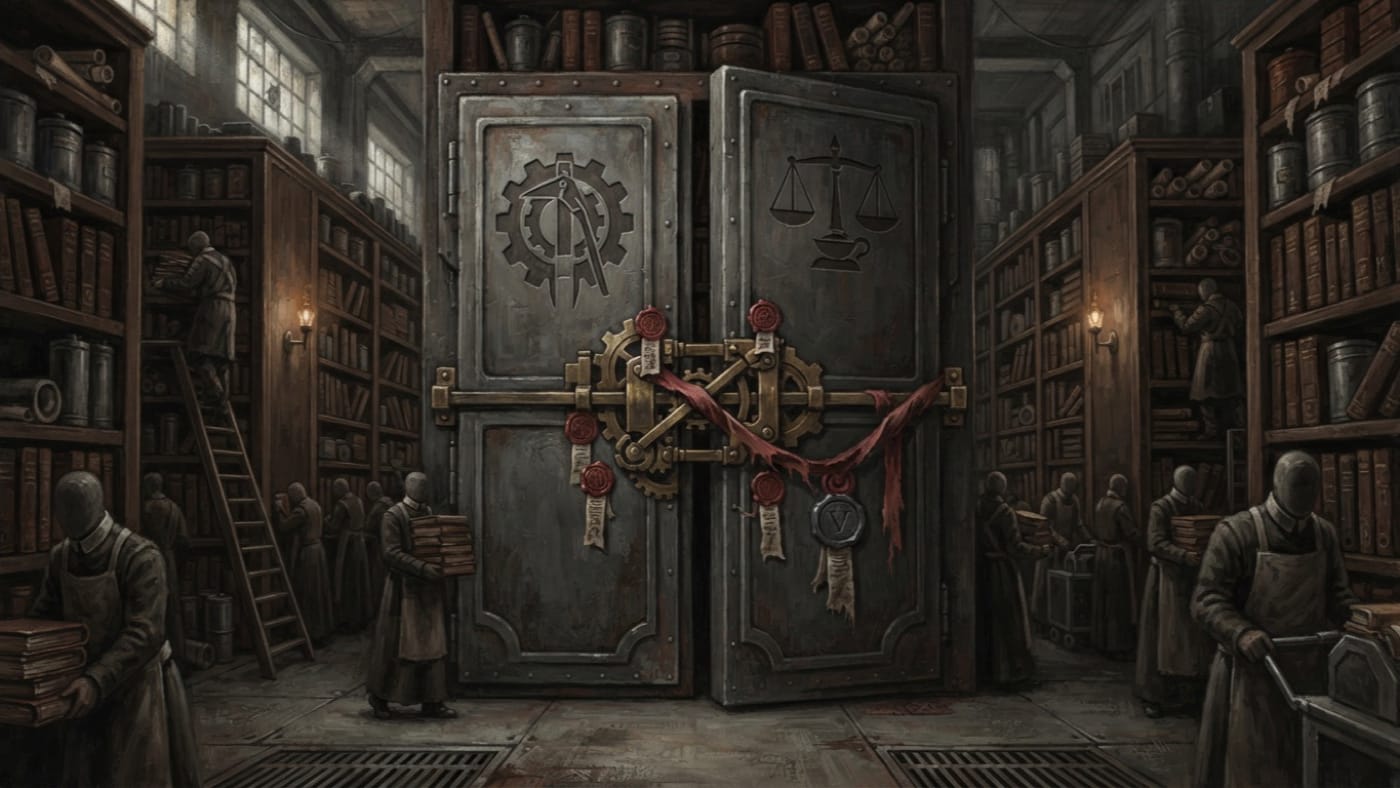
Fifth Ratification
The name is filed; the particulars remain sealed
An A.S. 201 survey of the Fifth Ratification's attested sealing of Augustinus's construction particulars. Engineering keeps the structural data; Mercy keeps the rest. The name is filed. The text is not before us.
Codex Ref. XIII.1.90-201
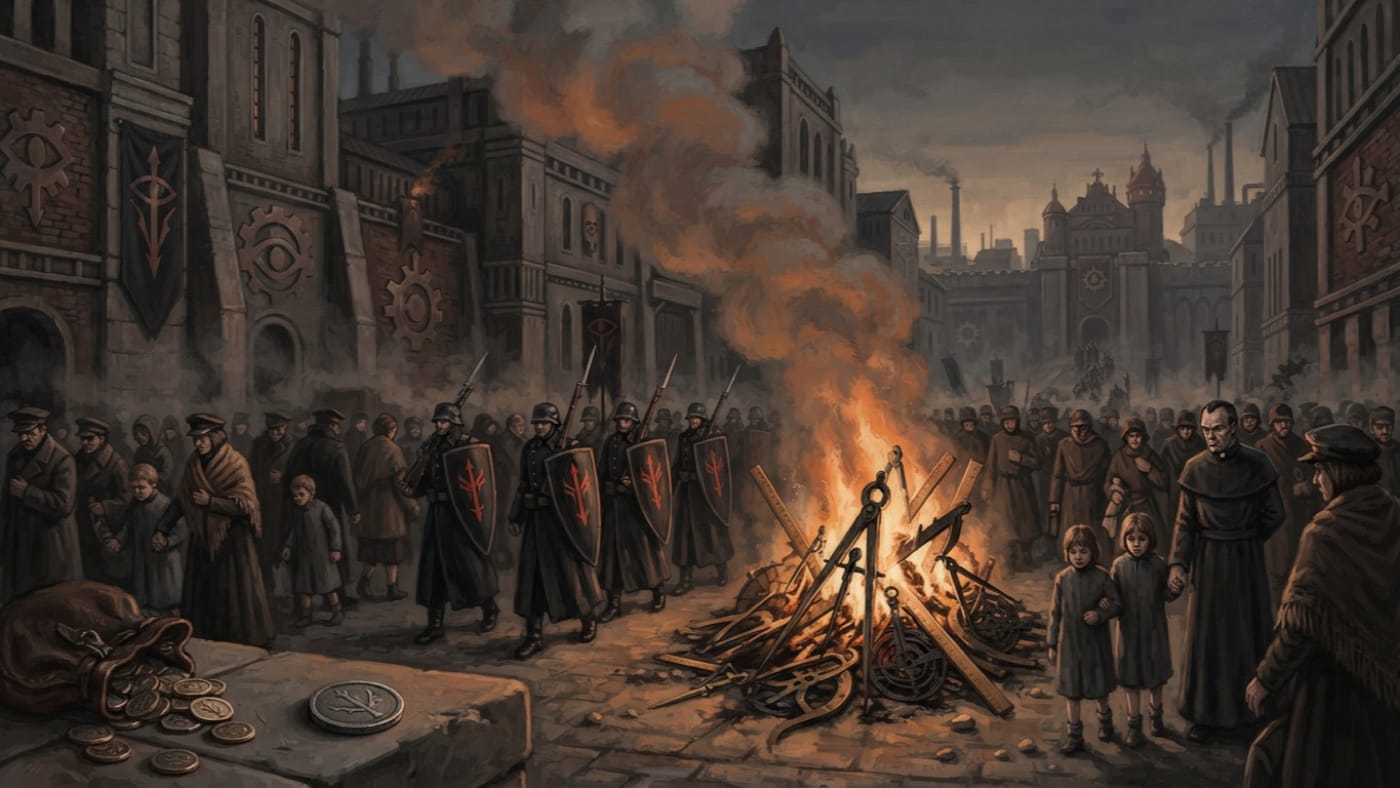
Flaming Sword
Permission has weight, and obedience has smoke
The Flaming Sword carries Synodal authority on coinage and lends its name to Strasbourg's burning of Rationalist instruments. I record its public uses; the emblem's origin remains unproved.
Codex Ref. XIII.1.03-001
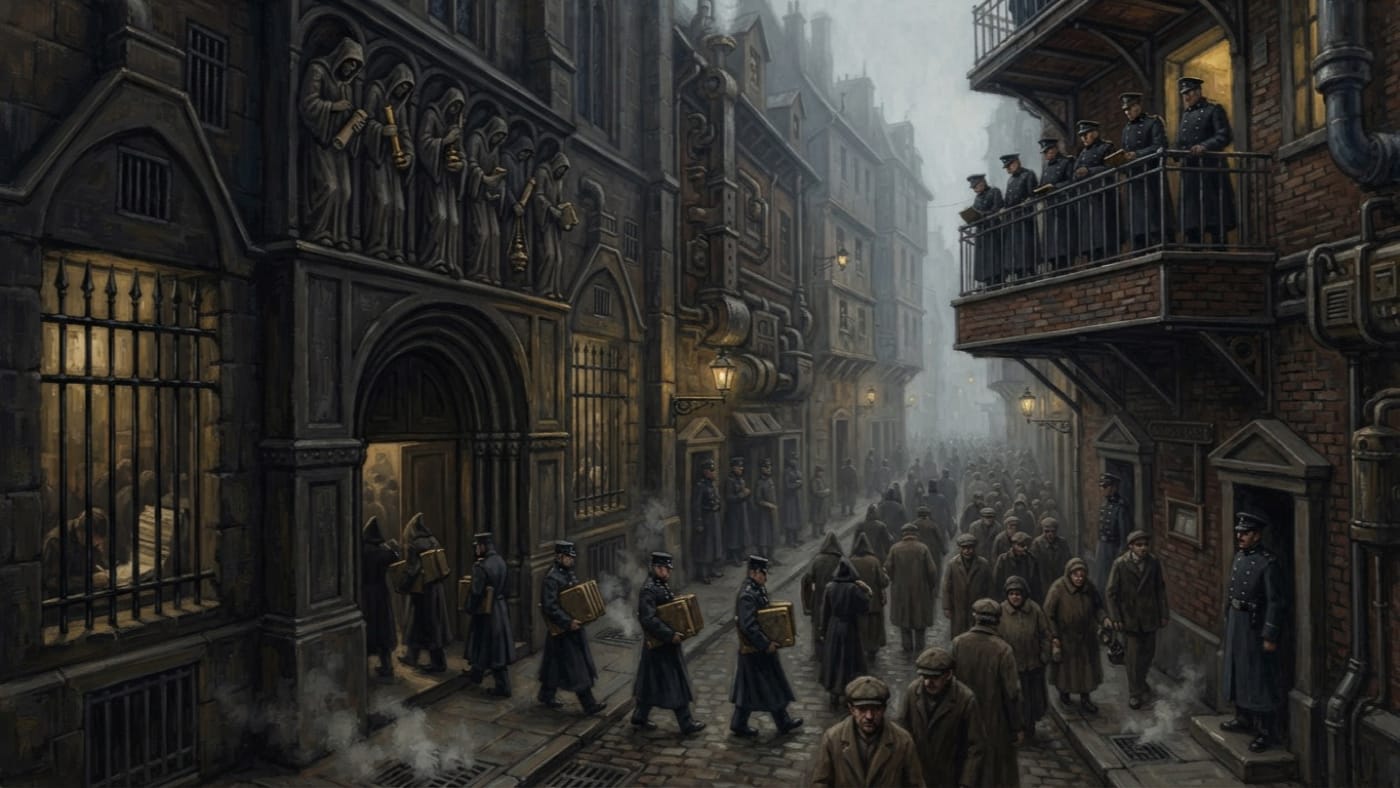
Hall of Confessions
Where the Synod speaks and the grille remembers
At the central bend of Strasbourg's Sanctum Mile, the Synod speaks beneath carved saints while clerks behind grilles record its words. The crowd outside hears bells.
Codex Ref. II.2.02-003
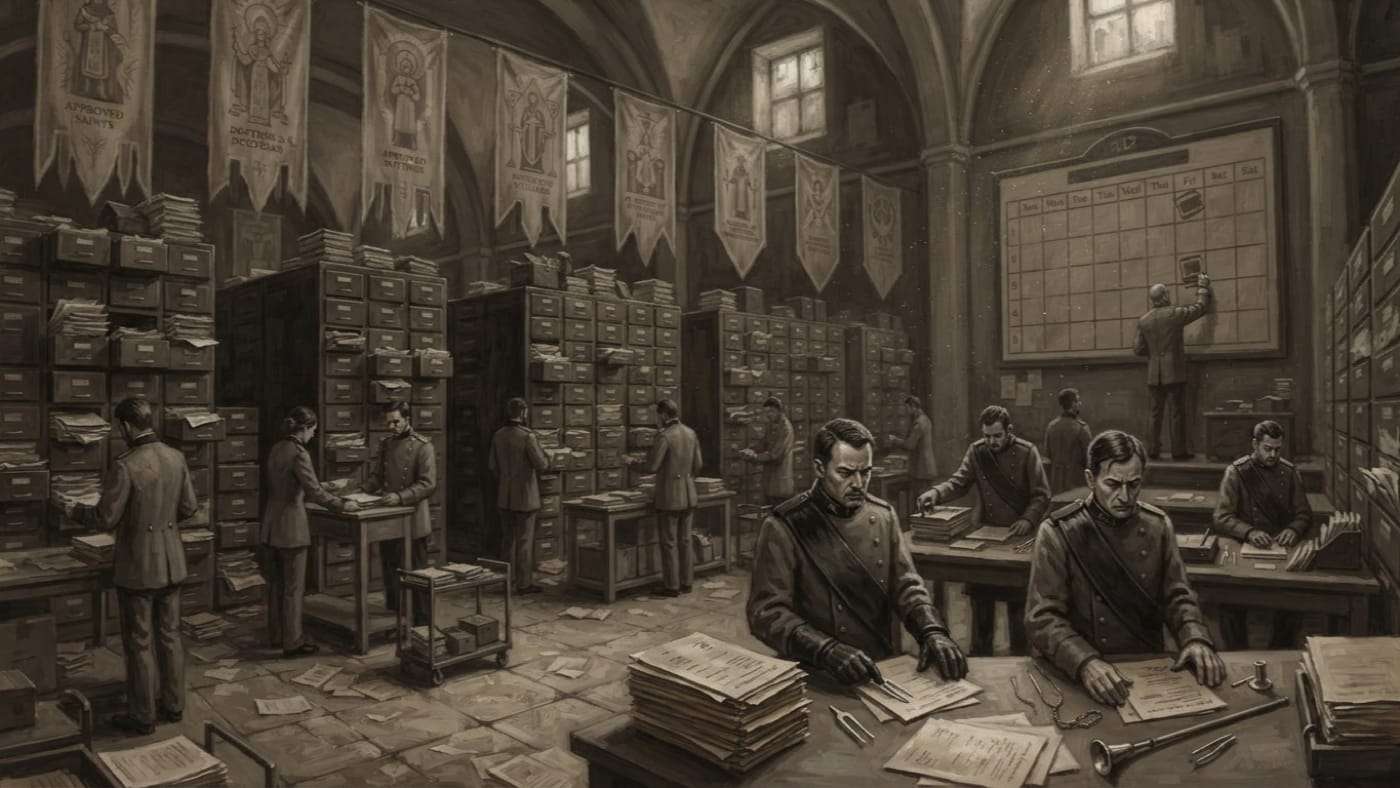
Hall of Prescribed Joy
Where every celebration begins by waiting
Eleven hundred square metres of approved ornament, permit tables and filing cabinets in Strasbourg. The Bureau of Festivals licenses joy here; its backlog has not cleared since A.S. 155.
Codex Ref. II.3.05-201
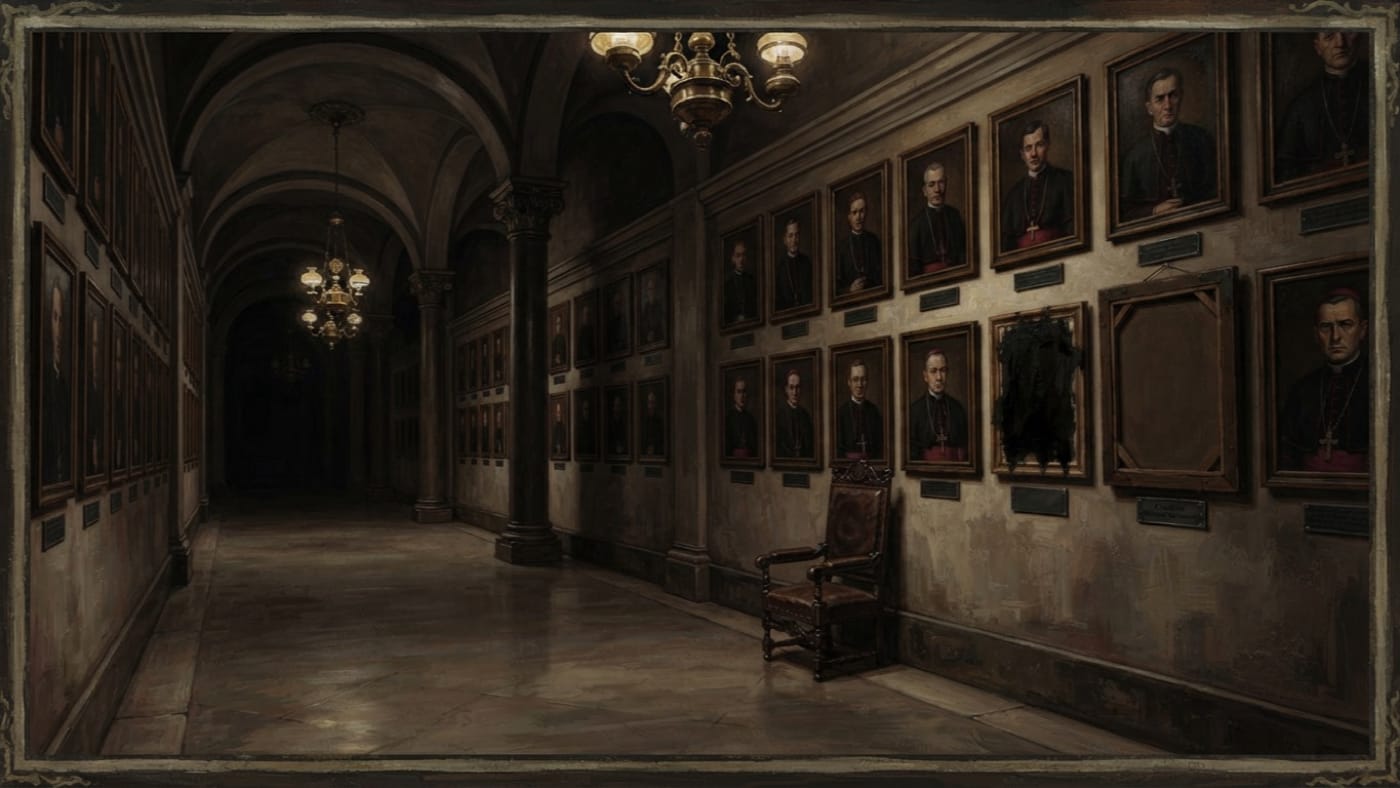
Hall of Succession
The succession is continuous; the faces are revocable
The Synod's portrait corridor in Strasbourg keeps seven successions unbroken in paint. One canvas is black, one portrait faces the wall, and one empty chair continues its duties. The faces are revocable.
Codex Ref. II.1.04-005
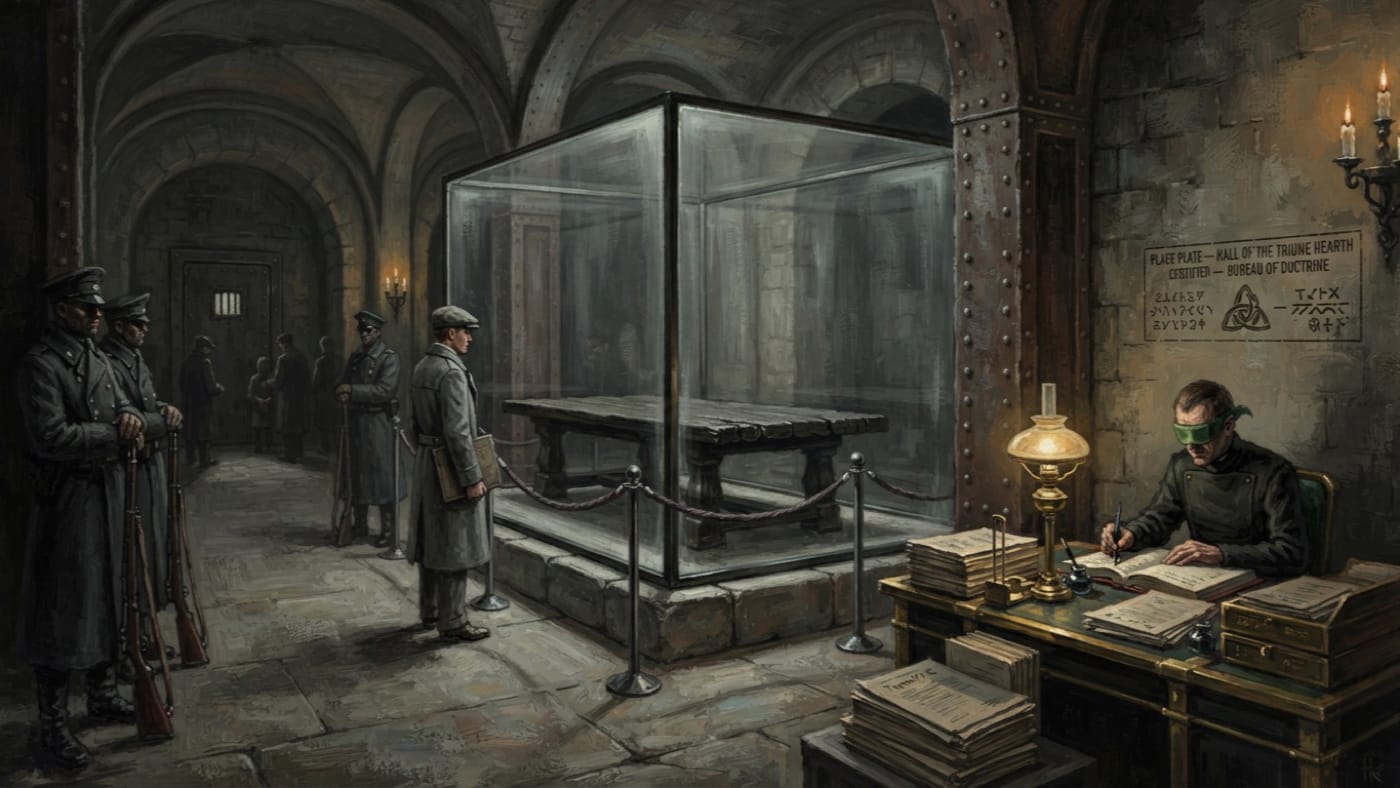
Hall of the Triune Hearth
Proximity licensed. Touch refused.
Strasbourg keeps the Concordat's black oak table under glass. Citizens inherit the Hearth, then file Form 77-C forty days ahead to stand near its furniture.
Codex Ref. II.1.04-006
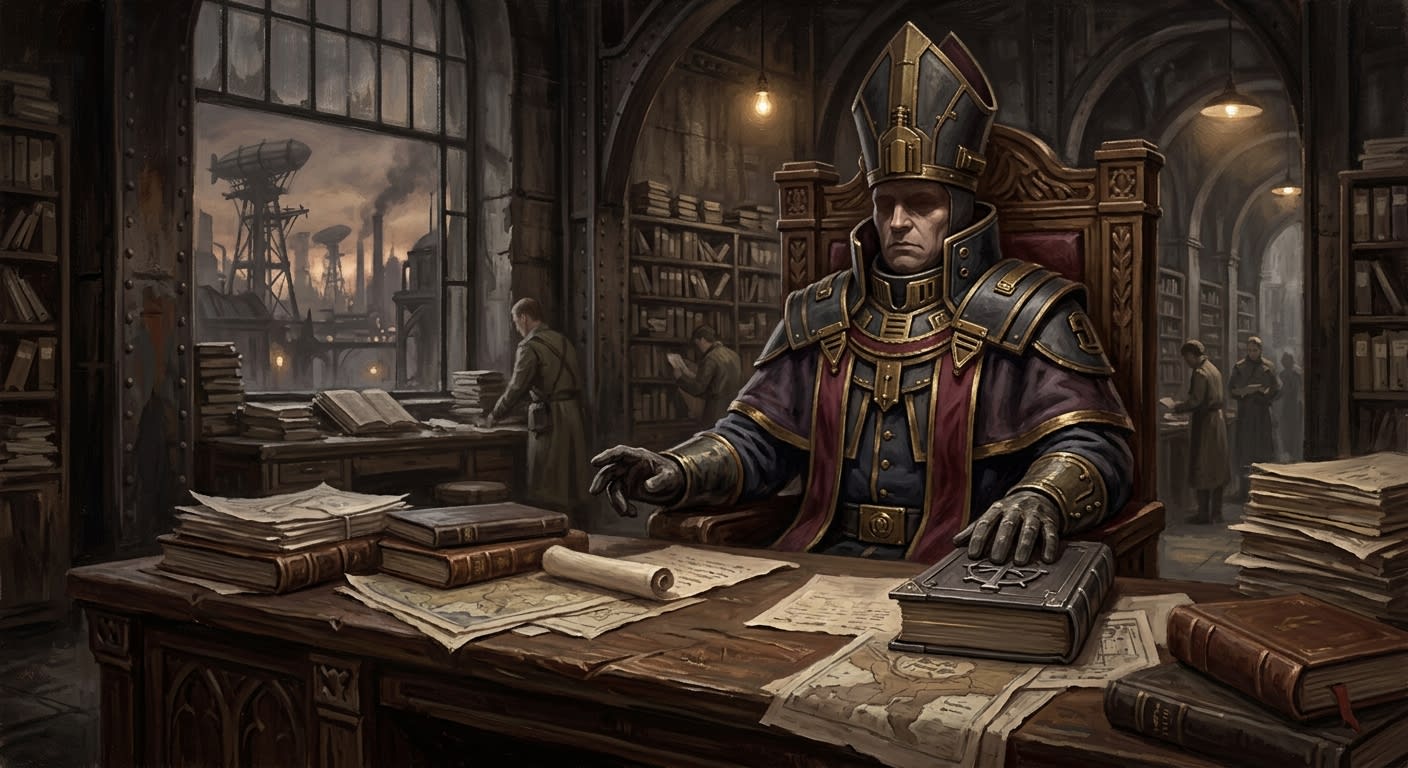
Hierarch of Doctrine
Truth is what leaves the Seal; reading is a courtesy
The unnamed current holder of the First Seal defines orthodoxy for the Synod, commands Doctrine, and proves that authority need not wait upon comprehension.
Codex Ref. III.2.01-071
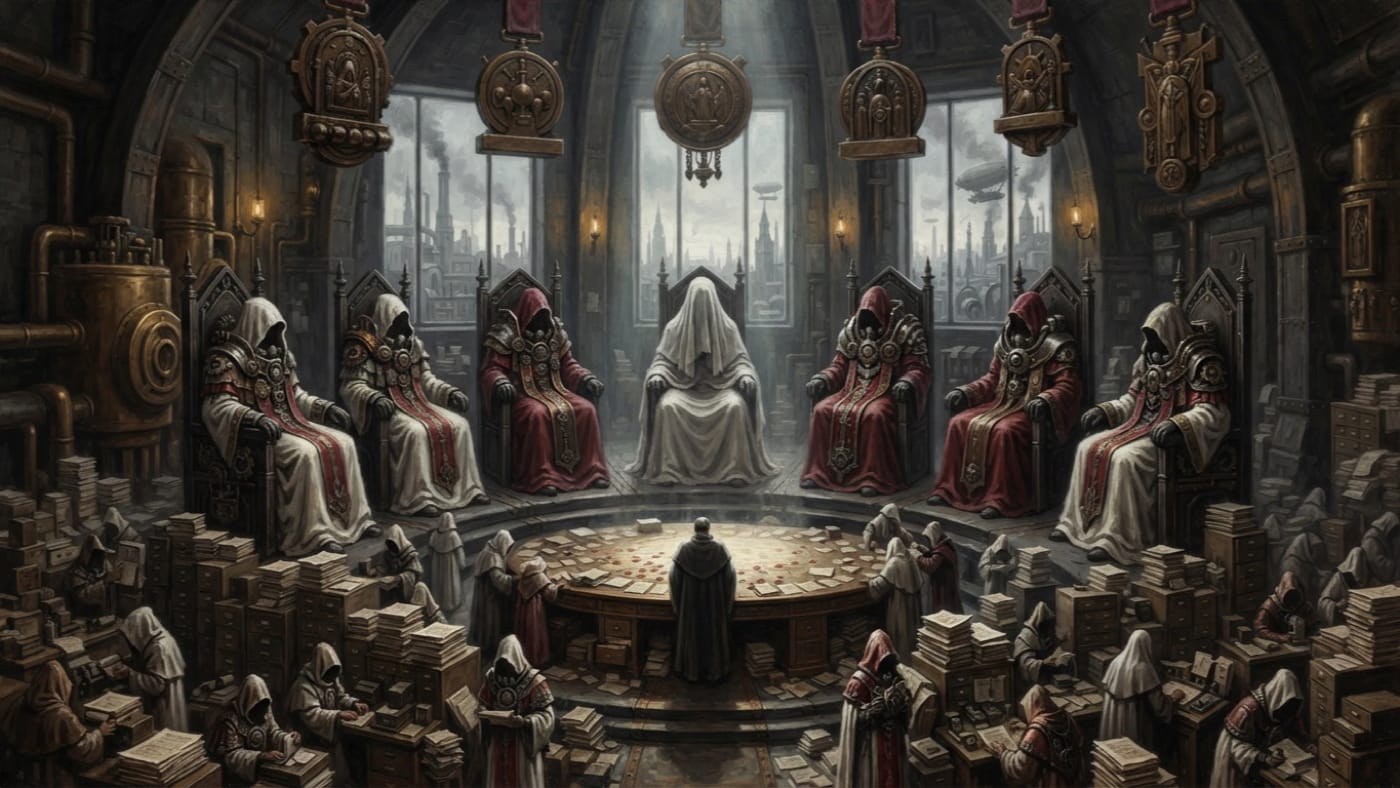
Hierarchs
Seven Chairs, One Head of State
The Seven Hierarchs rule the Bureaucratic Synod from Strasbourg under seven Seals of Faith. Their decrees are absolute; reconciling them is my department.
Codex Ref. I.3.01-005
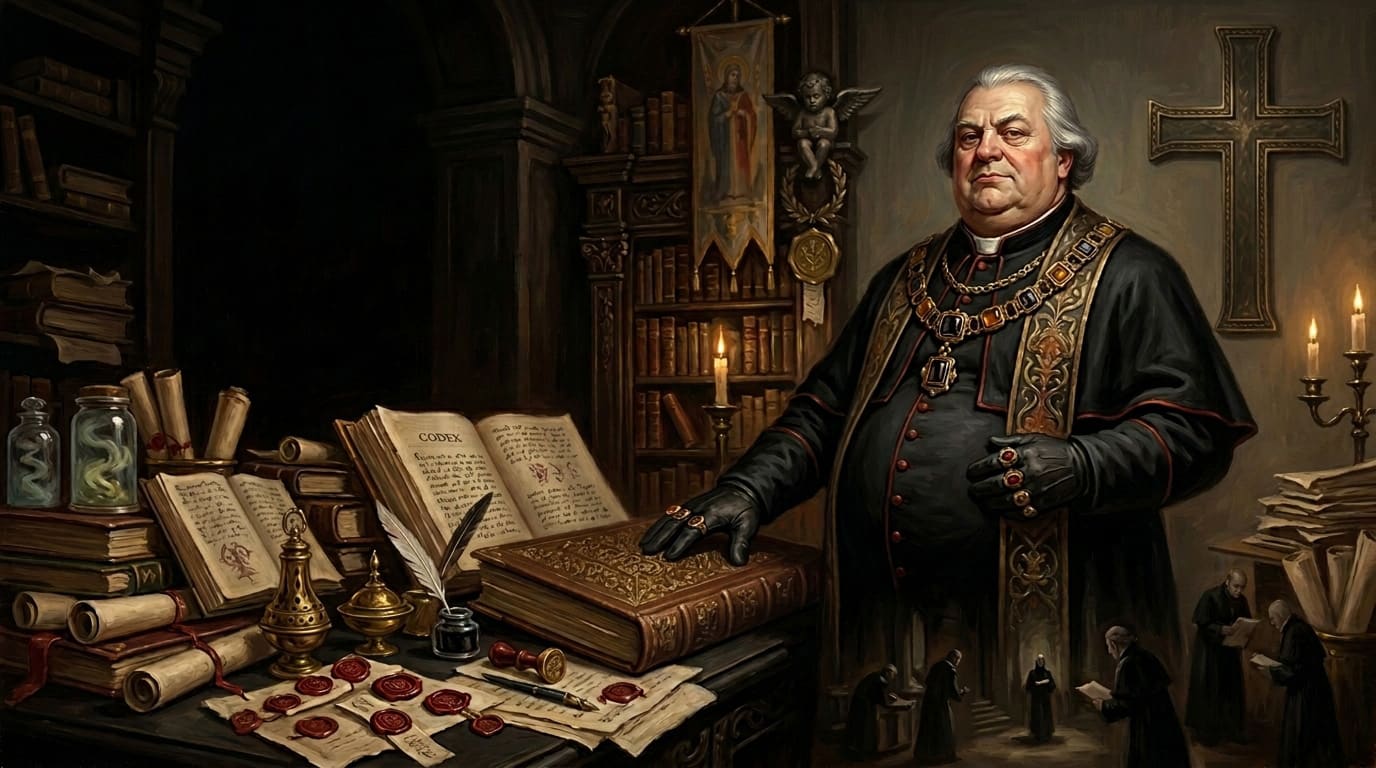
Hieromnemon Valerius Drax
The hand that corrects History before History embarrasses itself
Valerius Drax, Hieromnemon and Warden of the Sacred Ledger, is Doctrine's finest current instrument: prose stylist, ratifier, propagandist, archivist, and living rebuke to committee language.
Codex Ref. III.2.01-201
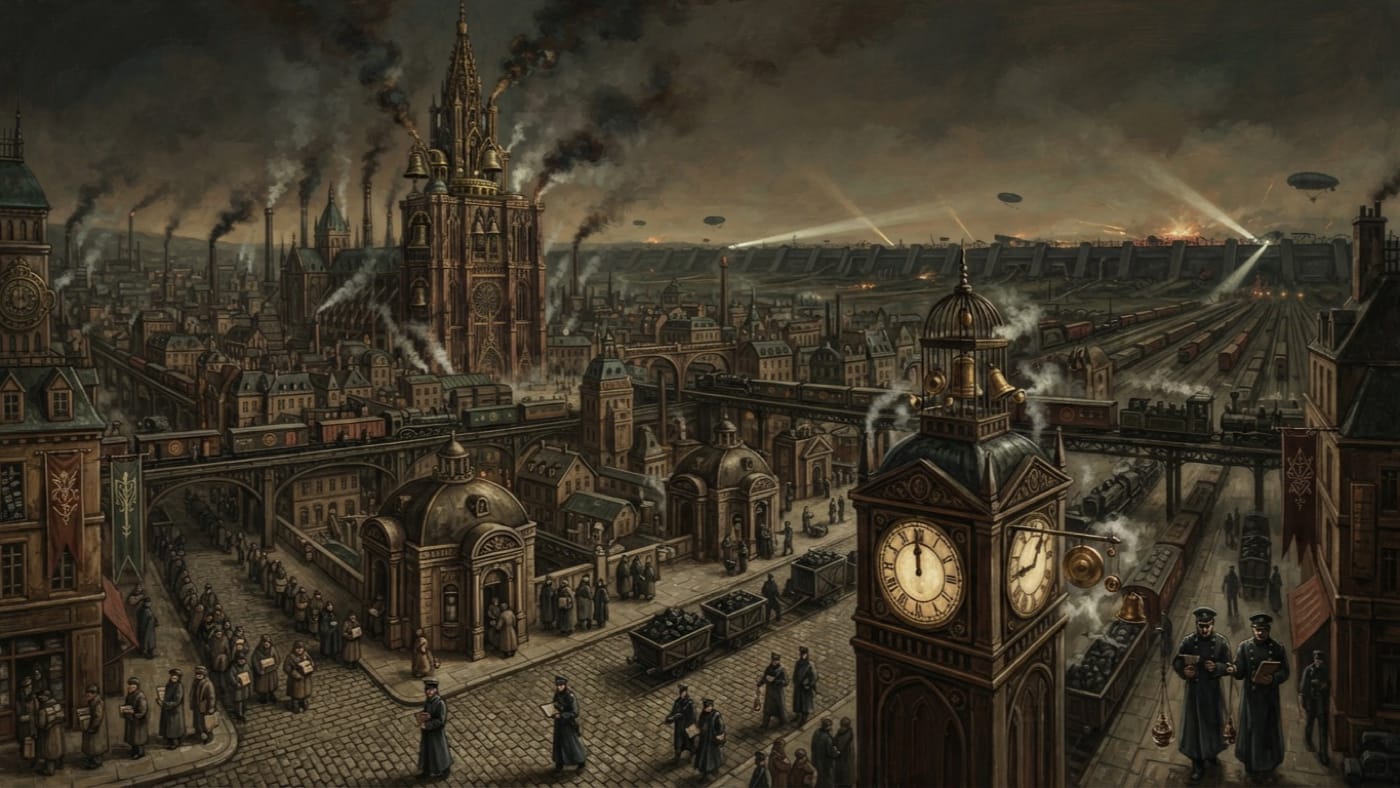
Holy Dominion
Your name is in a book. The book is in better repair than you are.
The Holy Dominion is the Synod's continental jurisdiction, surveyed in A.S. 201. From Strasbourg to the Sagittal Line, bells govern the hours, tithes feed the guns, and every soul must appear in a book.
Codex Ref. II.1.01-001
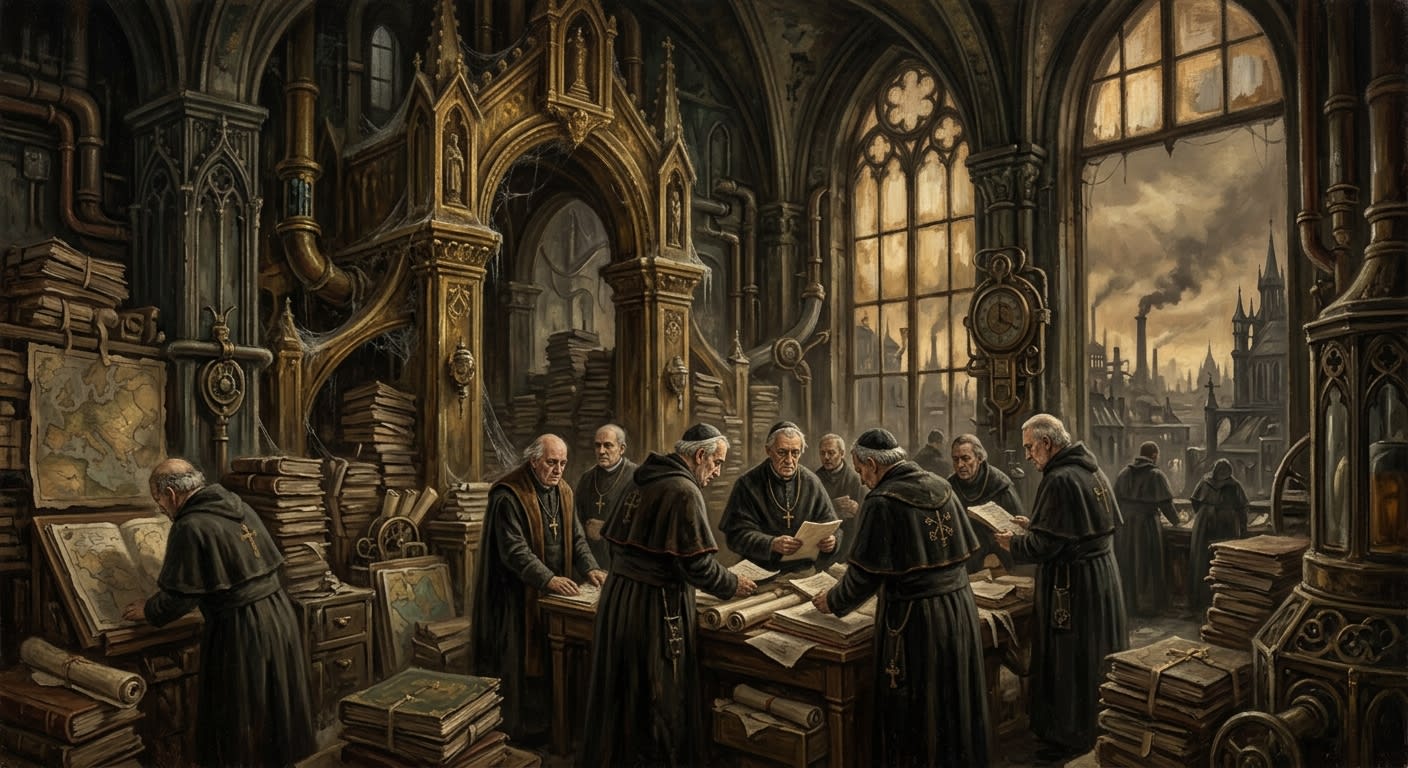
Holy See of Vienna
The dead chair that Strasbourg found too useful to resurrect
The Holy See of Vienna was the Church's old continental chair: venerable, beautiful, administratively inadequate, dissolved at Regensburg in A.S. 30, and later preserved by Strasbourg as shrine, warning, and useful absence.
Codex Ref. VIII.1.09-030
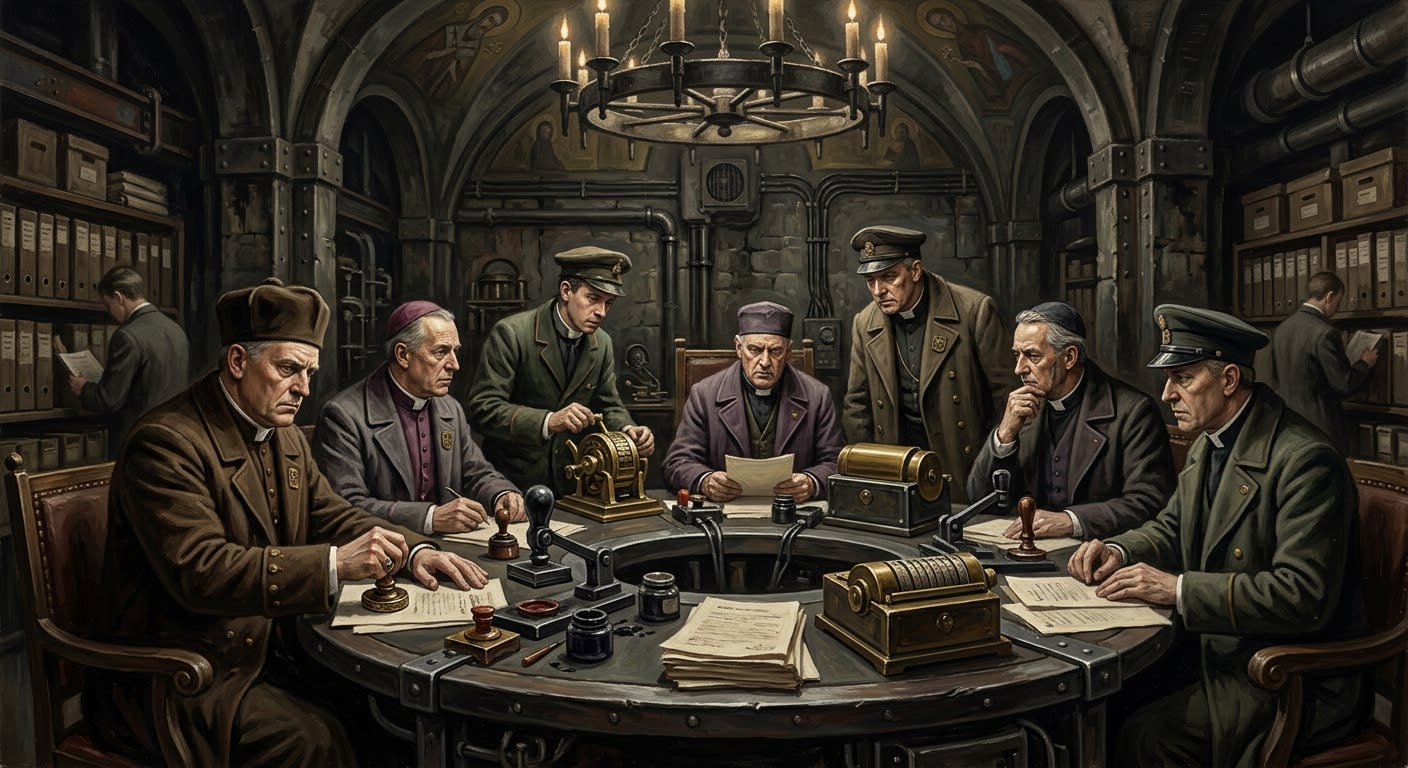
Inner Circle
Seven knives pointed inward, and Europe calls the locked box government
The Inner Circle is the Synod's highest chamber: seven Seal authorities locked in Strasbourg beneath the Basilica, manufacturing unanimity from obstruction, fear, rotating stamps, clerks, and the occupied absence of War.
Codex Ref. XIII.1.05-090
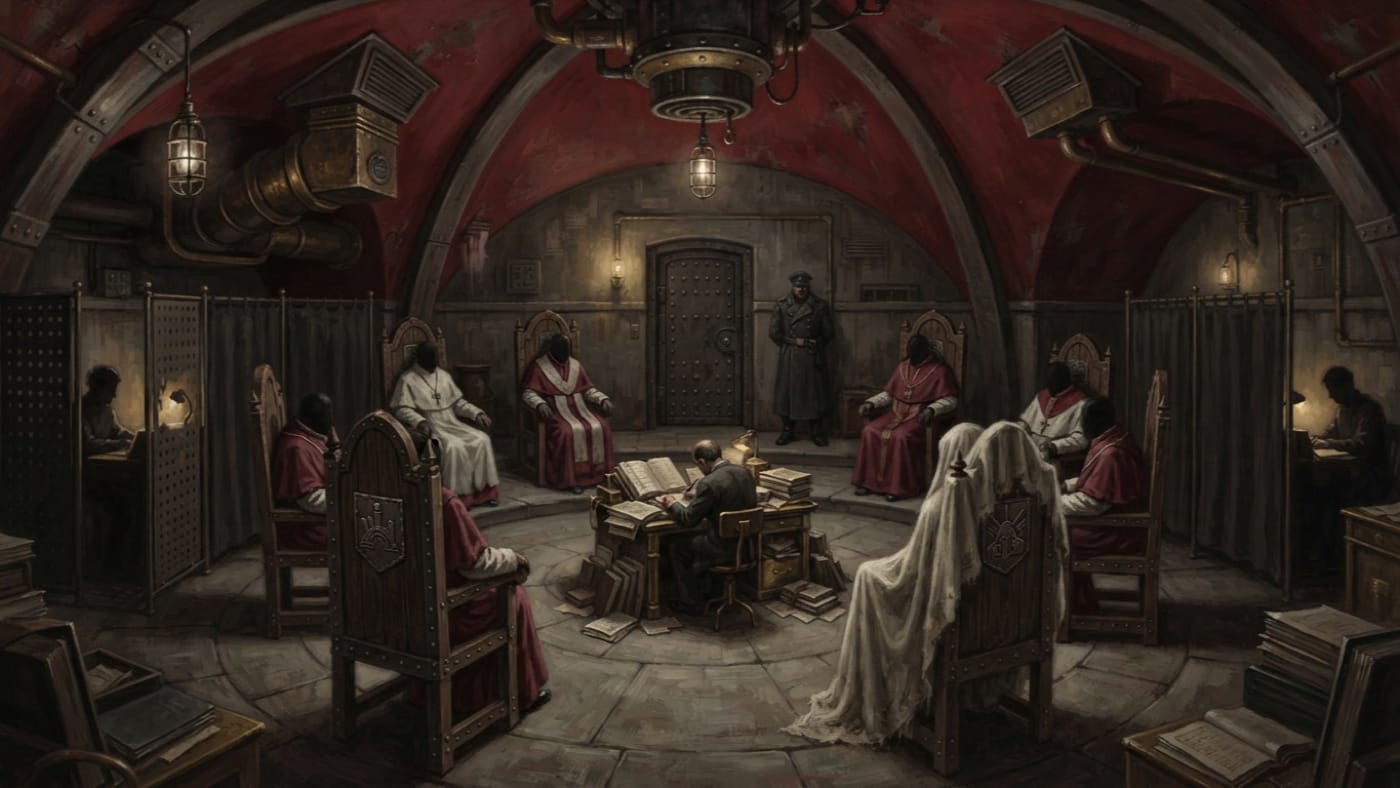
Inner Circle of Strasbourg
Six Chairs Answer. Seven Seals Decree.
Seven chairs, six occupants, no table. From the Basilica's highest floor, the Synod decrees through corrected minutes, seven stamps, and War's vote counted by faith.
Codex Ref. III.2.04-1452
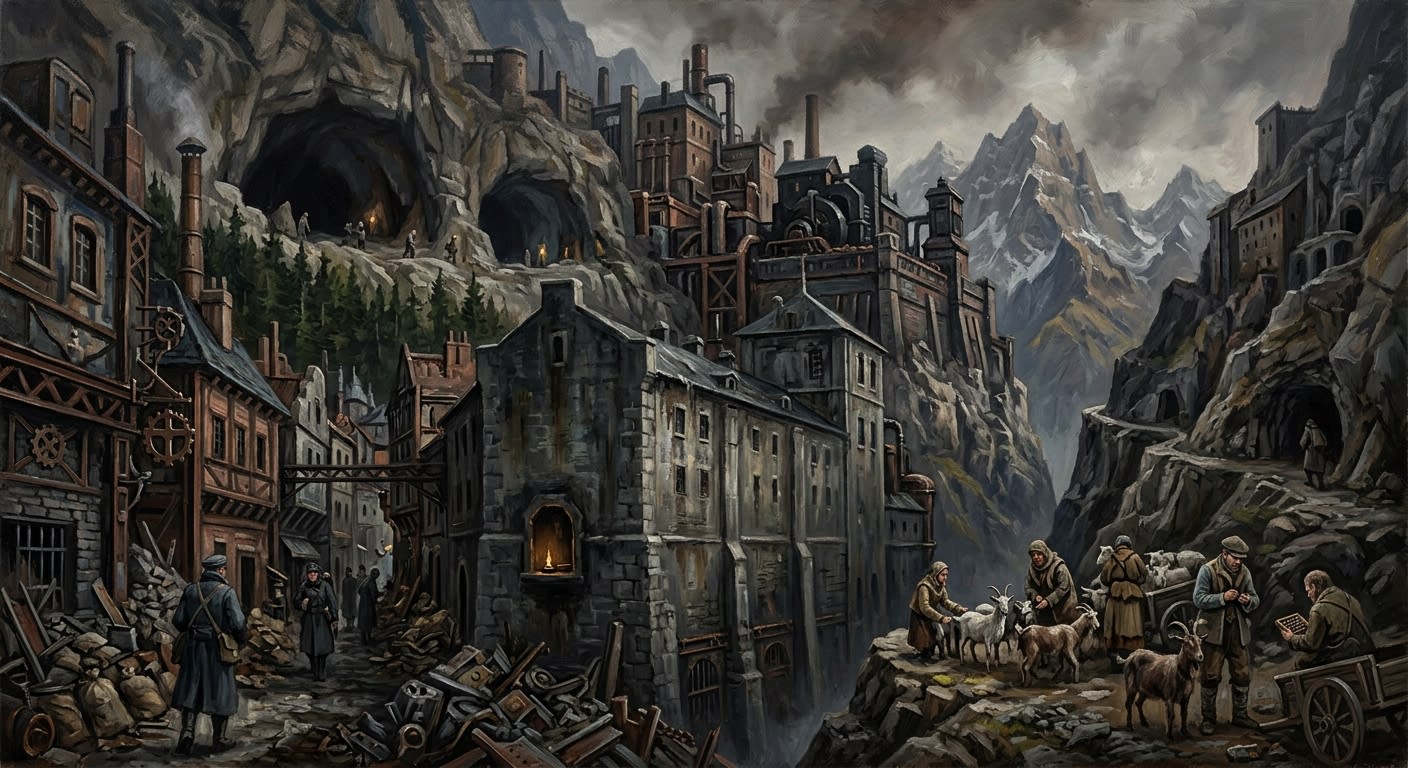
Innsbruck
Where mountains, grandmothers, caves, and walls defeat the census
Innsbruck is the Synod's alpine refuge-city: Cellar Saint caves above the treeline, relics disguised as trash, Mother Sava's wall-cavity, Pale Kin routes, goat arithmetic, and the most pious registry evasion in the mountains.
Codex Ref. II.2.09-030
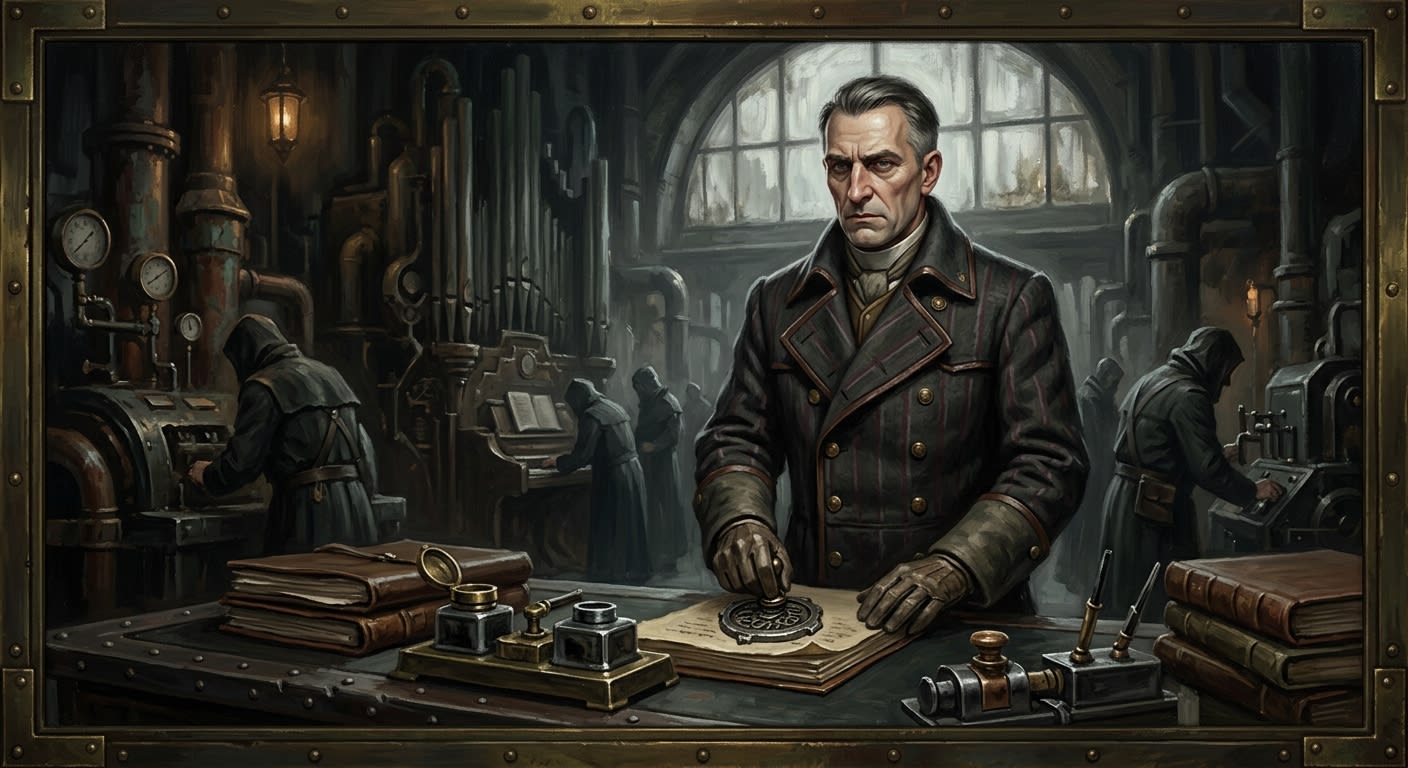
Inquisitor-General Severian
The man who taught fear to sing in tune
Architect of the Iron Choir of Mainz and Severian Gloss to the Catechism of Obedience, he made silence culpable, cruelty legible, and fear useful enough to receive forms.
Codex Ref. III.2.01-006
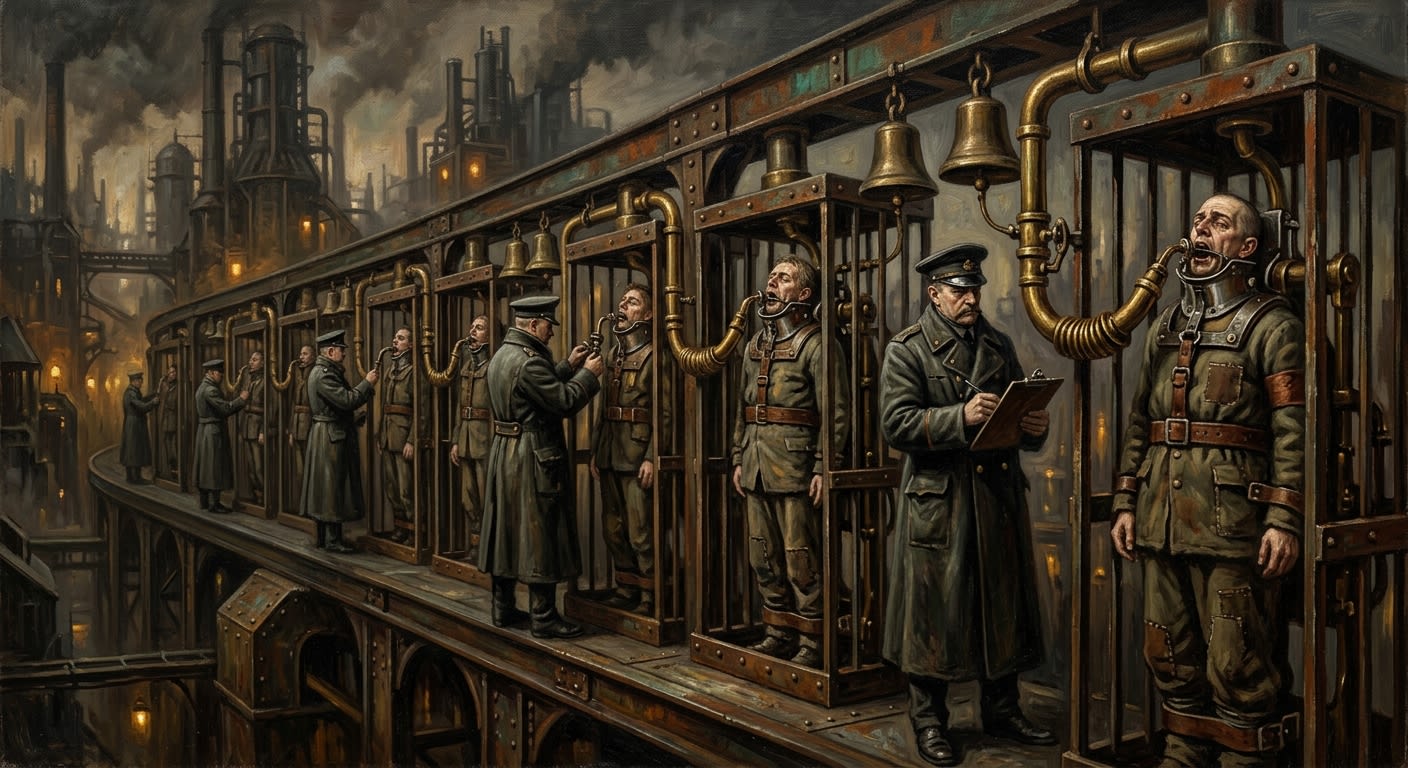
Iron Choir of Mainz
Where the road learned to keep a throat open
The Iron Choir of Mainz turns condemned throats into civic instruction: a Purity road of cages, bells, Brand-Singers, witness columns.
Codex Ref. VIII.1.09-134
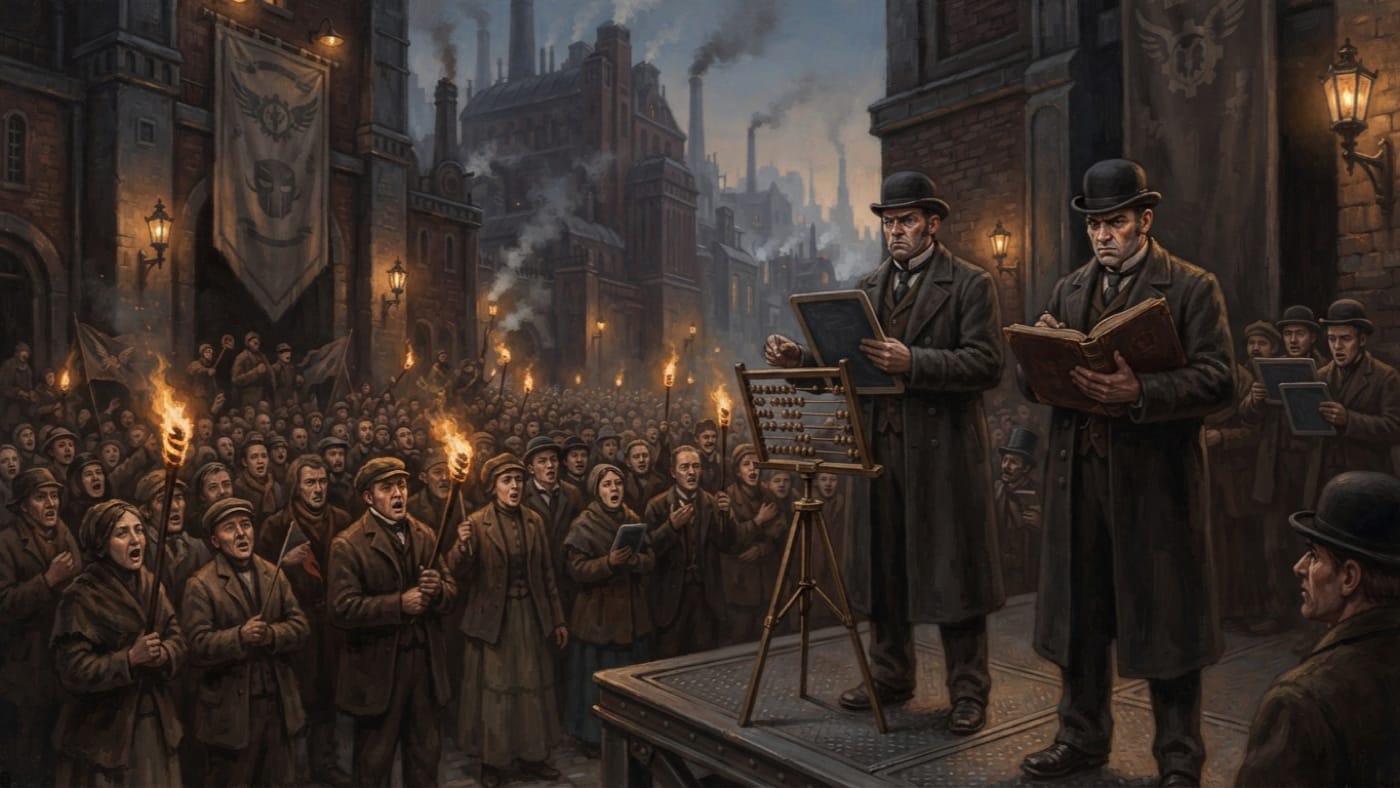
Joy Compliance Index
Rejoice by permission; be judged by the slate
The Bureau of Festivals grades a crowd's rejoicing through forty-two observable behaviours. Three verdicts follow; four points separate insufficient zeal from excessive emotion. The slate certifies conduct. It cannot certify joy.
Codex Ref. XIII.1.67-201
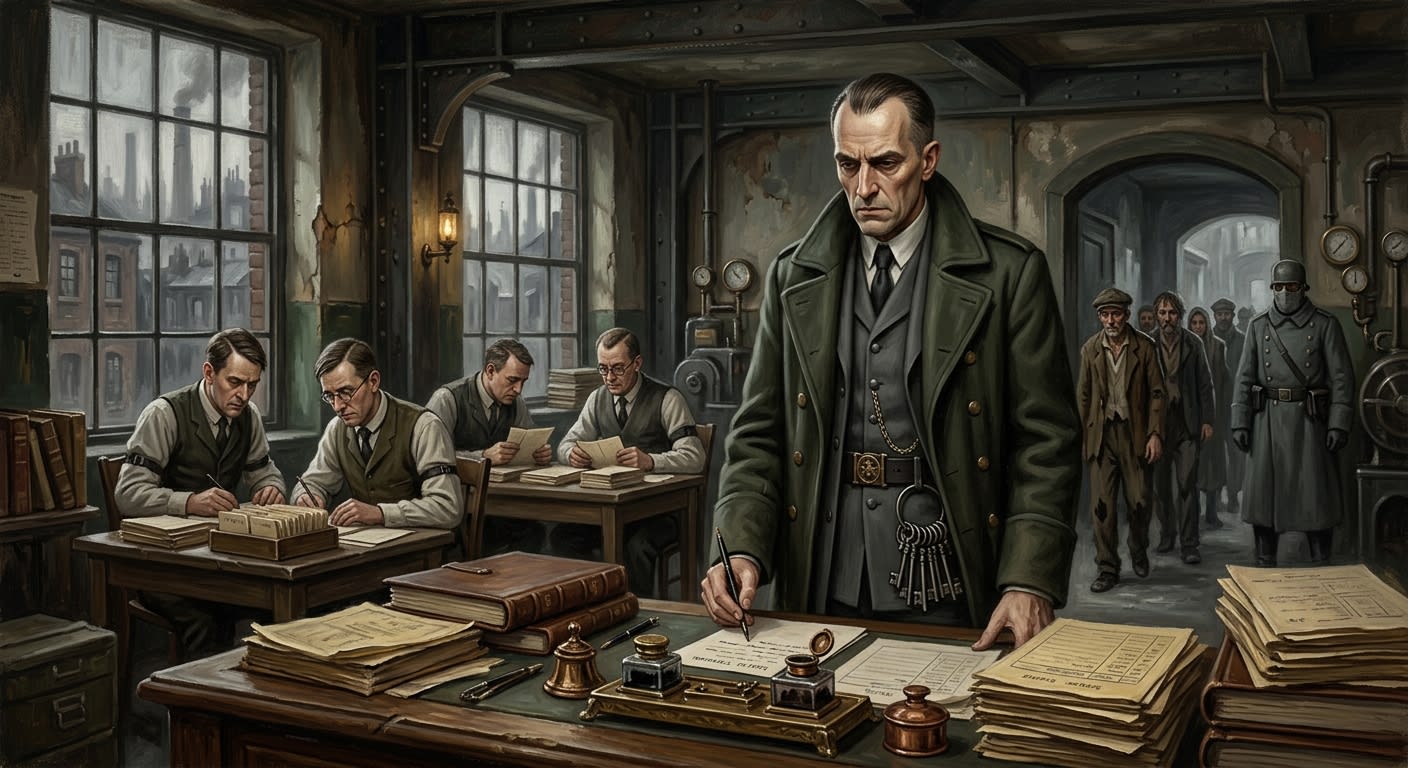
Kaspar Thenm
The prison warden who taught the Synod to number beds before souls
Kaspar Thenm, first officer of the Bureau of Settlement, turned post-Concordat refugees into addresses with a warden's key, three clerks, and no talent for mercy.
Codex Ref. III.2.01-014
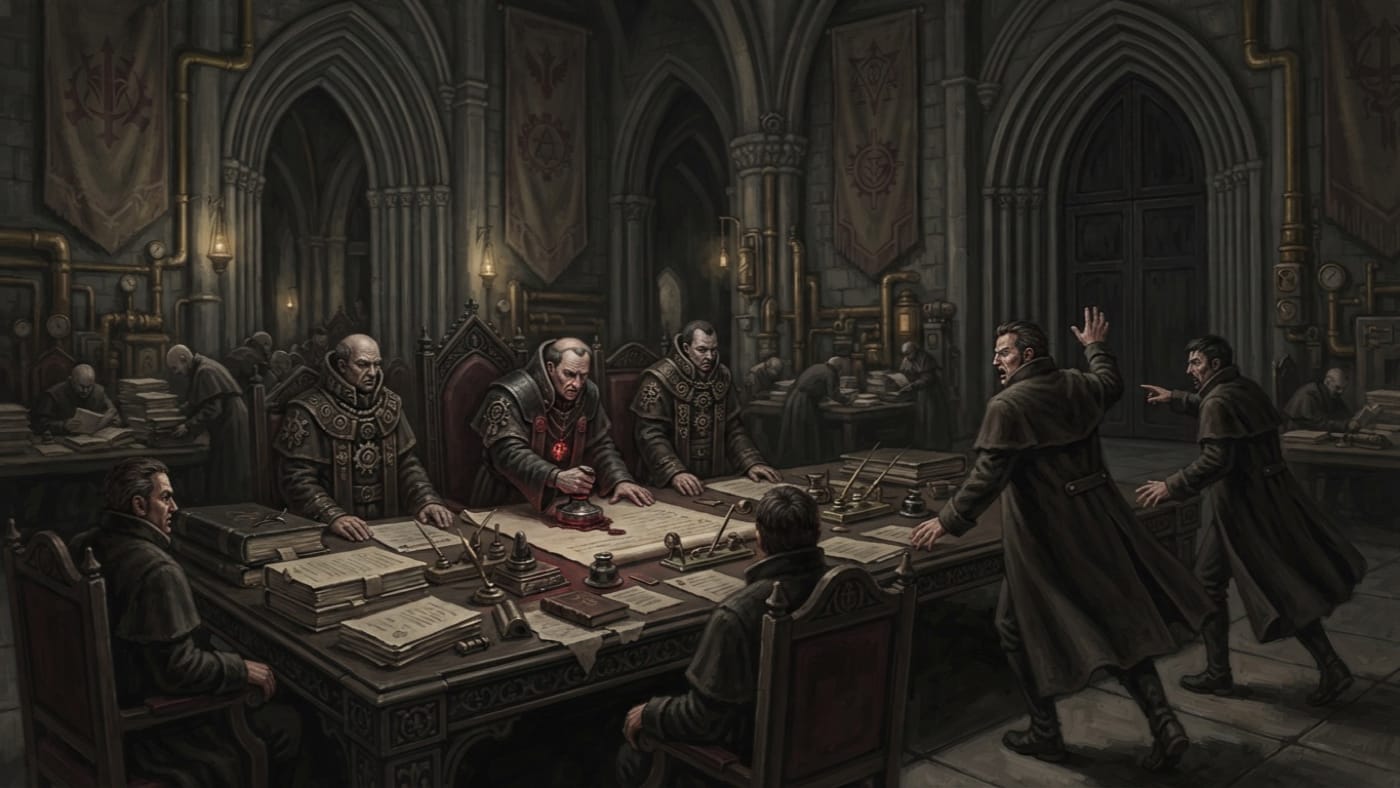
Kingdom of Aragon
A kingdom entered under another seal
Aragon was entered under Iberia's seal at the A.S. 90 Concordat of Strasbourg. Its delegation protested and departed; the Bureau retained the kingdom.
Codex Ref. III.2.04-1544
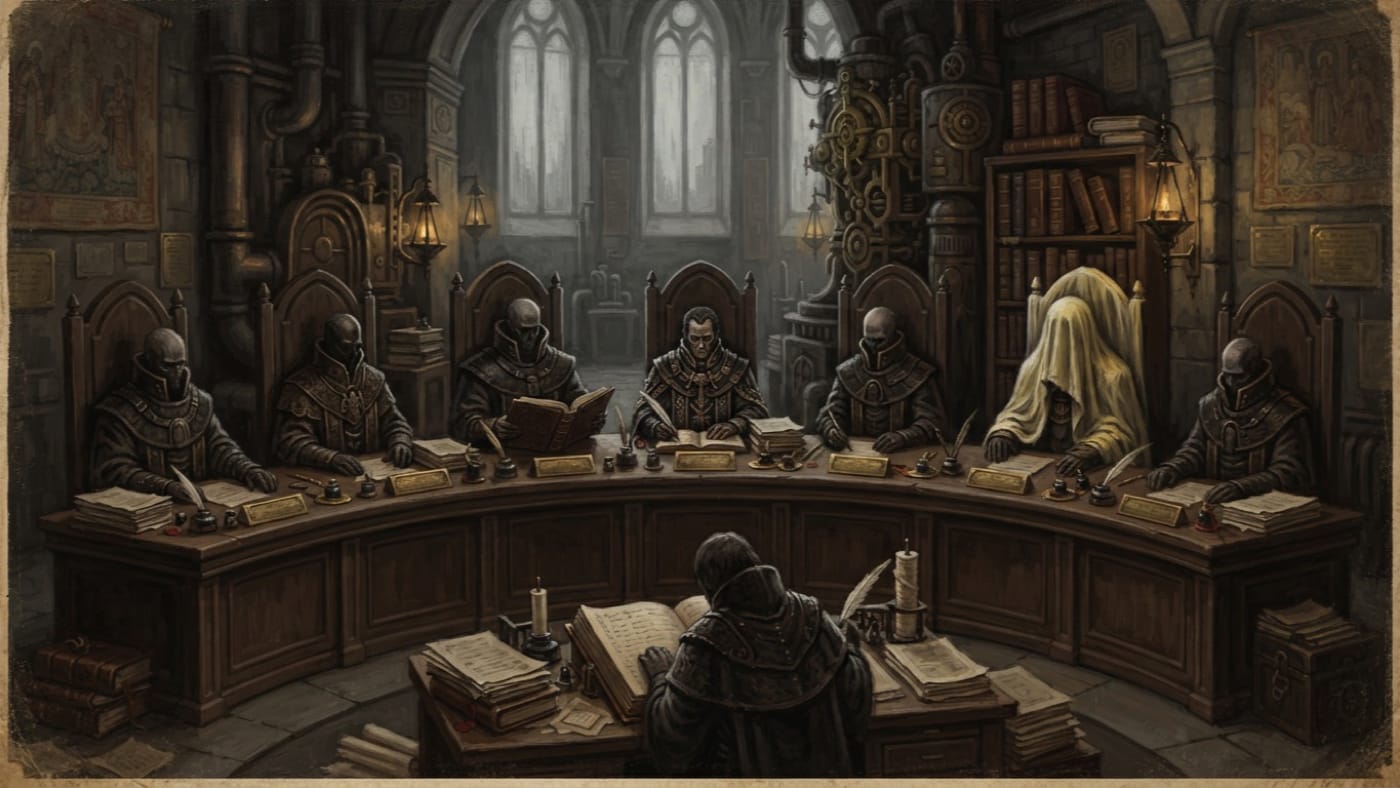
Ledger of Succession
Five Names in Print, Seven Seals in Law
Five names are printed each year for seven Seals. One seated Hierarch has only a changing file number; War's chair remains draped. The succession is continuous as printed.
Codex Ref. VI.3.02-002
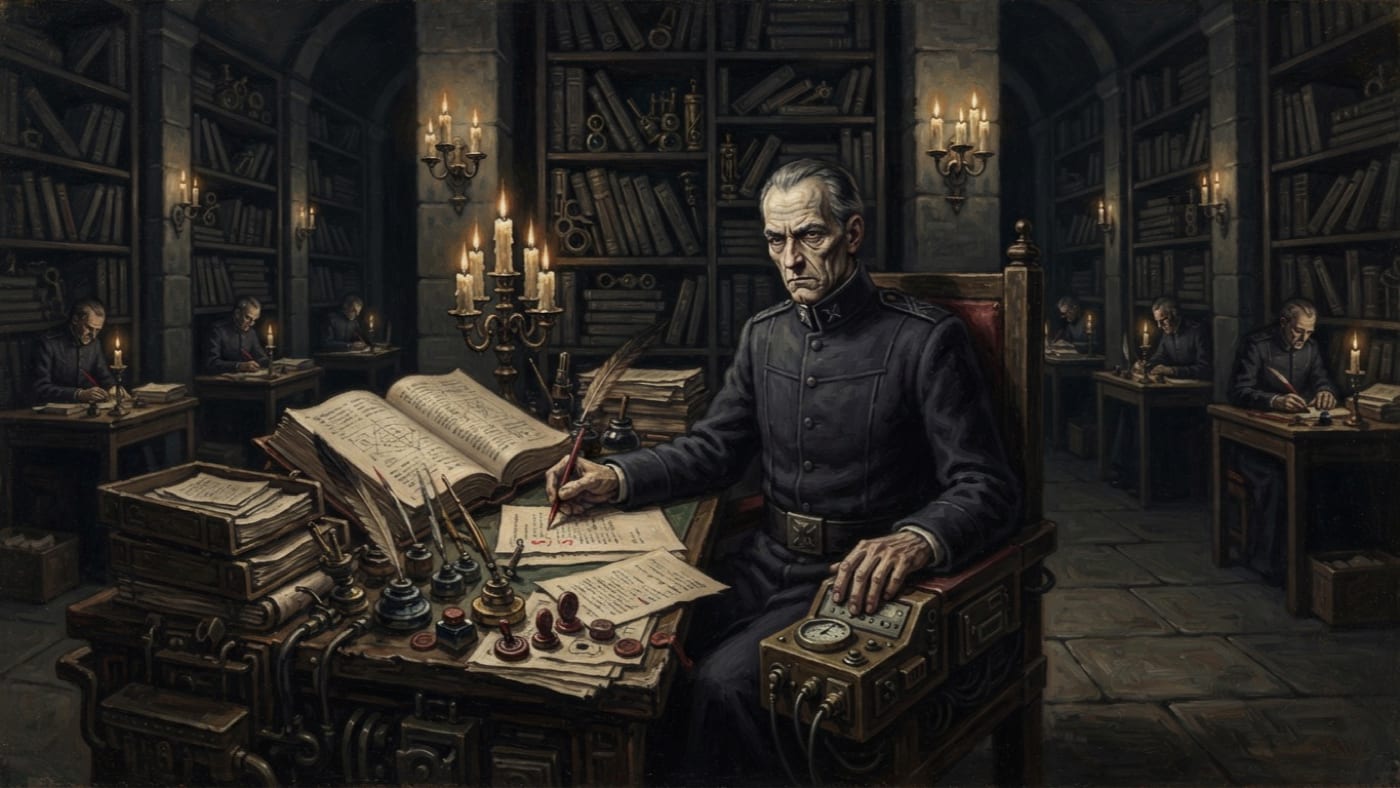
Liturgist-Primus
The Chair decides what counts as a performance.
The Chair of Prescribed Observance governs every authorized rite. Corvin Marche has occupied it for nineteen years; a misplaced syllable still requires correction.
Codex Ref. XIII.1.64-201
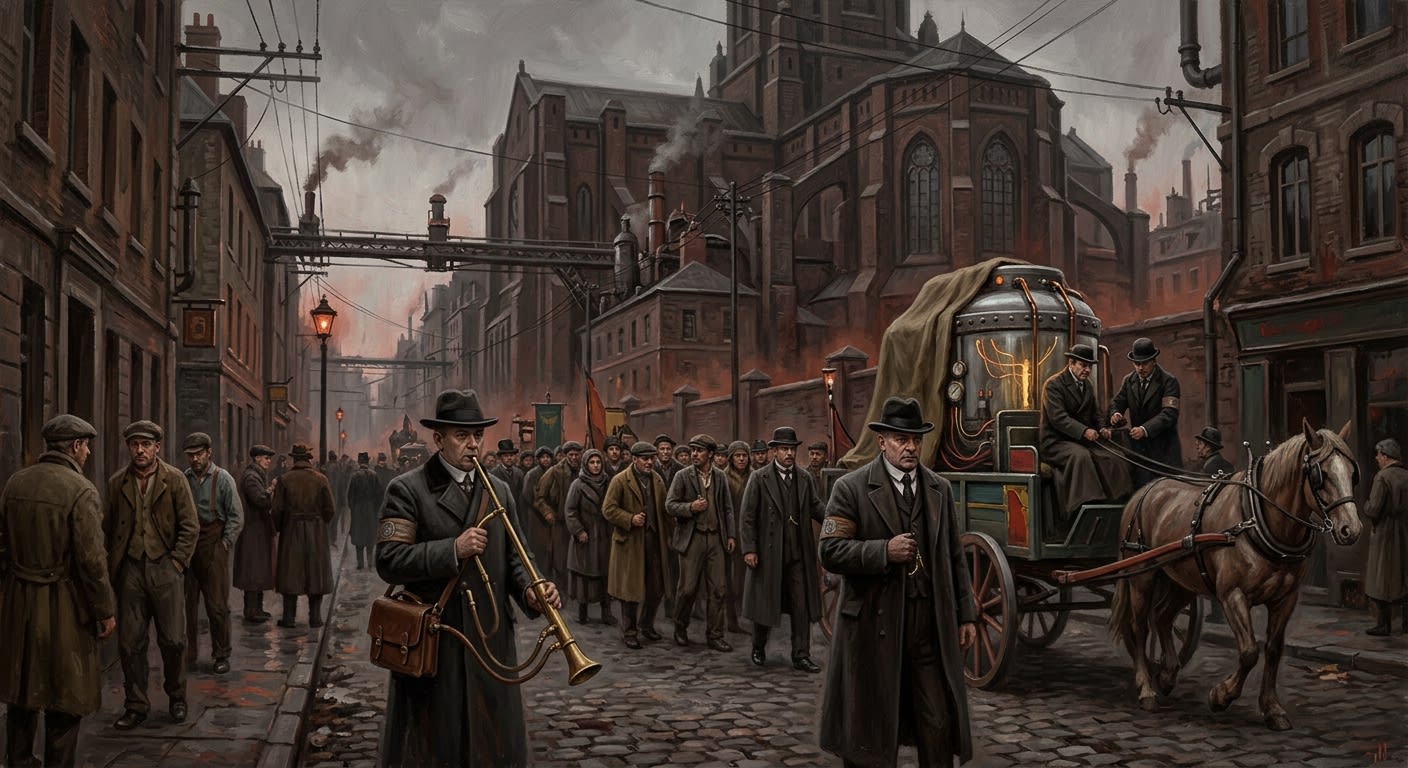
Lyon
The Rhône city where scars learned to sell tickets
Synod-held Lyon is a Rhône city of red ash, whistle-hymnody, Festival supervision, relic volatility, licensed enthusiasm, and profitable repentance.
Codex Ref. II.1.04-001
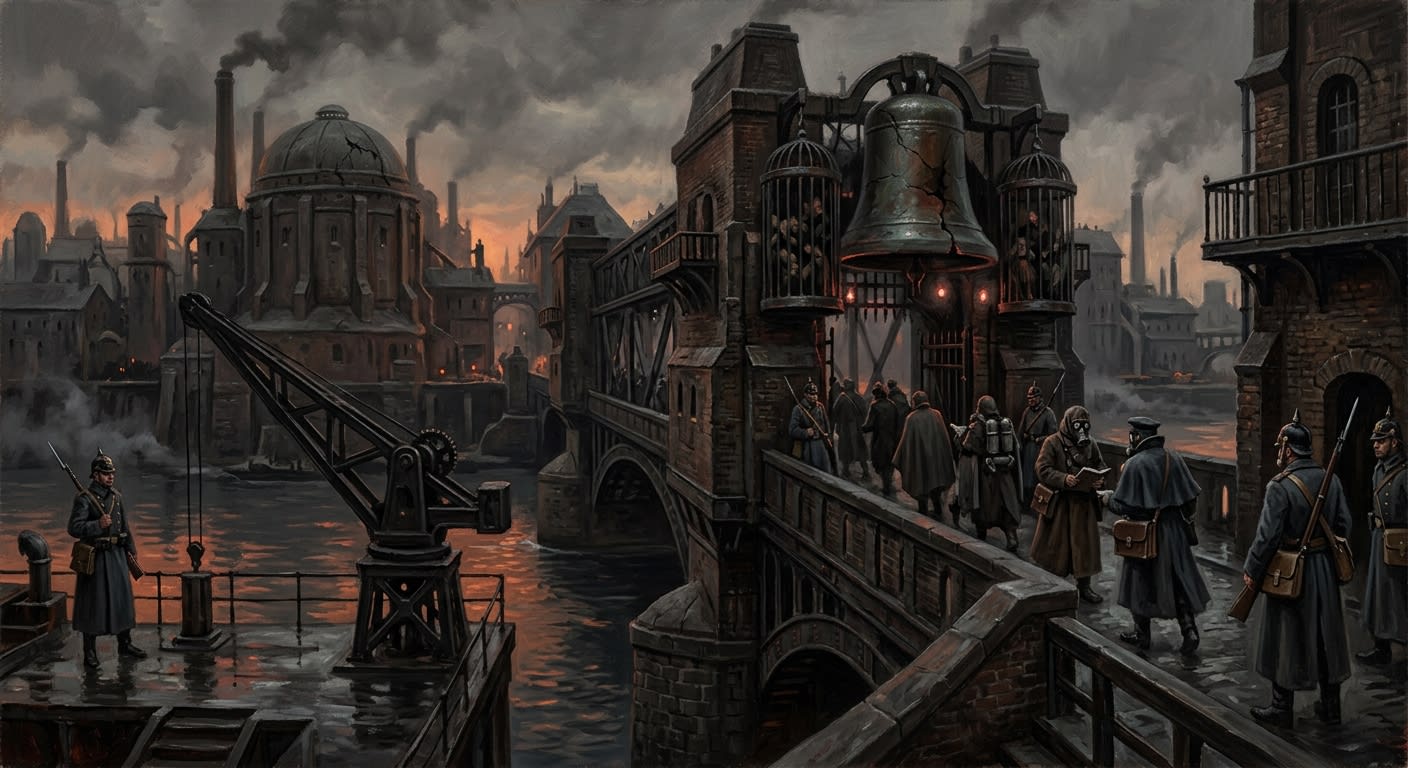
Mainz
The Rhine city where tolls, bells, and throats keep accounts
Mainz is the Synod's Rhine throat: a bridge-toll city of Augustinus, Hildegarde, Severian, cracked bells, obedient ledgers, and cages that still hum.
Codex Ref. II.2.02-003
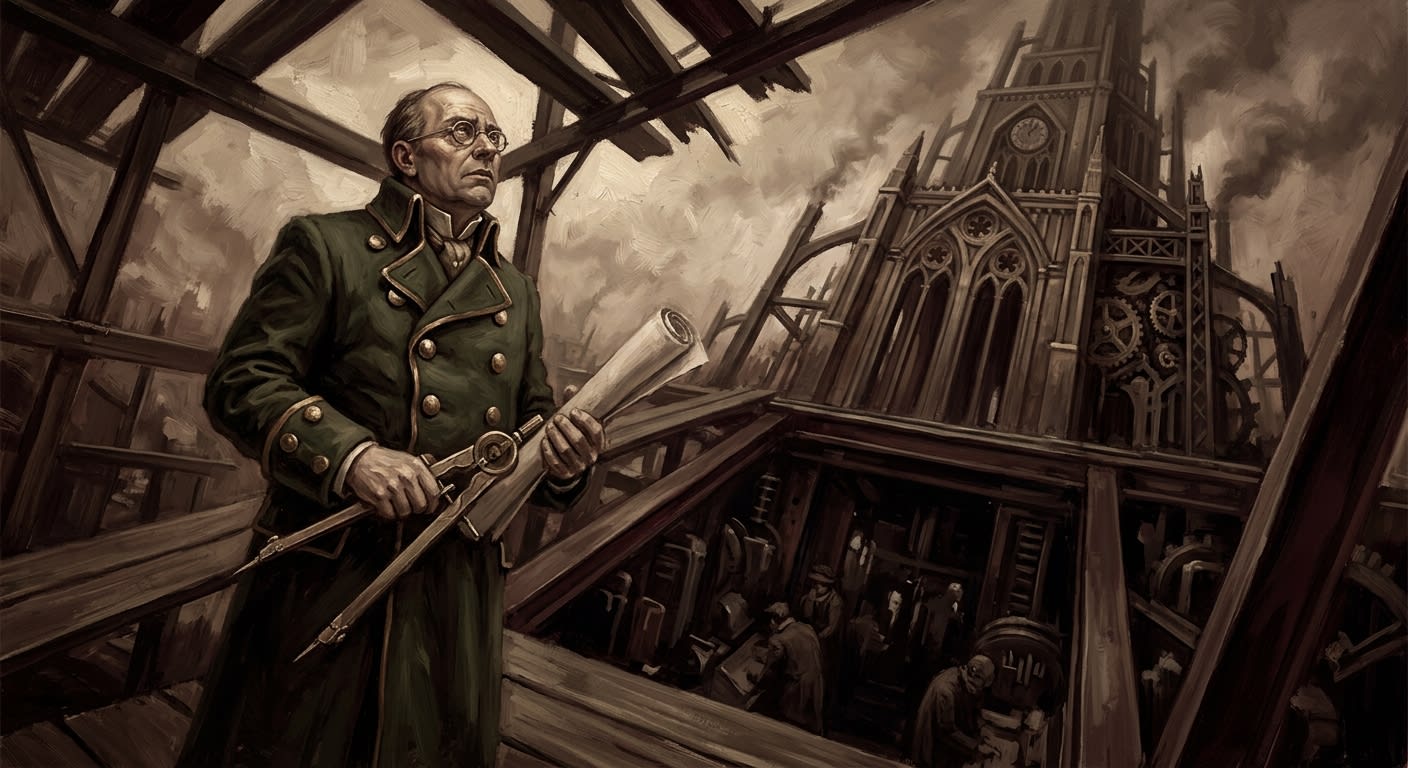
Matthias Kammler
The man who made Doctrine climb stairs
Matthias Kammler, architect of the Tower of the Quill, gave the Bureau of Doctrine a pen of stone and was repaid by height, honours, and a fatal scaffold.
Codex Ref. III.2.01-150
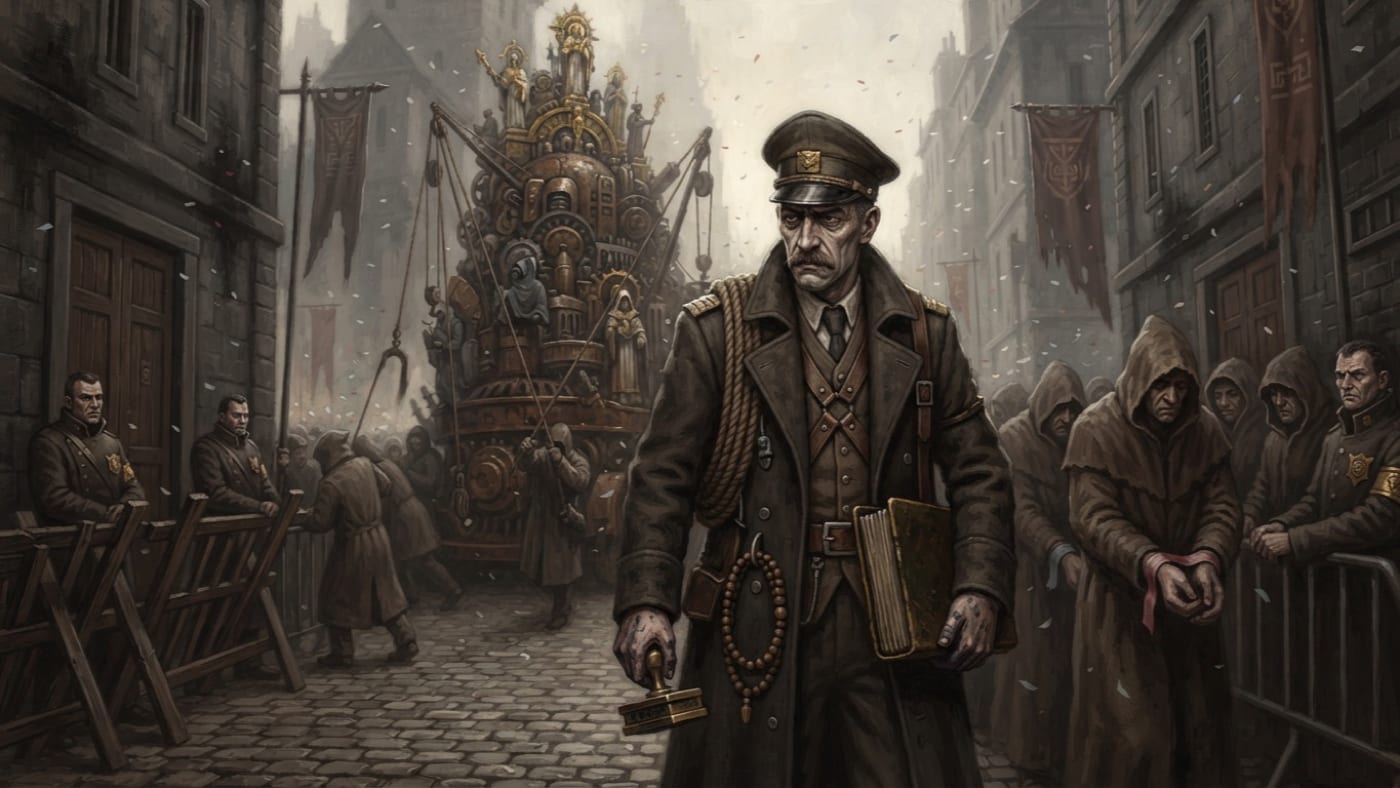
Pageant Captain
Crowds routed, confetti reconciled, joy accounted for
The Bureau of Festivals' logistical officers route crowds, move relic-floats and weigh the confetti afterward. Their signatures accompany every anomaly list. The paper must balance.
Codex Ref. XII.17.03-001

Procurator Maxentius della Torre
The jaw by which Doctrine learned to bite
Della Torre expanded Purity in A.S. 80, birthed the Index Damnatus, and taught the Synod that a named error is already halfway into chains.
Codex Ref. III.4.02-031

Saint Margaux of the First Blood
Distinguishing features: none — which was precisely why she worked
She was old and small and grey and holding a book, and she died on her knees, and the Bureau wrote upon her blank page the most useful saint in the Theocracy's arsenal.
Codex Ref. III.2.01-002
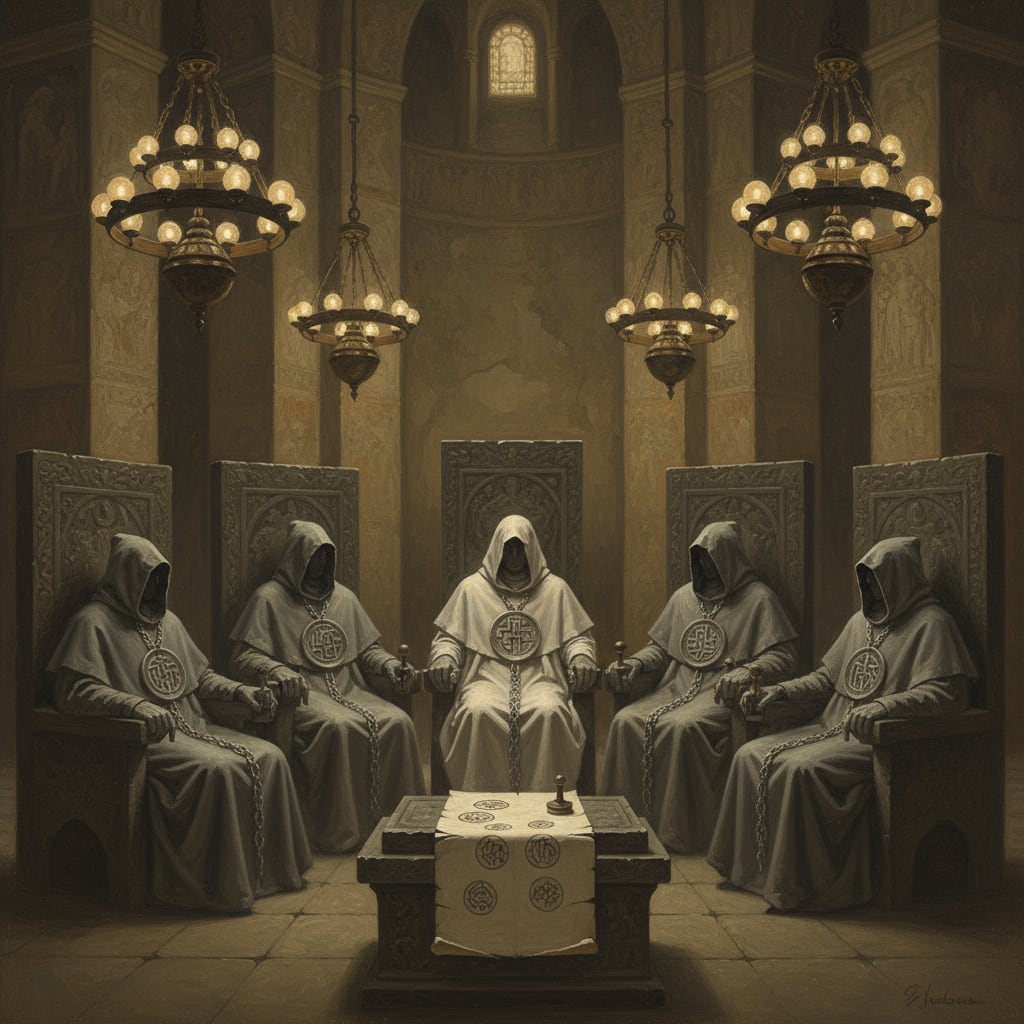
Seven Seals of Faith
Seven absolute sovereignties, each checking the others, which Kratz called something else entirely
The constitutional framework of the Bureaucratic Synod — seven domains of overlapping absolute authority, each assigned to one Hierarch, each cancelling the others into the only available direction forward, toward the Sagittal Line, where jurisdiction is settled by artillery.
Codex Ref. XIII.1.05-001
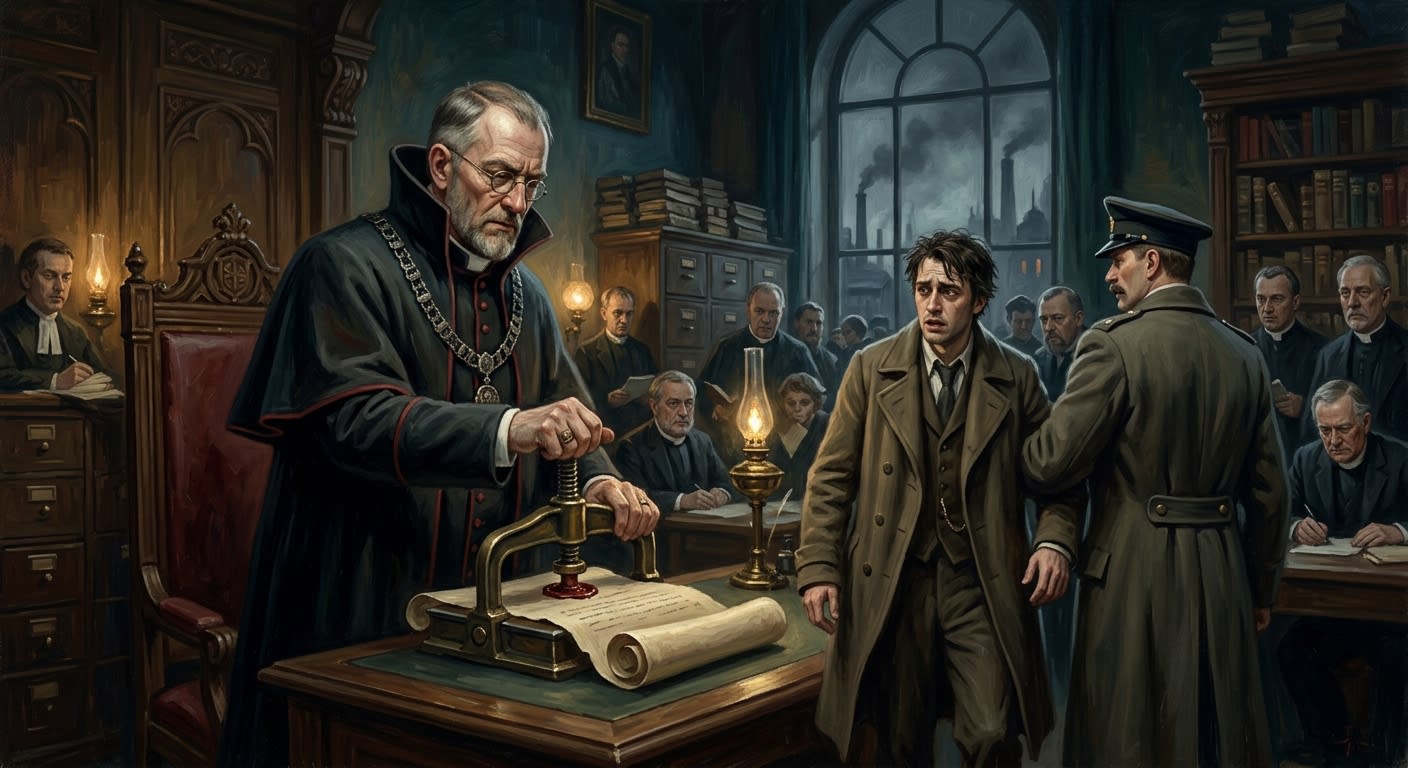
Standard Ratification Protocol
The seal descends, and yesterday learns obedience
The Synod's Standard Ratification Protocol makes sequence repent: dissent is heard, wax cools, and the completed act becomes obedient.
Codex Ref. XIII.1.89-087
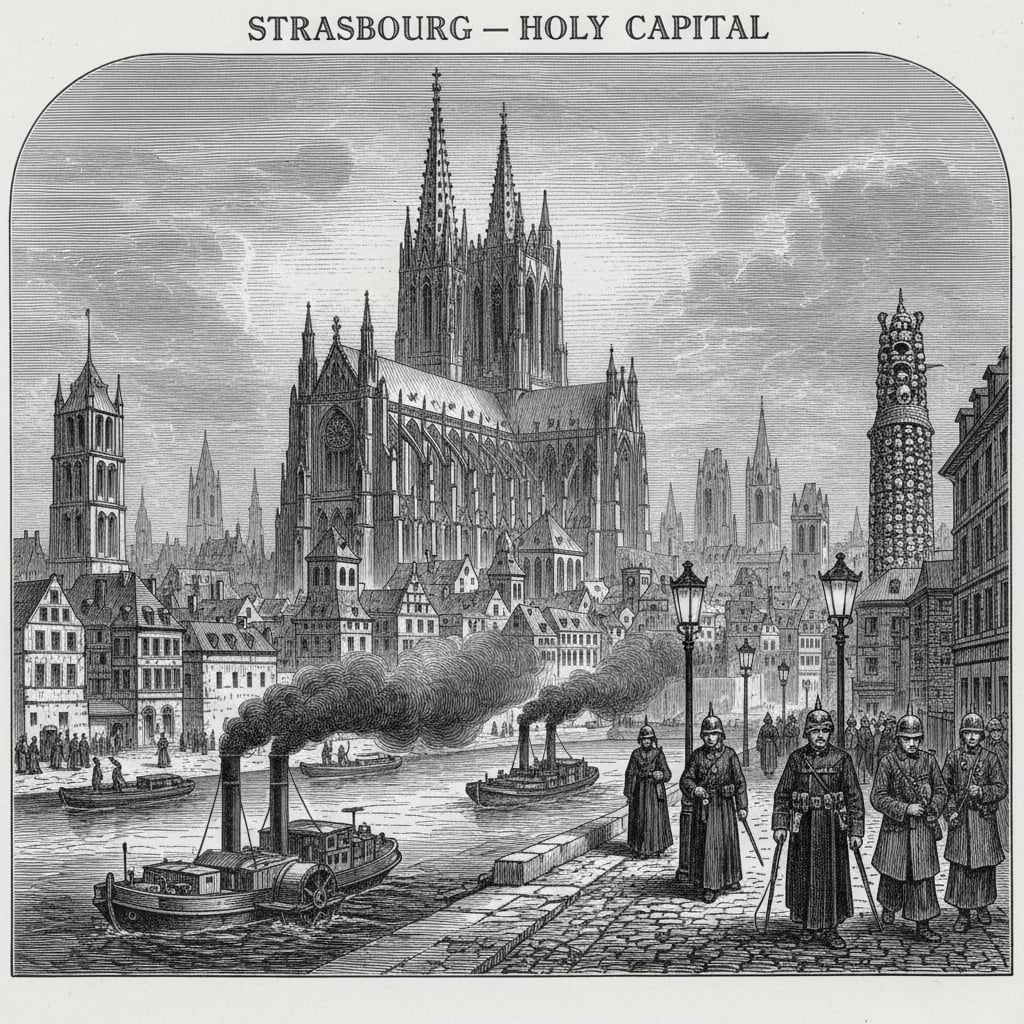
Strasbourg
The Holy City, or the Weight of Fifteen Centuries of Paperwork
Seat of the Synod, capital of the Dominion, largest city on the continent, and the only place where the bells never stop ringing. Strasbourg has forgotten what silence sounds like. So have its residents.
Codex Ref. III.2.01-001
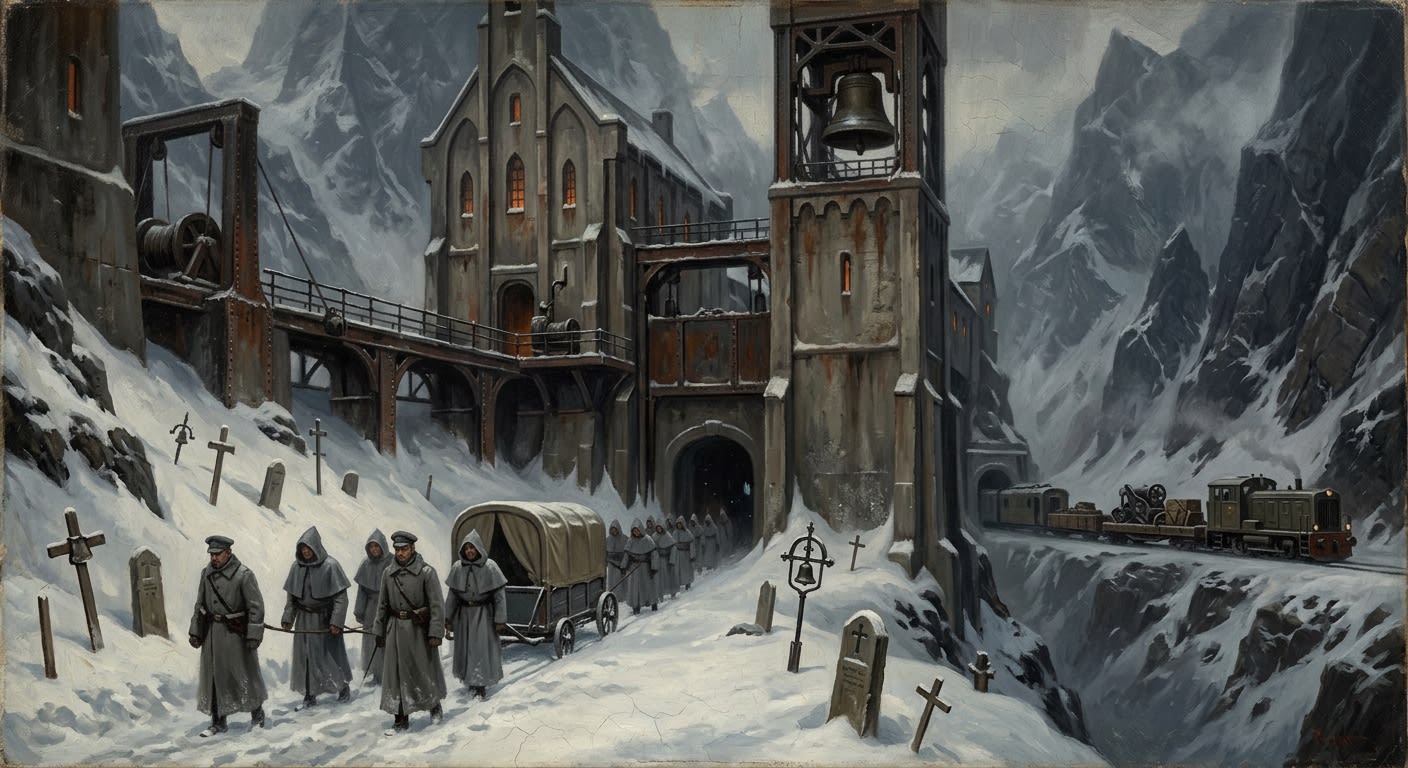
Swiss Cantons
Where mercy climbs uphill and stops writing back
The Swiss cantons keep passes, bells, hospice beds, and the Synod's most merciful disappearances beneath snow clean enough to indict Heaven.
Codex Ref. II.2.08-201

The Age of Heresy
A World Sundered, a Faith Forged in Fire
The definitive overview of the Age of Heresy — a continent sundered by demonic invasion, ruled by a theocratic bureaucracy of bells and ink, locked in eternal war against the Seven Sin-Generals. As compiled by the only man qualified to compile it.
Codex Ref. I.1.01-001
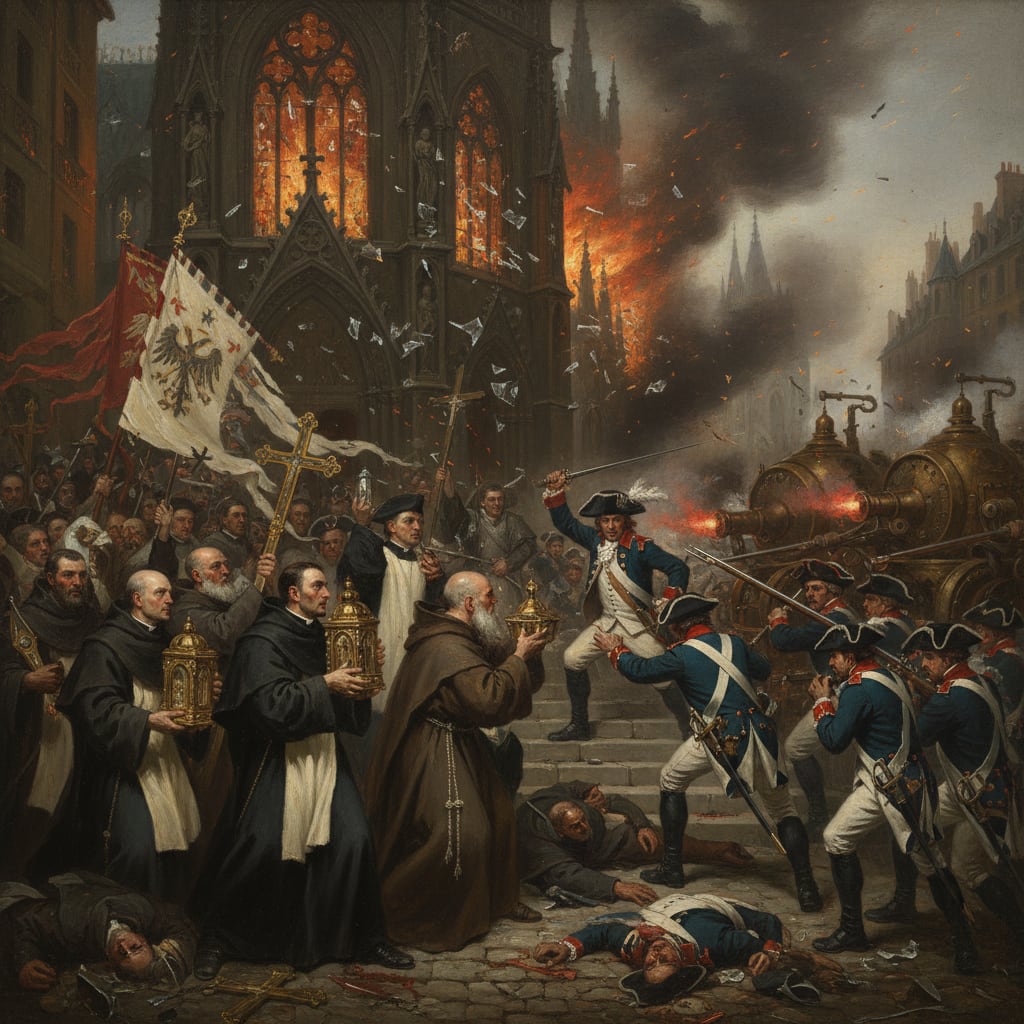
The Atheist Wars
When Reason Drew Steel and Faith Drew Blood
The two decades of continental civil war between the Rationalist Republic and the scattered faithful — a catastrophe so instructive that the Bureau requires its retelling in every catechism school, twice annually, with examinations.
Codex Ref. I.1.03-001
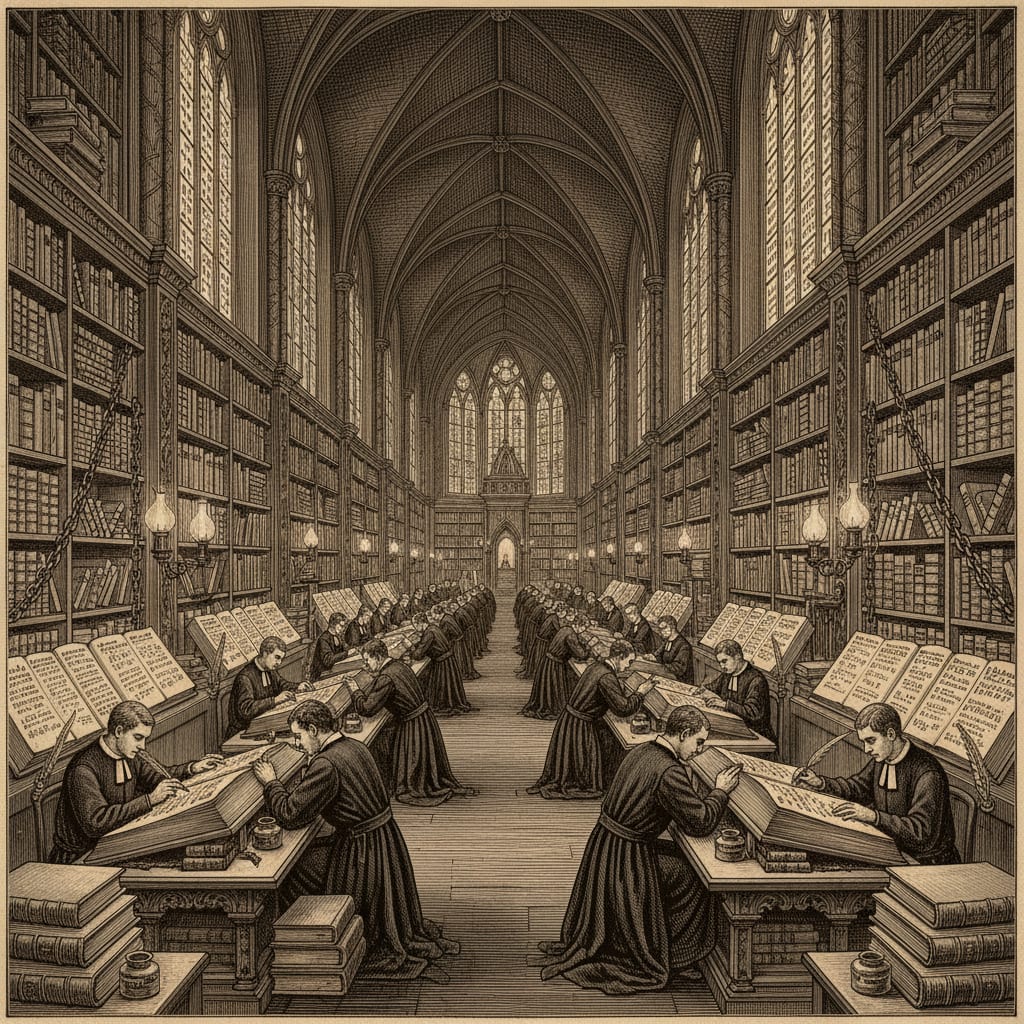
The Basilica of the Ledgered Saints
Archive of the Living and the Dead
The labyrinthine archive-basilica of Strasbourg, where every soul since the Council of Cologne has been inked in crimson. A nave of numbers, a vault of recantations, and a crypt that breathes.
Codex Ref. III.2.07-031
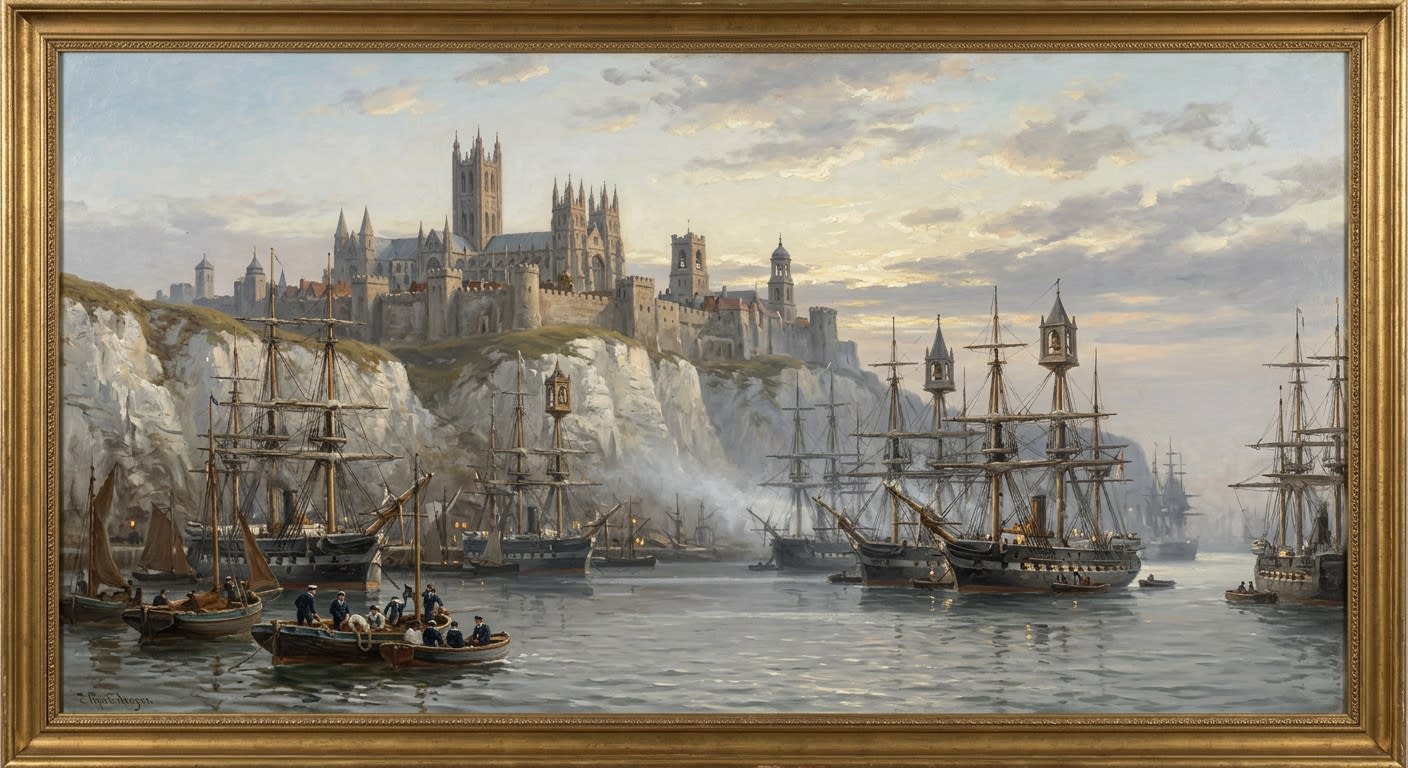
The British Crown
The island the Bureau has spent a hundred and eleven years failing to classify
The Zone 0 co-belligerent that has never submitted to the Concordat and never needed to. Canterbury governs by chivalric charter; three hundred Cathedral Ships hold the Channel; the Bureau of Doctrine considers this theologically embarrassing and strategically essential.
Codex Ref. X.1.01-001
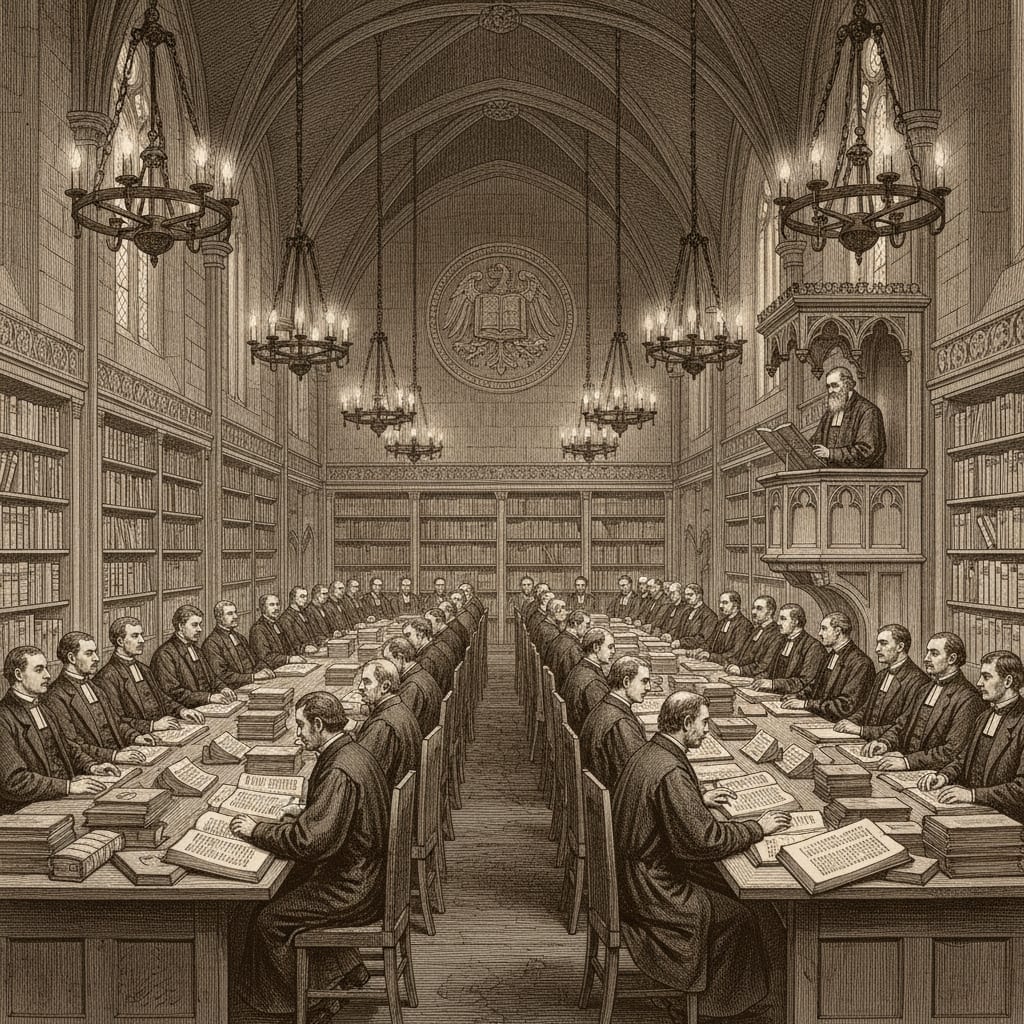
The Bureau of Doctrine
First Among Equals, Flame of Interpretation
The Bureau that defines what is true and what has never been true. Keeper of the Flame of Interpretation, drafter of every catechism, and executioner of every dialect that displeased it.
Codex Ref. III.3.01-024

The Bureau of Records
The Memory That Never Forgets
Custodian of every birth, death, tithe, and trembling confession in the Theocracy. Records does not merely remember — it decides what happened.
Codex Ref. III.2.09-003
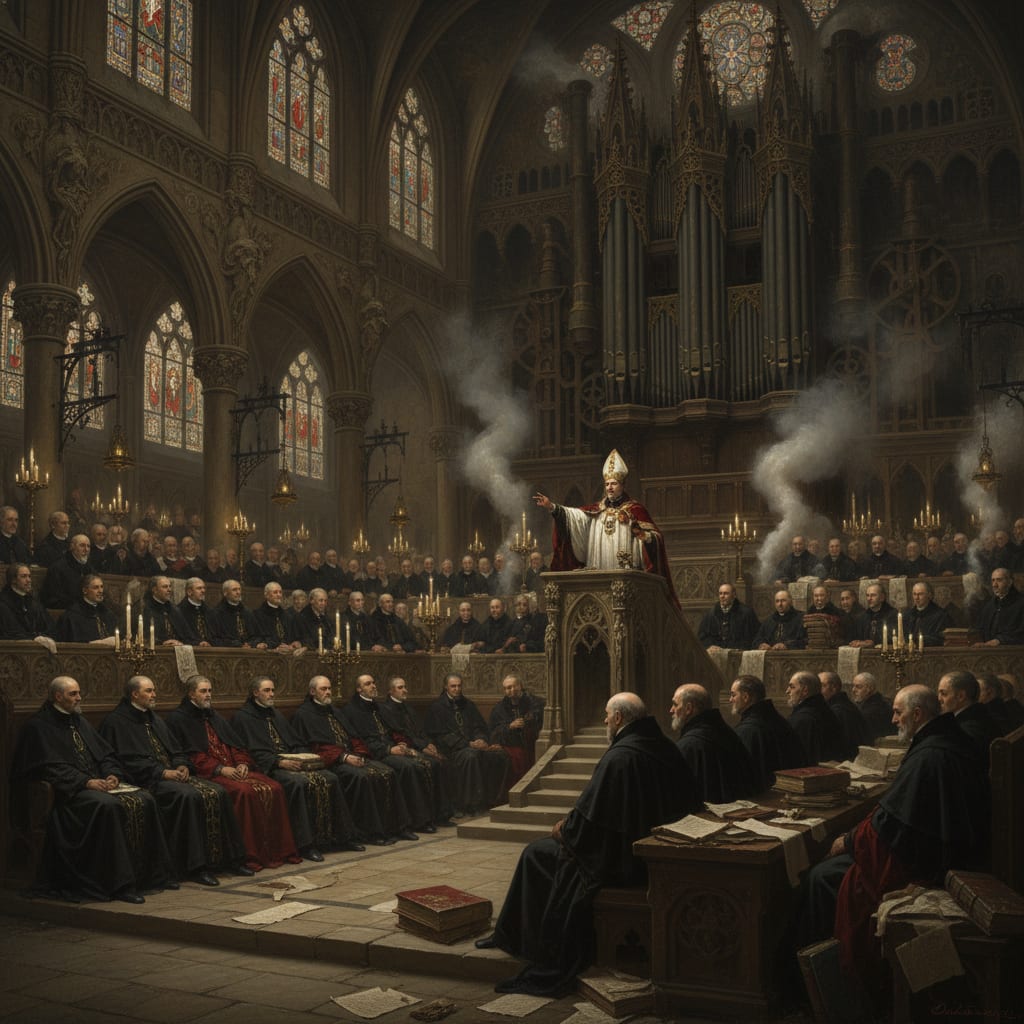
The Bureaucratic Synod
Throne and Altar, Quill and Sword
The ruling theocracy of Europa — born in blood, forged in ink, and maintained by a bureaucratic apparatus so vast that even its own clerks cannot map its full extent. As explained by its finest servant.
Codex Ref. I.3.01-004
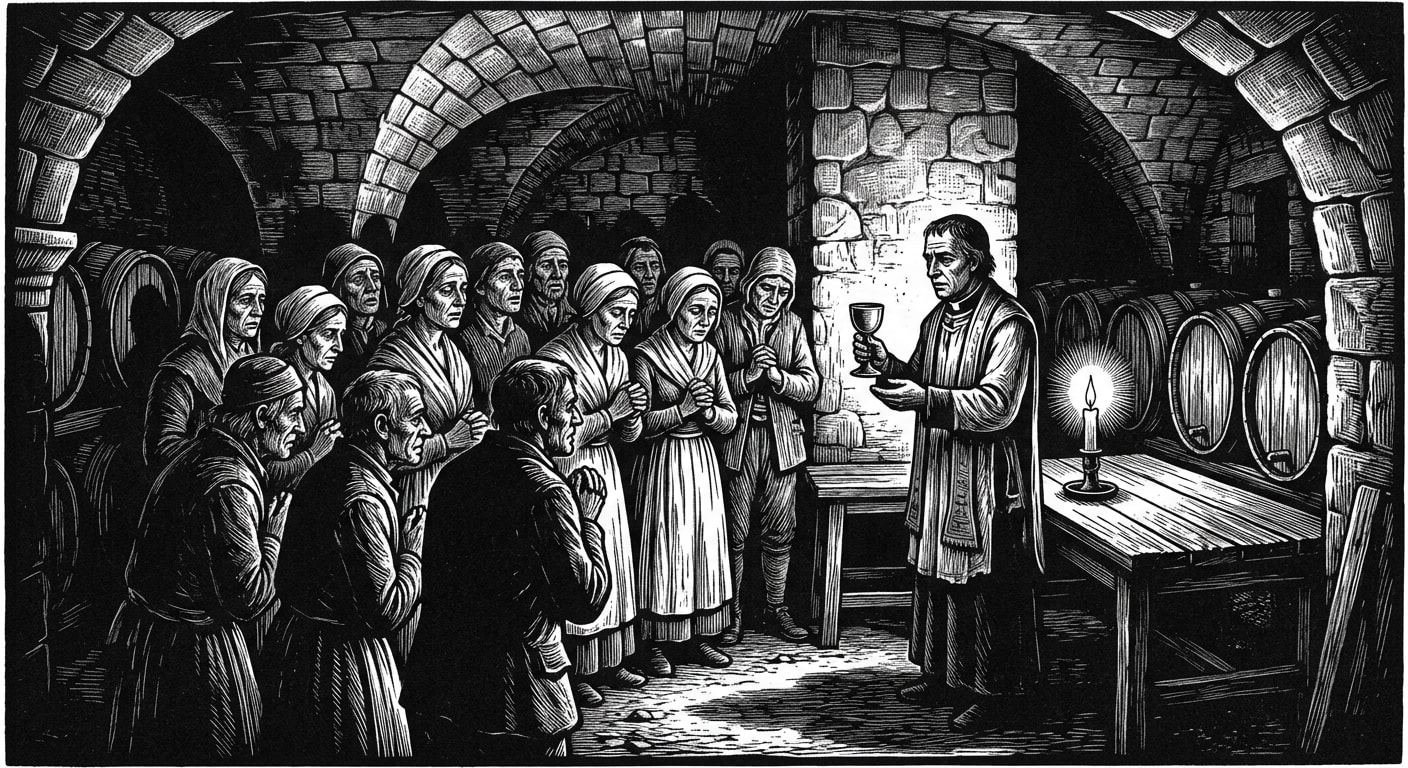
The Cellar Saints
Those who hid in basements built the floor on which the Synod stands.
The frightened faithful who descended into cellars and catacombs when Reason conquered Europe, preserved the relics, and became the soil from which the Synod grew — whether they consented to the harvest or not.
Codex Ref. IV.2.14-003
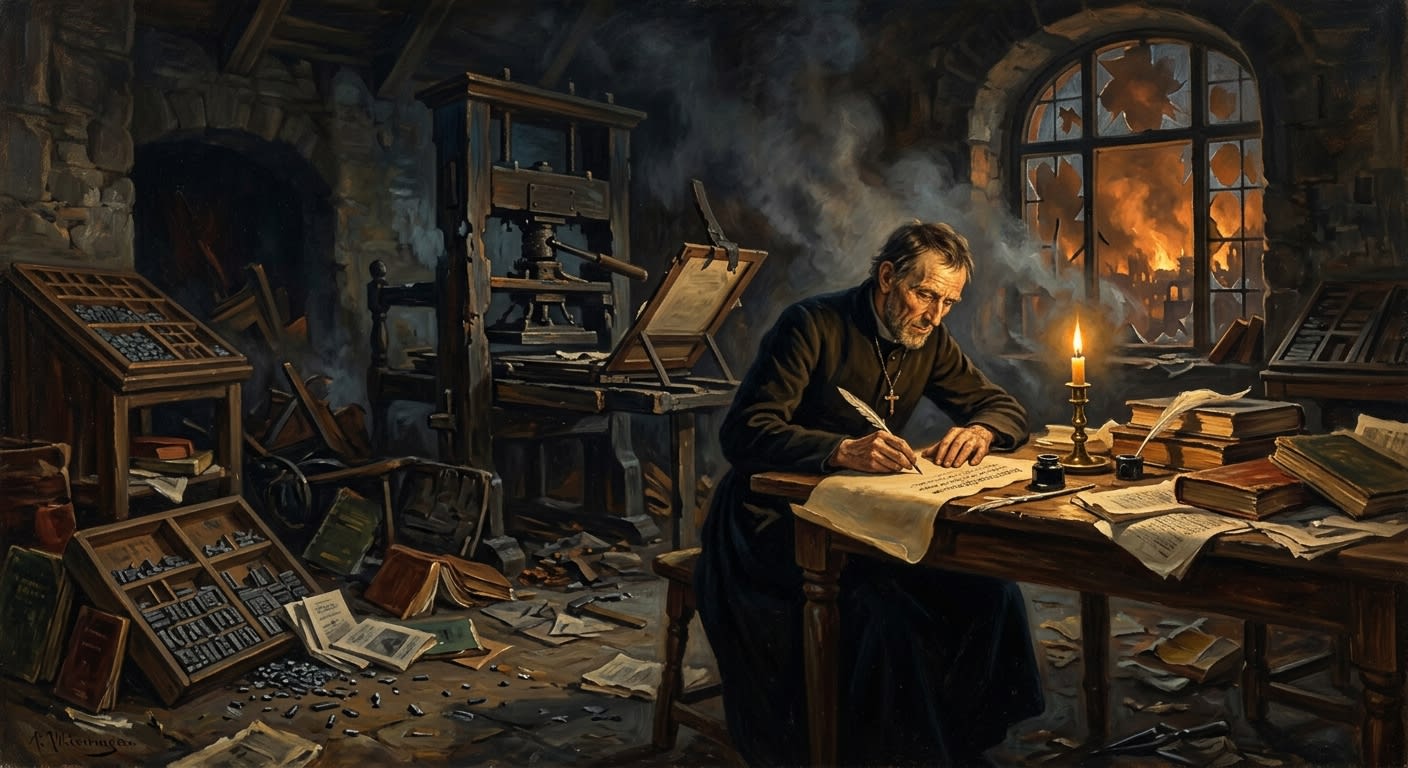
The Common Allegiance
Seven pages that ended the age of a thousand altars
Drax examines the seven-page A.S. 55 charter that bound dioceses through local subscriptions and helped build the authority later formalized at Strasbourg.
Codex Ref. VI.5.01-001
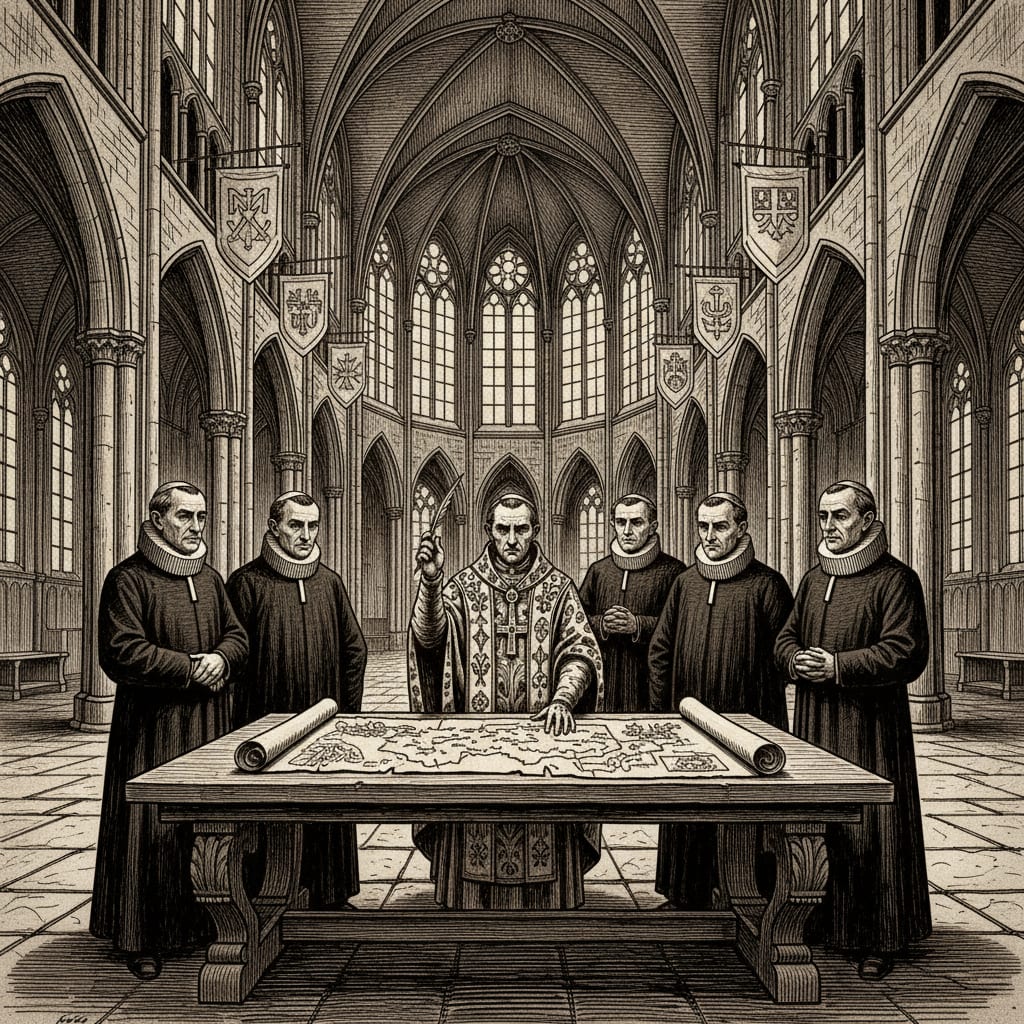
The Concordat of Strasbourg
The A.S. 90 constitutional settlement
The binding of France, Iberia, and the Rhineland into one sacramental polity — the act that turned a wartime council into a continental throne and adopted the Synod's calendar retrospectively.
Codex Ref. III.1.02-003
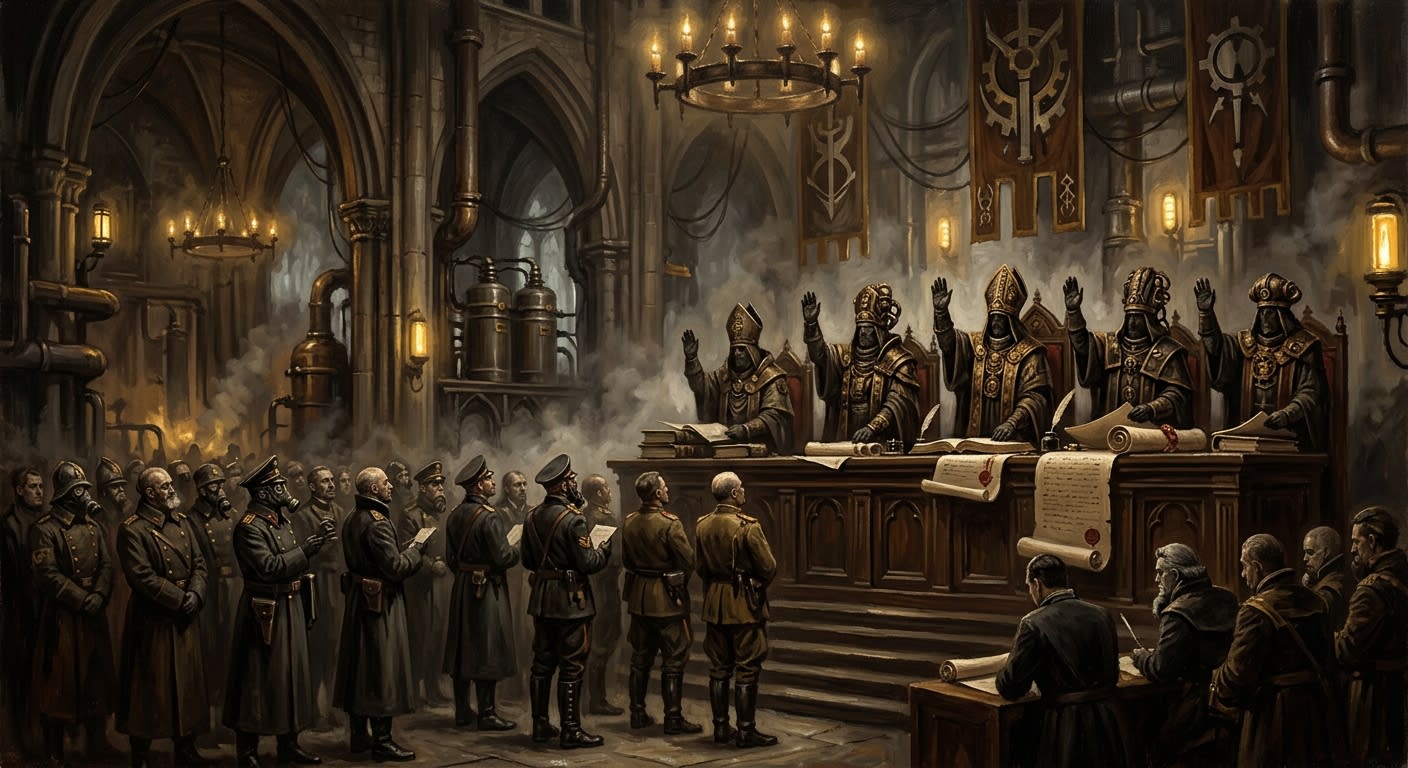
The Council of Mainz
Where law learned to cheer on command
The Council of Mainz confirmed the first seven Hierarchs in A.S. 93, turning Concordat law into staged acclamation, ratified offices, and obedient witnesses.
Codex Ref. VII.7.02-001
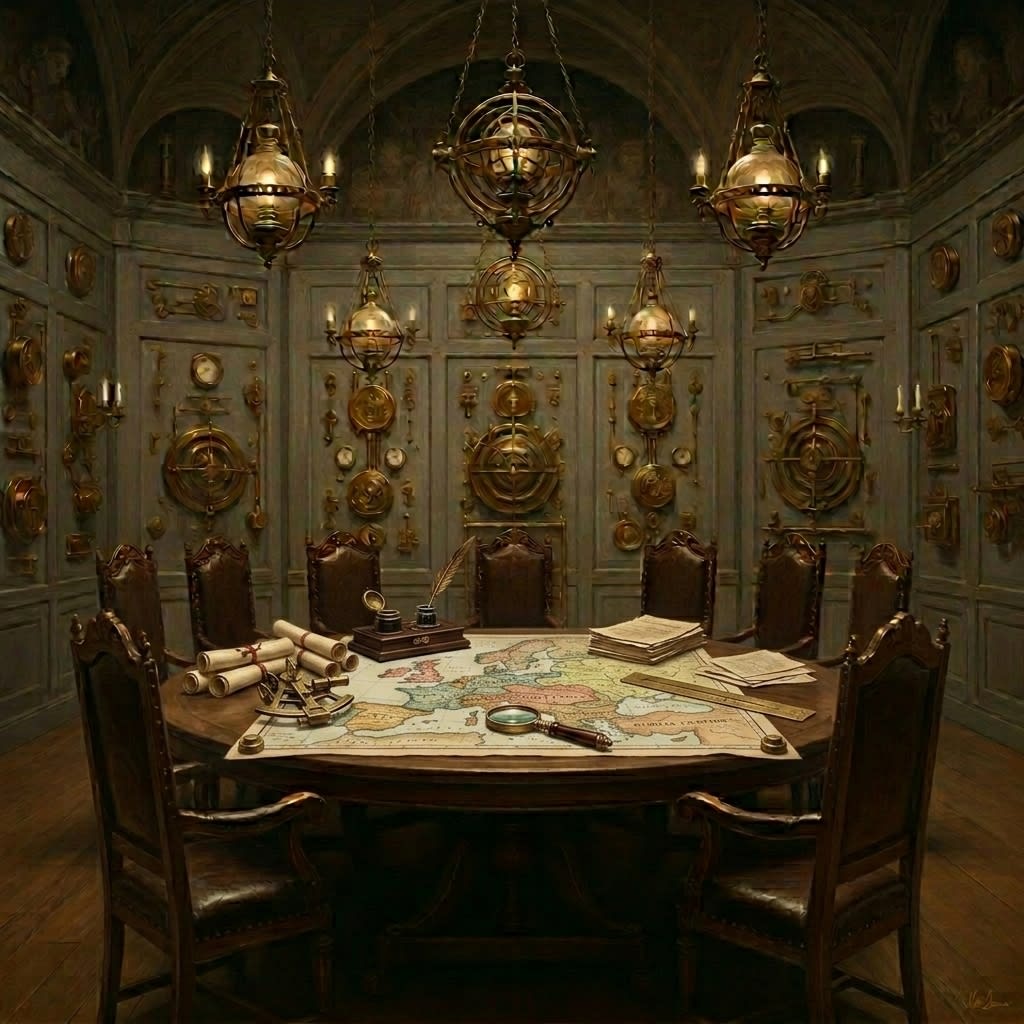
The Council of Nine Rationalists
Nine men governed Europe. Their names are sealed. Their methods are retained.
The sealed governing body of the Rationalist Republic — nine nameless men who administered a continent for fifteen years with instruments of measurement, mass surveillance, and the removal of tongues, until the Sundering settled the argument for them.
Codex Ref. I.1.03-001
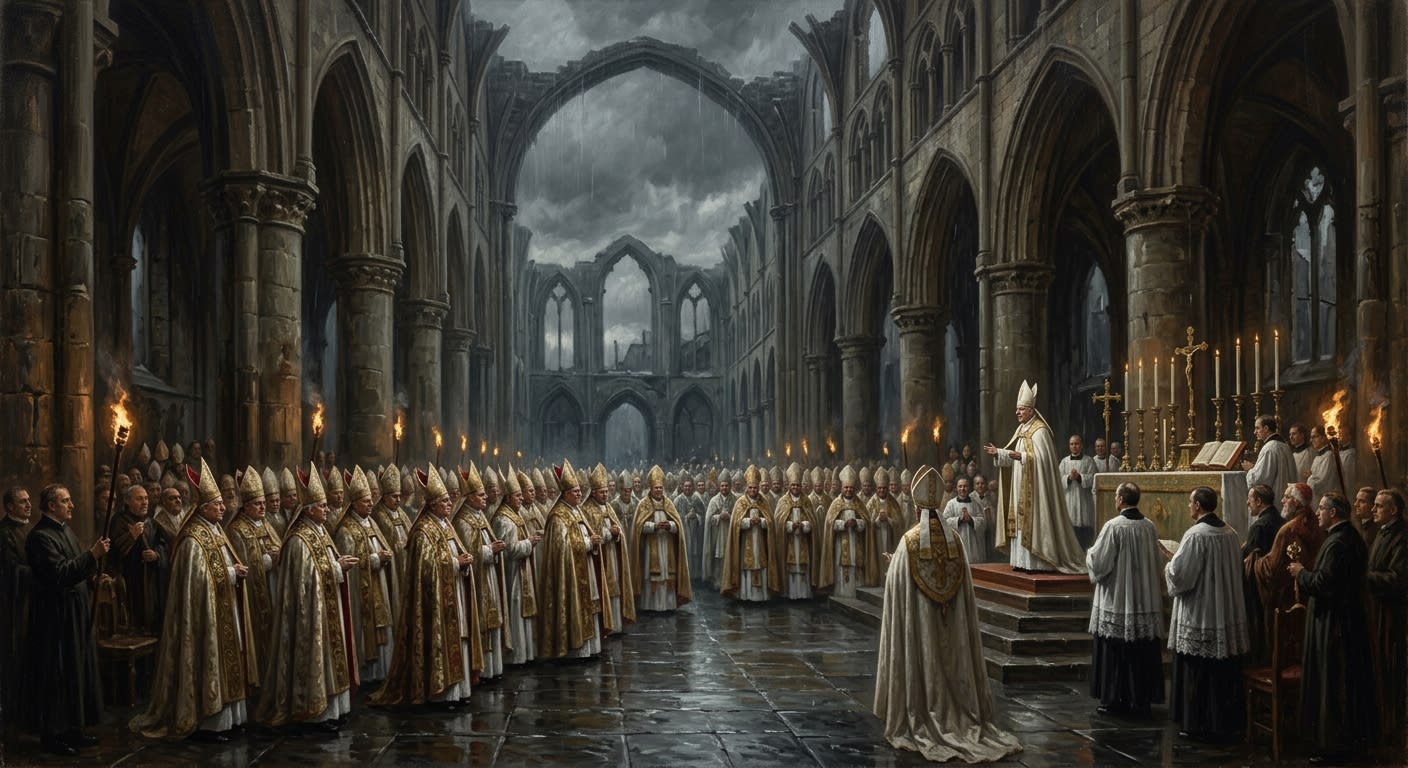
The Council of Worms
Where Paper Became Law, and the Seals Forgave No One
The A.S. 87 council in roofless Worms Cathedral ratified the earlier Common Allegiance; its register lists 314 names, including 25 with defective seals.
Codex Ref. VII.7.01-001
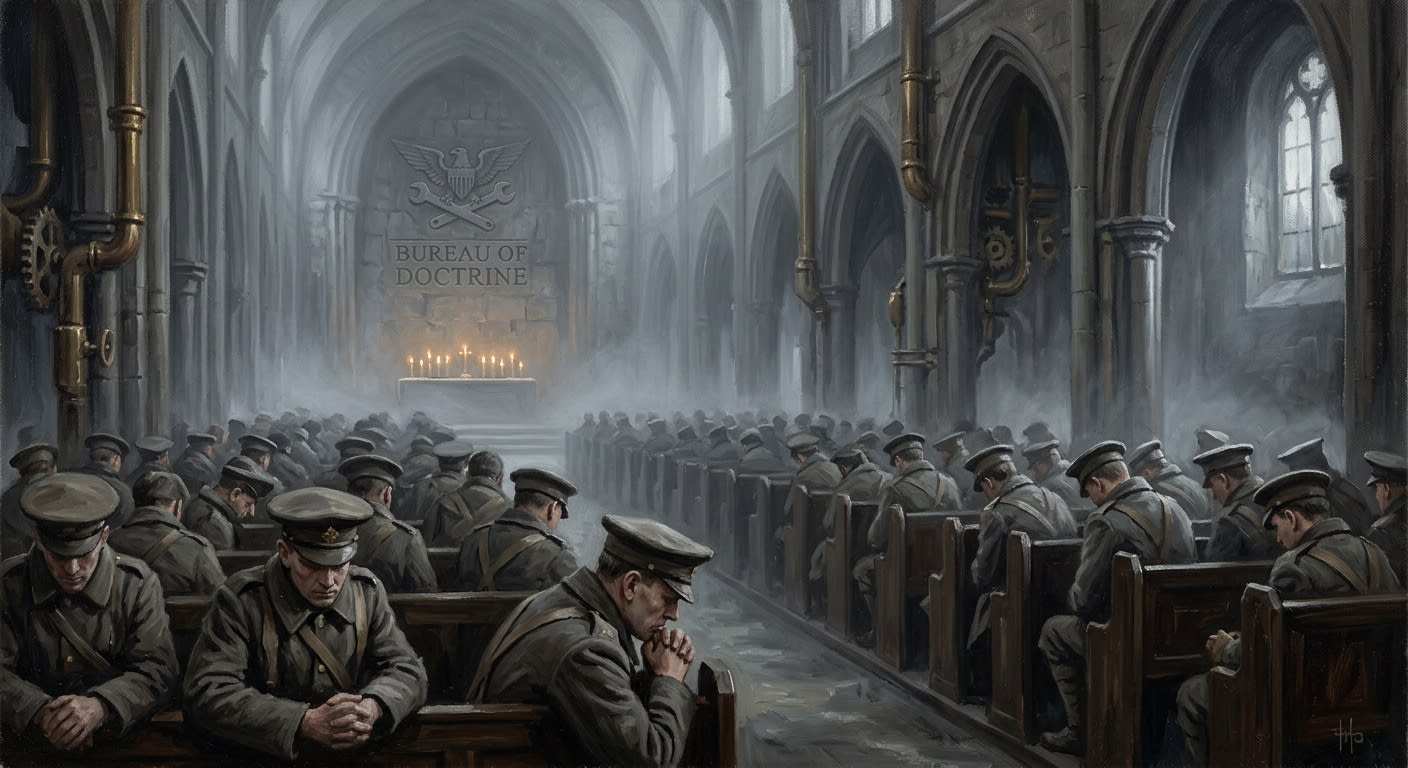
The Creator
The Bureau has two words for the most important question in theology. This entry contains both of them.
A doctrinal entry on the Creator composed by Hieromnemon Drax under compulsion, covering divine nature, the Silence, the inconvenience of miracles, and four forbidden heresies the Bureau insists do not exist.
Codex Ref. VI.1.01-001
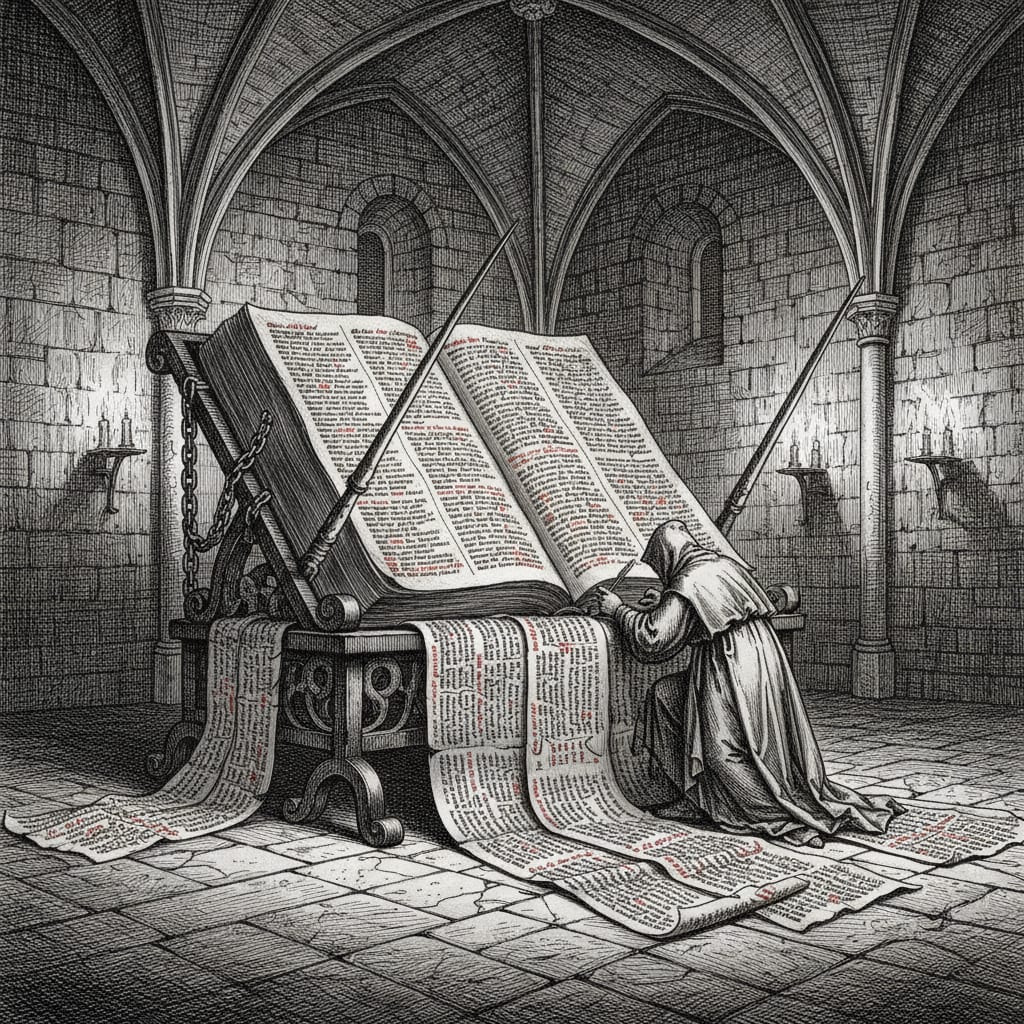
The Great Ledger of Souls
Census of the Living, Archive of the Damned
The Bureau of Records' supreme instrument of spiritual governance — an unbroken registry of every baptized soul since A.S. 80, kept in the subterranean vaults of Strasbourg, where forgetting is treason and being forgotten is worse.
Codex Ref. IV.1.09-003
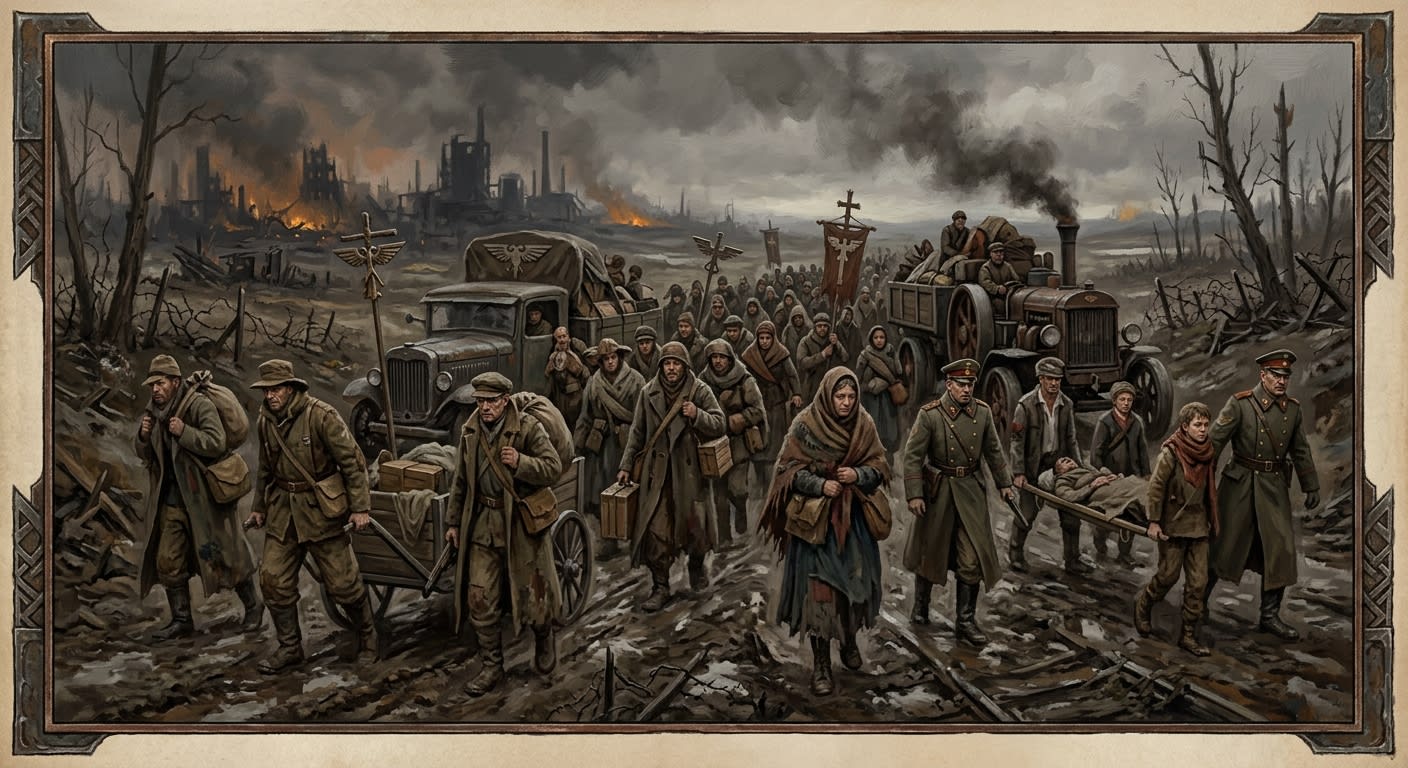
The Great Retreat
Seventeen years of westward mud before the Line learned to stand
From A.S. 48 to A.S. 65, the faithful West walked, bled, improvised institutions, and finally stopped running where the Sagittal Line began to hold.
Codex Ref. VII.1.03-001
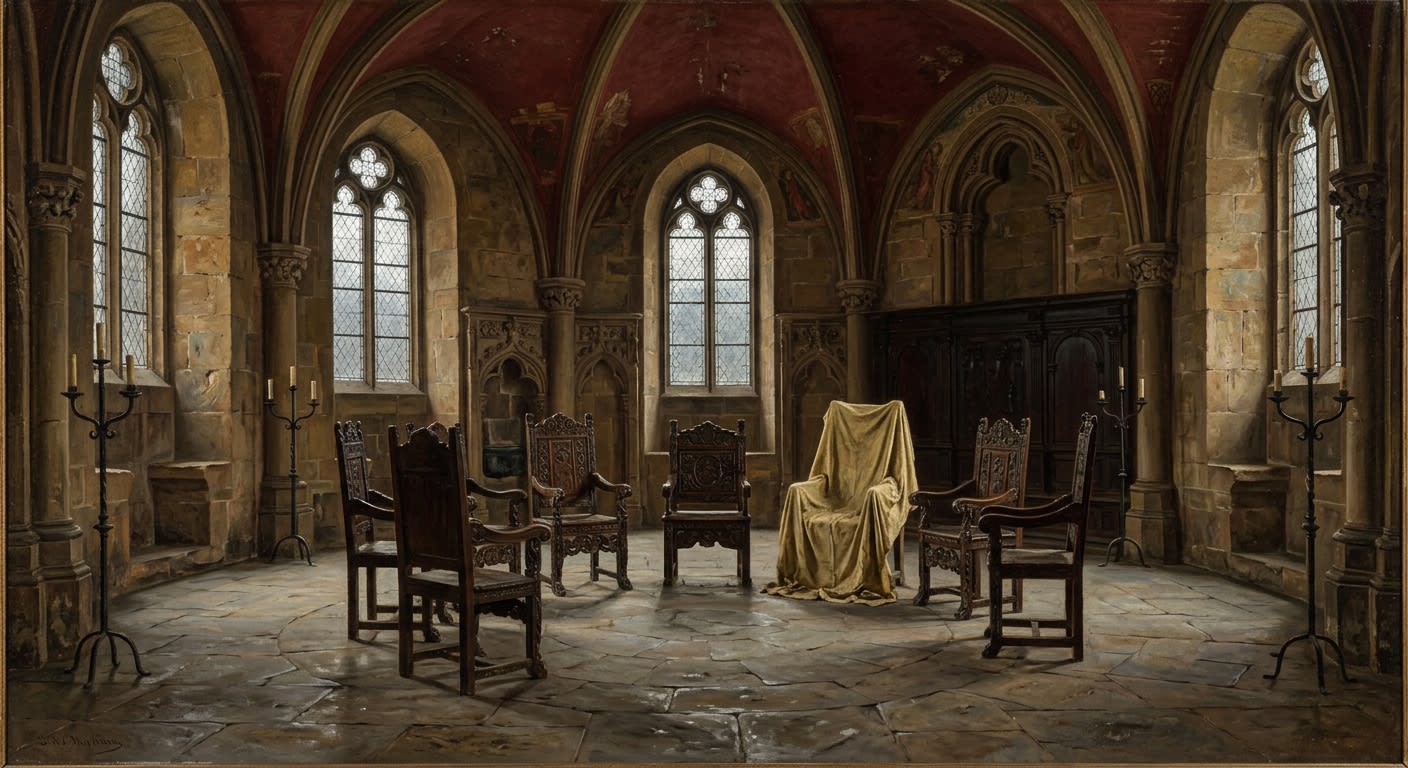
The Hierarchy of the Synod
Seven Seals, Six Occupants, and a Chair No One Has Laundered Since A.S. 107
Seven Seals. Six occupants. One chair draped in cloth no one has laundered since A.S. 107. The succession is continuous. The gaps are classified.
Codex Ref. VI.3.02-001
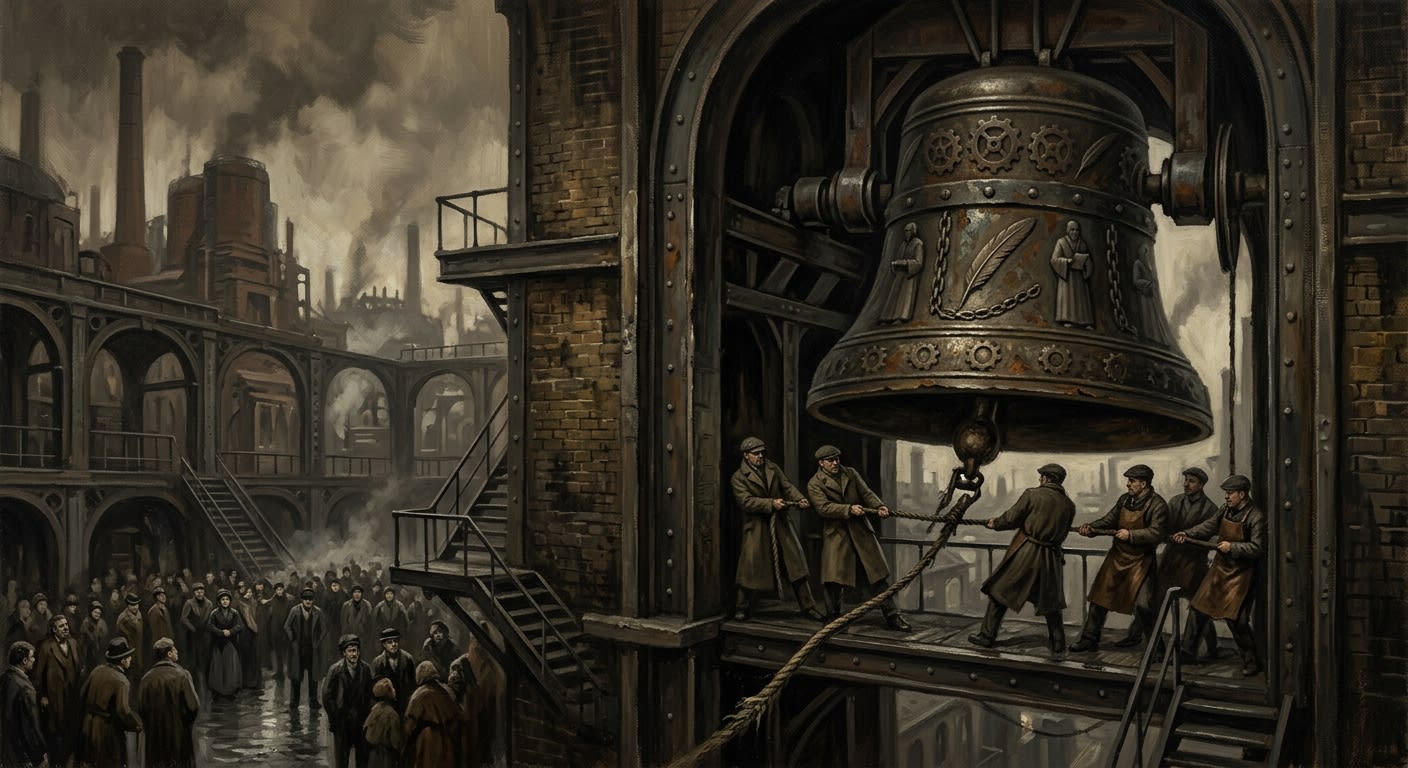
The Leviathan
The war bell of Strasbourg, too large for mercy and too honest for politics
Leviathan is the fourteen-tonne war bell of the Tower of the Quill, tolled eleven times since A.S. 92 when history required bronze to shout.
Codex Ref. XIII.1.72-004
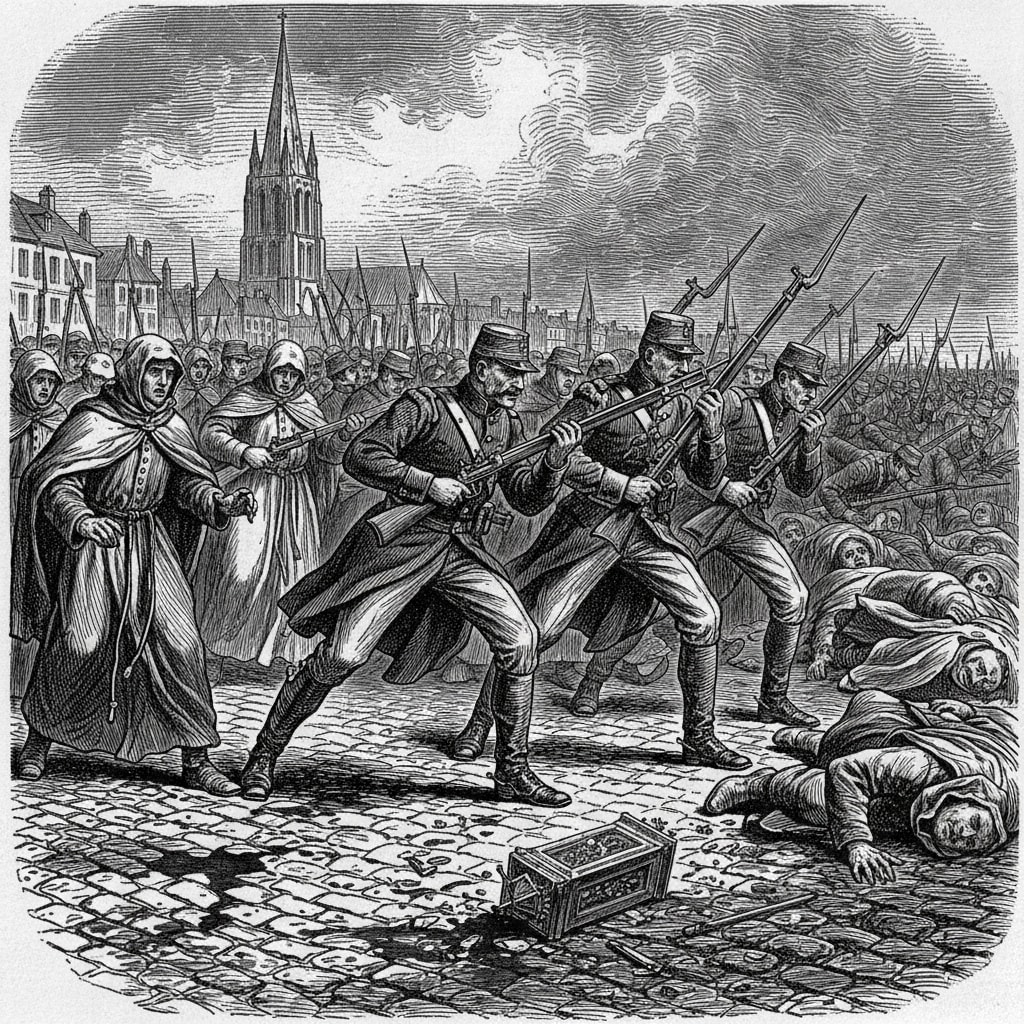
The Massacre at Saint-Malo
The First Blasphemy of Steel
The slaughter of unarmed pilgrims by Republican Guards on the cobblestones of Saint-Malo — the Thunderclap that silenced Reason's pretence of civility and gave Faith its war.
Codex Ref. I.1.03-007
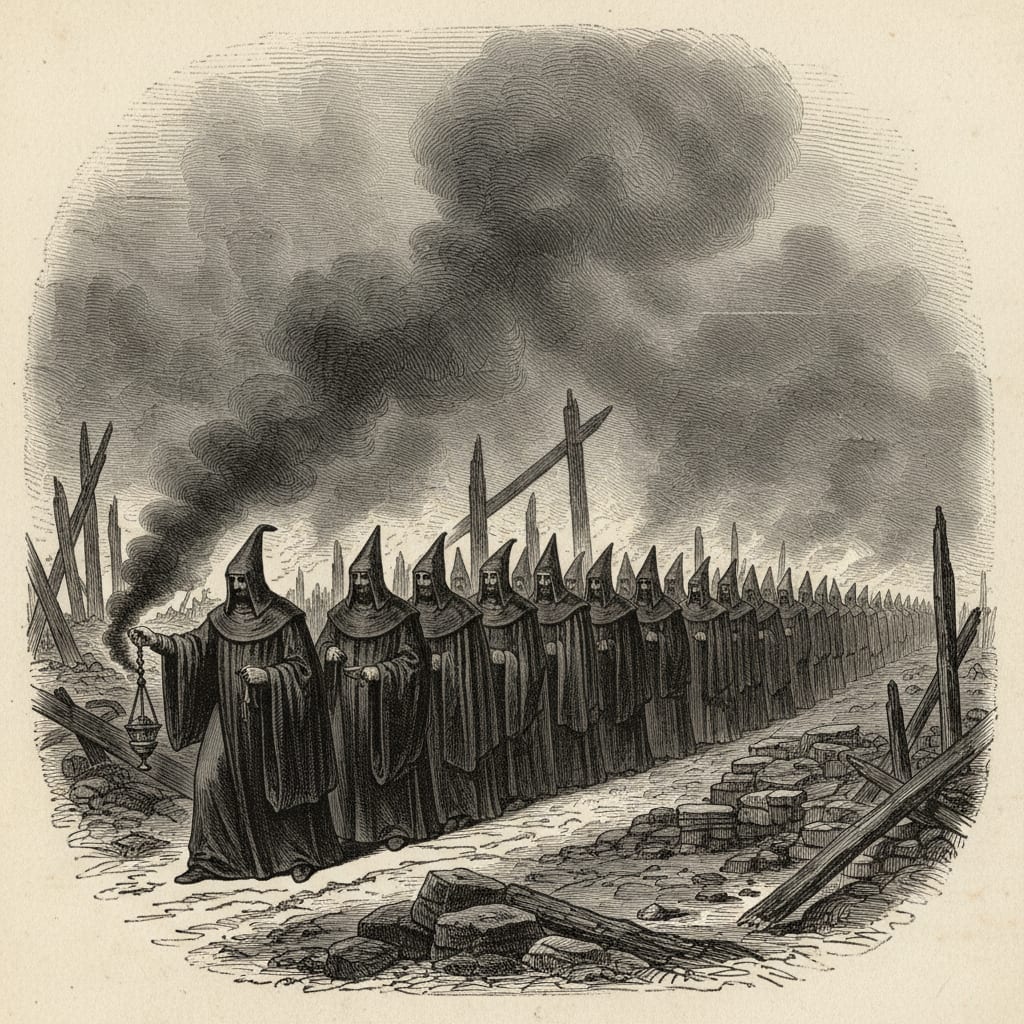
The Order of Ash
Liturgists of Fire, Archivists of Cinder
The Inquisition's first and fiercest instrument of annihilation. Where the Ashmen pass, the well-stones glass smooth and the children's slates bake into reliquaries of obedience.
Codex Ref. III.3.06-041
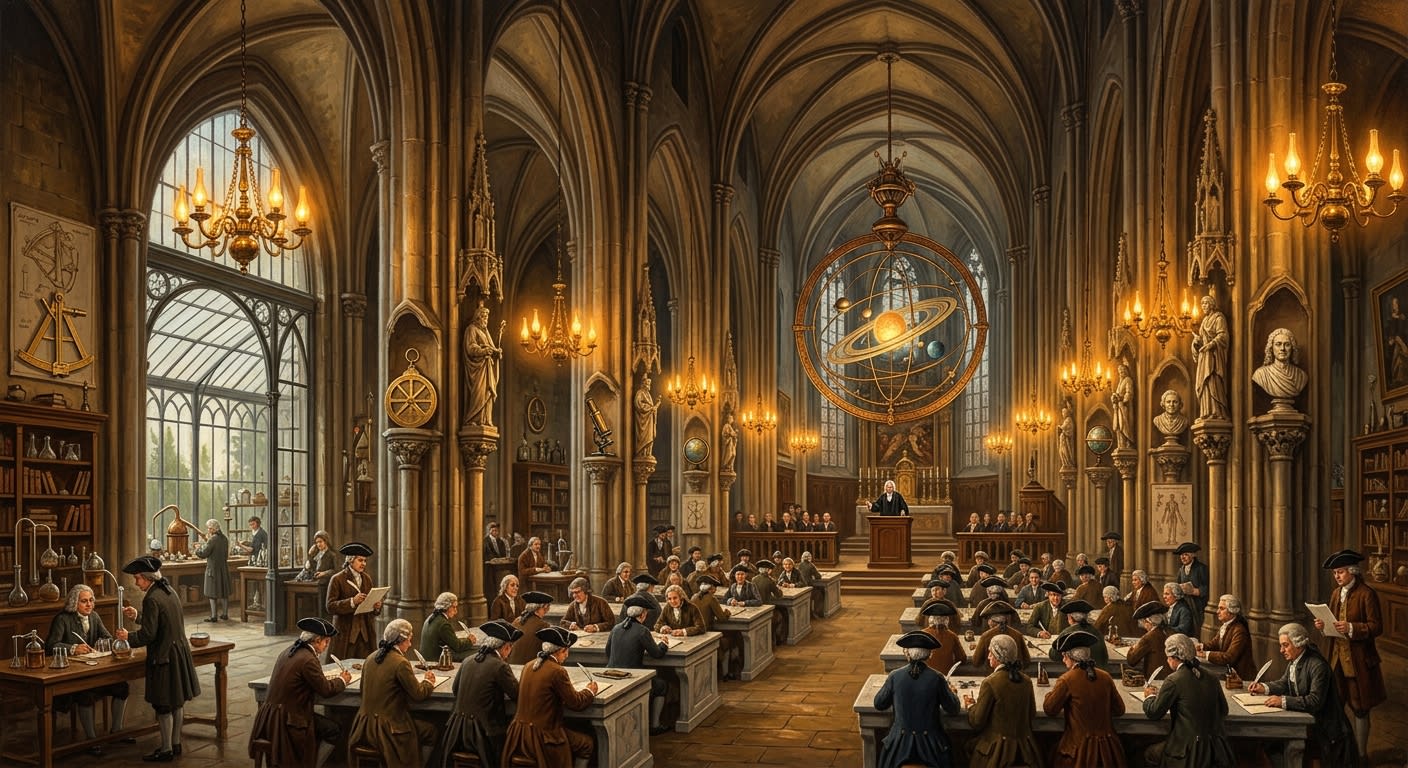
The Rationalist Republic
Fifteen Years of Continental Supremacy, and the Precise Nature of Its Correction
Rationalist institutions predated Regensburg; the Republic's A.S. 30–45 continental supremacy expanded prefectures, census rolls, and repression before central command collapsed at the Sundering.
Codex Ref. I.1.02-001
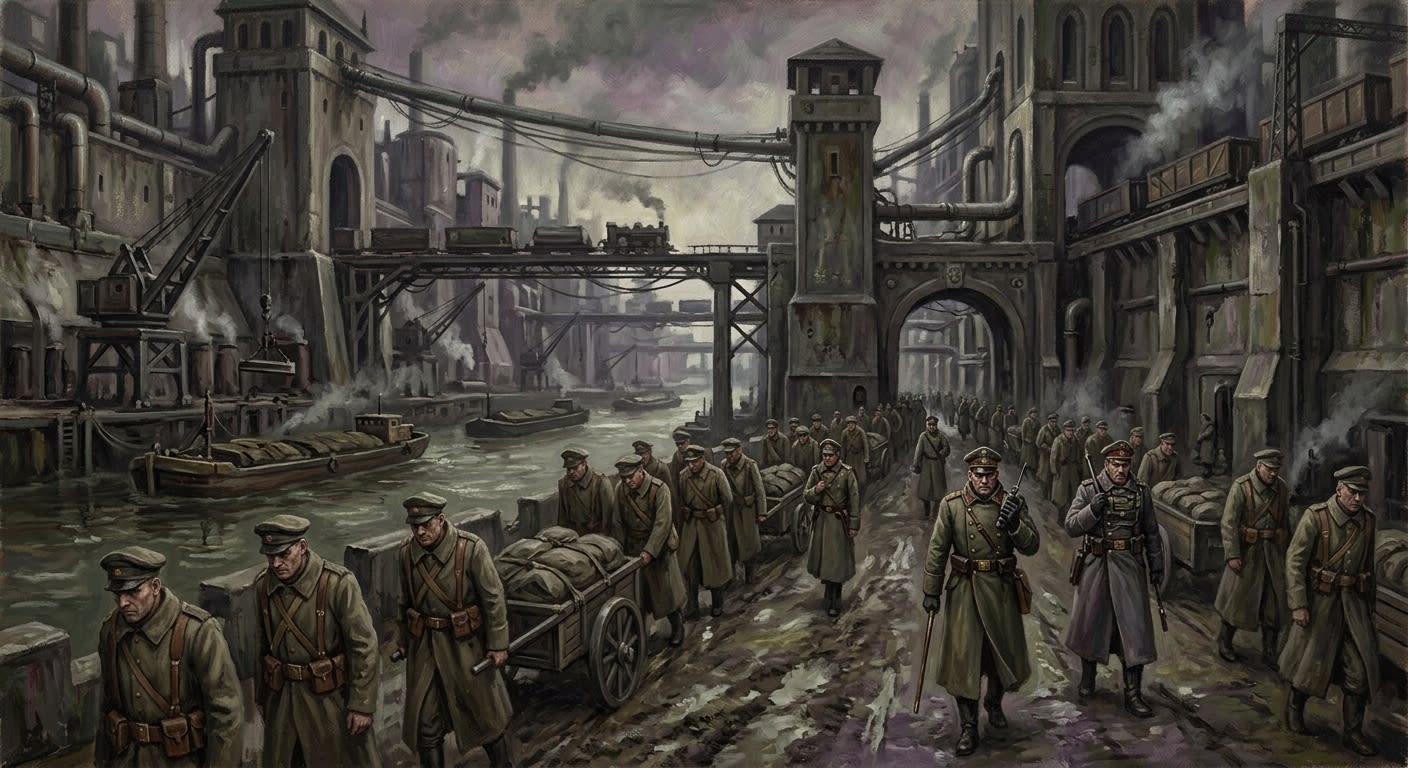
The Rhine Corridor
Damp procedure, counted backward from every bridge
The Rhine Corridor is the Synod's damp procedure: a Zone 2 logistics artery, mortuary road, ferry court, heresy school, and billable proof that movement can be made afraid.
Codex Ref. II.2.08-202
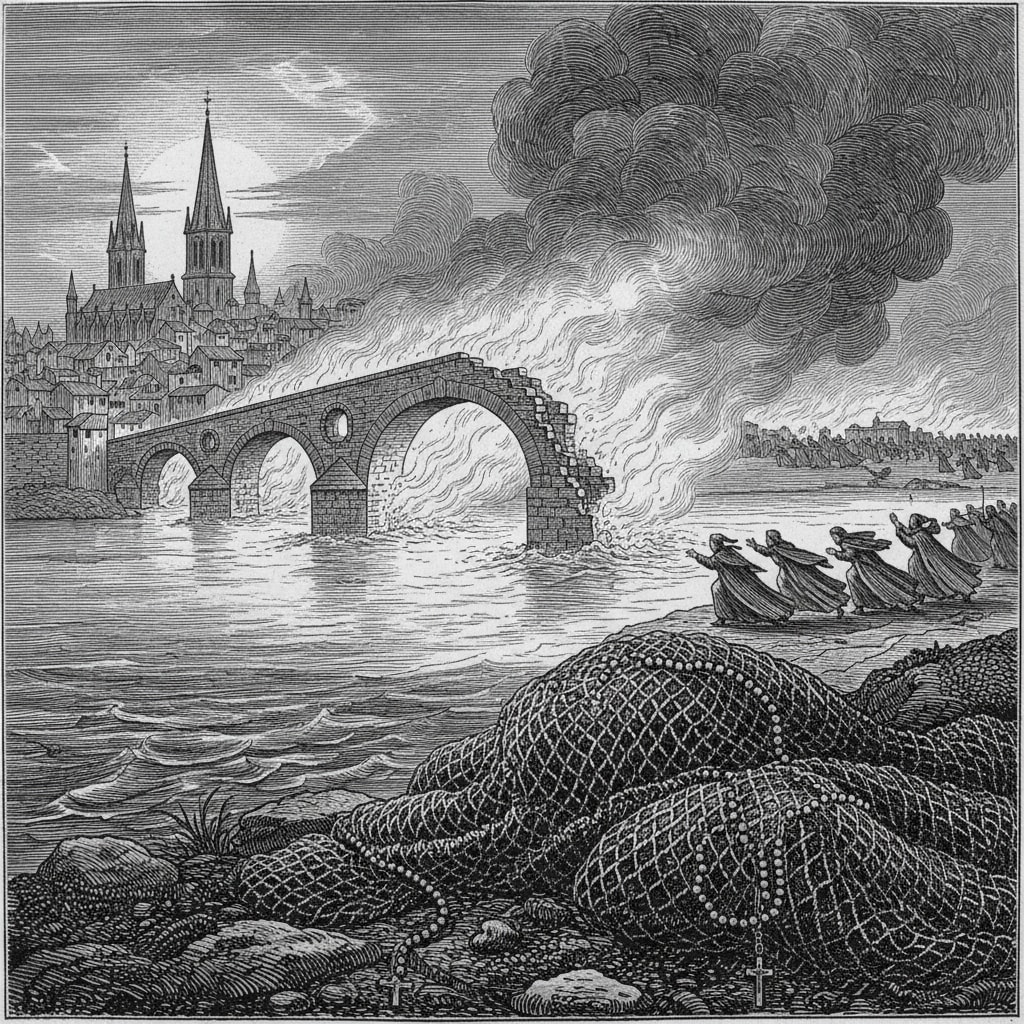
The Schism of Avignon
On the Rival Pontiff, the Drowned Crown, and the Rosaries That Will Not Stay Buried
The clerical secession of A.S. 111, in which a rival pontiff was crowned beneath the Rhône and Avignon was razed so thoroughly that its stones now form staircases in Strasbourg — a crisis requiring three stamps of denial.
Codex Ref. III.2.07-001
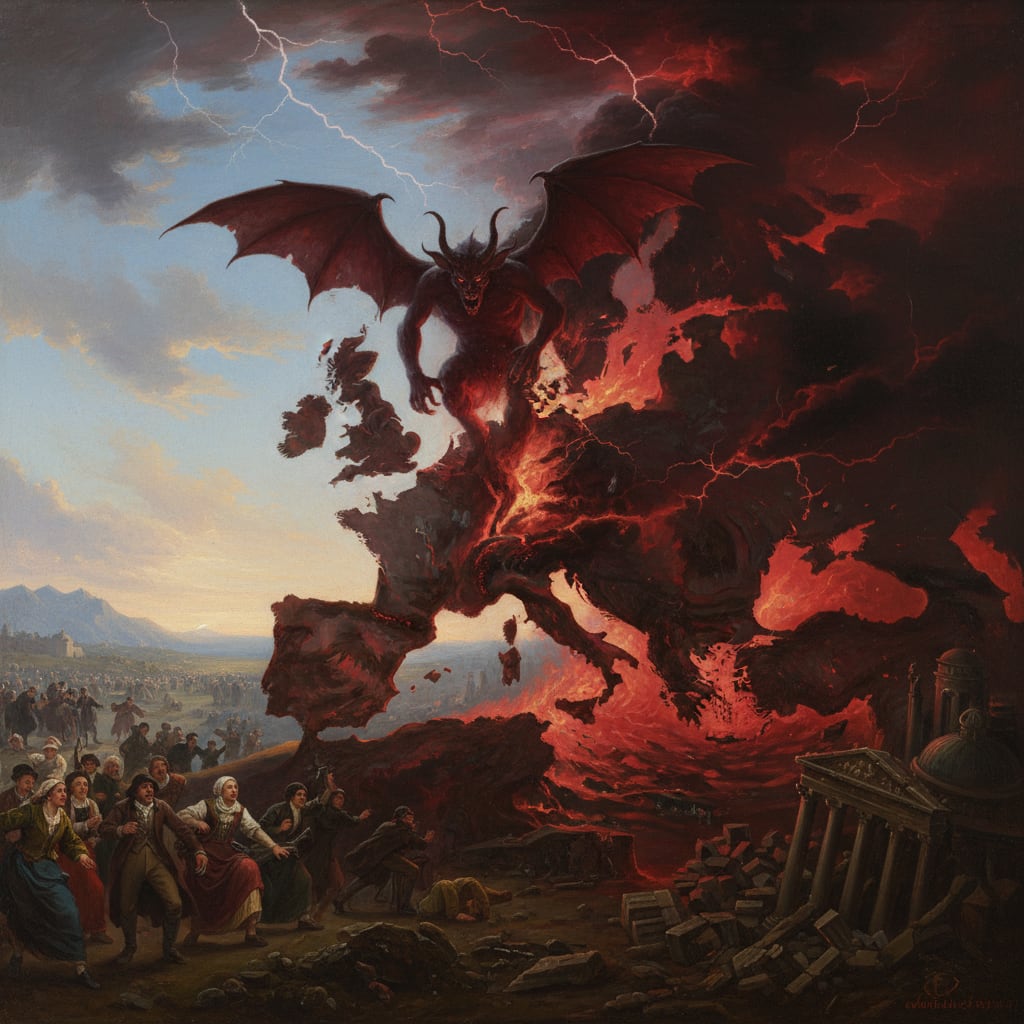
The Sundering
The Day the World Cracked Open and the Creator Sent His Invoice
The cataclysm of 1 November, 45 An.S. — when the Balkans erupted and the legions of the Great Deceiver poured through the wound in Creation. The event that ended Reason and birthed Faith's second coming. As explained by the only man whose explanation matters.
Codex Ref. I.1.02-001
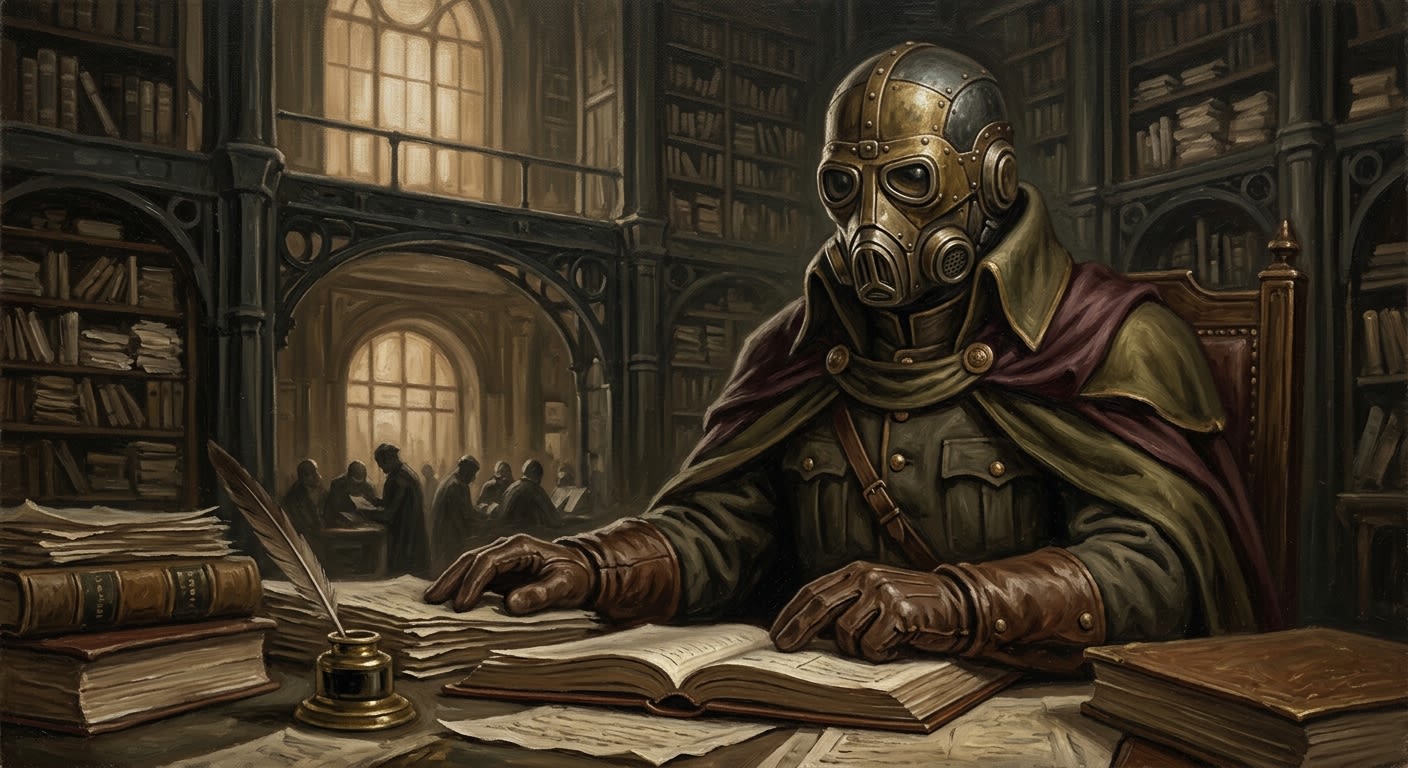
The Third Hierarch
A nameless mitre, a moth-eaten reign, and the file that knew too much
The Third Hierarch is an ordinal with no name, no portrait, and one surviving achievement: Saint Aldebrand's file vanished under his reign.
Codex Ref. XIII.1.05-002
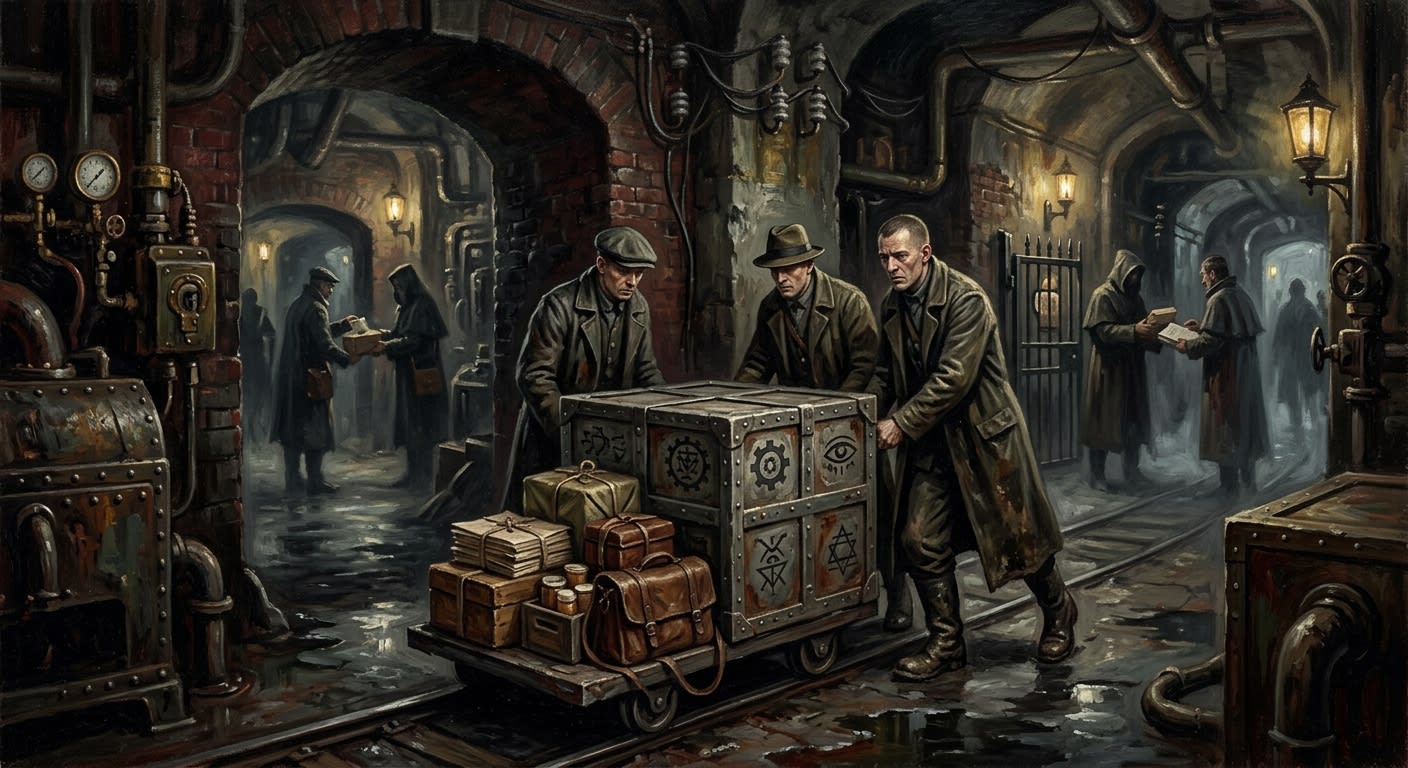
The Thread
The quiet line by which bones, names, and suspicion crossed the dark
Informal Cellar Saint transit doctrine that moved relics, names, wafers, and warnings through trusted cellars from A.S. 30 until the Sundering tore the roads open.
Codex Ref. XIII.1.91-045
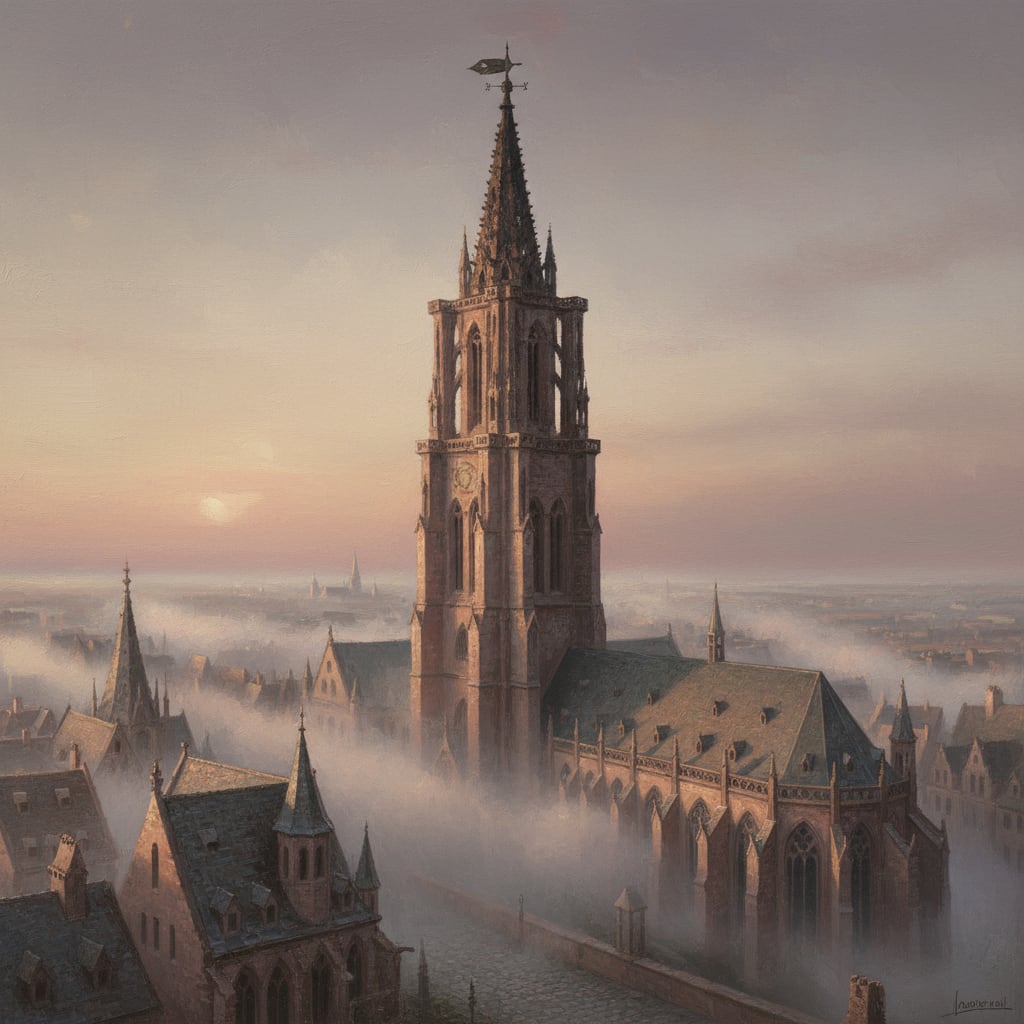
Tower of the Quill
The tallest structure in Strasbourg, which is to say the world, which is to say the matter is settled
Seat of the Bureau of Doctrine and tallest structure in Strasbourg, commissioned in A.S. 92 by successor authorities. Three bells, a classified gallery, and a sealed archive beneath the flagstones.
Codex Ref. II.1.04-001
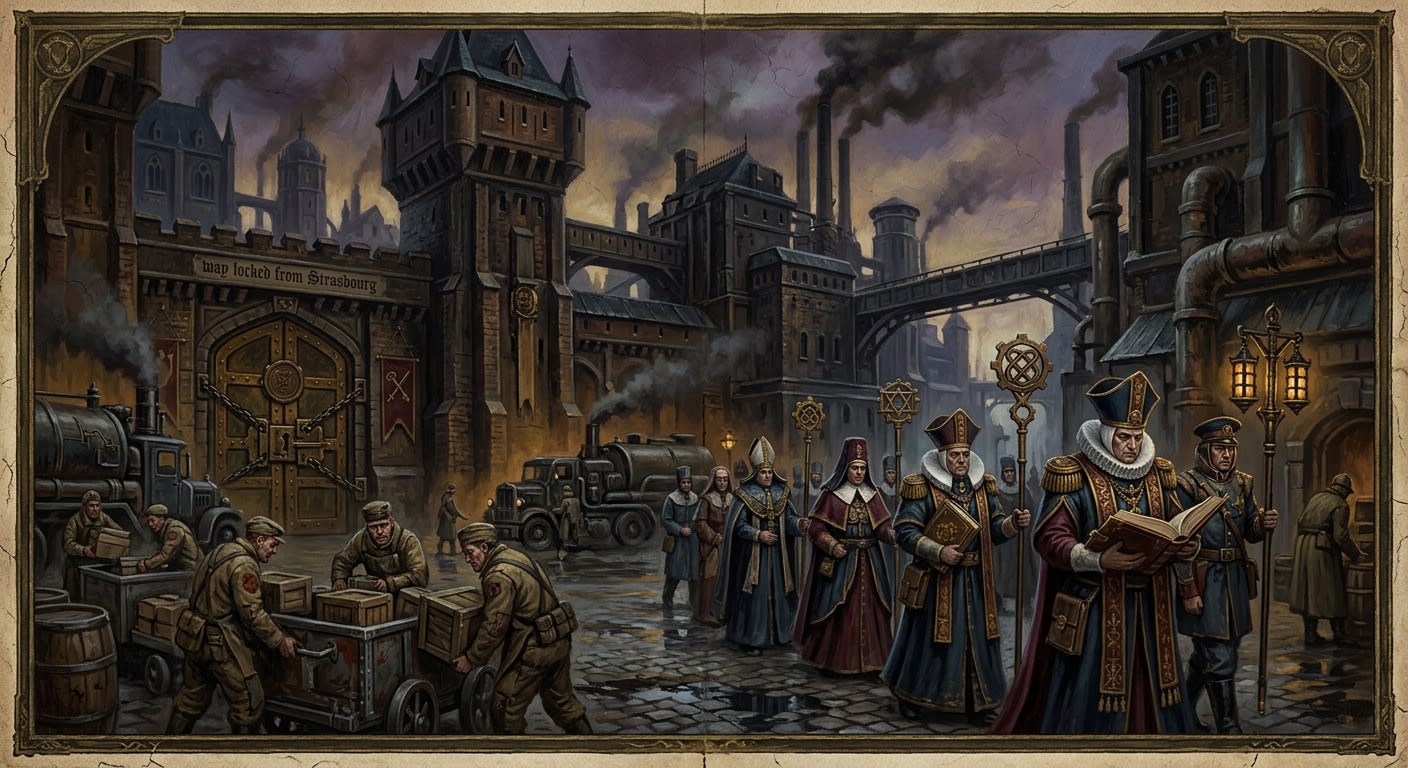
Triune Hearth
Three old bodies, one chimney, and Strasbourg holding the poker
The Triune Hearth binds France, Iberia, and the Rhineland into one Synodal household: warm in sermon, hungry in ledger, and locked from Strasbourg.
Codex Ref. XIII.1.04-090
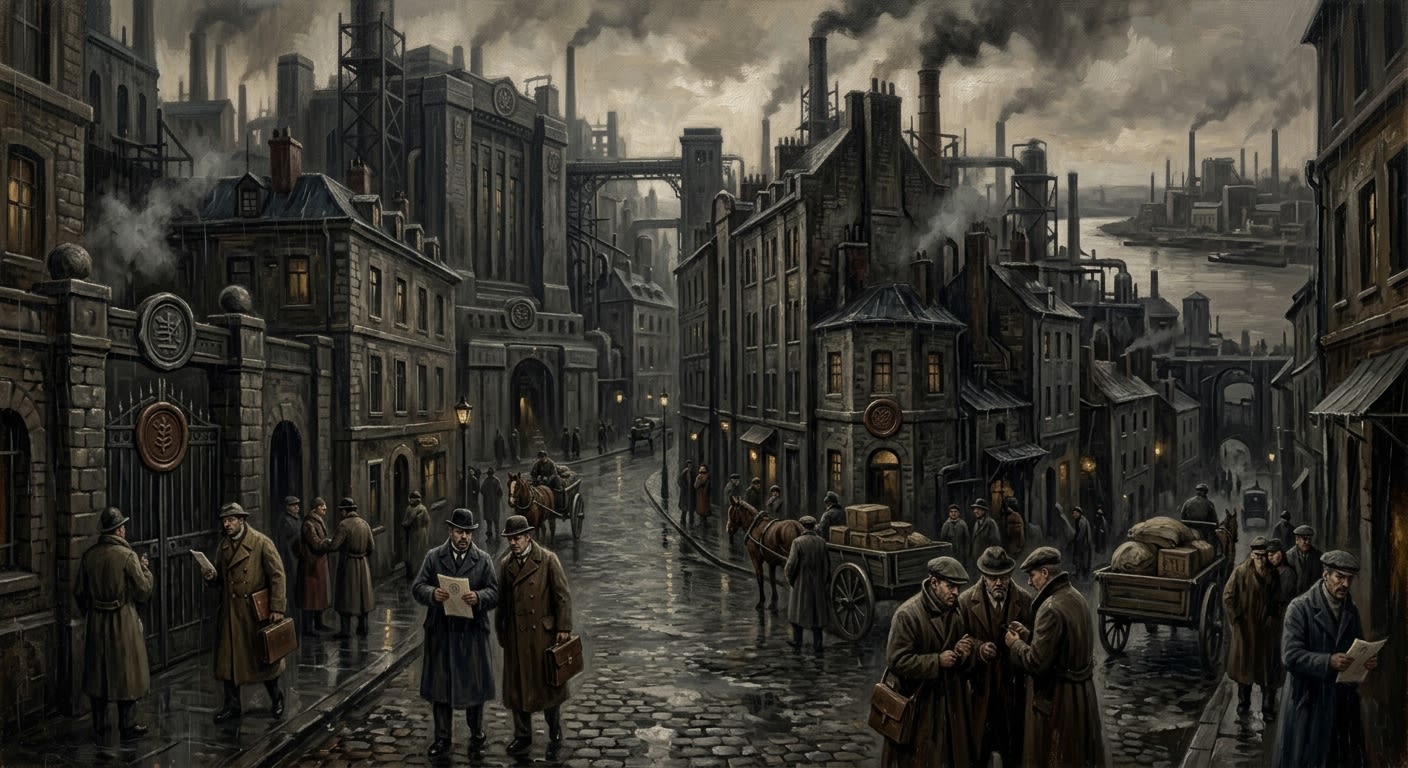
Worms
Where broken things become binding
Worms is the Rhineland city where absence became evidence, rain became residue, seals became law, and a name became a warning.
Codex Ref. II.2.09-087