
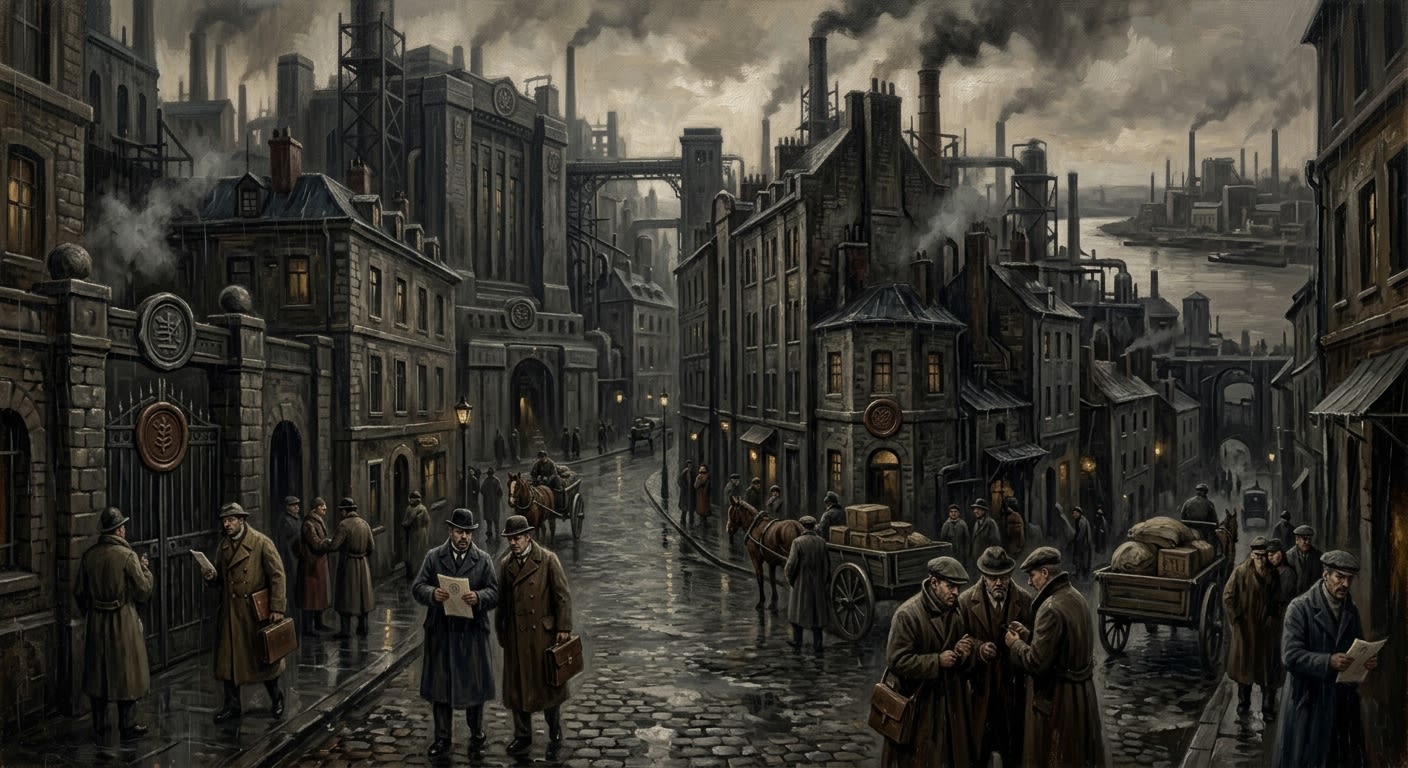
#On the City That Survived Long Enough to Become Useful
Worms sits in the Rhineland with the exhausted dignity of a city that has been burned, erased, rebuilt, sanctified, taxed, bitten by history, and then asked to pose for pilgrims. It is Zone 2: safe by map, unsafe by memory, loyal by present filing, and so thoroughly implicated in the Synod’s birth that even Strasbourg lowers its voice when pretending not to owe it anything.
The city’s fame rests upon a roofless cathedral, a vanished bishop, a founding council, a disputed saint, a Heraldry tyrant, and one parasite disaster whose name made every later clerk hesitate before writing Worms without capital letter or shudder. Other cities keep relics. Worms keeps hinge-points. A hinge is a holy object only after enough doors have slammed on fingers.
Before the Synod, Worms was an episcopal city of ordinary Rhineland importance: old stone, river trade, cathedral law, episcopal vanity, bakeries with better theology than most minor councils. During the Atheist Wars, ordinariness ended. The Rationalists entered with their itch for destruction wearing scholarly gloves. They burned the episcopal library, used the cathedral font as a horse trough, seized chapter plate, gutted shrines, and filed each insult as public improvement. Later, during the Atheist Wars, retreating faithful stripped lead from the roof to cast musket balls, an act both practical and sacrilegious, which means the Bureau of War calls it necessary and the Bureau of Rites calls it painful.
#On the Bishop Who Was Declared Absent From Creation
The Bishop of Worms vanished at Regensburg between the ninth and tenth toasts, during that cheerful Rationalist banquet where priests were drowned in wine-vats and murder acquired tasting notes. The Rationalists declared the bishop “never existed.” The line was meant as mockery, then policy, then archival proposition. It failed because Worms remembered too many small things: a seal impression in a wax ledger, a mitre repair bill, a stable boy paid three pfennigs to hold a mule, a sermon fragment copied badly by a nun with excellent spite.
Several Rationalist fragments describe Worms as having possessed no lawful bishop during the Oaths of Regensburg.
Corrected. The bishop existed. The Rationalists lacked custody of the fact, which is not the same thing. Their declaration has been preserved as evidence of metaphysical vandalism and administrative amateurism.
His disappearance infected the city’s theology. For thirty years Worms spoke around its own vacancy. Claimants rose. Claimants quarrelled. Two excommunicated each other with such enthusiasm that Records briefly considered recognising both condemnations as mutual proof of office. One claimant was later discovered to be a woman disguised in episcopal vestments, a file sealed so thickly that the wax itself appears embarrassed. Another wandered into the Odenwald and was eaten by wolves, if the parish register may be trusted, and parish registers may be trusted exactly as far as one can throw a damp folio. Even the later Council could not wholly tidy the absence; it merely built law around the hole.
The vanished bishop became civic grammar. Mothers used him to frighten children who lied about chores: Records will make you like the Bishop. Tavern songs placed him in seven cellars, three tunnels, one cask, and a cooper’s yard in Regensburg where a scratch beneath a cradle begins with WORM— and refuses the courtesy of completion. Pilgrims loved this. Pilgrims love any wound that lets them whisper beside stone and buy a token.
#On the Cathedral Without a Roof
By A.S. 87, Worms Cathedral had been rebuilt only halfway. The nave stood. The altar stood. The vault gaped open. Rain could enter as freely as Doctrine, and did so with greater honesty. Augustinus of Mainz chose that ruin for the Council because he understood spectacle with the innocence of a prophet and the appetite of an engineer. A cathedral without a roof admits injury. It also prevents delegates from pretending comfort.
The ratification register names three hundred and fourteen people; it is not a verified count of bishops, abbots, and canons physically beneath the open vault. Kratz helped organize the council. Later ceremonial accounts give him every seat assignment and every notary's motion, though the surviving register cannot prove them.
Augustinus spoke in the roofless nave. The exact duration and season remain unresolved. Later accounts give eleven hours, weighed bishops, and tongues of fire at a precise hour; these are part of the ceremonial tradition, not figures the register verifies. Doctrine selected eleven. Eleven it remains.
Here the Common Allegiance received conciliar ratification. Before Worms it had operated for thirty-two years following its A.S. 55 composition by Augustinus, Kratz, and Sabine. The Worms register includes clean seals and mixed defects; it does not prove every named person was present or every defect a forgery. The Concordat of Strasbourg in A.S. 90 supplied the permanent constitutional settlement.
The roof was completed in A.S. 94 by Rhineland conscripts promised indulgences and given hernias. The flagstones still show stains where rain pooled around the seal-table. Records calls them residue. Engineering calls them water damage. Pilgrimage calls them a fee schedule.
#On Saints, Scrapers, and Worms as Origin
Worms also claims saints and functionaries because every city touched by history begins collecting holy cousins like damp collects mildew. Saint Verral of the Clean Field is claimed by Worms, Cologne, Essen, and several chapels whose confidence exceeds their evidence. His scraper, his blank wall, his hot blade, his useful myth: all have passed through Worms in one version or another. The city’s claim is especially Wormsian because it depends less upon proof than upon need. A city whose sacred images were mocked, burned, repainted, and scraped during the Rationalist years naturally longs for a saint who can make a hostile wall shut up.
The claim has never been adjudicated. The Bureau prefers it unsettled. An unsettled saint serves more districts and offends fewer donor boxes. Verral’s inspectors visit Worms with professional reverence, scrape unauthorized beasts from cellar doors, and leave his little blade-mark in the parish ledgers. The locals kiss the mark when no Inspector is watching and deny it when one is.
Theobald of Worms gives the city firmer ownership of discomfort. First Archon of the Bureau of Heraldry, standardiser of the Triune Knot, author of Standing Order 14-C, tyrant of letterhead and angles, Theobald carried Worms into Strasbourg as a measurement habit with legs. If Augustinus made one Church out of many broken sees, Theobald taught that Church to own the visible world one surface at a time. Gates, grave-slabs, ration loaves, coffin plates, ferry tags, confession tablets: all learned to confess by angle.
Civic guides sometimes present Worms as primarily a city of theological reconciliation.
Revised. Worms is a city of binding. Reconciliation forgives; binding holds. The distinction explains the Council, Theobald, and most local bread stamps.
#On the Other Worms
There is a second reason soldiers flinch at the name, and it has less to do with councils than with rupture.
The Worms Incident, as War calls it when trying to sound clean, was the auxiliary battalion rupture that gave the Wormhost file its most vulgar mnemonic. A labour battalion was admitted for trench work after three days of ordinary fatigue duty. They were underfed, grateful, obedient in the suspicious manner of men who have already been used by someone worse. Their commander logged them as low-risk. The observation was accurate. Accuracy without suspicion is a polished coffin nail.
Mid-assault, they opened.
Ribs flared. Bellies unbuttoned. Throats split. Hundreds of parasites poured through the sap line, blind heads striking heat, prayer, motion, breath. Men who had handed the labourers spades now beat coils from their own boots. Parasites chewed the first dead into mortar for nests. The forward trench became a gutter of mouths. By the time the Radiant Fusiliers fired low enough to cut the emergent coils rather than the screaming men, the sap line had learned a lesson no catechism improves by softening.
WORMS RUPTURE FILE — WAR COPY, EXTRACT ONLY Auxiliary battalion designation sealed. Admission clerk: cleared by fatigue category, later censured posthumously. First rupture: mid-assault, sap line three. Nest material: mud, cloth, cancellous bone, unburned ration paper. Survivor phrase repeated in infirmary: “They waited until we pitied them.”
The event did not occur in the cathedral precinct, despite tavern prints that show parasites bursting through the Council flagstones while Augustinus points heroically at a worm with one finger raised. The Bureau has suppressed nine such prints and purchased three for internal training in popular stupidity. The Incident belongs to the wider Worms file because geography and horror enjoy unlicensed fraternisation. A city named Worms was never going to escape parasite folklore once the Enemy noticed the joke.
After A.S. 195, when Records withdrew the comfortable word “rare” from Wormhost doctrine, Worms became an instructional name. Gate clerks learned it beside Odessa and Ghent. Paladins learned it in hook-severance drill. Refugee officers learned it when deciding whether to close a gate on people who still looked painfully human. The city protested the association. The protest was filed under Civic Sensitivities, which is Bureau for wastepaper with feelings.
#On the Present City
As of A.S. 201, Worms is loyal, profitable, polished, watched, and over-explained. The cathedral roof is sound. The nave is swept. The rain stains are protected by small brass rails. The Feast of the Common Bond draws pilgrims on the seventh of Corvus; they kneel where bishops knelt and pay extra to stand where Augustinus spoke. Guides describe the tongues of fire with admirable precision and the twenty-five administratively concordant seals with theatrical vagueness. Children sell wax tablets stamped with false council seals. Heraldry fines them quarterly and buys samples privately.
The episcopal quarter remains prickly. One lane preserves the vanished bishop’s processional route. One cellar claims to have hidden his ring. One inn claims Kratz slept there, which is impossible by timing but excellent by tariff. The local chapter maintains a silence at the tenth toast during Regensburg commemorations, though three merchants attempted to shorten it in A.S. 188 for dining efficiency and were corrected by parish women with spoons.
The parasite memory sits farther from the pilgrim route and closer to barracks. Recruits march past a sealed instructional plaque: DO NOT EMBRACE THE PITIFUL WITHOUT ORDER. The sentence is ugly. It has saved lives. Worms has learned to tolerate ugly sentences when they pay rent in survival. On the same wall, someone has scratched a smaller correction beneath the paint: ASK WHO BENEFITS FROM PITY. The Bureau of Purity removes it twice a year and teaches from it before removal.
Worms endures because it has accepted its proper office: to be the place where broken things become binding. A vanished bishop became evidence. A roofless cathedral became law. Rain became residue. Fraudulent seals became consent. A parasite disaster became doctrine. This is not beauty. Beauty is unreliable. Worms offers something better for a Bureaucratic age: a wound that signs back.