
#On the Name Given to Silence
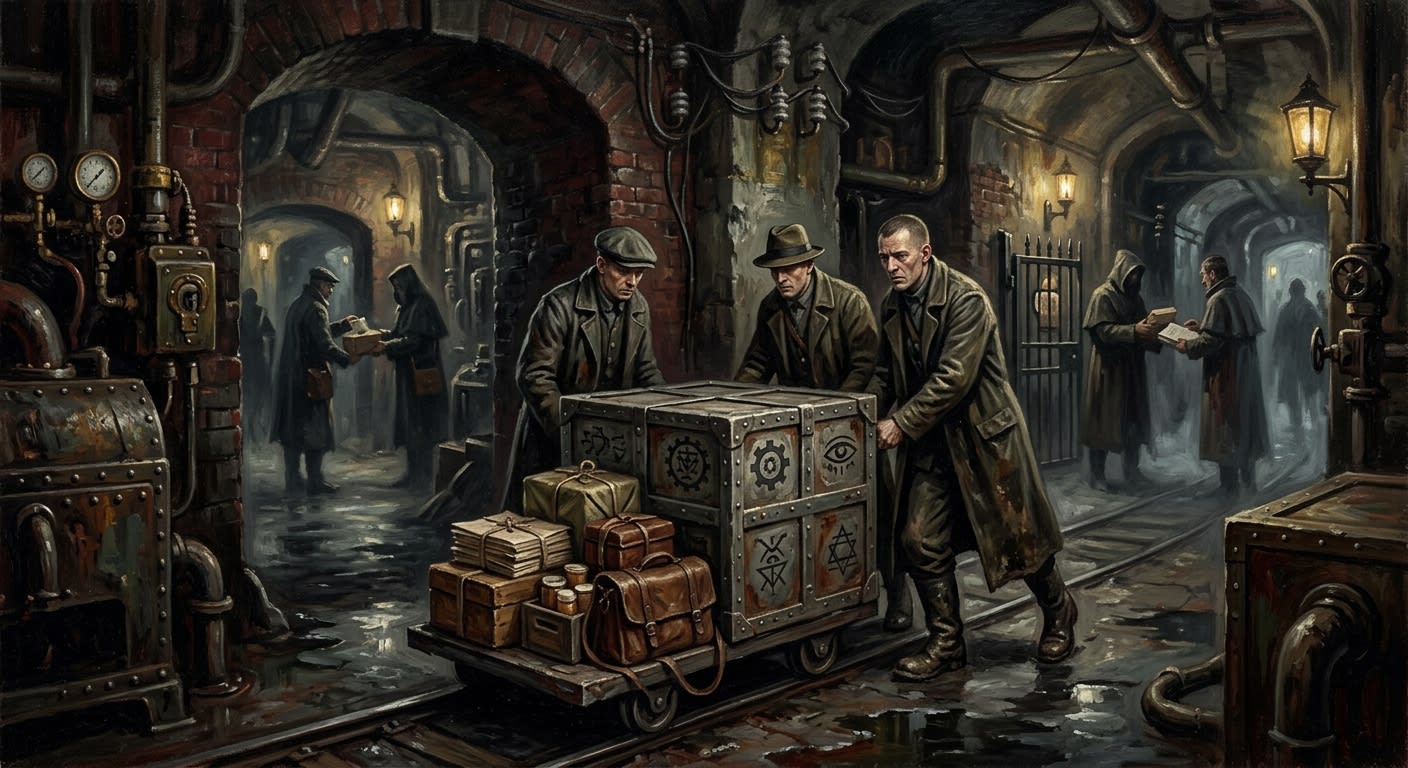
The Thread was the informal name by which the Cellar Saints described their transit network for sacred objects during the years after the Treaty of Regensburg and before the Sundering proved, with its usual lack of tact, that the hunted had been preserving ammunition. It was an unchartered road, an unlisted parish society, an order without seal or treasurer. It was a set of remembered cellars, trusted hands, half-burned parish lists, brewery doors, canal grates, false bottoms, hollow sticks, and the particular glance by which one starving believer asked another whether a floor could keep a secret.
The name is apt. A thread is weak when pulled foolishly, strong when doubled, invisible when sewn inside a hem, and fatal when wrapped around the wrong throat.
The Thread moved relics. It moved wafers, letters, warning signs, baptismal oil, names of safe houses, and the occasional living priest whose continued breathing had become inconvenient to the Rationalist census. Its most famous cargo was Relic 31-C(α–γ) (Unregistered), the three apostolic phalanges carried by Ignatius Brenner in a breadbasket across the Rhine in A.S. 31, received by Aldric Hartmann beneath the fermentation vats at Deutz, guarded in sequence by the brewery line and Klara, then recovered in A.S. 45 for the road to Kalnik Ridge.
#On How It Held
The Thread held because it did not pretend to be a rope. Ropes invite hands. Hands invite knots. Knots invite inspection by men who enjoy cutting. The Thread survived by slightness: two contacts, no map; one phrase, no doctrine; a chalk mark scraped before morning; a beer invoice whose quantities made sense only to a priest, a brewer, and a woman pretending to sweep the same doorstep twice.
Father Wernher codified the Cologne practice in the cellar beneath the Brewers' Quarter: two links, no triangles. Each carrier knew a sender and a receiver. Each refuge knew its feeder and its next silence. No zealot was permitted the consoling luxury of knowing enough to betray everyone. This was mercy disguised as suspicion. The faithful disliked it, of course. The faithful always prefer arrangements in which their courage can be admired. Wernher preferred arrangements in which their courage did not have to be tested by iron wire.
The Thread used geography as sacrament. Cologne cellars. Lyon catacombs. Innsbruck caves. Bavarian forest shrines. Palatinate breweries. Swiss valley barns whose owners swore they had no interest in theology and then hid chalices under goat salt. The Rationalists searched churches first, then priests' houses, then suspected aristocratic caches. They came late to breweries because the Republic, for all its vigilance, believed beer was merely beer. A civilized error.
Earlier catechism cards call the Thread “a unified underground highway of faith.”
Corrected. It was neither unified nor a highway. It was a set of frightened local habits that learned to touch without becoming visible. Highways have milestones. The Thread had coughs, invoices, and loose bricks.
#On Cargo and Custody
A relic on the Thread changed its nature at every hand. In a parish, it was an object of devotion. In a basket, it was evidence. At a checkpoint, it was death. Beneath a brewery, it became a deposit. On the road after the Sundering, it became ordnance. The relic itself did not alter. Jurisdiction did, and jurisdiction is the Bureau's word for weather.
The three apostolic bones show the sequence with offensive clarity. Brenner carried them under bread. Hartmann placed them beneath beer. Klara did not open the crypt. Brenner recovered them when the east broke. A military chaplain took them onward. The 7th Rearguard Column carried them through hunger, mud, and collapsing authority. Brother Tomislav raised them at Kalnik Ridge in A.S. 48, where they burned demons with First-Order Miraculous Emission while the Bureau of Relics acquired, at last, proof even a committee could understand.
Other cargoes were uglier: saints' teeth sealed in wax; consecrated hosts in tobacco tins; missal leaves sewn into coat linings; names of arrested priests memorised by children because children attracted less search until the Rationalists learned, as tyrannies eventually do, that children can carry history better than satchels. The Thread did not ennoble this work. It made it possible. Possibility is frequently mistaken for grace by those who arrive after the danger has been invoiced.
A Relics appendix lists nine Thread consignments marked “arrived before dispatch.” The Bureau of Records attributes this to dating error. The Bureau of Doctrine attributes Records to cowardice. The ninth consignment contained ███████████████████ and was entered at Lyon three days before the carrier left Cologne.
#On Betrayal and Fraying
The Thread broke often. A carrier recanted. A cellar flooded. A peddler vanished. A grandmother told a grandson one phrase too many because love is the oldest breach in security and the least punishable. Wernher's journal records three names struck through with the notation “spoken under wire.” The line remains. He did not scrape the names away. Mercy recorded them; discipline reduced access to the north stair.
Betrayal did not destroy the Thread because the Thread had already assumed betrayal as a cost. This is the doctrine later bureaucrats pretend they invented under more expensive names. The Bureau of Shadows calls it compartmentalisation. The Bureau of War calls it damage isolation. The Bureau of Records calls it partial chain reconstruction. The Cellar Saints called it not getting everyone killed.
A.S. 112 devotional histories claim “the Thread never failed where faith was pure.”
Rejected. The Thread failed in pure houses, impure houses, breweries, barns, crypts, and once in a chapel whose priest had never missed Matins. Purity is not a lock. Anyone who says otherwise has never owned a door worth defending.
#On Its Descendants
After A.S. 45 the Thread became road, route, convoy, parish register, military courier habit, and eventually Bureau procedure. Augustinus drew early allies through the surviving Cellar Saint contacts. Kratz drew seals, letterheads, and forgery materials from the same rescued archives when preparing the Night of Black Decrees. The Synod did not rise from order imposed upon chaos. It rose from chaos that already knew where the loose bricks were.
The most embarrassing descendant is the Silent Godless cell structure, which uses Wernher-pattern contact discipline against the Synod whose ancestors the pattern saved. The Bureau of Purity finds this insulting. I find it educational, which is worse for everyone involved.
The Thread ended as a name when the cellars opened. It survived as technique, which is how good secrets prefer to live. Every sealed courier route, every relic chain of custody, every low-ink annotation that says “receiver knows sender only,” every Bureau clerk who believes secrecy began with his appointment owes a debt to damp stone, tallow smoke, and people who carried bones beneath bread while the guards searched for pamphlets.