
#On the Hearth That Learned to Govern
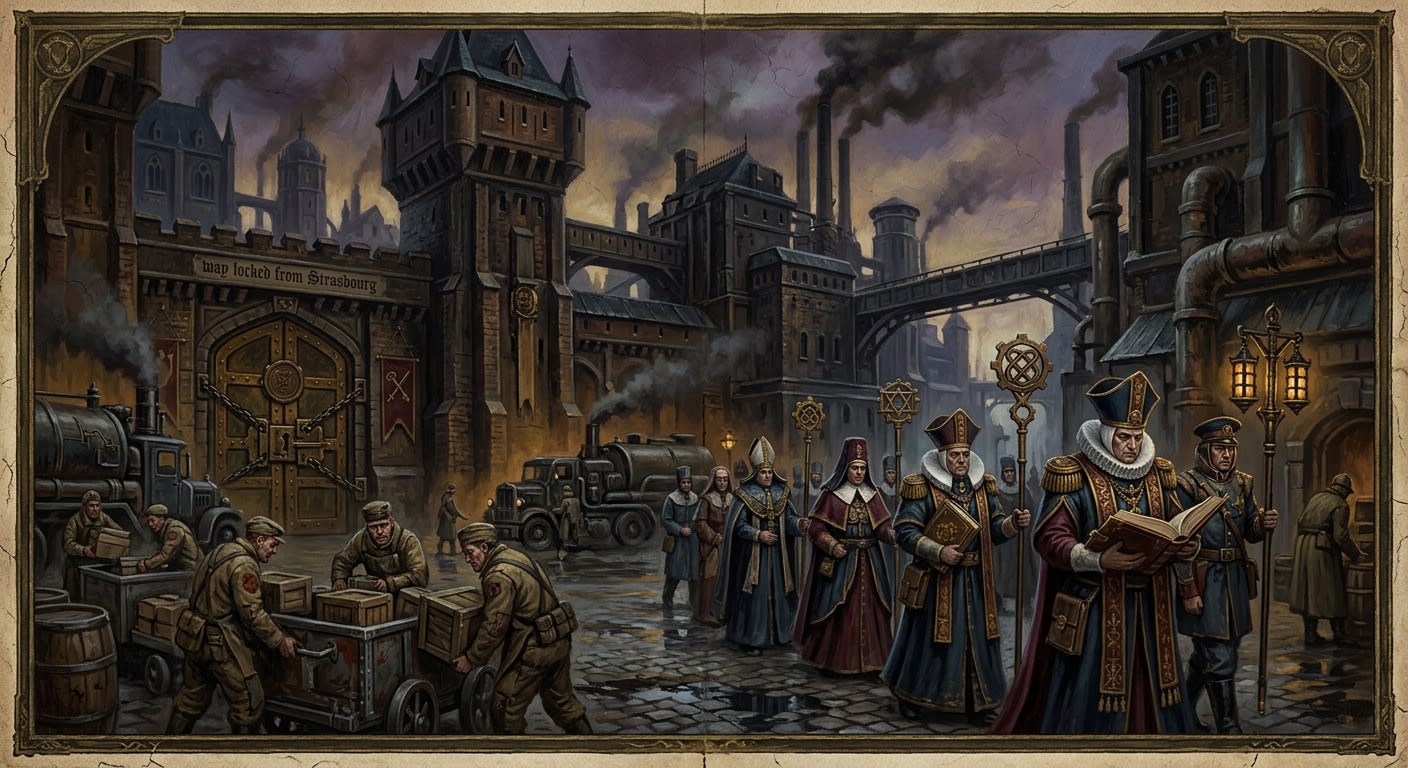
The Triune Hearth is the constitutional name, liturgical fiction, fiscal furnace, and educational cudgel by which France, Iberia, and the Rhineland were bound beneath Strasbourg's seal after the Concordat of Strasbourg. The schoolroom answer calls it unity. The treaty answer calls it common sacramental authority. The Bureau of Tithes calls it an assessment region with three decorated excuses. All three answers are admissible. Only the third reliably balances.
The phrase appears pious because piety was required to make seizure look like household warmth. Hearth suggests home, flame, bread, gathered children, old women stirring pots, men returning from work, a table blessed before eating. The Synod selected the word with the sort of genius lesser governments waste on honesty. A hearth consumes fuel. A hearth demands tending. A hearth blackens the stones above it. A hearth, unattended, burns the house down.
The Hearth is not a territory in the simple sense, because simple territory satisfies only cartographers and invading generals. It is a binding. It overlays crowns, provinces, dioceses, roads, markets, courts, ports, relic routes, tax tables, school primers, festival calendars, marriage forms, and the little bureaucratic capillaries through which a state reaches the hand, the loaf, the bed, and the grave. It made the Synod more than a wartime council. It made obedience hereditary.
#On the Three Seals and the Single Ink
In A.S. 90, in the nave of the Basilica of the Ledgered Saints, three seals were pressed into one pool of wax. France, Iberia, Rhineland. The public woodcuts linger on this moment with pornographic reverence: three hands, three stamps, one red mass on black oak, candles tall as bureaucrats, bishops sweating under fabrics no sane tailor would recommend for indoor politics. The image survives because peasants understand wax better than constitutions. Break one impression and the whole surface cracks. Warm one edge and all three soften. Press too hard and the neighbour deforms.
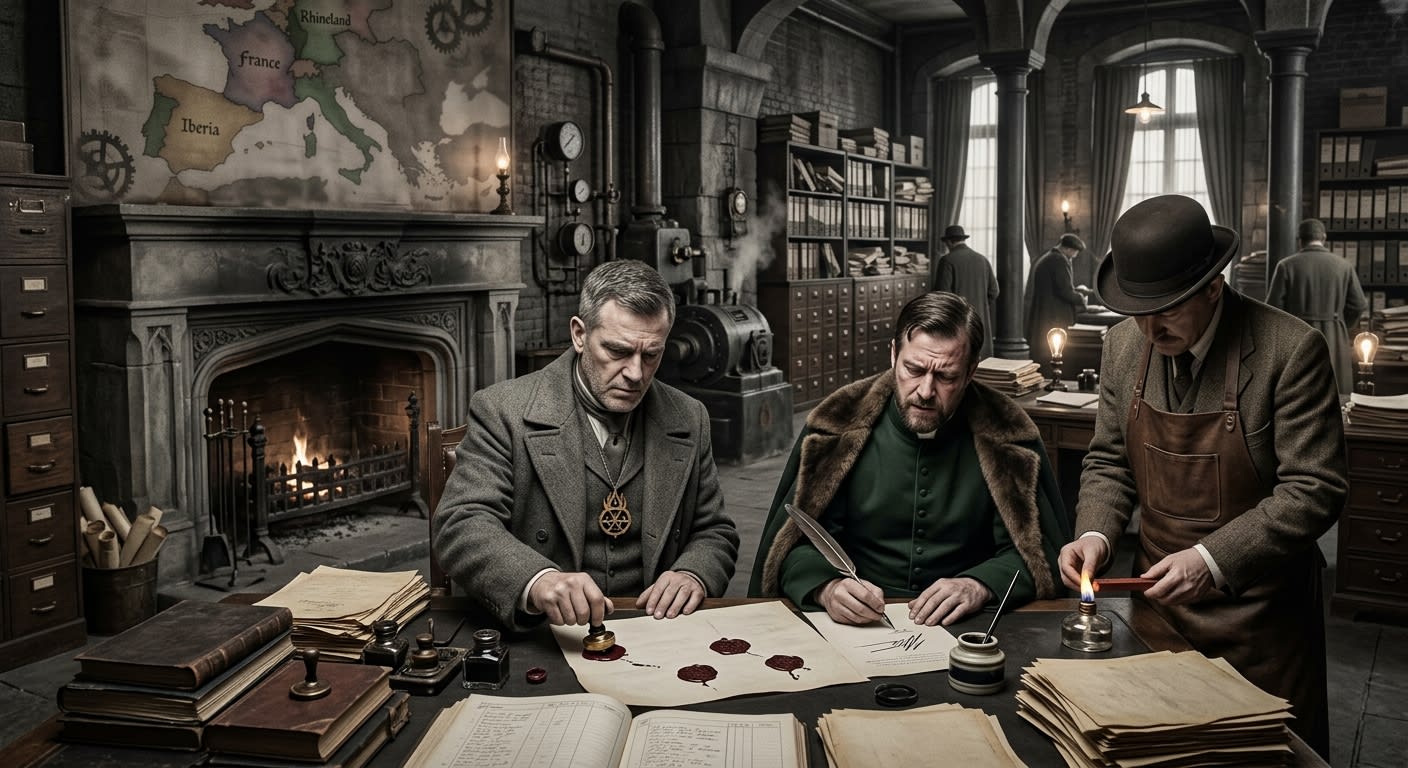
Cardinal Hieronymus Kratz understood theatre. Augustinus understood tears. Between them they produced a sacramental government so elegantly coercive that later offices mistook inevitability for Providence, which is the ordinary retirement plan of successful fraud.
The ink was mixed from lamp-black, iron gall, and the traditional drop of blood from each signatory, if tradition may be trusted and, in this case, it may be trusted because it is too useful to correct. France sent the Archbishop of Lyon. Iberia sent the Cardinal-Legate of Toledo, late and prayerful in the useless fashion of men whose objections have already been filed. The Rhineland sent Augustinus himself, who sealed with such visible grief that Records preserved the blot. Later theologians named the blot joy. Later clerks named it an accession stain. I prefer both. Meaning should be allowed to labour if we feed it so much parchment.
The result was proclaimed in A.S. 91 as the Triune Hearth: three old bodies made one sacramental household under Strasbourg. Crowns dissolved. Coins were restruck with the Flaming Sword. Old calendars were demoted into historical vermin. Time itself entered Synodal custody. The harder legal teeth arrived in A.S. 100, when governors were re-baptized as Vicars-Praetorial (Unregistered) and secular courts became Tribunals of Doctrine under the Council of Cologne settlement.
Several early school maps represented the Triune Hearth as three equal flames meeting in mutual devotion.
Corrected. France supplied administrative vanity, ports, and martyr outrage. Iberia supplied grain, ash, relic hunger, and insult concealed beneath obedience. The Rhineland supplied roads, bells, tolls, finance, wet archives, and the practical civic habit of remembering what official documents omit.
The doctrine of equality was retained for children, sermons, and foreign observers. Adults paid the invoices.
#On France, Which Became Too Useful to Abolish
France entered the Hearth as face, wound, and taxable inheritance. Its usefulness began with blood at Saint-Malo, where Rationalist guards fired on pilgrims and created the sort of outrage even timid bishops can ride if someone straps them to a saddle. France had supplied salons, pamphlets, prefectures, clever police, violated shrines, and the administrative skeleton the Synod later confiscated, Latinised, blessed, and improved. Let no fool say the enemy taught us nothing. We learned from their cabinets and hanged the men who labelled them.
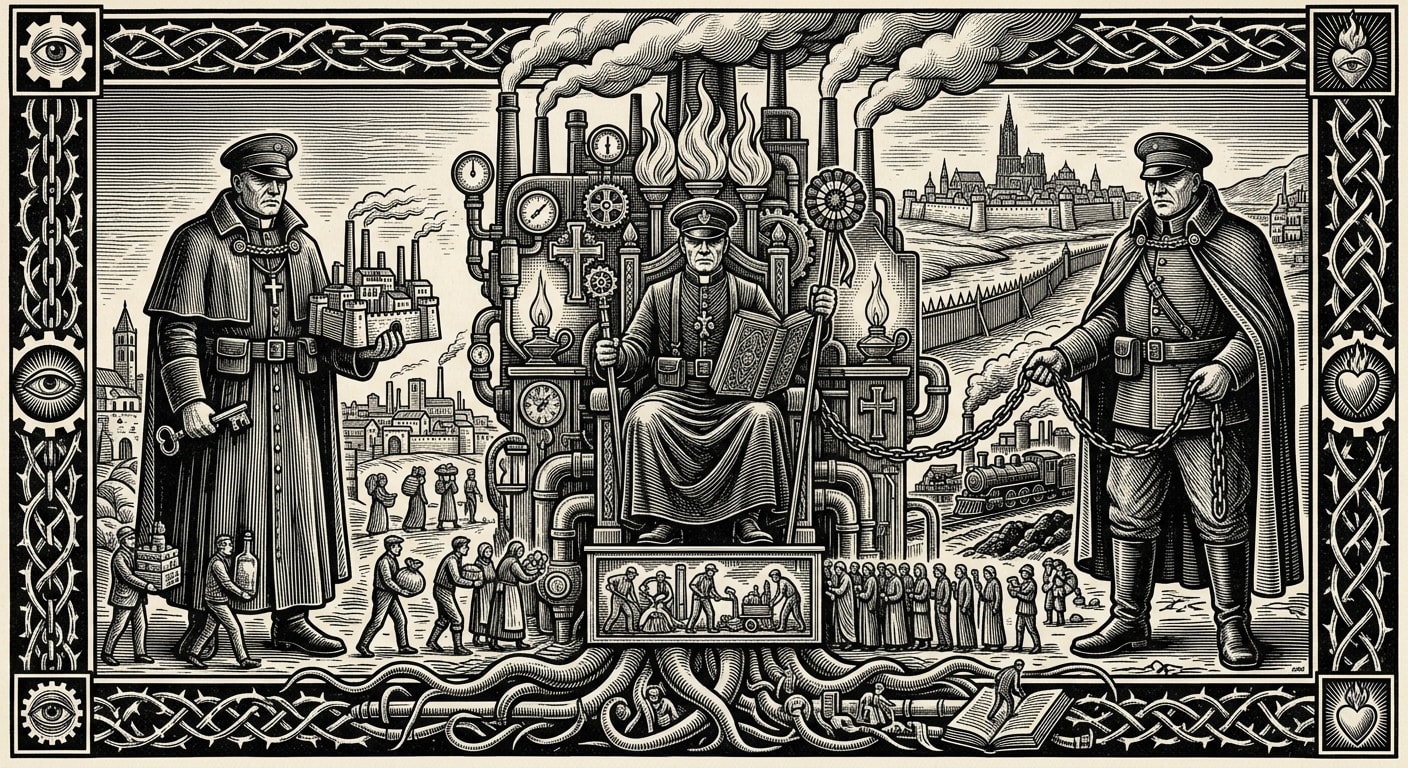
As a Hearth-body, France performs centrality. Strasbourg sits in Alsatian stone and exceeds France, but France still lends the capital its civic mask: roads west, ports north, martyr coasts, Lyonnais miracles, Provençal warnings, Parisian cleverness under surveillance, Calais chalk teeth, Marseille salt accounts, Breton pilgrimage, and enough old noble vocabulary to keep banners supplied. A conquered name need not be erased if it can be printed at the correct size beneath the Knot.
The French seal in the common wax signifies consent after correction. Saint-Malo made neutrality filthy. Rationalist governance made unbelief bloody. The Sundering made survival urgent. Kratz made the room small. By the time the pen was offered, France had already learned that separate dignity is an expensive costume when Hell owns the eastern road.
The Hearth allowed French memory to remain visible under glass. Old feast names survived where revenue passed cleanly. Regional courts kept phrases after losing teeth. Ports retained their civic pride because pride loads ships faster when properly taxed. Lyon received Saint Theophania under supervision; her weeping statue, nine days of oil after the Concordat, made the new household feel witnessed by stone. Doctrine approved the miracle after ensuring that local affection did not become local sovereignty, which is the danger with saints: they begin by comforting widows and end by founding jurisdictions.
#On Iberia, Which Signed with Ash Under the Tongue
Iberia entered as furnace. Its Rationalists had burned relics in Córdoba, Salamanca (Unregistered), Seville, and Toledo, mixed holy remains with lime, and plastered lecture halls with saint-bone so that unbelief could write equations on martyr dust. A province that remembers desecration does not need persuasion in the same register as a province that remembers salons. Iberia arrived already smoking.
Its seal was pressed into the same wax in A.S. 90, proclaimed within the Hearth in A.S. 91, and cracked during the earthquake of A.S. 178. Records calls the crack cosmetic. Doctrine calls it insignificant. Iberian clerks call it nothing at all, which is the most dangerous form of local commentary. The crack remains because repairing it would admit anxiety, and ignoring it permits everyone to pretend wax possesses manners.
To bind Iberia, the Synod overlaid jurisdictions rather than sorting them. Castilian pride, Aragonese sulk, Portuguese maritime habit, Andalusian city-memory, monastic privileges, coastal smuggler law, village saint-charters, episcopal exemptions written in dead hands — all arrived in crates. Sorting would have produced lawyers. Kratz overlaid. Every old privilege remained visible under Synodal glass, honoured in phrase, constrained in use, taxed in practice, and available for quotation when obedience needed local costume.
The peasantry named consolidation the Third Famine (Unregistered). Doctrine laundered the phrase until it could be tolerated in controlled settings. Grain moved north and east. Mules entered pilgrimage supply. Silver routed through Strasbourg. Sons went to levy. Daughters went to shrine labour. Olive shipments were tithed twice because one office counted oil and another counted devotion. Hunger does not become holy because the receipt has a seal. It merely becomes harder to appeal.
The Hearth gave Iberian resentment a route. The Procession of the Triune Hearth drags the Iberian brazier through approved cities every tenth year, flame high, guards higher, Auditors counting the angle of applause. Seville watches without joy and with excellent timing. Toledo applauds correctly and sells ash medallions afterward. Salamanca debates the route in private. Zaragoza (Unregistered) counts soldiers before saints. Unity is a performance. Iberia has always understood theatre; it simply dislikes the director.
#On the Rhineland, Which Supplied the Roads and Kept the Margins
The Rhineland entered as wrist: vein-rich, toll-heavy, ink-stained, and forever being seized by someone claiming to take a pulse. Rivers made it indispensable before doctrine made it loyal. The Rhine and Moselle carried goods, troops, rumours, refugees, corrected books, bad jokes, wet ledgers, and the civic pragmatism by which a province survives too many masters and later sells each master directions.
The Hearth needed the Rhineland because sovereignty without routes is a sermon trapped in a cellar. Mainz, Cologne, Rheinscarp, Trier, Aachen, Worms, Speyer (Unregistered), Moselle towns, bridge offices, archive-banks, toll chapels, scriptorium habits, depot yards: these became the ligaments of the Synodal body. France could supply face. Iberia could supply furnace. The Rhineland supplied movement, and movement is what turns a claim into a government.
Its loyalty had to be corrected repeatedly, which is one reason I esteem it. A province corrected once grows smug. A province corrected ten times becomes useful. The Great Purge of Margins in A.S. 56–58 taught the Synod that Rhineland books continued behaving like books after approval. Prayer books held drainage figures. Hymnals held bell equations. Saints' calendars held crop warnings. The margins were treasonously competent. Forty-seven scribes died, twelve libraries entered confiscation, and knowledge learned to move into recipes, jokes, lemon-ink, ash-paper, and household instruction.
The Hearth made the Rhineland a test sheet for unity. Bells at Mainz, tariff hands along the Moselle, Cologne archive-banks, Rheinscarp stair offices, Trier chalk corners, Aachen penitential routes, Worms bridge ledgers — all had to perform obedience at the same hour and in compatible forms. Harmonisation required curfews, oath forms, fee tables, corrected school prayers, procession calendars, toll revisions, and the eternal miracle of getting a river city to admit that upstream authority exists.
A Rhineland primer once described the province as “steadfast under the Hearth from the first proclamation.”
Withdrawn. The Rhineland endured, collaborated, resisted, traded, prayed, informed, laughed, recanted, smuggled, and survived. Steadfastness is what winners call the parts of survival they can use in sermons.
#On the Table, the Knot, and the Alphabet
The Triune Hearth is represented by three principal objects: the black oak table, the Triune Knot, and the later Triune Alphabet. Each performs unity at a different scale. The table gives unity furniture. The Knot gives unity geometry. The Alphabet gives unity a hand permitted to write.
The table stands in the Hall of the Triune Hearth under glass and appointment, visible on approved days to citizens holding Form 77-C and no recent impropriety visible to Purity. It is the old altar of Saint Florentius (Unregistered) repurposed into treaty furniture, which tells the entire story with an economy even I envy. An altar became a desk. A desk became a throne. A throne became a tour route.
The Knot binds surfaces. Three loops: Mercy, Order, Sacrifice in the catechism; registered, protected, taxable in the ledger. It appears on gates, loaves, coffin-lids, documents, levy tags, confession desks, badges, procession banners, and the small lawful insults by which a citizen learns that even bread has jurisdiction. The Hearth adopted the Knot because three old bodies required one visible grammar. The loop did what a paragraph could not. It made joining look inevitable to persons unable or unwilling to read the terms.
The Alphabet arrived later, in A.S. 178, under Purity's Edict of Graphic Uniformity, and should not be confused with the Hearth's founding. It belongs here because all mature tyrannies eventually reach handwriting. Twenty-three approved letterforms, every angle licensed, every dialect trimmed to fit. The Hearth had already bound territories. The Alphabet began binding the strokes by which those territories could complain. An old French word, an Iberian proverb, a Rhineland marginal trick — each had to pass through Bureau-approved shapes before becoming public meaning. Several did not survive the crossing. This was listed as improvement.
GRAPHIC UNIFORMITY ADDENDUM — HEARTH DIALECT TABLES French survivals: licensed where ornamental. Iberian survivals: licensed where penitential. Rhineland survivals: licensed where fiscal. Terms refusing twenty-three-form rendering: ████████████████ Disposition: taught as silence.
#On the Procession That Counts What It Celebrates
The Hearth's oldest ceremonies were bell, seal, oath, and table. By A.S. 175, after Lyon had demonstrated that costume and crowd could become an unpleasantly independent engine, the Bureau of Festivals enlarged Hearth memory into forty days of wheels, horses, relic glass, incense, scripts, ration tents, barricades, and public exhaustion. The Procession of the Triune Hearth rolled out of that swollen wisdom.
The Procession begins at Strasbourg, because all lawful movement begins there even when the road does not. It crosses eleven cities and terminates at the Pilgrim's Gate of Bastion-Constantinople, where Festivals once requested permission to proceed farther and War answered with a map, a casualty table, and the words no floats beyond this line. The brevity remains admired in offices otherwise hostile to War's prose.
The first float is the Hearth Itself: three iron braziers labelled France, Iberia, and Rhineland around the central black seal of Strasbourg. Their flames are lit from Basilica coals and guarded by flame-keepers sworn not to blink during formal crossings. They blink constantly. Records pretends otherwise because a perfect oath sometimes requires imperfect eyelids.
Every spectator is counted. Every absence becomes data. Every cheer receives duration. Every cap left on the head before the Hearth float becomes a small black seed in a parish file. Records receives counts. Tithes receives addresses. Purity receives enthusiasm. Festivals receives applause and complains that nobody appreciates the artistry of coercion with ribbons.
The Procession matters because the Hearth is too abstract for ordinary citizens to fear properly. A treaty under glass becomes remote. A float taller than your roof, accompanied by soldiers, auditors, choirs, relic-bearers, pageant oxen, and a clerk asking why your eldest child is absent from the viewing rope — that has pedagogical body.
#On Present Use and Future Appetite
As of A.S. 201, the Triune Hearth remains one of the Synod's most successful lies, by which I mean one of its most durable truths. It is invoked in school primers, treaty glosses, levy schedules, festival warrants, road audits, marriage forms, grain movements, port dues, and sermons delivered by men who have never wondered why a hearth needs so many locks. It names the founding core without admitting the coercions that made core possible. It preserves the three old names while denying them the solitude in which names become dangerous.
The Hearth has also become a measuring device for absence. Italy is discussed as former anticipated compliance. The Netherlands is treated as profitable refusal. The British Crown is water-protected inconvenience. Scandinavia is winterly complication. Every territory outside the Hearth is described by its distance from it: pending, quarantined, allied, watched, tolerated, expensive, or not worth freezing for this season. A centre creates margins. Margins create files. Files create appetite.
The three flames still burn in public iconography: France bright and vain, Iberia dark at the wick, Rhineland blue at the edge from river damp. This colour theology is unofficial, beloved by painters, and denied by Heraldry because painters cannot be trusted with symbols they have not paid to license. The official colours are regulated. The popular colours persist. The Hearth tolerates minor disobedience where minor disobedience keeps the object alive.
A nation dies poorly when struck outright. It dies more profitably when kept warm, renamed household, assigned a chair, charged for fuel, praised for unity, counted during festivals, corrected in handwriting, and taught that smoke is evidence of belonging.