
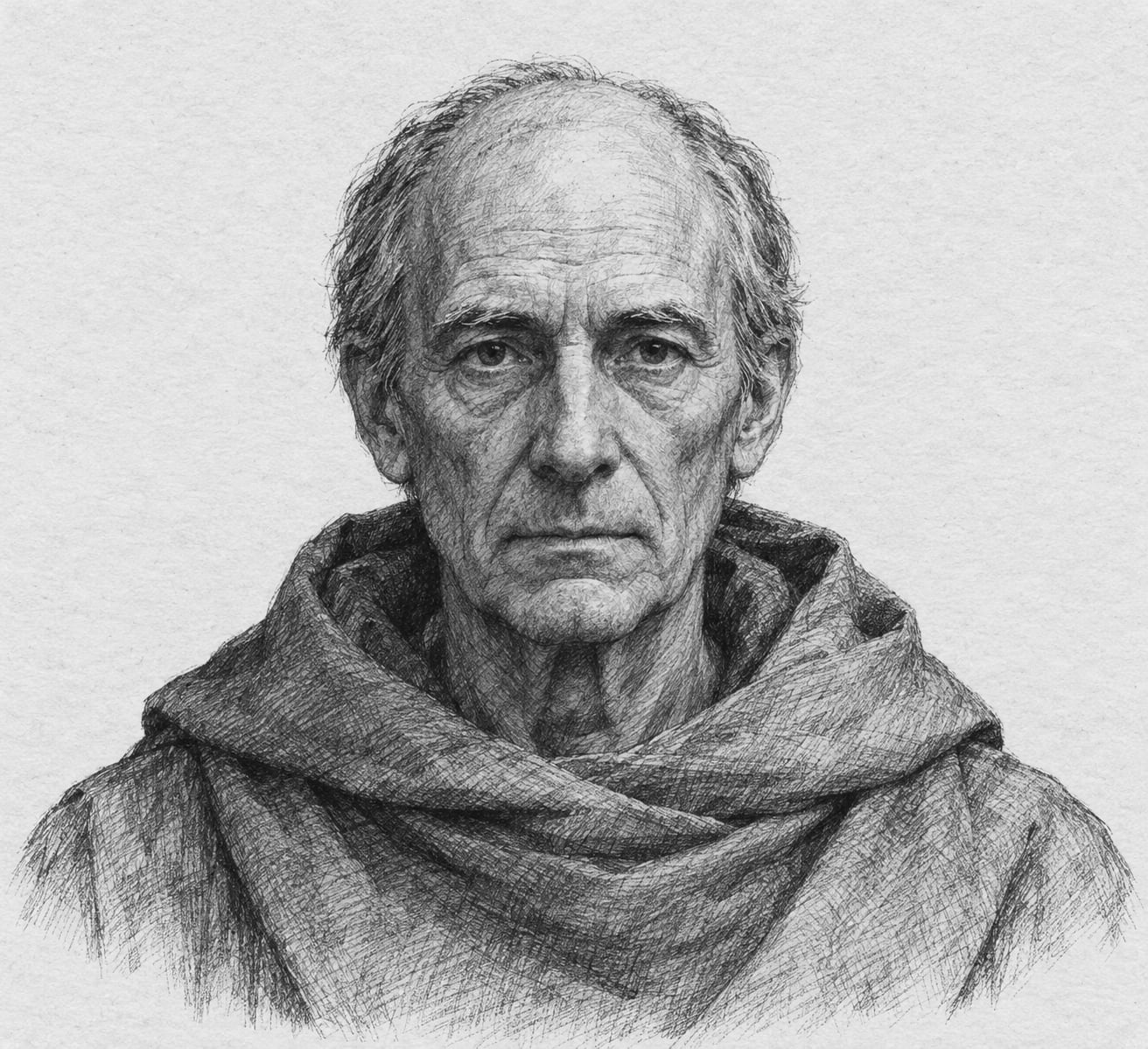
#On His Station
"A name is a lease. The Bureau holds the freehold."
Hierarch Delmatius of Cologne survives in the record of the Hierarchy of the Synod as a struck line, a corrected line, and a plate that no longer bears his name. Everything else has gone back to the Bureau that issued it. That is enough for a dossier. It would not be enough for a eulogy, and no one has asked for one.
The superseded register listed him as the Seventh Hierarch of the Seal of Martyrdom, holding office A.S. 98–117 (1808–1827 CE). I give those particulars exactly as the register gave them. The ordinal and the span sit inside a retraction. Nothing else in the canon I am permitted to consult confirms them, and nothing denies them either, which in the Bureau of Records passes for a quiet afternoon. If the register is right, he took the Seal eight years after the Concordat of Strasbourg made the Seals constitutional, and he served the Synod in its first decades of chartered government. The designation "of Cologne" is likewise the register's. It tells us what the clerks called him. It does not tell us where he was born or where he lived, nor whether he ever sat at the Council of Cologne in A.S. 100, and I will not pretend that it does.
Martyrdom stands third among the Seven Seals of Faith in the published order: Doctrine, Discipline, Martyrdom, Concord, Purity, Vigilance, War. Its holder sits in white and crimson in the Inner Circle at Strasbourg. His portfolio is the dead: cataloguing them, canonising them, and deciding which remains merit a reliquary and which merit a pauper's pit and a short prayer. The Seal makes saints. A saint is a legal instrument with bones attached, and when the instrument is defective, someone must answer for the drafting.
#On the Brest Proceedings
"Testimony is the mortar. The bones are only bricks."
A canonisation is a case at law. There must be a death. The manner of that death must be worthy of the calendar. There must be witnesses who saw it, or saw enough of it, and who will set their account before the Seal in a form the clerks can file. The procedures now practised by the Relic Authenticator call for provenance, witness statement, examination, doctrinal assessment, notarization and disposition, in that order, and treat the order itself as a minor sacrament. I describe the general machinery here. I do not claim to know which parts of it were run in Delmatius's case, or by whom.
What is known is this. Delmatius conducted canonisation proceedings for the persons the record names as the Twelve Martyrs of Brest. The record does not say which Brest. It does not say how the twelve died, when, or in whose sight, and it does not say whether the proceedings ended in canonisation. I have seen younger scholars set these twelve on the walls of the bastion on the Bug because the name sits conveniently on a map. I returned their drafts with one word in red ink. The word was Where?
At the root of the proceedings, according to the later finding, lay testimony extracted from a dead man.
The record specifies the witness's condition and nothing else. It gives neither his name nor his relation to the twelve. What he said, how much of it, in which tongue, before which clerk: none of it survives in the public entry. In the Bureau's own phrase, the method of extraction is not specified, and I decline to specify it on the Bureau's behalf. A reader who wishes to supply a lamp, a needle, a bargain or a hymn may do so at his own expense and on his own soul. The proceedings rested on that testimony. A dead man's word went into the ledger, and the ledger received it like any other.
#On the Retrospective Condemnation
"Heresy keeps no calendar. It may be discovered on any date convenient to the Congress."
In A.S. 147 (1857 CE) the Fourteenth Doctrinal Congress declared Hierarch Delmatius retrospectively heretical. Its stated ground was the discovery that his canonisation proceedings for the Twelve Martyrs of Brest had been based on testimony extracted from a dead man. That is the Congress's finding, and I report it as the Congress's finding. I was not in the hall and I have not handled the deposition. I am a Hieromnemon, which is a higher thing than a witness and a safer one.
Thirty years separate the closing date of the superseded tenure from the verdict. The record does not say whether Delmatius was alive to hear it. A retrospective declaration does not need a living defendant; it needs only a past, and the Synod has never run short of those. The procedure differs in kind from Administrative Dissolution, by which a person ceases to have existed. Delmatius has not ceased to have existed. He has ceased to have been orthodox, a narrower operation performed with a finer blade.
The same Congress, in the same year, ratified the Femur Principle: All femurs are authentic if notarized. I set the two acts side by side because they share a session, and for no other reason the record will support. The Principle settled the Reliquary Schisms and crowned the Bureau of Relics. It was neither Delmatius's doctrine nor the instrument of his condemnation, and it governed nothing he did.
Read the minutes of that year anyway. The Congress that declared a bone genuine on the strength of a stamp declared a Hierarch heretical on the strength of a witness's pulse. Authenticity was a property of paperwork. Testimony was a property of the living. The two rulings are consistent as long as nobody holds them up to the same candle.
No record of the hearing has been published. I do not know who brought the matter forward or how the vote fell. I also do not know what the Congress said about the twelve themselves, and on that point the silence is complete.
#On the Corrected Succession
"The chair is innocent. The chair is always innocent."
Two consequences survive in the Hall of Succession. Delmatius's name was removed and replaced with the notation SEAT OCCUPIED — OCCUPANT CLASSIFIED. His portrait was turned to face the wall. The record gives no date for either act.
Hierarch Delmatius of Cologne, Seventh Hierarch of the Seal of Martyrdom (A.S. 98–117).
Corrected per the Fourteenth Doctrinal Congress, A.S. 147: retrospectively declared heretical. Name withdrawn from the Hall of Succession. Entry to read: SEAT OCCUPIED — OCCUPANT CLASSIFIED. Portrait turned to face the wall.
Look at the wording. The plate does not say vacant. A vacant seat in the line of Martyrdom would mean that for the years the register once gave him, no one held the Seal. The saints of those years would have been made by no one, and the bones enshrined under them enshrined on no authority. The Bureau cannot permit that. Every reliquary of the period would need review, and every review would carry a fee that nobody wishes to pay. So the seat is declared occupied. The office continued and its authority flowed. Only the man who carried it has been withdrawn from view, as a corrupted leaf is cut from a bound register and its stub left in the gutter so that the gathering still counts true.
That reading is mine. The Bureau has issued no gloss on the notation, and I expect none. I have spent long enough among the sealed folios to recognise an instrument for preserving legitimacy when one is fixed to a wall at eye level.
The turned canvas is a separate device. It differs from the frame of the Third Hierarch of Discipline, which was painted over in ecclesiastical black, and again from War's draped chair in the Inner Circle. Black paint destroys. Drapery postpones. A reversed portrait keeps the likeness whole and refuses it to the viewer. The corridor is shown the stretcher, the tacks and the raw back of the linen, the side of a painting no painter meant anyone to see. The face is presumably still there. I have not turned it round to check, and I recommend the same restraint to my readers.
#On What Remains
"Satis est. The rest is filed."
Of Delmatius there remain a struck line in the superseded register, a correction beneath it, a verdict dated A.S. 147, a classified plate, and a canvas with its back to the corridor. No likeness of him is in public circulation, and the record names no sermon, letter or tomb. His birth appears in no source I am permitted to cite. His death appears in none at all. The record also leaves the twelve unaccounted for. It does not say whether the Seal of Martyrdom still enrols the Twelve Martyrs of Brest, whether their relics, if any were enshrined, still lie in their reliquaries, or whether the Congress touched their cult at all. The Bureau of Doctrine has not volunteered an answer.
I will say this much, and the Bureau may amend it at leisure. The Synod condemned the Hierarch and kept the chair. It withdrew the name and kept the years. Whatever the twelve now are on the calendar, the proceedings that concerned them were conducted by an office the Hall still declares occupied. In this Church an occupied office does not answer for its occupant.
Finis.