
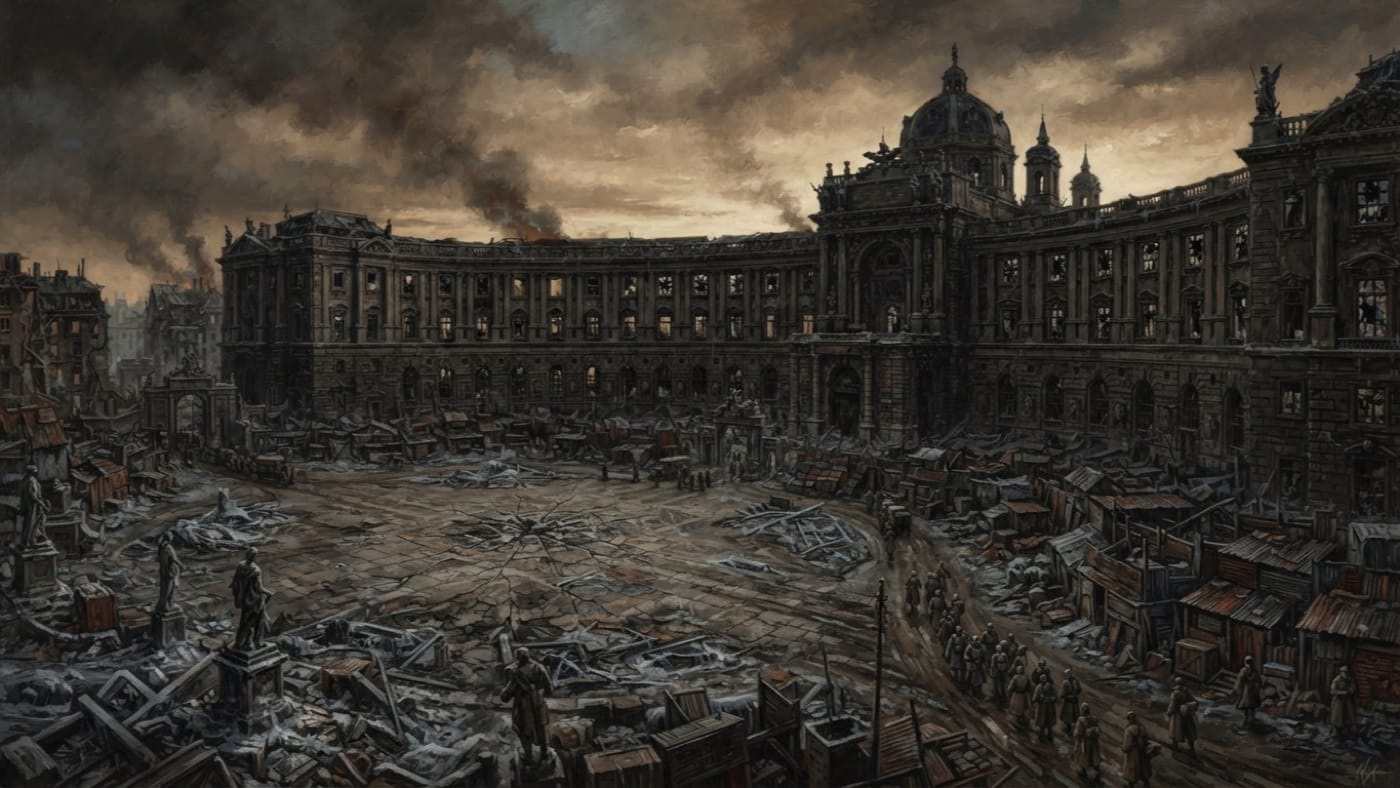
#On the Palace and Its Paperwork
The Hofburg is a palace in Vienna-Ruins, and two injuries made it famous. The first is its glass, broken in A.S. 95 by a blow struck at another building entirely. The second is its paperwork, reportedly left on the table by men who expected to return to it.
The glass has seventeen witnesses. The paperwork has one sentence in a ledger.
I state the difference at once because popular accounts never do. Tavern sermons and pilgrim songs run the windows and the minutes together in a single breath, as though a reliquary and a Rationalist inkwell could share a shelf. They cannot. The windows belong to the Siege of Vienna and to a miracle the Bureau of Doctrine has ratified. The minutes belong to the reclamation record, which says the palace was sealed and expects the reader to be content with that.
A Warden of the Sacred Ledger has a professional interest in any rival authority that died with its desk in order. The Rationalist Republic governed by motion, minute and countersignature. Those are the instruments I use myself, and I resent seeing them in the hands of the damned. I have never handled the Hofburg minutes, and I know of nobody whose handling of them I could verify. That has not stopped me from having opinions about them.
#On the City Around It
Vienna has died more often than most cities have been founded. The Rationalists took it as their capital and dissolved the Holy See there at swordpoint. After the Treaty of Regensburg in A.S. 30 they built bonfires in the Heldenplatz in front of the palace and fed them the Church's effigies and relics. The fires burned cold, and three of the onlookers died of exposure. The Republic called this weather. It called most things weather.
The Hofburg looked down on all of it. I offer no account of who built the palace, in which century, or for which crowned family. The Codex has no ratified record of any of that, and the Bureau does not stamp a family tree for a house whose last tenants voted the Creator out of existence.
The city outlived its masters but not by much. After the Sundering of A.S. 45 it held out briefly and then fell. For most of the next half-century it belonged to plague-fires, salvagers and whatever crawled through the lower districts after dark. The Concordat of Strasbourg gave the Church its constitution in A.S. 90. Five years later the Synod still did not hold its own former See. When it came back to Vienna, the city was occupied by a man.
That man was Althazar of Pest, a sorcerer-lord in command of Rationalist remnants and daemon-cult auxiliaries. He held a capital whose Council had already fallen silent. Where he slept, and whether he ever entered the palace, the record does not say. I decline to furnish his bedroom for him.
#On the Glass Broken in A.S. 95
The Siege of Vienna lasted nine months. By its last weeks Clemens Stahlhand held the cathedral precinct around Saint Rupert's altar with starving men and rationed wine, and Althazar's column was pushing through the inner breach. Clemens carried out the reliquary mace of Saint Aldebrand, whose femur the Bureau of Records had once declared absent from inventory. He met Althazar on the altar steps and struck him once.
Everything known about that blow reaches us through testimony. The testimonies disagree about posture, weather and the words spoken. Seventeen of them agree on a low note that lasted nine seconds and was felt in the sternum more than heard. They report that iron split, that the stones of the Heldenplatz opened in a radial wound, and that the glass of the Hofburg shattered. Althazar was destroyed and the hostile column broke apart.
The blow was struck at Saint Rupert's altar, and the palace was never the field of combat. It was a bystander, and it is valuable for exactly that reason. A witness who fought in the battle can be accused of loyalty. The Hofburg had been the seat of the opposing party, and it gave its evidence by breaking its windows.
Doctrine ratified the miracle in A.S. 104, the same year Clemens was beatified. Clever people find that timing convenient. I find clever people convenient too, since they mark themselves out for the auditors.
Commemoration needs material, and Synodal commemoration is particular about its material. A bell can be recast and a banner rewoven. A painting can be revised to give the saint a firmer jaw. The breakage in the testimony is harder to improve on, because seventeen mouths have already fixed it. A preacher who mentions the Hofburg's glass is not repeating a miracle story. He is citing the enemy's damage report.
An older chronology in the Codex's descriptive record places the Siege of Vienna in A.S. 201.
Corrected. The siege, the blow and the broken glass all belong to A.S. 95. The clerk who wrote the earlier figure confused the year he was copying in with the year of the miracle, a mistake that flatters the copyist and nobody else.
#On the Meeting Left Undisturbed
The reclamation entry for A.S. 95 reports that the Hofburg was sealed with the last meeting of the Council of Nine undisturbed, and that the pen in the final minutes was still wet.
That is the whole account. Other inventories repeat it and add nothing, the way a choir repeats a cantor without improving the text. Repetition does not count as corroboration, and the Bureau of Records knows it, even if the guidebooks do not.
The entry leaves a great deal out. It gives no date for the session, which may have sat in any year of the Republic's decline, and it lists no one present. It does not quote a word of the minutes or name the motion under discussion. It is silent on what happened to the Councillors, whether they were in the room, and whether they were there to be found at all. I will not supply what the entry omits. Others have tried, with chairs and corpses and a clock stopped at the decisive hour. Their versions sell well and have never earned a seal.
The ink is a separate matter, and a delicate one. The entry says the pen was wet. It does not say for how long, or who checked, or by what method a Synodal clerk tells ink from damp. Some pilgrims link the wet pen to the blow at Saint Rupert's altar, or link both to the broken windows, and build out of them one grand mechanism of judgement. Doctrine has ratified no such mechanism. Any preacher who teaches one is preaching on his own account and will answer for it on his own account.
Even so, I may enjoy it. The Council governed half a continent by resolution. It drafted edicts that cut out tongues for prayer, issued pamphlets calling relics pig bone, and gave the hour of the Creator's abolition to the minute. By the inherited account, this body left its own minutes unfinished, with the pen still on the page. For the Warden of a ledger it is the most edifying Rationalist document there is, and nobody has to read it.
#On the Palace in the Living Town
Vienna today is a Zone 3 shrine-town of about ninety thousand souls on the Central Corridor. Through it run the supply convoys and pilgrim traffic bound for the Carpathian approaches, and through it the regiments headed for Bastion-Przemyśl and Bastion-Sibiu take on bread, powder and absolution. The Bureau of Pilgrimage keeps its corridor headquarters there. The living town grew up around the ruins the way a parish grows around a relic, with everyone keeping an eye on the collection box.
The Hofburg is useful to such a town. A convoy chaplain preaching to men who will be in the mud by Candlemas wants an example of a Church victory that needs no allegory. Clemens's blow broke a palace's windows from another building, and seventeen witnesses swore to it. The sermon practically writes itself, though the Bureau still prefers that the chaplain write it.
The sealed meeting serves a quieter purpose. Doctrine catechists use it to show what becomes of a government that thinks its procedure is permanent. They are told to call it a reported closure, and to stop there, without the bodies, the clock or the speculation about who sat where. Some of them manage it.
The windows are attested. The meeting is recorded. The Councillors are unaccounted for in this file and will stay that way until a higher seal than mine says otherwise.