
#The Evening Interval
At Bastion-Constantinople the day does not simply end. It is closed the way a ledger is closed: by an authorized hand, at an authorized moment, with a stroke that cannot afterward be taken back. The garrison calls that moment the Hour of Vespers, and the term deserves a definition before some enthusiastic parish vicar supplies one for you.
This entry concerns the evening interval as it is kept at the Hinge of the South, the southern anchor of the Sagittal Line. In that span, sanctioned bell-time gathers worship, civil order, the readiness of the guns and the arithmetic of the clerks under one roof of bronze. The general office is treated under Vespers. The martial peal has its own entry under Iron Vespers. Both were defined elsewhere, under the Codex that governs every belfry of the Church. The Hour is what Constantinople does with them, and it holds no charter of its own.
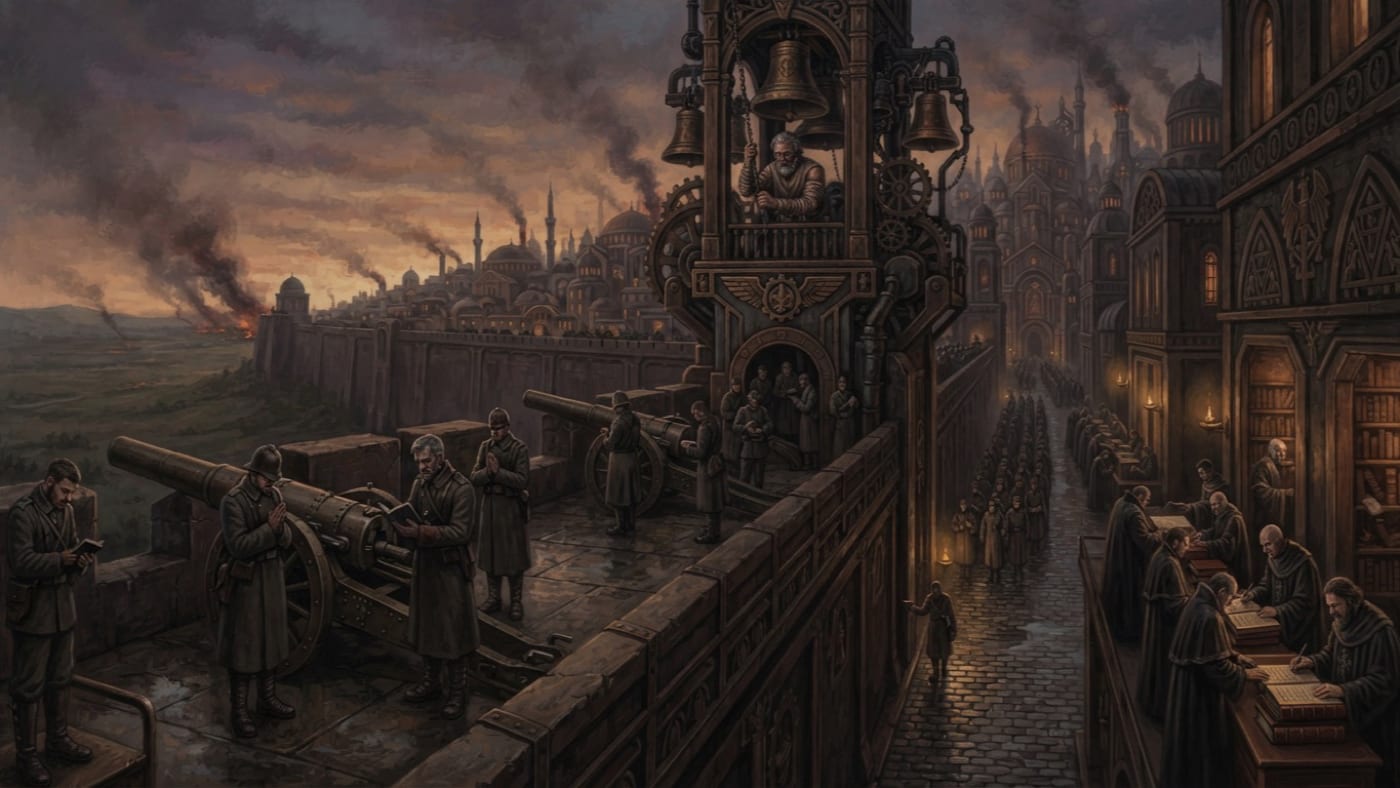
Stand on the northern wall when it comes. The Thracian approaches smoke to the horizon. Gunners swab the pieces on the ravelins. Behind you, at the western end of the Sanctum Mile, the Belfry of the Hinge faces down the avenue toward the Cathedral of the Perpetual Registry, and between the two the whole city waits for permission to stop. The parish clergy say the carillon keeps time for half the front. I own no instrument that measures half a front. I have only the faces of men who stop talking when it begins.
#Who Owns the Hour
Four Bureaus claim the evening. Each is correct within its jurisdiction, and the Synod recognizes no other kind of correctness.
The Bureau of Bells maintains the instruments and codifies the peals. The Bureau of Doctrine assigns their meaning. The Bureau of Tithes attaches to each toll the obligations it carries. The Bureau of Records witnesses that the peal occurred and enters the fact. Remove any one and the other three will carry on for a week out of habit. Then someone will ask for a countersignature, and the whole edifice will discover that it was standing on the fourth.
The lineage is short and should be kept straight. Bell practice on the frontier is older than any office that governs it. The Office of Bells was constituted in A.S. 52, while the Church's councils were still provisional and the Line was still a ditch with ambitions. Constantinople was ratified in A.S. 68. The current Bell Codex was ratified in A.S. 115. It is the recension that now judges every evening at the Hinge lawful or otherwise.
The Lore Book's entry on the Bureau of Bells dates "Strasbourg's Bell Codex" to the year 231.
The current Bell Codex was ratified in A.S. 115. The year 231 has not yet occurred and is withdrawn. The constitution of the Office of Bells in A.S. 52 was a separate act. The Office existed for sixty-three years before the Codex by which it is now judged, and it managed somehow.
Beneath the Bureaus stands the man who does the work. The Bellwarden checks the evening's chart against its seal and confirms who ordered the peal. He oils the lock, tests the tension and logs every deviation he can hear, along with several he only suspects. His toll-key is chained to his body. Rope burns lie on his forearms in layers, like wax on a seal that has been renewed too often. Brass grit sits in the creases of his ears. Doctrine owns the meaning of the Hour, and the Bellwarden owns its bruises.
#Beneath the Evening Peal
The first stroke sets off several hundred separate events. They happen at once, in every quarter, among people who have never met and will be audited separately.
On the parapet, the watch is counted. In the offices along the Sanctum Mile, clerks turn from the day's requisitions to the day's reconciliation. The Doctrine of Holding requires ledgers to be closed by dusk, and in Constantinople dusk is a matter of record rather than astronomy. In the Hammers, the conscript barracks, twelve thousand men hear the same bronze and arrange themselves by what their sergeants have taught them it means. In the civilian quarters, shutters move and lamps are reckoned. Somewhere in a lane, as has happened in every belfried city since bells were licensed, someone is begging a Bellwarden to hold the curfew one peal longer because a child is still on the far side.
I will not supply the schedule. The Bureau of Bells holds the exact spacing of the evening peals, their stroke-count and duration, and the hymn sung beneath them. It publishes them in the forms it chooses, and I decline to improve on its silence with guesswork. Every person in the city knows the order of things better than I could print it. They learned it the way one learns a language: by being corrected.
At noon, a man who misses the peal finds the kitchens locked. The ration queues of Constantinople learned long ago to sing or starve. The evening asks something subtler of him. I can document nothing that is locked at Vespers. Yet the Hour is when the day's account is drawn up, and a man who was not where the bell expected him has already become a question in someone's ledger.
#Prayer Beside the Guns
The pilgrim imagines Vespers as a sung office in a cathedral, and in the Cathedral of the Perpetual Registry that is exactly what it is. On the wall, it is also a roll call with incense.
Three observances share the evening, and they must be kept apart. Men who confuse them tend to be standing in the wrong place when it matters. Vespers is the evening office of prayer. Iron Vespers is the martial evening peal under which the Codex secures a fortified place and accounts for it. The Ninth Peal is curfew. After it, the night is governed by ordinances such as the Curfew Ordinance of Quiet Hours and their local descendants. A soldier at the Hinge passes through all three before he sleeps. He would be insulted to hear them called one thing. Under oath, he could not tell you where one ends.
The guns explain why. A front-line fortress facing Maldrake the Wrathforged across the Thracian Plain cannot afford a prayer that leaves its batteries unattended. A Church facing the Great Deceiver cannot afford a battery that has not prayed. Necessity joins the two in the evening. Powder is reckoned while psalms are said. A relic is checked while a sergeant checks bayonets. The same tired men perform both duties within the same quarter-hour. Doctrine calls this the highest proof of the city's devotion. The Bureau of War calls it a staffing problem.
Hunger presses from the other quarter. The marshes opposite the Ravelin of Purity belong to Kargath the Devourer, whose craft is the convoy that arrives short and the grain that never arrives at all. The evening reckoning is where his work shows: in ration tallies that will not close, and in the quartermaster's columns, which must be explained before curfew falls.
#The Day's Unfinished Account
Here the Hour earns its reputation, and here the Bureaus stop agreeing.
The parish clergy teach, and Doctrine affirms, that every soldier who dies within earshot of the Constantinople carillon is entered into the Book of Departures without the need of a clerical hand. It is a beloved teaching, preached at the Hour to men with good reason to want it. The Bureau of Records has replied in a note that is neither unsealed nor sealed. Its ink never runs dry in Constantinople, the note says, and that is a different thing from autography.
I am an officer of Doctrine and a creature of Records. I have watched the clerks at evening, and their pens move throughout the Hour. Perhaps they copy what is already written, or perhaps nothing is written until they arrive. I am not licensed to settle the question, and the Codex declines to settle it on my behalf.
Both Bureaus share a fear of the wrong sound. The Hour depends on every bell being authorized: the right instrument, the right chart, the right seal and the right hand on the rope. A peal that no one ordered is the Bellwarden's oldest nightmare. If the city is lucky, it is sabotage. If not, it is something harder to file. The bells reported near the Third Ossuary ring in sequences the Bureau of Bells cannot identify. They belong to a separate dossier and a separate anomaly, and they are not the source of Vespers. I record them here only because a city that keeps its evening by authorized bronze cannot be indifferent to bronze that answers to no one's authority.
#Present Application
In A.S. 201 the Hour is kept at Constantinople under the A.S. 115 recension. Bells, Doctrine, Tithes and Records keep it, along with men who have rope burns. Bellwardens still taste brass at the end of a shift. Their hearing goes as their seniority rises. The best of them count in their sleep and flinch at quiet, which in Constantinople is a qualification. The clerks still close their columns before curfew. On nights when the columns will not close, they close them anyway and enter a note.
I am asked from time to time whether the Hour could be simplified. It could: one bell, one meaning, one ledger. Each Bureau would have to surrender something, though, and the Bureaus did not survive a century and a half of war by surrendering things to one another.
The day is closed at Constantinople because the bell says so. The bell says so because four Bureaus have signed beneath it. Whether the Creator has also signed is beyond the competence of this entry.