

#On the Duty
The roster chooses the Word. The gunner chooses where it lands.
This survey records the Hymn-Gunner's post as it stands in A.S. 201 / 1911 CE. I compiled it from vessel files, inquiry records and the Aerial Wing's operating notes. It describes present practice and nothing older. It gives no founding year, because the file holds none. It cites no gunners' charter either. I looked for one and found requisitions.
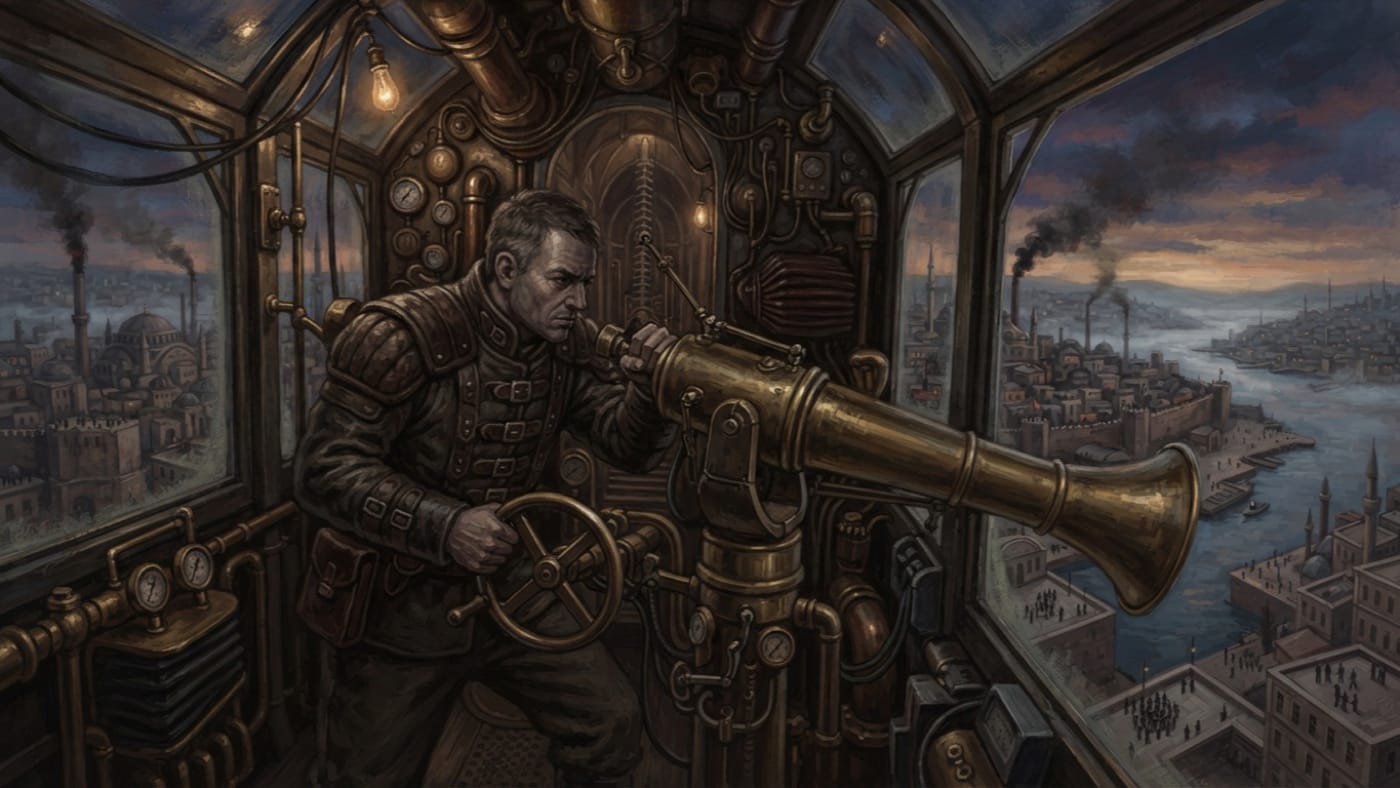
The Hymn-Gunner aims the Sermon-horns. Aboard the Vigil Ark Saint Barachiel that means four brass projectors, one at each cardinal point of the gondola. Each sits on a swivel carriage with a reinforced collar, and each is governed by bell-pressure through the chapel spine. The gunner turns them toward the listeners the day's sermon was rostered for: soldiers on the chain-booms, dockers, harbour clerks, households in the listening sectors, craft on the strait, and whatever keeps station beneath the craft. The complement lists the post beside the chaplain, the bombardier and the signals officer. Eleven persons ride in the gondola, and one of them is paid to decide which way the theology faces.
Visitors find the title funny until they stand under the horn.
#On Aiming the Word
The Aerial Wing's notes list what the gunner tracks: wind, height, congregation density, target hostility, water carry, shrine echo, fog shelf, and the small delays by which a word reaches the wrong ear first. The list reads like a weather report drafted by a Confessor. Each item names a way for a sermon to arrive somewhere it was never sent.
Wind comes first because the strait moves and the sectors do not. If the gunner lays a horn square on a quay in a crosswind, the sermon goes to the quay's neighbour, and the neighbour has not been rostered for it. Height comes next. The Barachiel keeps station at five thousand feet. From there the Word has a long way to fall, and the gunner must reckon where the listeners will be when it lands as well as where they stand now.
Density is a matter of bodies. A packed square drinks sound into coats, shoulders and the backs of heads. A thin one lets the sermon ring off cobbles and come back to hear itself. Hostility is on the list too, and I will not pretend it was put there for the comfort of the hostile.
Water carries sound generously, which is both its virtue and its vice. The Bureau of Bells' acoustic surveys report that the sermon is intelligible about forty feet below the Bosphorus surface under tested conditions. That is a survey finding and not a range guaranteed on every patrol. The fish have been present at more Exhortations than most seminarians. No one has filed their belief.
Shrine echo works against the gunner. Harbour chapels, ravelin walls and ossuary masonry throw the sermon back, so the sentence arrives twice, half a breath apart, and the listener catches neither copy. A fog shelf over the strait can hold the Word above it or carry it past its sector into another. The delays are the subtlest item. Near ears hear before far ones, and a crowd that hears in ragged order may chant in ragged order, which an auditor will mark down.
The notes give no tables for any of this, and I supply none. The horn turns on its carriage. The gunner judges the air. The Word goes down.
#On the Roster and the Return
Five offices touch the sermon before a gunner touches the horn. The Bureau of Doctrine supplies the approved daily roster. Bells, through its Catechetical Division's Aerial Wing, selects from the roster and runs the delivery. The Bureau of War directs the vessel's military employment. The Bureau of Rites consecrates it. The Bureau of Orison and Song licenses devotional broadcasting across the Church and coordinates acoustic standards. The Doctrine of Aerial Sermon lets none of them claim the whole.
The Hymn-Gunner points the approved words at their assigned listeners, and the duty ends there. A gunner does not write doctrine. A gunner cannot amend the roster, command the chaplain or the bombardier, or rule on an excuse slip. Signal integrity belongs to the signals officer and to the trade of the Orison Signal Engineer, whose work is testing a transmission for inversion. Those checks are theirs, and a gunner with steady hands cannot perform them.
Below, the Sky-Sermon Attendance Auditors count bodies in the listening windows and report each sector's compliance upward. This is where a stray horn stops being a technical matter. If a sector could not hear the sermon, its Choir Rate drops, its ration priority falls, its curfew tightens, and its residents may be marched into compulsory assembly where the horn reaches and an auditor can watch their faces. The auditors' idiom covers it: If the radio fails, mark the roof. A misjudged crosswind at five thousand feet becomes a hungrier street by the following week.
The ledger keeps four claims separate. The gunner aimed. The sector heard. The household attended. Belief appears in no column. The Bureau finds the arrangement restful.
#On Suppression by Sermon
The parent entry reports what a well-handled horn can do. It can sweep a quay with penitence, pin a boarding craft under a chant, hammer a ravelin with grain-duty exhortation, or drown an unlicensed song before the song becomes a crowd. I record these as reported capabilities. I do not certify what any of them does to the body underneath, and I do not grant the horn power over masonry.
The last capability concerns the Church most. An unlicensed song has a tune, and a tune gathers people. An authorised chant laid over it from above denies the tune its listeners. The suppression is acoustic. It is also lawful only because the chant came off the roster. A gunner who turned the horns on a song with words of their own choosing would have stopped being a gunner and become a heretic with very good equipment.
The ledger also separates the horn from the gun. The bombardier has charge of the censer-racks and their sanctified incendiaries. The racks are a different weapon with a different hand on the catch. The reliquary-chapel sanctifies the corridor of air the Ark passes through, and that corridor is the aerial Bellway. A loud horn makes no Bellway. On the Bastion-Constantinople walls, Shrine-Deck Crews load guns, manage recoil and reconcile shot ledgers. The Hymn-Gunner fires nothing and spends no powder, and the gunner's results appear in someone else's book.
#On Kael's Hearing
Sergeant Kael was never a Hymn-Gunner. She was the third crew's bombardier, certified on censer trajectory tables in A.S. 192 / 1902 CE. During the A.S. 197 / 1907 CE eastern survey she corrected a drift error in the port rack and kept four incendiaries from falling on a Synodal grain convoy. Her rank was her own and implies nothing about anyone else's.
She belongs in this survey because of a line in her crew chief's report: she could tell a hymn-gunner's cadence slip from engine vibration through the chapel floor. Two calculations were running in that gondola, side by side. The gunner leaned the Word into the wind and the shrine echo. The bombardier computed drift and release for a falling censer. Both jobs deal with air and both depend on the floor staying still, but they share no table and no tradesman. Kael's ear could tell them apart in the floor itself. The ledger demands the same distinction of every crew, though few have the ear for it.
Her file shows no gunnery training, no combined post and no school for both trades. It shows a bombardier who knew which of the noises around her was not hers.
After the A.S. 199 Broadcast she declined Swiss convalescence and went to Kestrel-7 on the Blightmarsh perimeter.
#On the Limits of Correct Delivery
A gunner can aim a sermon but cannot shorten it. In A.S. 179 / 1889 CE the Barachiel was assigned the complete Lenten Exhortation, footnotes included, at fourteen hours. The fuel ran out at about two in the morning, propulsion failed, and the Ark drifted toward Anatolian waters with its horns still preaching the appendix on oaths and tithes to the seabirds. The Ark did not fall and the envelope held. The Aerial Wing's restriction followed: no Ark shall be armed with a sermon longer than it can preach before nightfall. Good aim does not appear anywhere in that rule.
On the 3rd of Argent, A.S. 199, all four horns carried a voice from outside the roster for eleven minutes and forty-three seconds. Witnesses called it an apology. The transcript lies under the Hierarch's Seal, and the speaker, the addressee and the mechanism remain unidentified. The inquiry's crew list places the third crew's Hymn-Gunner asleep at the hour. I draw no culpability from that, and neither does the file. The point is narrower. Engineering found the carrier lines, throat plates, swivel mounts and chapel spine sound. Every carriage, collar and governor that a gunner relies on worked as designed, and none of it could say who was speaking.
A preliminary Aerial Wing note described the Broadcast as "Sermon-horn malfunction, probable carrier contamination."
Withdrawn by the existing record. The horns functioned within tolerance, and no carrier contamination was found. Sealed files now read "unauthorised source compliance." The gunner's apparatus was cleared. The question of the source was not.
The post stands as follows. The gunner aims the roster's Word at the roster's sectors, over the roster's hours, and reports clarity without source.