
#On the Volume Designated
Being a description of a book the Codex cites by page and cannot describe by cover.
The Hymnal for Desperate Hours is a liturgical reference work issued under the authority of the Bureau of Orison and Song. On page 4,117 the Bureau prescribes the Antiphon of Endurance, thirty-two verses, assigned to siege conditions. On the 23rd of Argent, A.S. 170, at Bastion-Constantinople, forty-seven people sang that entry while consecrated cement rose to their mouths. Everything else the Ledger holds about the book would fit on the back of a pilgrim's receipt.
I set down the limits plainly. A Warden who pads a thin file is a forger with better posture. The Ledger names no compiler and no composer of the Antiphon. It gives no year of first printing, no edition, no binding and no total count of pages. The figure 4,117 is a locator. It tells the reader where to turn and says nothing about where the book ends. Whether the title fills one volume or a shelf, the record does not say. The missing compiler's name is simply missing. It is not a redaction, and I will not dress it as one for the reader who came here hoping for a conspiracy. That reader may skip to the final section, where the Bureaus have provided one at no charge.
#On the Authority to Sing
The Bureau of Orison and Song licenses hymnals, choirs and devotional broadcasts, and it puts sound to work on the front. It exercises these chartered functions from the Cloister of Calibrated Breath in Strasbourg. There the licence hall stamps what the faithful may sing, and the disciplinary listening chambers deal with what they may not. In the Synod a hymn is an instrument of state with a tempo attached. The Bellways carry sermons over the trenches. Litanies tuned to the eardrum break up riots. Unauthorised melody is prosecuted as heresy, and the melody smugglers who trade in it are hunted accordingly. In Vienna a folk lullaby once spread without sanction, and within a month five thousand mothers had been branded for it. The Bureau does not regard music as a private matter.
A prescription on page 4,117 is therefore an order of a particular kind. It tells a garrison what to sing when the walls are under assault. It does not tell an engineer how to mix cement, a captain whom to put in a breach, or a confessor whether a volunteer has truly volunteered. Those instructions belong to other Bureaus and other manuals. The reader who mixes them up will find, as the Bureau of Records found, that the mistake has to be withdrawn in print.
The Ledger holds none of the Hymnal's own regulations: who may keep a copy, who may lead from it, what happens to the chaplain who turns to the wrong page. I have searched. The Litany-Engineers carry working hymnbooks stained with oil and scribbled with powder arithmetic. I cannot certify that any of those battered volumes bears this title, and I will not certify it by assuming so.
An earlier draft of this entry described the Antiphon's use at the Sixth Ravelin as "the routine application of page 4,117 to Bureau sealing procedure."
Withdrawn. The Bureau of Records acknowledges that no manual, regulation or doctrinal memorandum provides for sealing living personnel inside consecrated cement. It has withdrawn its own phrase "routine operation" from the published account of the Vigil of the Hollowed. The Hymnal prescribes a hymn for sieges. It prescribes nothing else.
#On Page 4,117
The entry is assigned to siege conditions and runs to thirty-two verses. The Bureau has published those two facts about its contents and no others, which is more than most saints receive.
Thirty-two is the verse count of the Antiphon. It is not the number of hymns in the book, and the clerk who has catalogued the Hymnal for Desperate Hours as a thirty-two-hymn pamphlet is invited to correct his card before I correct it for him. The Codex does not reproduce the verses. The Ledger holds the citation, not the score. I have no record of the melody, the tempo or the hymns on the facing pages.
The precision deserves a moment. Picture a garrison under assault, Forge-Beasts on the glacis and the curtain shaking. The Bureau directs it to page four thousand one hundred and seventeen, and somebody in that garrison has to find the page. I imagine a chaplain licking his thumb. The Bureau has never published how long the Antiphon takes to sing. On the 23rd of Argent the Sixth Ravelin measured it for them, in cement.
#On the Prescribed Hymn at the Breach
Only as much of the siege as the hymn requires. The rest is filed under the Vigil of the Hollowed.
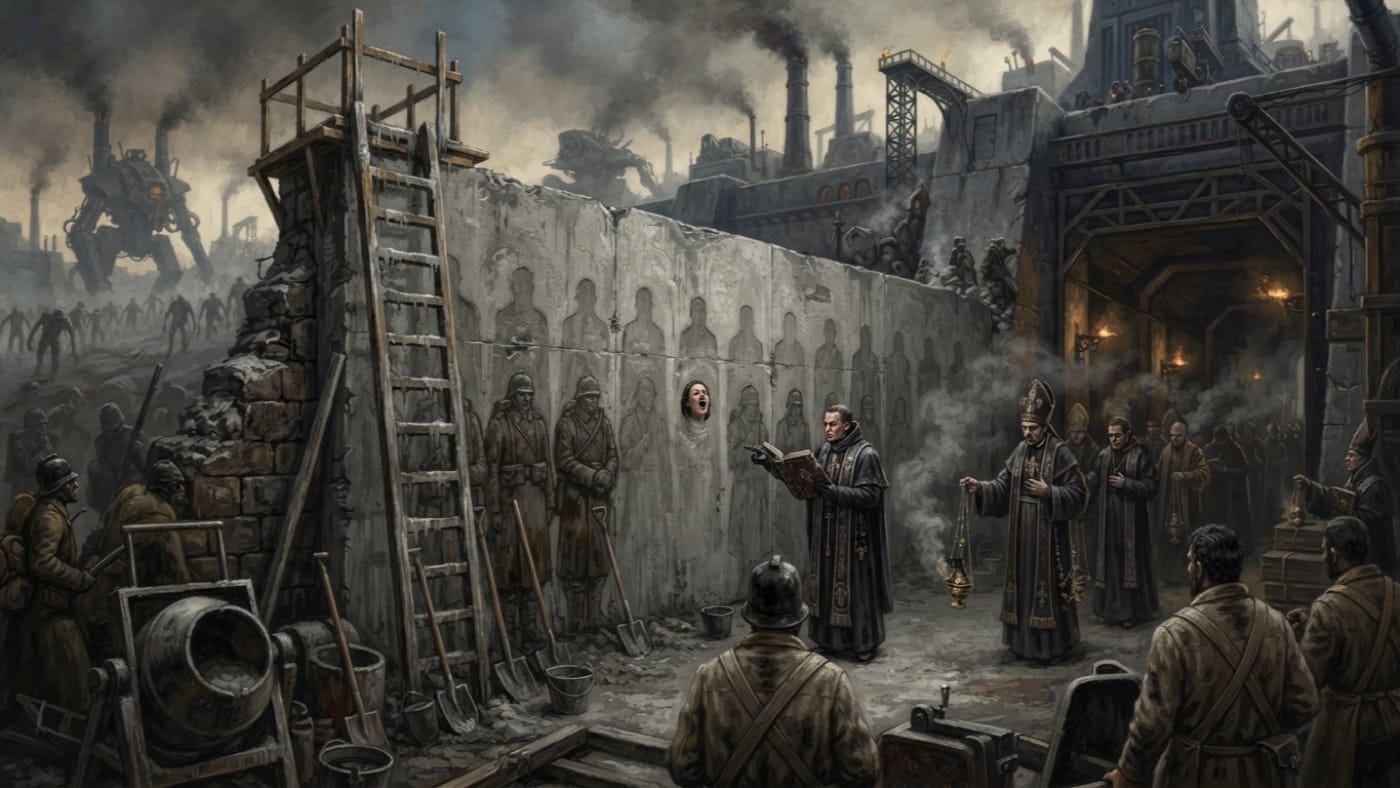
On the evening of the 22nd of Argent a Night Paper reached the Sixth Ravelin, the Ravelin of Correction. By dawn the relic batteries of its southern curtain stood unmanned. The details belong to the parent entry. At dawn Maldrake's Wrath host struck the curtain with Forge-Beasts and a column of Hollowed, and one hundred and forty metres of wall came down. The garrison held the gap for nine hours with pike, rifle and blessed incendiary. Then the Bureau of Engineering's forward team came up from the inner works with a pour-frame and sixteen cartloads of consecrated cement.
Forty-seven people entered the frame: soldiers, civilians, confessors, ammunition-handlers, two clerks of the Bureau of Records, and a widow entered in the Ledger as K. They began the Antiphon while the cement was being mixed and kept singing as it was poured. This is the Hymnal's documented use. Page 4,117 was sung in the conditions it was written for, by people standing where no manual had ever put anyone.
The verses kept the time that no clock recorded. At the twenty-seventh verse the cement reached the mouths of the shorter volunteers, and the taller sang on. By the thirtieth one voice remained, a woman's, and she finished the last stanzas alone. The witness statements disagree on whether she was the widow K. or one of the confessors. The Bureau of Records settled the disagreement by sealing both files. Forty-seven began the Antiphon. One finished it.
Fourteen witnesses attest the singing. Some said the sound became part of the cement. The Bureau of Rites classified the phrase as metaphorical. The Bureau of Bells classified it as possibly literal. The Bureau of Doctrine classified it as a matter for the Bureau of Doctrine. Orison, whose page it was, is not recorded as offering any view.
The names of the forty-seven are sealed under the Fourth Ratification (Unregistered), and Doctrine calls their act voluntary and miraculous. The seal covers the names. It does not cover the hymn they sang, which the garrison choir performs in public every year.
#On the Annual Recitation
The Vigil is kept on the 23rd of Argent. The Ravelin Chaplaincy processes from the Cathedral of the Perpetual Registry to the Ravelin of Sorrow, the Fifth Ravelin, where civilian access ends. Chamber 7 lies beyond it in the closed Sixth Ravelin. On a clear day it shows across the works as a darker stretch of the southern curtain.
There the garrison choir performs the Antiphon of Endurance in full, all thirty-two verses. Pilgrims who know it join in, and those who do not stand silent. The choir sings past the twenty-seventh verse and the thirtieth with every voice still present.
Then the chaplain reads the Bureau of Doctrine's account of the sealing. It runs to three pages. It does not name the forty-seven, describe the cement rising, or mention the woman who sang the last stanzas alone. The Bureau publishes the hymn complete and the history in three pages. Page 4,117 says more about the 23rd of Argent than Doctrine does, and page 4,117 never mentions it.
#On the Limits of the Record
Documented: the Hymnal's title, its Bureau, its page and its verse count, and the singing of the 23rd of Argent, A.S. 170, attested by fourteen witnesses. Reported: Chamber 7 remains warm, hums, and performs above specification. The Bureau of Engineering attributes the warmth to residual exothermic curing in Report 7-C/170-Ravelin-6, filed A.S. 171, and has repeated the phrase in its surveys ever since. Interpreted: Rites says metaphor, Bells says possibly literal, Doctrine says refer to Doctrine. No Bureau has shown that the hymn did anything to the cement. No Bureau has shown that it did nothing.
The record also leaves a question open about the frame rather than the song. Was the Engineering team that brought the pour-frame and cement dispatched before the wall fell? Did anyone standing in the frame know beforehand that page 4,117 would be needed? The Bureau of War's dispatch logs and the Bureau of Engineering's deployment schedules for the 22nd and 23rd of Argent are sealed under the Fourth Ratification. I do not claim the sacrifice was arranged. I claim that the logs are sealed.