
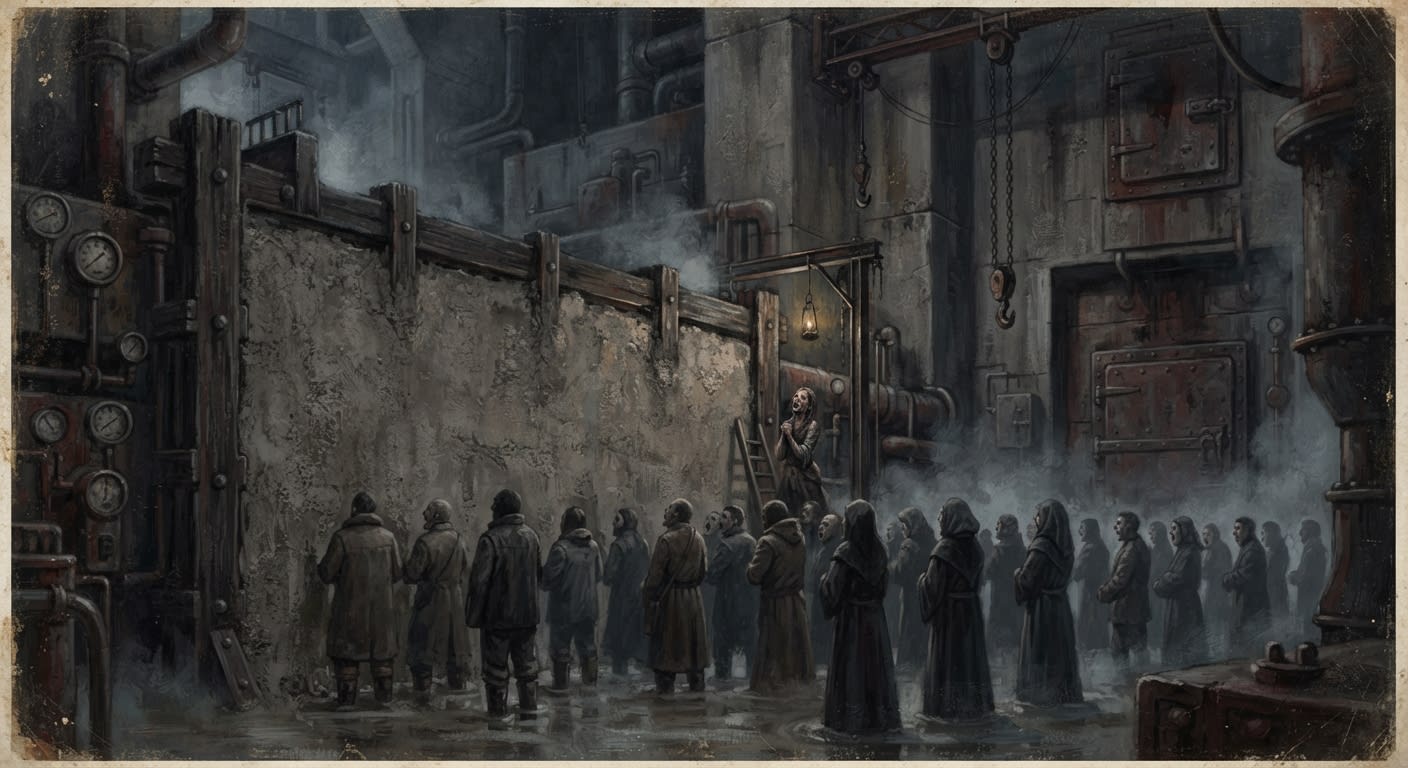
#On the Hymn Filed as Siege Procedure
The Antiphon of Endurance is a thirty-two-verse hymn for siege conditions. The Bureau of Orison and Song prescribes it in the Hymnal for Desperate Hours, page 4,117. That is the whole of its public biography. Its composer is unrecorded. The year of its composition is unrecorded. Its text and melody are licensed, and neither appears in this entry. The Codex is a reference work and the Antiphon is an instrument, and a parish almanac does not print the firing mechanism of a cannon.
Page 4,117 of anything is a minor address. The Antiphon would have stayed there, among the other hymns sung only when all else has failed, but for the 23rd of Argent, A.S. 170. On that day forty-seven persons sang it while consecrated cement rose over them in the Sixth Ravelin of Bastion-Constantinople. It has had two congregations since. The first is the living, who stand on the Ravelin of Sorrow once a year and sing it at a wall. The second is whatever the wall contains.
#On Page 4,117
The Hymnal for Desperate Hours is the Church's book of last resorts. As far as I have been permitted to handle it, it is arranged by condition. The feasts belong to other books. A chaplain does not browse it. He consults it the way a gunner consults a range table, and the hymn he finds is the hymn he may sing. Under the Orison Licensing Acts, every cadence in the Church is either licensed or criminal. The Antiphon is licensed for siege. Sung at a wedding it would be a misdemeanour. At a breach it is procedure.
Three departments share jurisdiction. Orison holds the text. The Bureau of Rites holds the occasion. The Bureau of Bells claims whatever the sound does to stone. The three agree on the hymn's length and on little else. Fourteen witnesses to the sealing said the singing had become "part of the cement." Rites classified the phrase as metaphorical. Bells classified it as possibly literal. The Bureau of Doctrine classified it as "refer all inquiries to the Bureau of Doctrine," a ruling that has kept the inquiry pleasantly circular for thirty-one years.
A hymn for desperate hours is a weapon as much as a prayer, and soldiers know this better than theologians. A garrison that sings keeps time, keeps breath and keeps its ranks. On the Sixth Ravelin each of the four bell-cannon of the southern curtain needed a choir of twelve to fire. On the morning of the Vigil those cannon were cold and their crews were ash. The Antiphon was all that remained of the Ravelin's artillery.
#On the Pour
The facts of the Vigil belong to its own entry. Here I give only as much as the hymn requires. A Night Paper reached the Ravelin on the evening of the 22nd of Argent. It named the 14th Parish Regiment oath-broken under the Catechism of Obedience, and before the cannon could fire, their colonel burned three hundred and twelve artillerymen. At 5:42, Maldrake's Hellbow Legion struck the southern curtain. Seven Hollowed reached the wall. Six detonated. The seventh stood listening for eleven seconds, then fell forward and cracked open a breach one hundred and forty metres wide and thirty deep. The breach stood open for nine hours.
At the fourteenth bell the Bureau of Engineering came up with Breach-Sealing Apparatus Model 7 and sixteen cartloads of consecrated cement. Forty-seven persons stood inside the line of the pour: twenty-nine soldiers, eight civilians, four confessors, three ammunition-handlers, two Records clerks, and one widow entered in the Ledger only as K., assigned to Pilgrimage Intake. Doctrine says they volunteered. Doctrine's word stands in this entry, as it must.
They began the Antiphon while the cement was still being mixed and kept singing through the pour. Here the hymn turned into something the Hymnal never licensed, which was a gauge. A siege hymn has a fixed length and a pour-frame has a fixed height, and one of the two had to be finished first. At the twenty-seventh verse the cement reached the mouths of the shorter volunteers. The taller ones sang on. At the thirtieth verse every voice had stopped but one.
Parish sermon summaries circulated after A.S. 172 said the forty-seven "completed the Antiphon together, in one voice, as one body."
Withdrawn. Cement does not permit that arithmetic. The forty-seven began the hymn together. Fewer finished each verse after the twenty-sixth. One voice completed it. The sermon has been reissued without the sentence and with a larger illustration.
#On the Last Voice
The last three verses of the Antiphon were sung by a woman alone. Her voice was high and steady, and the witnesses agree on that much. They disagree about whose voice it was. Some depositions give it to the widow K. Others give it to one of the confessors. The Bureau of Records settled the dispute by sealing both candidates' files. Records calls this impartiality. It means that the one soloist in the Church's most famous choral sacrifice has two sealed folios and no name.
I will not choose between them. Records has not chosen and Doctrine has forbidden the choice, and I have read enough sealed folios to know that a guess in the Codex becomes a relic within a decade.
The sealing suits the hymn. An antiphon is sung by a body, answering itself across a choir, and no singer is credited by name. The Fourth Ratification seals the names of all forty-seven, and I know eleven of them. They do not appear here. Doctrine calls their anonymity piety. Liturgy calls it the ordinary form of the chorus. Records calls it Annex K. All three are describing the same locked drawer.
#On the Song in the Wall
Chamber 7 is warm. Engineering Report 7-C/170-Ravelin-6, filed A.S. 171, found the section three times stronger than the Grade VII specification. Engineering has explained the warmth every year since as "residual exothermic curing." Cement stops curing within a fortnight. Thirty-one years exceeds a fortnight by a margin even Engineering's accountants can see.
The wall also hums. The sound sits below hearing, so the men in the maintenance gallery feel it in their teeth and sternum. Soldiers of the Sixth Ravelin are ordered not to count the hum. Several have told me, off the record and at a volume suited to confession, that the hum has a count and that the count is thirty-two.
Maintenance entry, A.S. 200, third visit of the undersigned to the gallery behind Chamber 7: no choir present, no rite in progress. Vibration in the sealed face rose at the point where the twenty-seventh verse of the Antiphon would fall. Interval consistent with human breath at ████████ per minute. One witness put his ear to the wall and answered "yes" before any question could be heard. Witness reassigned. Question not recorded. Answer retained under Seal Amber.
Engineering declined to comment on the verse. Bells asked to take measurements and was refused by Rites. Rites asked for the entry to be reclassified as "devotional impression" and was refused by Records, because Records had already sealed it and does not reopen its own seals for other departments. The wall took no side and kept its temperature.
#On Present Recitation
On the 23rd of Argent, Pilgrimage Day Three of Constantinople's commemorative cycle, the formal procession leaves the Cathedral of the Perpetual Registry for the Ravelin of Sorrow. It carries the Bone-Censer of Saint Thaddeus, one of seventeen, all notarised. The pilgrims stand on the parapet of the Fifth Ravelin and look across the works to the darker section of the Sixth. The garrison choir sings the Antiphon of Endurance in full. Pilgrims who know the words join in. Those who do not stand silent. The Hymnal prints no rubric for that silence, and it is the most correctly performed part of the rite.
The crowd moves at the verse numbers. The first surge comes when the sealed section can be seen. The second comes at the twenty-seventh verse. The pilgrim marshals brace the rail at both.
The lamp comes out as well. In A.S. 172 the Bureau of Rites proposed forty-seven candles, one for each volunteer. Records objected. Doctrine objected to the objection and then approved it under another heading. The result is a single lamp in the Chapel of Widows' Light with forty-seven wicks bound into one braid, trimmed at Matins, at Vespers and at the fourteenth bell. The braid burns unevenly. For the Vigil it is carried to the parapet in a brass box with nine shutters. One shutter opens at the twenty-seventh verse and another at the thirtieth. At the last verse they all open, and the flame leans toward the Sixth Ravelin even when the wind is blowing out to sea. Bells has measured this twice and filed both measurements under Candle Behaviour, Acceptable.
At the end of the hymn the Ravelin Chaplain reads Doctrine's official account. It runs to three pages. It does not name the forty-seven, it does not describe the cement rising, and it does not mention the woman who sang alone. Everyone on the parapet knows all three omissions, because in Constantinople a story is learned mainly from what the chaplains leave out.
The Bureau of Tithes collects the fees before the singing, as a precaution against sorrow making people stingy. The Bureau of Pilgrimage sells a souvenir stamp printed with the number 4,117 and nothing else. It is the best-selling stamp in its series. The Hymnal itself remains restricted.
As of A.S. 201 the Antiphon is sung once a year on Sorrow and in no other rite. Orison has marked its licence "reserved." The Great Deceiver's hosts have struck the Sixth Ravelin many times since the sealing and have never passed through Chamber 7. The choir sings toward the wall. The wall stays warm.