
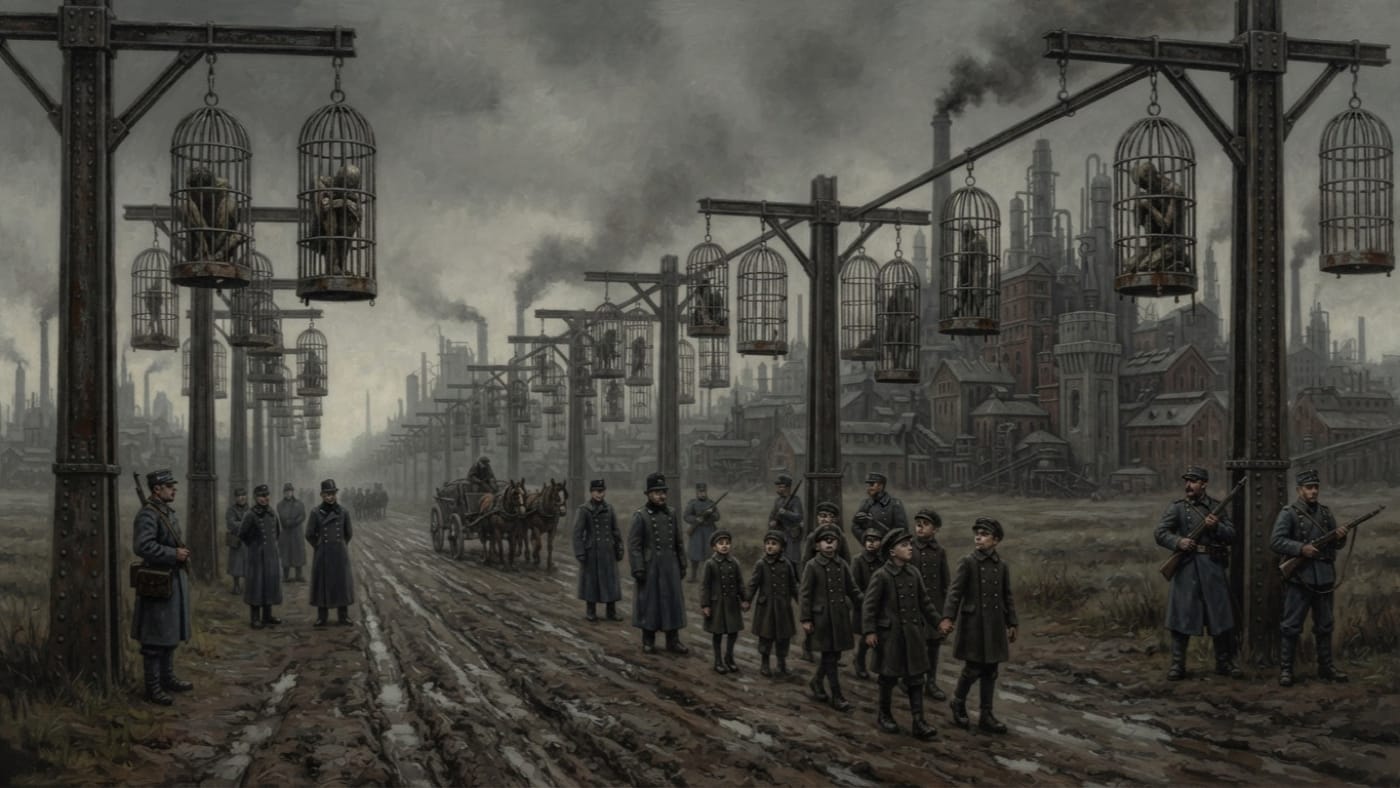
#On the Name and the Road
The Synod uses the name "Iron Choir" for two things and has never apologised for either. In the chambers of the Bureau of Purity, it means the licensed hymn sung while a confession is branded into flesh. On the road out of Mainz, it means a row of cages. The first is a procedure. The second is a congregation that was never permitted to leave.
The cages hang from iron stanchions along the Mainz road, on the stretch the older surveys place toward Strasbourg. Every carter bound for the capital passes beneath them the way a communicant passes beneath a rood-screen. They were filled with heretics condemned under Severian of Mainz and made to sing hymns, their throats cut shallow so the singing carried on until wounds and death closed it. Purity's literature calls it a song without end. A Bureau that controls the definition of "end" can say such things.
Most of the cages are empty now. Purity treats this as a maintenance detail.
#On Severian and the Civic Body
Severian appears as Grand Inquisitor in some registers and Inquisitor-General in others, and Records has never found a reason to choose between them. He reviewed the ledgers of Mainz and declared the city "a single heretic body." He did not mean it as a figure of speech. A body is treated by incision, so he took Mainz apart parish by parish and street by street, the way a surgeon works on a limb he has already decided to keep only in part.
His Commentaries on Faithful Severity state the principle without upholstery. Where heresy is suspected, the suspicion is destroyed, and the innocent dead go into the column marked prevention. The cages put the Commentaries on public display. A parish emptied in a cellar teaches one cellar. A parish hung singing along the high road teaches every wagon, every pilgrim column, and every toll clerk with a chit in one hand and a conscience in the other.
Records adds a footnote I have always enjoyed. Mainz overshot its Severity Index during his tenure and was issued a corrective famine. Severian complied: for a month he fed the trenches with his own city. That counted as instruction too. When the correction was finished, he signed the city's discharge and stamped it with blood that never quite dried. I have handled that stamp. It still prints.
The road taught him something the Synod later wrote into law. In A.S. 134, at the Eighth Doctrinal Congress, Severian added Article 19 to the Catechism of Obedience. The cages had shown that fear could be kept up like a building, with stanchions, rust schedules and visiting hours. Article 19 moved the building indoors and handed every household the keys.
#On Licensed Song
Here the name splits, and careless chroniclers mix up the halves. The condemned in the cages sang because they were made to. The Iron Choir Brand-Singers sing because they hold a licence, and they are paid in salt, tea, ration priority, and the infirmary bed their throats will one day need.
The two halves meet at the brand. A confession burned in under licensed hymn may end in a chamber ledger, in a Pillar of Glass, or in a cage on the Mainz road. Records has never produced a single organisational chart covering both singing choirs. Nobody has asked for one.
A Brand-Singer's office is to keep confession-by-pain steady. Doctrine prefers to say they "guide the tongue toward truth." The rite has six movements, which the professionals recite the way other trades recite prices:
- The room is tuned with rod and metronome token.
- The Opening Hymn steadies the subject's breath.
- Each segment of the confession is cued to a note pattern.
- The Brand-Smith lays the iron on the beat, so the scar agrees with the text.
- A closing tone is held, then a silence.
- The singer reports any pitch anomalies, and a scribe certifies the confession clean.
Pain opens. Hymn orders. Truth seals. The slogan is shorter than the procedure and much easier on the voice.
You know them by the iron-grey mantle, the white licence cord at the wrist, the ash on the cuffs, the throat seal stamped weekly and the small brass tuning ring. Their hymn slates carry approved verses only. Their wax earplugs are for afterwards, when the silence must last a full bell-hour.
The profession quarrels in three schools. Mercy Tone sings slow and sustained to keep the subject alive, and families pay for it. Purity approves, since a preserved subject also remains available for further processing. Judgment Tone sings sharp cadences to hurry the confession along, and officials pay for that. The Silentists hold that any singing invites the wrong listener, and would cut the rite down to metronome and breath.
The work leaves its practitioners with scarred cords, soot in the lungs, and bell-sickness, in which the sufferer hears tempo in the rain and in their own pulse. Auditors test their intervals without warning. Now and then the room answers: the hymn comes back half a beat late, in a harmony nobody in the chamber sang. Purity files this as an anomaly for inquisitors. The singers keep their own rule for it: if the room sings back, stop breathing. I record the rule and decline to certify its cause.
#On the Audience and the Schoolroom
Every great Inquisitorial spectacle divides its labour the same way. Doctrine supplies the text. Purity supplies the condemned. Orison and Song supply the air. War holds the cordon. Tithes supplies the crowd by fining anyone absent. The Mainz road needs less staffing than most, because a road brings its own crowd. Commerce does the summoning, and the cages only have to hang there.
The Procession of Tongues in Prague is a feast-day event. The Iron Choir runs every day. The Inquisition practises what its manuals call selective visibility: some terrors, like the Silent Confessional, are meant to be whispered about, and others are meant to be seen by everyone. The Choir belongs with the second kind. A people soaked in spectacle goes numb, and a people starved of it gets curious. So the Inquisition's calendar alternates high feasts of cruelty with low fasts of rumour. The road gives Mainz a steady daily dose.
The Little Witness Program marches Catechism School classrooms past the cages. The children walk in pairs and are told to look up.
The Bureau of Mercy protested. Purity pointed out that children die in the trenches every day. "Let them die literate," Mercy said. "Let them live obedient," Purity answered. The Council of Veils ruled for obedience. The Bureau of Records went on keeping the figure. I report it as Records' figure, because nobody else was allowed to count.
#On Denunciation and Stolen Spectacle
The cages left Severian with a problem of scale. A road teaches whoever travels it, and most heresy stays at home. Article 19 fixed this with a twenty-four-hour reporting window and a gloss short enough for children: Silence is shelter. After A.S. 134, no citizen needed a cage to learn what a cage was for. They watched their neighbours, their children and their own pauses, and turned themselves in for inspection without being summoned. The Choir needed a road. The Article needs only a kitchen.
The method had another student. The Theatres, the public-charity faction of the Black Ledger, use the grammar we taught the continent: bells for sequence, witnesses for memory, staging for meaning. They hand out stolen bread under the second bell, in front of hungry children who count the loaves aloud. Nobody in Records has documented an encounter between their Queue-Saints and the Mainz road, still less any shared descent. None is needed. When I once listed the Iron Choir among our own inventions, I listed it with pride, and I have not withdrawn the listing.
The difference lies in the licence. The Choir's audience leaves frightened of the Synod. The Theatres' audience leaves grateful to a criminal. The bells sound the same in both. Bureaus charged with confiscating stories find this hard to forgive.
#On the Present Condition
On windless days, travellers on the Mainz road report that the crossbars hum. The Engineers attribute it to resonance from the bellways. Purity calls it the murmuring of saints. Records files both explanations and certifies neither. My own view is that the cause matters less than the fact that people hear it. A cathedral is a place you visit. This one you have to pass.
Severian's fate has been settled several times, and every settlement disagrees with the others. One account says his bones hang in a Mainz cage and rattle in the wind. Another says he was found dried to a husk, the skin stretched across his own cage like parchment, after a masked figure carrying a ledger was seen at the cathedral gate. Doctrine says he died of piety. The Order of Severance once went further.
The Order of Severance names Severian of Mainz the first Judge: an Inquisitor whose zeal outgrew its name.
Corrected. There has never been, nor will there ever be, a transformation of Inquisitor into Judge. Confusion between the two is sedition. The Order of Severance keeps its theory. The public keeps the correction.
As of A.S. 201, the installation stays in service as public instruction, and its survey entry reads like an inventory of a sanctuary nobody is allowed to close. The rust seams are logged. The stanchions are inspected. The schoolrooms keep coming, and the hum continues on windless days whether or not anyone is in the cages.