
#On the Soft Recitation
“Hymns are nets.” — Mercy Preacher idiom, entered by Purity, understood by Purity some decades late.
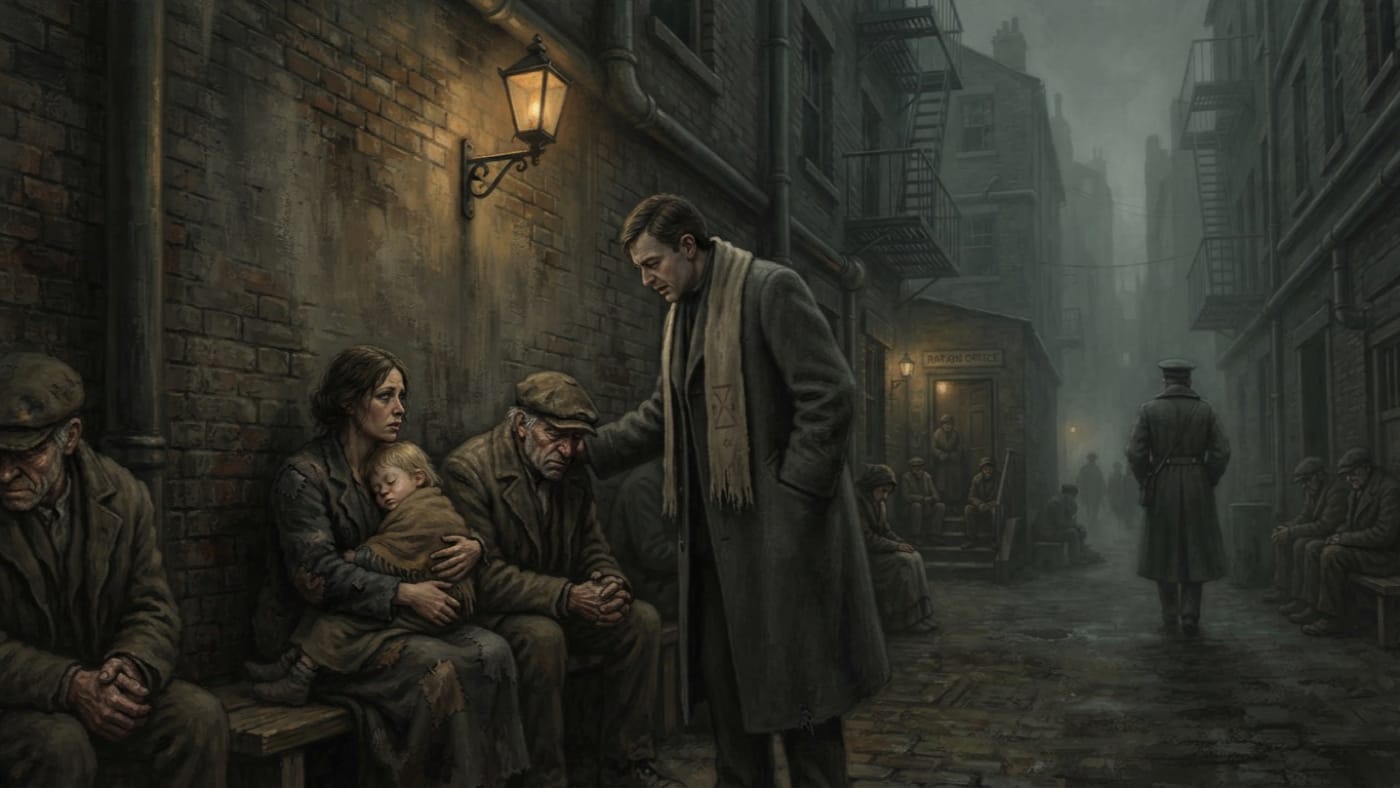
A lull prayer is an official mercy form: a soft recitation spoken in curfew lanes, in plague wards, in orphan dormitories, and on the benches outside ration offices, where the hungry sit with their elbows on their knees and wait to be called. Its declared purpose is to calm. People hear it as a bedtime prayer because children hear it most and remember it longest. That is a misreading. The lull prayer is said over the carter who received his levy mark at noon, the widow who has stopped counting bells, the fevered man on the third cot, and the girl at the dormitory rail. Distress has no age of majority, and the Synod sends its soft speech wherever distress collects.
The reason is masonry. A frightened street after curfew is a crowd in waiting. A crowd needs Wardens, Wardens need wages, and walls repaired after a riot need stone, mortar and a requisition signed in triplicate. Twenty murmured lines from a grey stole under an amber lantern cost one stipend and some lamp oil. The Church has always preferred the cheaper sacrament.
The lull prayer must be kept apart from the Approved Comforts. Those are the fourteen forms established under the Curfew Ordinance of Quiet Hours in A.S. 94, drafted by Rites, vetted by Purity, and described by their own entry as public-order utterances rather than prayers. A Licensed Consolator may use both in the same hour at the same bench. I hold no instrument that defines the relationship between the two repertories, and I will not forge one to tidy a shelf. The Ordinance dates the Consolator office. It does not date the lull prayer, and no register I have seen records when the first one was spoken.
#On the Attribution to Old Faron
Tradition credits Old Faron the Hush-Monger with being the first to make a lull prayer carry aid instructions. The claim is narrow and should be kept that way. He is not credited with inventing the lull prayer, which served as official mercy before anyone thought to load it. He is not credited with founding the Lantern Mercy Preachers, whose unlicensed tenderness began without him. The tradition gives him one craft: hiding practical help inside a recitation designed to calm.
Tradition also places that craft before the Warden Sermon Trials of A.S. 134. It offers no founding year and no first performance, and no lane claims the first night. No trial transcript names Faron. Purity takes the silence as proof of his cunning. The Preachers take it as proof that he was protected. A careful archivist takes it as proof that the transcripts do not name him.
His personhood remains unverified. The Bureau has a name, several spellings, four sketches that disagree about one eye, and a technique that works whether or not anyone ever owned it. For the purposes of this entry, the attribution is the artefact. I catalogue it the way I would catalogue a reliquary whose bone has gone missing: with care, with a receipt, and without kneeling.
Earlier Purity summaries called Faron the author of the Lantern Mercy heresy.
Corrected, as the Faron dossier already records. The heresy predates any recoverable reference to Faron. What tradition assigns him is the aid-bearing lull prayer and the methods of evasion around it. The narrower charge is smaller history and larger administration.
#On What the Informed Ear Receives
The method depends on two kinds of hearing. A stranger on the bench hears a lull prayer and is calmed, as the form intends. A listener who shares the lane’s circumstances, and who was told on some earlier evening to listen for a certain cadence, hears the same lines, is calmed by them as well, and comes away knowing what to do next.
The Faron dossier preserves reported readings. “Sleep beneath the western eave” was a blessing on rest to anyone passing; to a prepared household it meant use the west stair. “Count three bells and bless your cousin” meant wait until the third bell, then send the child to kin. Neither line contains a command, a street name or a target. The general Preacher account states that the added sentence is never an instruction, and on the page that is true. The surface carries no order. The direction lies in the prepared listener, and the listener cannot be transcribed.
These readings belong to particular lanes on particular nights. They are not entries in a codebook. In one ward the western eave meant the west stair. In the next ward an eave is only an eave, and an assessor who arrests a man for sleeping under one gets laughed at by his own sergeant. There is no key, which is exactly why Purity keeps looking for one.
Three practices are routinely confused, and the confusion reaches the indictments. The lull prayer is the recitation form. Concealed aid is one use of that form. Phrase-rotation, the technique attributed to Faron under the street name “speaking like water,” varies the wording from night to night while keeping the useful meaning, so that no two transcripts match. Beside these sits the work of the Tongue-Smiths, who move meaning through emphasis, pause, local idiom and shared grief without changing a word. A rotated line defeats a clerk’s comparison. An unchanged line said with a different breath defeats the clerk’s ear.
The labour is divided. Fog Preachers do the speaking. Tongue-Smiths prepare the language and its delivery. Candle-Runners carry fragments and blessing schedules. Mercy Architects arrange the routes and the refuge referrals that a heard phrase can point toward. Some Lantern Brotherhood patrols contribute omissions, taking the next street at the right quarter-hour. That is how a line spoken on a bench becomes a family on a stair.
Most lull prayers carry nothing. A grandmother soothes a child in a plague ward and the child sleeps. Purity’s error and the Preachers’ cover are the same fact: any given recitation is probably innocent.
#On Transcripts and the Hearing Room
Each step that makes the method useful also makes it dangerous. Repetition gives a clerk two matching lines. A recognisable voice gives an informer a face to describe. Written instructions give a tribunal an exhibit. Informer testimony gives it a narrative. Conspicuous results give it a motive: a stair that empties too neatly, or a dormitory bed found cold on the morning of a levy. A Preacher can rotate every phrase and still be hanged by a safe house that fills too efficiently.
The concrete price was set in A.S. 134. Seven Licensed Consolators from Rhineland districts went before a sealed Purity tribunal on the charge of pastoral overreach. They were watched at dusk stations by plainclothes Confessor-Booth Clerks and had their supplemental sentences read back to them in a small room by men trained to drain warmth from ink. Five were reassigned to trench chaplaincy. Two were immured. The sealed digest preserves no collection of lull prayers and no confession to a code. What it established was precedent. Afterward, written instruction among the Preachers was treated as poison and fragments replaced orders.
Purity learned as well. Clerks lay transcripts side by side, card against card, and mark variance in the margin. Rotation defeats the simplest test, which is matching the same sentence across separate nights. Purity’s answer was to compare function across unlike wording. The Red Lanterns now train to distrust sermons that are too clean for too long, so excessive verbal conformity has itself become a smell.
Classification Advisory 14-L, in its attested A.S. 199 revision, sets out the thresholds: surveillance priority; arrest upon documented recurrence; a first citation that may be filed as pastoral enthusiasm; a second that must be filed; immurement upon the third. The advisory does not state that recurrence of function counts as recurrence. Officers interpret it that way, and that is a reading of the text, not part of it. Its rubric also cannot be applied backward to the seven of A.S. 134, whose tribunal kept its own arithmetic.
A clean file proves nothing in either direction. The absence of actionable evidence is not innocence, and it is not guilt.
#On the Present Recitation
By A.S. 178 the practice had become ordinary enough to split a brotherhood. The Cologne Schism showed how far some watch circles had gone in shielding Mercy Preachers, and three answers came out of the cellar. The Ward-Soothe Purists cut their contacts and went back to calming without comfort. The Lantern Loyalists kept a pragmatic tolerance, because a quiet street needs fewer boots. The Soft Insurgents took up the aid-bearing prayer as a commitment and stopped treating it as a regrettable necessity. All three positions came later than the practice. None of them created it.
As of A.S. 201, the lull prayer is still said at every hour the bells permit. The arrangement is cruel in a way peculiar to it. The listener must understand enough to act. The speaker must say little enough that the listener cannot be made to repeat it. The child who carries “three bells” to an aunt’s door may never learn there was a stair, a safe house, an omitted patrol, or a man in the doorway with ink under his thumbnail. That child has been made into a courier by a lullaby, which no tribunal has yet found a form to record.
The institutional use is no cleaner. A lull prayer that only calms also keeps the queue seated until its names are called, keeps the ward quiet while the cart is loaded, and keeps the dormitory asleep while the register is amended. Purity calls this mercy, and the Preachers call it sedation. In practice it is both, depending on the lane.