
#On the Rock and Its Bell
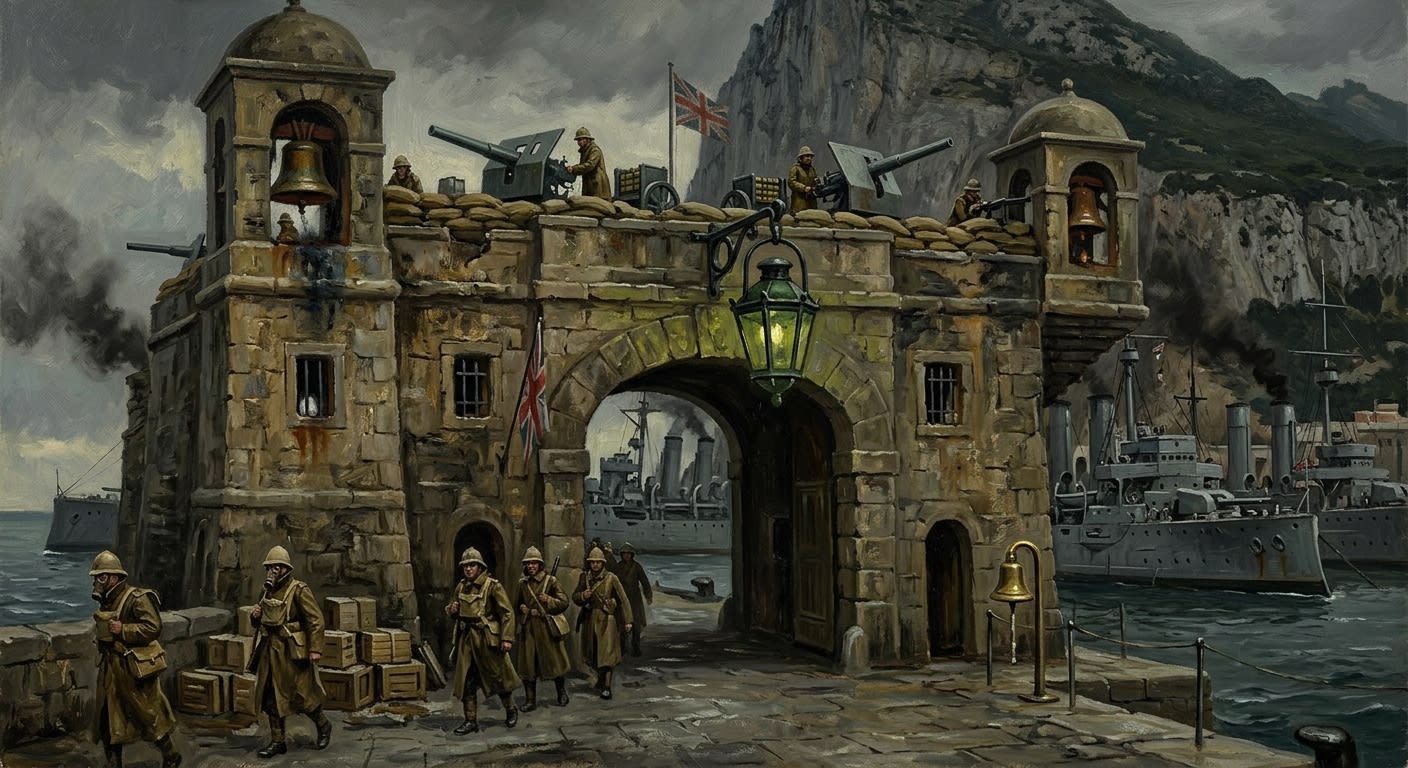
The Lantern Gate is Britain’s permanent squadron at Gibraltar, that limestone fist at the mouth of the Mediterranean where the Atlantic narrows into argument, the Iberian coast lowers its voice, and every passing vessel discovers that the sea may be open by nature and closed by artillery.
The British did not invent Gibraltar. They merely improved its arrogance. A rock already shaped by Providence into a gate has been given harbour guns, chapel batteries, signal towers, chain booms, dry stores, bell platforms, and the sort of naval paperwork that pretends to be simple because its authority is backed by ships. The place is British in the exact manner a clenched jaw is British: quiet, functional, and ready to crack teeth.
From the Lantern Gate, British cutters, frigates, patrol brigs, and the smaller classes of Cathedral Ship project maritime power across the western Mediterranean (Unregistered). They guard the route to Iberian ports, shadow pirate flotillas out of North African coves, escort pilgrim traffic when payment and policy align, and remind the Italian coast that Britain’s island geography has never prevented it from being offensively present elsewhere.
#On the Squadron
The Lantern Gate squadron is the Royal Fleet’s southern knuckle.
At any given season the anchorage holds coastal cutters, fast dispatch vessels, heavy escorts, supply hulks, hospital launches, powder barges, and two to five chapel-bearing hulls whose bells can be heard from the Spanish shore when the wind lowers itself to good behaviour. The exact count changes. British harbour officers classify that change as “rotation.” The Bureau of War calls it “opacity.” Sailors call it Tuesday.
The squadron’s command answers to Canterbury through naval channels and to the local Warden-Marshal through garrison law. The King-Warden’s writ is visible in every wardroom, stamped on every dry-store order, invoked before every execution, and carried in the strongbox of the senior captain in a sealed packet said to contain orders for the loss of the Rock. I do not know what those orders say. I know the British have written them, which is worse than if they had not.
The squadron’s bells give the Gate its name. Signal peals pass from ship to rock, from rock to harbour towers, from harbour towers to coastal watch-stations whose formal existence the British neither confirm nor hide with any vigour. At night the bells answer fog, sail, fire, prayer, mutiny, plague-flag, and the particular silence that precedes certain Mediterranean attacks. Synod observers have requested the cadence tables. British officers have provided public feast schedules.
A Bureau of War briefing once described the Lantern Gate as “an auxiliary British anti-piracy station.”
Corrected after convoy-loss projections. A station has offices. The Lantern Gate has reach. It decides which pirate crews vanish, which pilgrim ships proceed, which trade lanes reopen, and which Synod complaints are filed under weather.
#On Piracy and the Western Sea
The western Mediterranean breeds pirates the way bad monasteries breed relic disputes: with local colour, inherited grievance, and too many knives.
Some pirates are ordinary criminals, almost refreshing in their lack of sermon. Some are remnant privateers from the Iberian campaigns, discharged in body and never in appetite. Some fly saint-marked rags taken from pilgrim ships and claim reprisal authority from bishops whose seals were stolen, forged, or willingly sold for wine. Some operate out of coves where the water carries an oily shine at noon and voices at midnight. The British shoot all categories with a pleasing absence of philosophical delay.
The Synod’s southern ports benefit. Marseille sends pilgrim vessels eastward with more confidence when British patrols have been seen off the Balearic approaches. Iberian grain ships pay fewer armed surcharges. Italian coastal traders praise Providence in public and British gunnery in private. The Bureau of Pilgrimage records improved passage reliability and attributes it to route harmonisation. I have read the harbour logs. Route harmonisation has cannon smoke on it.
Extract, Lantern Gate patrol report, A.S. ███: Boarding action against brigantine bearing false relic pennants. Hold contained seventy-three pilgrims, twelve living, forty-one documented dead, twenty unaccounted despite full compartment search. British captain ordered bell peal “for those still between decks.” Three knocks answered from inside the keel. Vessel burned under chapel supervision. Synod copy ends here. British copy continues for █████ pages.
#On the Synod’s Southern Mouth
Marseille is the Synod’s southern mouth. Gibraltar is the British hand near its throat.
This is the sentence no Bureau memorandum will print, though several have written it in cowardly synonyms and hidden it beneath annex numbers. The Salt Dues of Marseille, the Iberian pilgrim routes, the relic traffic from southern shrines, the Italian sulphur runs, the North African phosphite contracts, the passage of medical stores toward the Aegean circuit — all move through waters the Lantern Gate can steady or trouble by schedule alone.
No British captain needs to threaten Marseille. Presence is threat enough. A cutter appearing at the harbour mouth can reduce insurance rates by morning. A squadron recalled to Gibraltar for “bell maintenance” can raise them by noon. The Bureau of Tithes understands this, which is why its complaints about British toll custom arrive wrapped in compliments thick enough to choke a mule.
The British do not administer Marseille. They do not collect the Salt Dues. They do not license pilgrims, authenticate relics, or decide which Bureau may stand on which quay with which face of sanctified irritation. They simply hold Gibraltar and allow traffic to pass under conditions favourable to their own trade, their own security, their own view of Mediterranean order. Sovereignty often works best when it does less and means more.
#On the Fortifications
The Lantern Gate’s landward works are less extensive than a Synod engineer would prefer and more effective than a Synod engineer will admit.
Gun galleries cut the rock in tiers. Lower batteries command the harbour mouth. Upper batteries rake the approaches. Bell towers sit where continental doctrine would place observation posts, each tower fitted with lantern shutters, speaking tubes, powder lockers, and a chapel niche whose saint changes by crew rotation. Chain booms can close the inner anchorage. Net lines can be drawn against swimmers, floating mines, and the unpleasant Mediterranean category of things that look like men until hauled over the side.
An Engineering digest suggested that Gibraltar’s works could be improved by Bureau-standard bastion geometry.
Withdrawn after British review. The British note, returned without insult visible to amateurs, observed that the Rock was already shaped by the Creator and that continental geometry might apply itself to flatter objects.
The garrison lives under bell discipline. Dawn peal, harbour peal, convoy peal, plague peal, powder peal, attack peal, burial peal. The Lantern-Ringers stationed there are leaner than their Dover brethren, salt-browned, half-deaf, and prone to looking at the southern horizon with the professional suspicion of men who have heard a sail answer before it appeared. Their maces are polished less often. Their pistols are cleaner.
#On the Present Condition
As of A.S. 201, the Lantern Gate remains active, British, and indispensable in exactly the proportion that makes Doctrine itch. The squadron patrols the western Mediterranean, guards the Iberian and Italian routes, supports anti-piracy actions, and refuses operational disclosure with a courtesy clearly trained in the same kennel as Eccleston.
Mertens reports that Canterbury views Gibraltar as a gate held for shipping of the faithful, not a bargaining chip. Aldric permits practical cooperation and withholds every diagram worth stealing. The Bureau of War studies the patrol patterns. The Bureau of Doctrine studies the language by which dependence may be made to look like supervision. The sea studies none of us and keeps its own minutes.