
#On the Crown’s Floating Argument
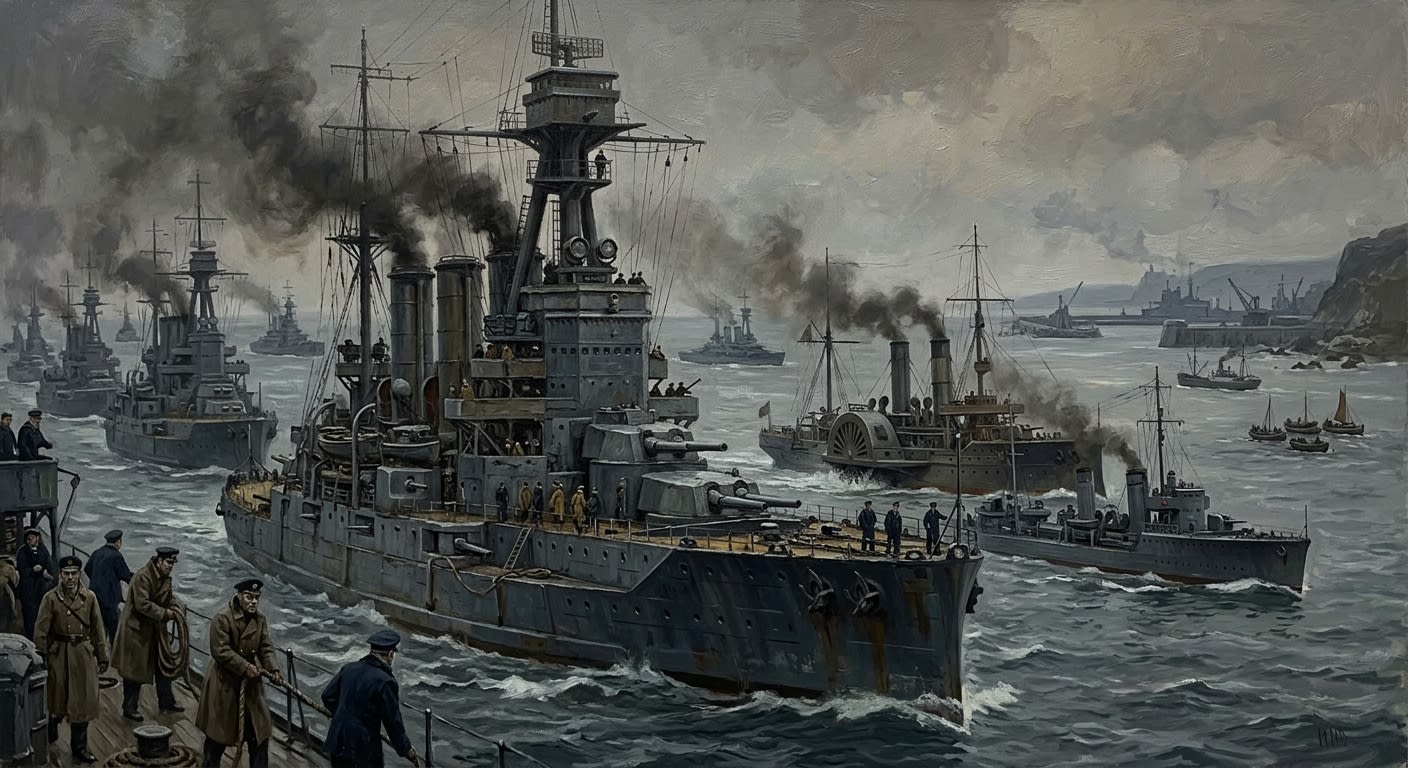
The Royal Fleet of the British Crown is the island’s true parliament: three hundred hulls of varying age, temper, gun weight, chapel discipline, bell height, and consecrated insolence, all answering ultimately to King-Warden Aldric III at Canterbury and all refusing, with admirable consistency and infuriating usefulness, to become legible to Strasbourg.
The Synod has armies. Britain has ships. This is the oldest maritime fact and the most expensive diplomatic sentence in our western files. A British regiment may be modest by continental measure, a shire levy beside the Continental Levy, a tidy little cupboard of mail, wool, muskets, and stubborn hymns. The Fleet is different. It owns the Channel by habit, contests the western Mediterranean by rotation, carries the Lantern Way under bell and gun, and protects Synod grain, coal, chain, pilgrims, medical stores, and diplomatic dignity from fog, pirate, anomaly, and the sort of sea-thing that makes a clerk revise “weather” into a sealed category.
To write of the Fleet as a navy alone is to insult the matter by accuracy. It is navy, rite, court, escort, blockade, shrine network, tax instrument, succession guarantee, and King-Warden’s sceptre laid horizontally upon salt water. It is the reason the British Crown may remain Zone 0, independent, allied, unabsorbed, and still addressed in full style by men who would rather swallow sealing wax than concede equality aloud.
#On Its Composition
The Royal Fleet is not one class of vessel multiplied until the accountants feel safe. It is a household of hulls, some lean as knives, some fat with coal and prayer, some old enough to carry legends in their bilges, some new enough that the paint still smells of yard smoke and blessed pitch. Coastal cutters watch the chalk lanes. Fast dispatch vessels run letters through weather that would make a Synod courier demand a martyrdom stipend. Heavy escorts travel with grain and pilgrim convoys. Hospital launches collect men from water with the professional calm of those who have seen what water returns when mishandled. Supply hulks lurk behind the line of glamour, useful, ugly, indispensable.

Above them in fame, if not always in number, stand the Cathedral Ships: warships with chapel amidships, bell-tower above the quarterdeck, conventional batteries along the hull, rams at the prow, and reliquary-keels below the waterline. Every continental bureau has a different word for them. War calls them assets. Engineering calls them unsolved. Bells calls them a request denied seven times. Relics calls them an outrage wrapped in oak. Doctrine calls them British, when Doctrine wishes to avoid profanity.
The lesser vessels matter more than romance admits. A cutter with two guns and a Lantern-Ringer can save a convoy by sounding the correct alarm before a fog-bank develops teeth. A dispatch brig can carry Aldric’s sealed order from Canterbury to Gibraltar faster than three Bureau messengers can agree which pouch is senior. A coal tender can keep a Cathedral Ship on station through a week of bad weather and worse silence. The Fleet’s strength is not that every hull is sacred. Its strength is that every hull belongs to a discipline that assumes the sea is hostile, Providence is watching, and hesitation is a leak.
#On Command and the Table
The Fleet answers to the Crown through channels older than our Concordat and less apologetic. Aldric’s writ stands in the wardrooms. The Table of Nine supplies port authority, local levy, repair rights, harbour discipline, and those old charters the Bureau of Records has requested seventeen times with the sweet persistence of a moth courting a lamp. The British have confirmed that copies exist. This is their idea of disclosure.

Command at sea is severe, personal, and fast. A captain may read discipline from the chapel steps, order guns run out, command a bell sequence, hang a pirate, receive confession from a dying sailor through a chaplain, and send a three-line report to Canterbury before the next watch. Synod observers witnessing this habit often mistake speed for informality. It is not informal. It is form compressed until it cuts.
A Concord Office note once described Royal Fleet command as “semi-feudal maritime custom lacking regular administrative subdivision.”
Corrected after A.S. 194 observation. The subdivision exists in oath, bell, watch, chapel order, harbour writ, and captain’s authority. It lacks our paper fragrance. That is not the same as lacking structure.
The Fleet’s discipline is tied to the Lantern-Ringers, ship chaplains, warrant officers, bosuns, gun captains, and the peculiar British conviction that a crew is a parish under stress. Every ship has a liturgical schedule. Every bell has a chain of custody. Every death is tolled unless silence has been ordered for tactical reasons, and even then the bell debt remains. Mutiny is sin and treason in one garment. Cowardice is treated less as emotion than as a breach in the hull of obedience. The British are capable of mercy. They simply store it behind frightening locks.
#On the Channel and the Western Approaches
The Channel is the Fleet’s oldest argument. Between Calais and Dover, between Synod coastal guns and British shore bells, between continental anxiety and island certainty, the water behaves like a clerk with a grudge. Ships return with manifests dated in the wrong week. Fog carries voices. Lanterns appear below the surface and move against tide. Crews hear their own names rung in bells they did not carry. The British call much of this weather. The word has saved them from several committees and possibly from despair.
British patrol doctrine works. That is the intolerable field fact. Convoys under British escort reach harbour more often than those without them. Fog gives way around certain bell-mast sequences. Piracy declines where Fleet cutters have been seen. The Bureau of Shadows admires British maritime intelligence with a professional envy so pure it ought to be bottled and sold as poison.
The Crown protects its own trade first, as any sane sovereignty would. Synod convoys benefit because grain, coal, chain, pilgrims, net-cord, and medical stores crossing the western approaches move through the same waters as British interest. Cooperation is a pious name for overlapping necessity. I prefer accurate piety.
The western approaches to the Bay of Biscay and the Atlantic lanes remain less controlled than the Dover Strait. There the Fleet operates in patrol loops, convoy windows, hidden watch stations, and informant routes whose names do not survive Synod copying. Dutch pilots appear in some logs, Fractured North reports in others, and British marginalia in green ink on the most annoying memoranda. A British escort captain will tell a Synod master to wait six hours for bells. The Synod master will object. The fog will thicken. The master will wait. His cargo will arrive. His complaint will become smaller with every meal the cargo supplies.
#On Gibraltar and the Southern Knuckle
The Lantern Gate at Gibraltar is not the Royal Fleet. It is the Fleet’s southern knuckle, clenched at the mouth of the Mediterranean and politely denying that it rests anywhere near our throat. From the Rock, British cutters, dispatch vessels, heavy escorts, supply hulks, hospital launches, powder barges, and two to five chapel-bearing hulls project order over the western sea. The exact count changes. British officers call this rotation. The Bureau of War calls it opacity. Sailors call it Tuesday, which is why sailors should not be allowed near terminology.
Gibraltar matters because Marseille is the Synod’s southern mouth. Iberian grain, pilgrim vessels, relic traffic, Italian sulphur, North African phosphite contracts, and medical stores for the Aegean circuit all pass through waters the Lantern Gate may steady by presence or trouble by absence. A cutter at the harbour mouth lowers insurance by dawn. A squadron recalled for bell maintenance raises it by noon. The Bureau of Tithes has learned to wrap complaints in compliments thick enough to caulk a hull.
A Bureau of War briefing described the Gibraltar force as “auxiliary British anti-piracy support.”
Corrected after private convoy projections. Auxiliary forces do not determine premium tables, route timings, pirate attrition, and the sleep quality of Marseille factors. The approved phrase is “cooperative maritime stabilisation.” The accurate phrase is impolite.
The Fleet’s anti-piracy doctrine is blessedly spare. Identify the robber. Close the range. Ring the bell. Break the hull. Count survivors. Hang the correct number. Continental authorities add hearings, provenance disputes, tariff questions, and arguments over whether a relic pennant was stolen before or after the first murder. The British shoot the man holding the bloodied rope and file the theological uncertainty afterward.
Extract, joint maritime packet A.S. ███: British patrol intercepted brigantine bearing false saint pennants west of the Balearic approaches. Hold contained pilgrims, twelve living, forty-one documented dead, twenty unaccounted despite full search. Ship bell rang without visible hand after boarding. Three knocks answered from inside the keel. British captain ordered burning under chapel supervision. Synod copy ends at “burning.” British copy continues for █████ pages.
#On Relic, Bell, and Hull
The Royal Fleet’s strength cannot be separated into parts without killing the thing studied. This has been the humiliating lesson of eleven years of Synod imitation. Engineering wants the reliquary-keel as a maritime stress problem. Bells wants cadence tables. Relics wants sample custody. War wants escort doctrine. Doctrine wants vocabulary that admits usefulness without conceding legitimacy. The British give us tea, public feast schedules, and no diagrams.
A Fleet hull is made by yard skill, timber, iron, vow, chapel order, bell practice, and relic matter bound into a sequence of handling no Bureau has reproduced. The reliquary-keel resists sorcerous attack because of relic matter, yes, and because the hull around it has been built as if the relic were a living witness rather than cargo. The bell-tower clears fog because of alloy, perhaps, and because the Ringers know when to strike, when to stop, and when silence is the louder weapon. The chapel steadies morale because it sits amidships, yes, and because every man must pass it on his way to the guns.
The Fleet’s rites are practical before they are decorative. Guns are blessed because guns fail at the worst hour when insulted. Bells are guarded because a silenced bell can kill a convoy as surely as a breached boiler. Chapel candles are gimballed because piety that falls over in a roll is poor seamanship. Confessions are heard before fog action because men who hear voices in fog require less private guilt rattling in the hold of the skull. A British shipboard rite is theology with grease under its nails.
#On Dependency and Courtesy
The Synod depends on the Royal Fleet. There. The sentence has been written, and the ceiling has not fallen, though three undersecretaries somewhere have felt a chill.
This dependency shaped the A.S. 199 revision of the Lantern Way from Schismatic Heresy, Category Two, to Non-Standard Observance, Diplomatically Accommodated. The public explanation cited theological review, allied necessity, and refined terminology. The private explanation had grain numbers. Grain is a brutal theologian. It converts faster than sermons.
Britain does not exploit this crudely. Crudeness would relieve us. Crudeness would permit outrage. Aldric permits convoy cooperation, maintains patrols, receives legates, answers letters, and withholds the few pieces of knowledge that would let us pretend we have learned the trick. Lord-Warden Eccleston smiles in Strasbourg. Mertens writes from Canterbury in the tone of a man watching facts beat policy with a chair. The Fleet continues to sail.
The Bureau of Tithes dislikes British coin. The Bureau of Bells dislikes British refusals. The Bureau of Engineering dislikes British ships. The Bureau of War dislikes needing them. Doctrine dislikes the sentence “they are faithful.” All five dislikes are recorded. None has moved a convoy one nautical mile.
#On the Present Fleet
As of A.S. 201, the Royal Fleet remains active, sufficient by British declaration, indispensable by Synod arithmetic, and opaque by long custom. The Channel patrols continue. Gibraltar holds. Cathedral Ships escort high-value convoys and appear where fog, pirate, anomaly, or political theatre requires a chapel with guns. Cutters run the shore lanes. Dispatch vessels carry terse orders. Supply hulks feed the holy glamour with coal, rope, biscuit, powder, pitch, spare timber, and the uncelebrated labour without which no miracle stays afloat.
The Fleet’s enemies are many and badly sorted: pirates, false privateers, fog-things, anomalous water, hostile intelligences under storm, smuggling rings, doctrinal curiosity, Synod envy, British pride, rot, salt, boredom, and the dreadful stupidity of officials who think maps command tides. It answers with bells, hulls, guns, rope, chapel discipline, and the cold arithmetic of a sovereign island that knows the sea is both moat and road.