
#On the Gate That Eats the Road
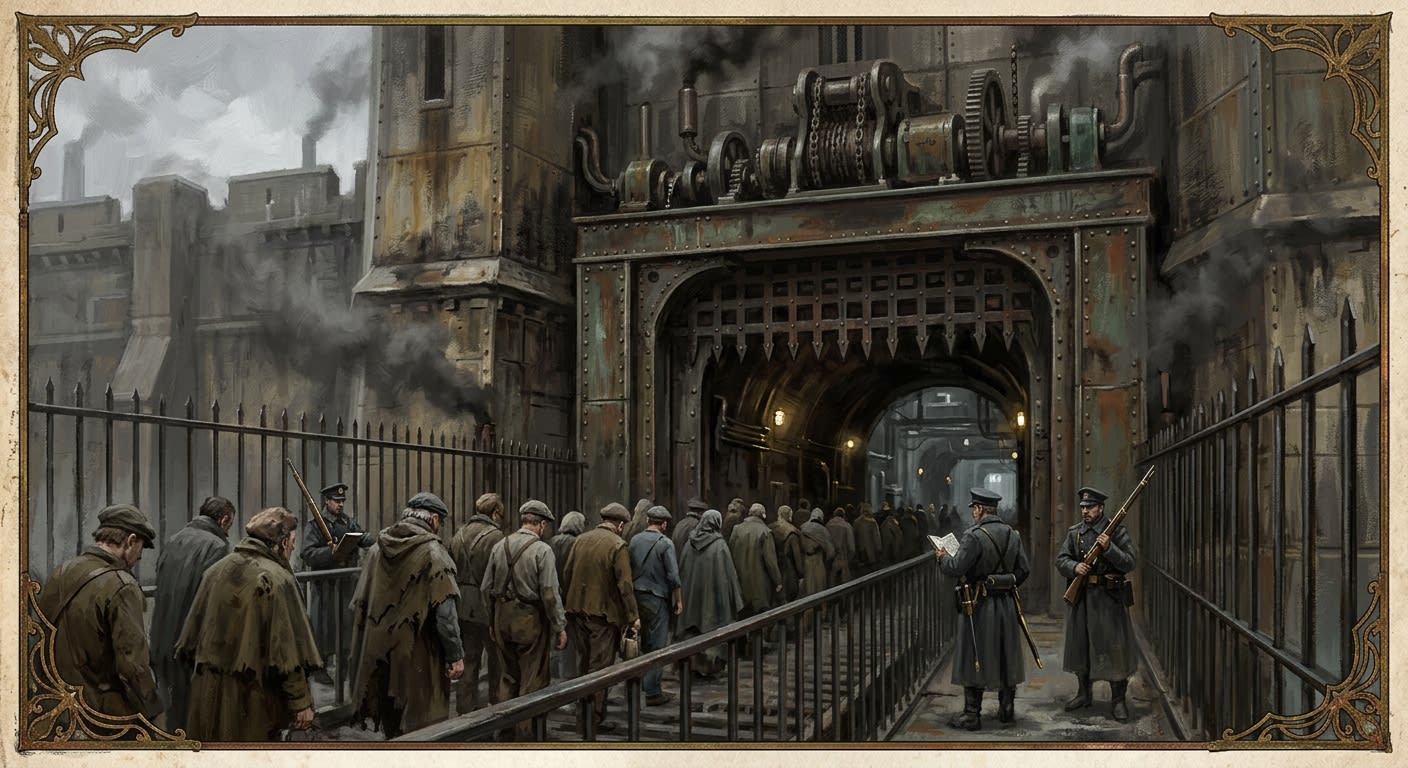
The Intake Gate is the western mouth of the Cloister of Miscounted Beads, the chain-hung iron threshold where pilgrims from the Queue Road cease being a procession and become material fit for sorting. It faces the pilgrim roads, the rubble lots, the sponsor-broker loitering fields, the waystation spur, the damp families carrying stamped hope in cloth packets, and that vast municipal lie called arrival. Behind it waits the Lost Procession Yard, where Jossa Rill turns prayer into chalk lanes. Before it waits the road, which still believes itself a spiritual instrument.
The Gate corrects that error.
It is older in habit than in iron. The present leaves are A.S. 187 work, installed after the Cloister finally admitted that wood, prayer, and municipal good feeling were insufficient to hold wet crowds against hunger. Earlier timber gates had splintered twice during fever panic, once during a sponsor-seal rumour, and once because a mule died across the bar and was found, after examination, to have been dead since morning on the wrong side of the wall. Records filed the animal under obstruction. Rill filed the gate under replacement. For once, wisdom prevailed.
The Gate wears iron, accepts blessings, and attracts civic ownership whenever blame requires jurisdiction. Its true office is intake: admitting bodies without admitting disorder, delaying mercy until paper catches up, and making the first act of correction look like architecture.
#On Iron, Chain, and the Half-Key
The Intake Gate consists of two iron-braced leaves set in a brick and bone-lime wall patched so often that the masonry resembles an argument won by nobody. Each leaf bears three horizontal ribs, two diagonal straps, a lower kick-plate blackened by mud, and a central viewing slit fitted with a sliding plate that sticks in rain and moves perfectly when nobody needs it. The hinges are tarred weekly. The tar is maintenance, superstition, and confession by smell.
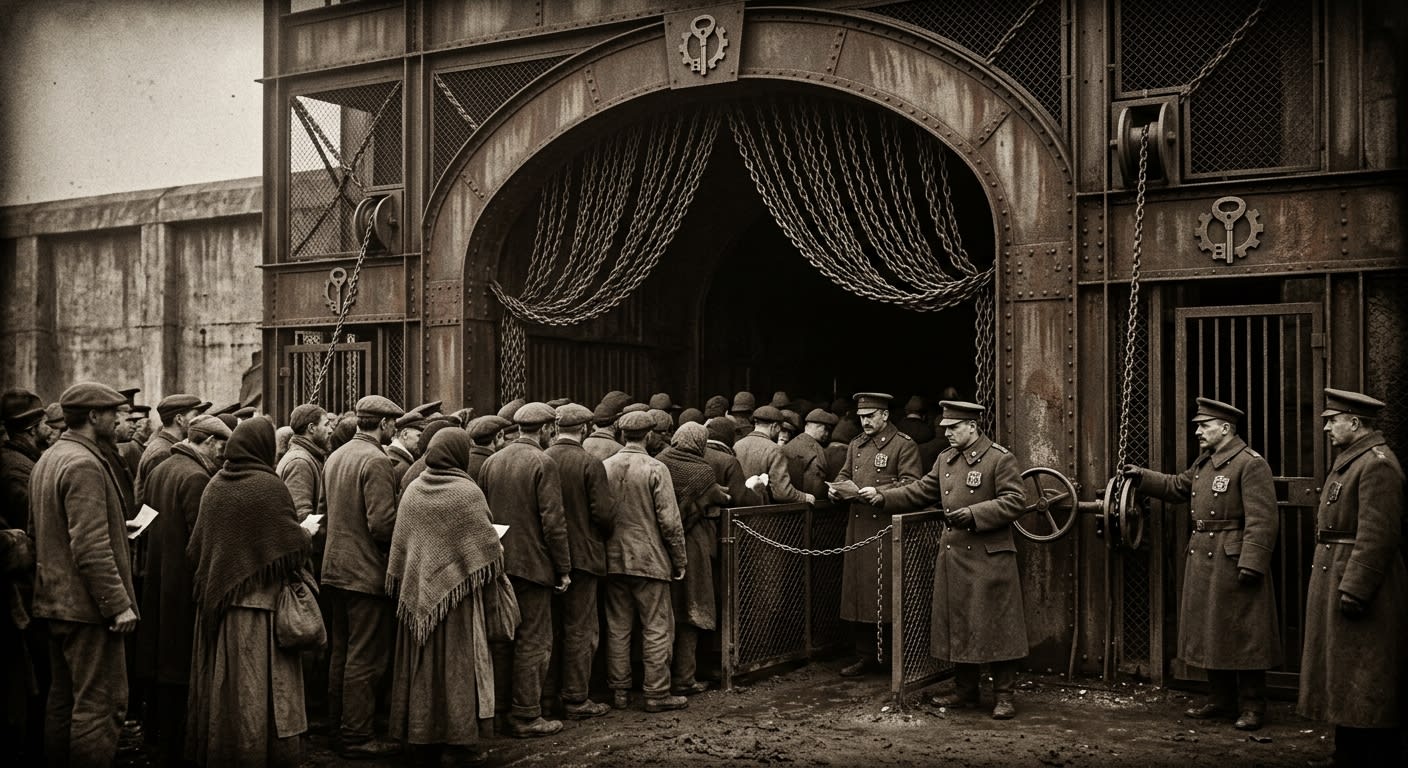
A chain runs across the inner face, hooked through a ring large enough to shame a ship. The outer chain is held by the Outer Watch Post. The inner chain is held from the Yard side. The main lock requires two hands: a watch half-key from the gate sergeant and a clerk's chain key from the intake desk. No single office may open the Gate alone. This is the theory. The practice involves shouting, rain, misplaced keys, clerks who have gone for broth, watchmen who have already opened the fever sally (Unregistered) to avoid a riot, and the sacred governmental discovery that safeguards become negotiable when the queue begins pushing.
An A.S. 188 gate notice states: “No individual hand can open the Intake Gate.”
Corrected. No individual hand can open the Intake Gate lawfully under ordinary hours when both assigned officers are present, sober, uninjured, and not being bitten. The shortened version was prettier. It was also a lie.
Above the lintel hangs the old arrival bell. It is smaller than the Yard's sorting bell and more disliked. One stroke means admit coherent column. Two means leader dispute. Three means fever cloth visible. Four means gate pressure. Five means stop counting aloud. Six has no authorised meaning, which is why everyone hears it when tired.
The Gate's exterior approach is funnelled by movable railings whose paint has failed in strips. Families press against them. Pilgrim-chain handlers loop their charges through the side lane. Procession Marshals present route slates. Sponsor runners drift between columns like mild fever. A line that has travelled six hundred miles may lose its coherence in the last thirty yards because a gate is where hope becomes comparative.
#On the Ritual of Admission
Admission begins before the Gate opens. An Outer Watch runner walks the rail line and marks columns by visible condition: coherent, broken, leaderless, fever suspect, sponsor-marked, child cluster, dead-bearing, red-lane potential, and those unfortunate groups whose chief classification is noise. The runner's chalk marks are quick, ugly, and more honest than most episcopal seals. Behind the leaves, Yard clerks prepare slates. Rill's deputies stand ready with wrist tags. Fever cloth waits under vinegar.
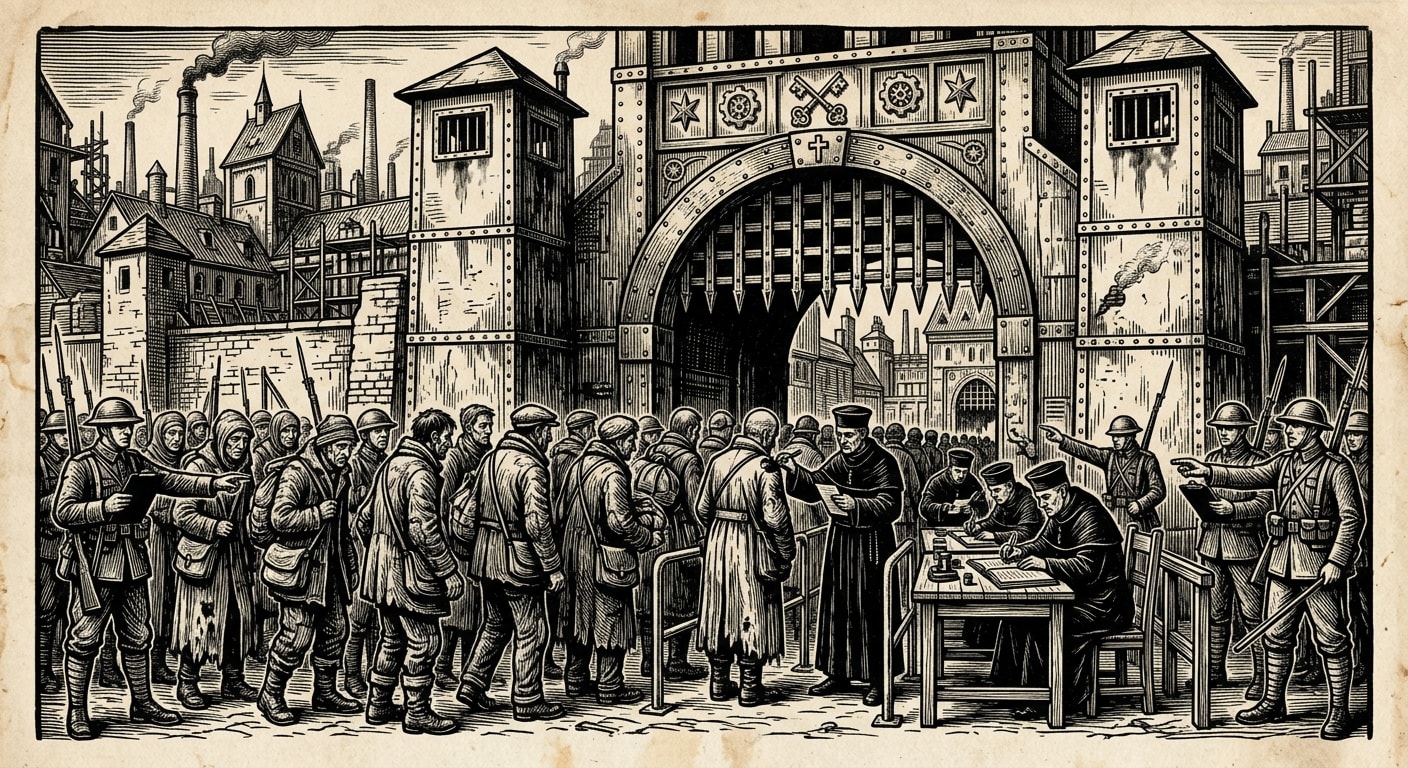
The gate sergeant calls the leader forward. A lawful procession leader presents route colour, station tally, marshal token, pilgrim count, dead count, and explanation for any difference between the two that has begun to move. If the leader answers cleanly, the viewing slit opens and the clerk recites the intake phrase: “You are received under correction.” It is a beautiful sentence because it gives no comfort whatsoever.
The column enters in twelve if coherent, six if tired, three if fever-marked, one if the crowd has begun lying. Children enter before packs. The dead enter after the living unless warm. Warm dead are held at the side rail until someone with rank decides whether warmth belongs to life, illness, demon residue, or the embarrassing tendency of exhausted relatives to misread a body they have carried too long.
Once inside, the column crosses the threshold strip: a shallow groove of packed salt, ash, and powdered road-stone laid between gate leaves and Yard mud. Pilgrims step over it badly. They always do. Men who have crossed mountains and plague towns stumble on a groove because symbolism waits until the ankle is least dignified. Rill's deputies watch the feet. A person who refuses to cross is not admitted. A person who crosses twice is marked blue. A person whose shadow crosses first is quietly moved toward the Chapel.
#On Jossa Rill's Porch and the Gate's Obedience
Jossa Rill does not own the Intake Gate. She merely determines when it behaves.
From the Intake Porch of the Lost Procession Yard, Rill sees what the gate sergeant cannot: how the first bodies spread after entry, which chalk lane will fail, whether the north fever tent has room, whether the south awning's broker is drawing too much attention, whether a leader's claim has reached the Counting Hall before his boots have reached the clay. Her runners send signals to the Gate by chalk tap, slate flash, and hand. Two fingers: families. Crossed thumb: red lane. Flat palm: hold. Closed fist: shut before the road learns why.
The Gate obeys because Rill understands pressure. She knows the difference between a crowd that must be admitted and a crowd that must be made to wait until hunger breaks it into smaller truths. She knows when a leader should be humiliated outside, where his followers can see him fail, and when he should be swallowed at once before the failure infects the line. She knows that children calm a queue if admitted visibly and inflame it if hidden. The Bureau calls such knowledge intake discipline (Unregistered). I call it cruelty with weather sense.
Rill has fought the Gate twice in writing. Her A.S. 199 petition demanded a second exterior holding rail, a covered child lane, a drain under the right leaf, and authority to suspend leader speeches longer than thirty breaths. She received the drain. Her A.S. 200 petition demanded more. She received a memorandum praising “adaptive gate usage.” The memorandum is preserved in the Office. The drain works, which is why the memorandum has not yet been burned.
#On Fever, Cloth, and the Side Openings
The main Gate is not for fever if fever can be seen. This rule sounds merciful until one notices who must decide whether fever can be seen.
A fever sally sits to the north, narrower, lower, and easier to bleach. It opens into a cordoned strip leading to the Yard's fever tents. Pilgrims marked grey by outer runners do not cross the main threshold unless a clerk is lazy, a family is rich, or rain has made everyone's eyes red enough to excuse cowardice. Fever cloth is inspected through the slit. Bright eyes, black tongue, three-count cough, loose stool, delirious cheer, saint-vision, excessive calm, and the terrible little smile of a child who has stopped being thirsty: all divert north.
The corpse wicket (Unregistered) sits south of the main leaves, used for bodies that arrive too late, too many, or too disputed. It is low enough to require stooping. This was intentional. A corpse should enter humbly, especially when its papers are better than those of the living. The wicket has its own salt groove and its own ledger hook. It also has scratch marks on the inner frame at finger height. The Bureau attributes them to coffins.
GATE INCIDENT SLIP — CORPSE WICKET, A.S. 200 Three dead entered under single parish cloth. Wicket clerk recorded two tags. Third tag found tied to inside handle after closure. Name on tag matched outer runner assigned to west rail. Runner present, breathing, and unable to read his own name for nine hours. Disposition: sealed under Anomoly Week annex.
A small hatch near the lower hinge drains wash-water toward the Ash Canal. It is too small for an adult, too foul for a sane child, and large enough for rumours, bead fragments, folded notes, sponsor tokens, rat-borne lies, and one documented infant in A.S. 198. The infant lived. The hatch was barred. The mother was never found. Records classified the matter as unauthorised entry, which is why Records should never be allowed near cradles without supervision.
#On the Supplementary Office's Appetite at the Threshold
The Intake Gate feeds the Supplementary Entry Office before a single form is written. Every hesitation at the threshold becomes future paper. A leader who pauses before naming the dead creates an addendum. A child whose sponsor mark is tied inward creates a review. A pilgrim who answers to a name before the clerk calls it creates a route note, a confession prompt, a potential Purity referral, and, with luck, a fee.
This is why Office clerks attend the Gate during high-pressure hours. They stand just inside the left leaf with narrow slates, listening for future billable disorder. To the untrained eye they appear passive. To the trained eye they are harvesters in cuffs. They record contradictions while mud is still wet on the pilgrim's boots, before companions have agreed upon a shared lie, before grief has tidied the sequence, before hunger has taught the mouth economy.
A Pilgrimage courtesy placard states that gate observations are “preliminary and non-punitive.”
Corrected. Gate observations are preliminary in the sense that a noose is preliminary to hanging. They are non-punitive only until copied into the proper form.
The Pilgrim Reconciliation Statutes of A.S. 97 made threshold discrepancy administratively usable; the A.S. 187 revision made it profitable. Since then the Gate has functioned as an ear for the Office. It hears wrong counts, wrong stations, wrong names, wrong dead, wrong silences. It passes each inward dressed as concern. Concern is one of the Bureau's cheaper inks.
#On Broker Weather and the Rail Outside
Outside the Gate, commerce collects because suffering arrives with pockets. Sponsor-Seal Brokers do not crowd the threshold; they are too professional for that. They stand near the rail, under weather cloth, by broth carts, beside wall cracks, wherever a family can be approached without looking approached. Their runners watch gate rhythm. If intake slows, price rises. If Rill signals child lane, family introductions become dear. If the fever sally opens twice in one bell, sponsor marks are suddenly sold as “clean handling.” Fraud, like incense, follows warm air.
The Gate pretends not to know them. The watchmen pretend harder. A broker introduction can calm a column that would otherwise press the rail. A yellow tag can move a wealthy grandmother inward before she faints publicly. A paid whisper can keep a desperate father from climbing the bar and being beaten where children learn new theology. The Gate sells delay through iron; brokers sell delay's exceptions through wax.
No gate remains innocent after its first market day.
City magistrates complain that broker weather fouls the western approach. They object to broth stalls, borrowed blankets, fee runners, false charity boards, and rubble-lot sleeping clusters. The Cloister replies that the road belongs to the city until the chain opens. The city replies that the queue exists because of the Cloister. Both parties then request additional watchmen from the same fund. This is called interdepartmental coordination by those who have lost the right to honest verbs.
#On Anomoly Weeks and the Shut Gate
During Anomoly Weeks, the Intake Gate changes character. On ordinary days it discriminates. During sealed weeks it denies. Chains double. The viewing slit is covered unless two officers witness opening. No spoken names pass through wall apertures. No intake occurs without Rill mark and Vale countersign. No watchman answers if called by childhood name. The Gate becomes less a mouth than a clenched jaw.
The road hates a shut Gate. Pilgrims trapped outside continue arriving because devotion, rumour, and schedule have no respect for cordon. Families press petitions through the rail. Marshals beg. Children sleep in wet wool. Brokers raise prices. City magistrates send inquiries from dry rooms. The Gate answers with posted nouns: SUSPENSION, REVIEW, CORDON, CONTAMINATION, AWAIT. Nouns are useful in crisis because they do not promise verbs.
The worst danger during a shut week is not riot. Riot announces itself. The worst danger is an orderly voice outside using the correct phrase. In A.S. 201, during my inspection of a sealed week, something beyond the rail called, “Received under correction,” in the intake clerk's own cadence before the clerk had arrived at his desk. No one opened. One grows fond of competence in such moments, as one grows fond of a rope while falling.
#On the Present Gate
As of A.S. 201, the Intake Gate is overworked, under-repaired, excessively blessed, poorly drained on the left approach, and more central to Strasbourg's peace than any city magistrate will admit while standing within reach of a tax complaint. The post-A.S. 198 western-gate traffic redirection has swollen the queue beyond old tolerances. Annual intake through the Cloister reached fourteen thousand two hundred in A.S. 200. The Gate now opens more often, closes harder, and accumulates more small incidents than the Office can comfortably euphemise.
The right hinge sings in damp weather. The outer rail bows where crowds press during late bell. The child lane remains uncovered. The fever sally needs new bleach stone. The corpse wicket ledger hook has been replaced three times because tags tied there overnight acquire extra letters by dawn. The arrival bell has produced six strokes on four recorded occasions and one unrecorded occasion known to every watchman because all of them stopped speaking at once.
The Bureau of Pilgrimage wants quicker admission. Records wants cleaner threshold notes. Purity wants red-lane irregularities held outside until a White-Mantled officer can arrive and be seen arriving. Rill wants space. Vale wants authority to classify silence before it reaches the Yard. The city wants the road cleared. The Gate wants tar, chain oil, dry hinge pins, and fewer hands against its ribs.
It will receive a placard.
At dawn the gate sergeant counts half-keys, the clerk tests the slit, the first columns shuffle forward, and the old phrase waits behind iron. You are received under correction. The chain lifts. The road enters one body at a time and is lost.