
#On the Five Chambers
"Five Lungs on the register. Count the ones that answer."
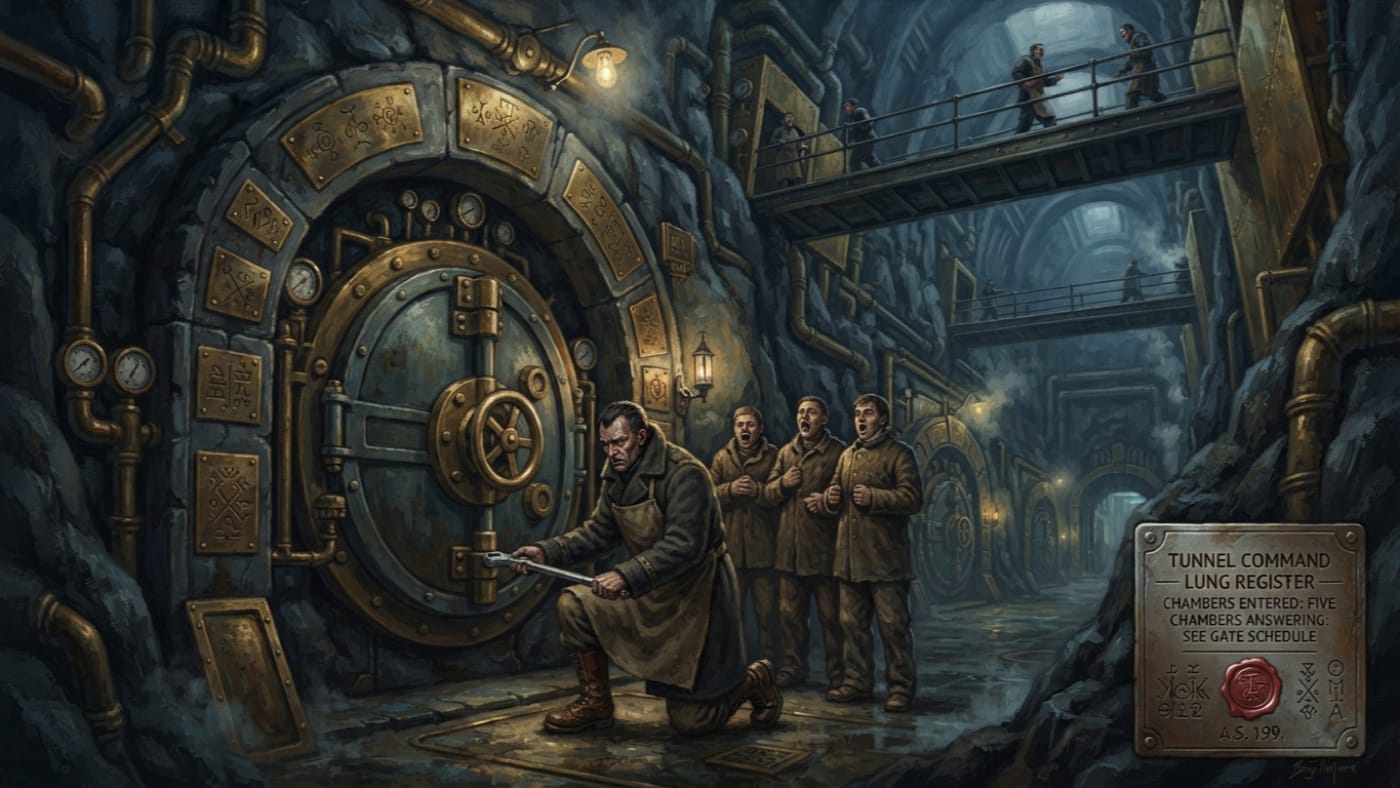
The Lung chambers of Bastion-Irongate are five excavated halls along the Transit Spine, the principal bore through the cliff complex. The Lungs are rooms. I say so at the outset because visitors hear the word in a barracks and arrive expecting something that breathes by itself. These rooms were cut from black basalt and ribbed with iron. Brass valve plates and gasket seats face their thresholds, bone-lime grouts their seams, and the mountain keeps them damp in every season. Air moves in them because men and women make it move. The name records what the chambers do for the fortress rather than what they are.
The register says five, and it is accurate in the narrow way registers prefer. One of the five is the Third Lung. It has been sealed since A.S. 94 and stays in the count the way a dead brother stays in the family Bible: entered, ruled through, never removed. How many of the other four answer fully on a given day is a matter for Tunnel Command's gate schedules, and Tunnel Command does not lend its schedules to theologians. I have not subtracted one from five and published the result. Dossier writers who do arithmetic in public get transferred.
The garrison says the name of only one Lung without lowering its voice: the First, the Dormitory Vaults. The others go by number. No file I was permitted to read sets down the functions of the Second and Fourth. I record the blank and leave it to men with keys.
The Transit & Breath Office's inherited registry describes Irongate as "carved into a steep alpine ridge," a high pass between two valleys, under the formal style of the Savoy Transit Bastion.
Bastion-Irongate occupies the Iron Gates gorge of the Danube near Orșova, on the present Romanian–Serbian border, in Zone 4. Counted north to south, it is the fifth of the seven bastions, between Bastion-Sibiu and Bastion-Shipka. The ridge was never alpine and there were never two valleys. The "Savoy" style has been retired.
#On the Sound That Keeps Them
"Seat the ring. Speak the line."
The public account belongs to the Choir Magistracy, and it is the only account a licensed worker may give aloud. The Lungs are held by pressure. At the doors and seams, gasket seals seated in brass hold the pressure. Sound holds the seals: prescribed harmonics, calibrated in the Choir Nave and carried through the complex by Gasket Choir crews working in continuous shifts. If the prescribed sound lapses, the seals lose their seating. If the wrong frequency is sung at a seam, it may unseat the seal faster than silence would.
I write this as liturgy, because the Synod pays me to. It is also plumbing. The Gasket-Hymn Mechanics who service the Lung thresholds follow a sequence that any honest fitter in any engine chapel on the Line would recognise:
- clean old grease and stone grit from the seat;
- inspect the ring and set it;
- check alignment against witness marks chalked on the brass;
- bring the bolts down in the order the rite card dictates, while the chant crew holds its line and the torque key turns;
- verify the pressure at the gauge;
- file a rite sheet under the mechanic's own name.
The name is the part that matters. If a seal fails after a properly filed sheet, it is a defect. If it fails after an improperly filed one, it is heresy, and the mechanic will learn the difference in a room without windows.
The rings come up from the Valve Quarter, the hot side-throat off the Spine where the foundries pour. A Lung threshold uses up rings the way a cathedral uses up candles. The Quarter counts, stamps and issues its output. Some of that output is counted a second time in the Underchords, at another price.
I cannot give the frequencies. They are written on hymn pages that are numbered and vaulted, then recalled when the bearer dies or is demoted. The Magistracy holds that this secrecy protects the mountain. It also protects the Magistracy, and in Irongate the two are treated as one sentence.
#On the Chamber That Closed
"Sixteen days of knocking. The register keeps the days."
The Great Hush of A.S. 94 is why everything written about the Lungs since has been written in the imperative. Its full account belongs to its own dossier. For nine hours the atmosphere of the complex fell silent. The pressure systems failed in a cascade, each failed seam loading the next. The Third Lung was then carrying dormitory overflow, supply staging and part of the complex's pressure mediation, and it came down. Three thousand dead were ratified. I use the registry's word. A clerk ratifies when he cannot check the count by looking.
The location registry also records sixteen days of knocking from behind the fall and eleven months of excavation. It does not say how the first figure relates to the second. I decline to arrange the two into a story.
The Third Lung was never reopened. It lies sealed beside and beneath the Choir Nave in the southern cliff complex, a restricted scar behind a wall. New works have been cut into the rock nearby since then, Ward Eight of the Breatheries among them. None of them has been certified as reopening the chamber, and the crews at Ward Eight are reminded of this in writing.
What the Third Lung did reopen was the law. Silence in a breath line became a crime with its own court. Continuous maintenance stopped being a sensible schedule and became a moral condition, enforced through the licence, through heat allocation and finally through the Hush Court. Every coercion in Irongate can trace its warrant back to that wall, and most of them do so aloud.
#On the Price of a Bunk
"Sing clean, sleep warm."
The First Lung houses people, or more exactly, it houses labour between shifts. Bunks in the Dormitory Vaults are rented by the hour. The vault smells of damp wool and tallow. The wool is damp because nothing dries in basalt, so every coat in the room is on its second or third wet day. The tallow burns in the lamps and, in bad weeks, goes into men who cannot pay at the ration stalls along the vault wall.
A bunk belongs to a voice. The Magistracy grades voices and licenses them. The licence decides how much warmth a worker may draw, what ration they may buy and whether they may stay in the fortress at all. The Transit & Breath Office runs the other half of the same instrument: breath assessments, permits, heat allocation and quarantine. A strong voice sleeps warm. A thinning voice gets fewer hours on the board. A failed voice becomes a file.
The lung-rot outbreaks of A.S. 199 expanded the Breath Office's quarantine powers. A worker who falls below the line on the candle test leaves the First Lung for the Breatheries. Ward Seven there has been full since the outbreak, and Ward Eight is being cut out of raw rock to take the rest. The Magistracy sends auditors. A coughing chorus labourer loses his tier, then his heat, then his bunk, and finally his place among the licensed. His slot on the hourly board in the First Lung is let again before his blanket has cooled.
The fortress needs voice. The work spends voice. The work pays in the warmth needed to keep the voice. When that sum fails at the bottom of the column, the Office does not alter the sum.
#On the Passages Beside Them
"Every sanctioned wall has a back."
The Underchords are not inside the Lungs. They lie beside them, in spaces the sanctioned apparatus once cut, used, sealed and struck from the survey: abandoned ventilation passages, maintenance crawls and the cavities behind the brass acoustic baffles. The upper reaches run closest to the Transit Spine and the Lung chambers. They are warm because the Valve Quarter is hot and the Lungs are kept. The Underchords live on the maintained complex's heat, its air and its leaking rings. They depend on the Gasket Choir more completely than any licensed bunk-renter does, because a cartel has no way to petition the Magistracy when the pressure drops.
What the Underchords mostly take from the Lungs is knowledge. Stolen hymn pages, the calibration stanzas themselves, are traded below grade alongside counterfeit licences and oxygen bulbs. A man who holds the stanza for a seam knows which sound keeps it seated. By subtraction, he also knows which sound does not. That is why the pages are vaulted, and why they are stolen.
The Counterkey Circle has been visible to the authorities since A.S. 198. It claims that other harmonics could maintain the mountain more safely than the Magistracy's prescription, and that the real danger is the monopoly on that prescription. I record the claim as theirs. The Magistracy holds two positions. The first, that counter-frequencies can unseat seals, is established. The second, that the Circle intends to use them, is for the Hush Court to decide. Neither party has invited me to test its proposition in an occupied chamber.
#On the Present Condition
"The register says five. The crews say tonight."
As of this writing the Lung chambers are maintained, and in Irongate that verb is always in the continuous tense. The chant crews are thinner than the shift tables require. The Breath Office holds quarantine powers it did not have before A.S. 199, and its wards are fuller than it can staff. The Circle recruits from the men the licensing audits turn out. Behind its wall the Third Lung stays sealed.
At the threshold of the First Lung there is a brass valve plate with a gasket seat beneath it. Someone has to clean that seat, set the ring, bring the bolts down in order while a crew holds the line, and sign the sheet. It will be done again tonight, and the sheet has a space for the name.