
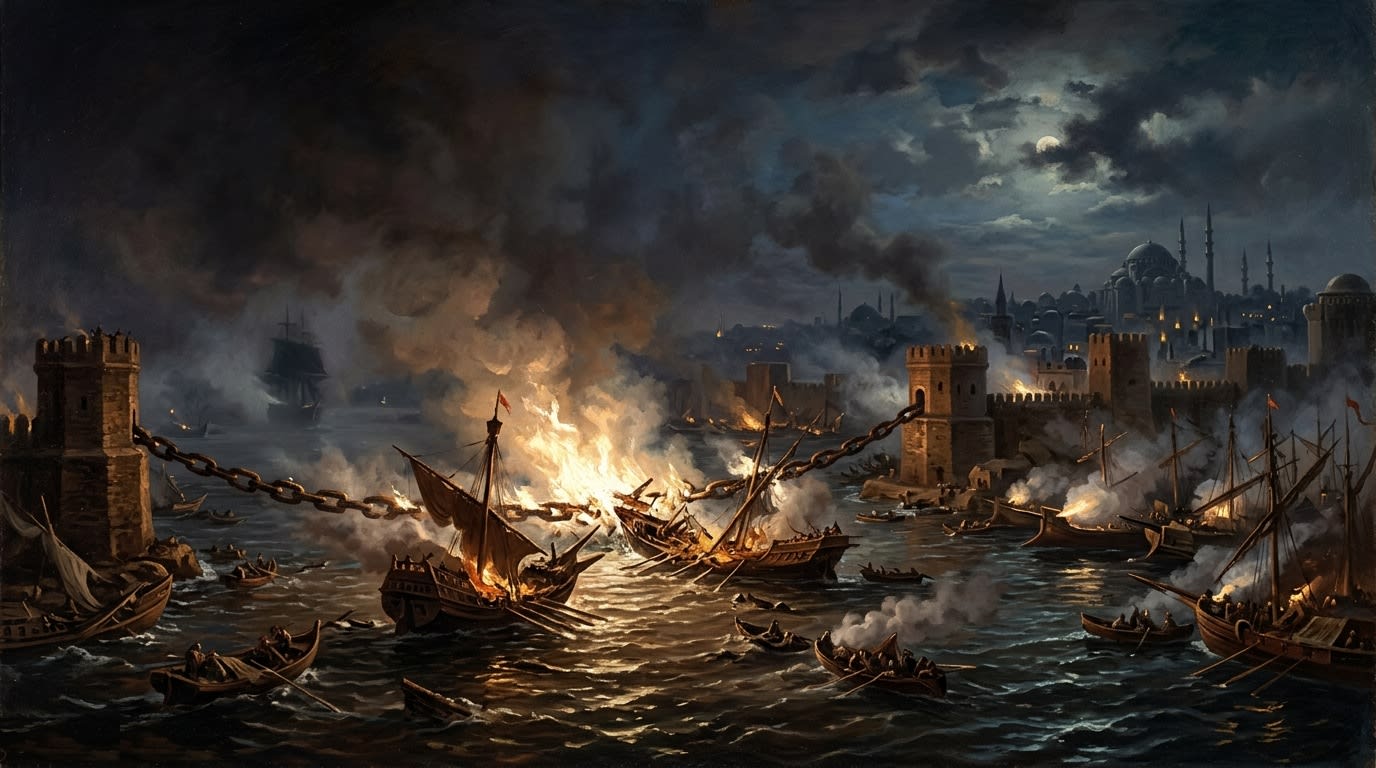
#On the Fourteenth of Ferrum
The Black Sea Armada entered the Bosphorus on the fourteenth of Ferrum, A.S. 162, in the hour when honest ships prefer harbour and dishonest ships prefer fog. Forty-seven demon-crewed vessels came out of the northeastern dark during harvest convoy season, when the channel was fouled with grain hulls, pilgrim craft, oil barges, and the usual floating evidence that Providence loves mankind less than the Bureau of Tithes loves manifests.
The Anatolian tower saw them first. Its signal reached the Harbor of Chains in eleven minutes and consisted, by all trustworthy copies, of one useful sentence: Sails to the north-northeast. Number: all of them. This is the sort of report that makes a commander immortal if he survives and responsible if he does not. Praefect-Naval Cassius Tern survived, and so the Bureau of War discovered, after seven hours and fourteen minutes, that it had always considered him brilliant.
Tern ordered the Chain of Saint Anakletos raised, the ravelins manned, and three runners dispatched: one to the bells, one to the Reliquary Flotilla, one to the Cathedral of the Perpetual Registry, because catastrophe must be announced, resisted, and filed before it can become history. The bells answered. The Flotilla answered. The cathedral, being a cathedral, took longer and charged for the wax.
#On the Vessels
The fleet's construction remains an affront to every licensed shipwright from Marseille to Genoa. Eleven were iron-bone war-barges, nine fire-ships, seven ram-vessels with prows shaped from single teeth, six fog-carriers, and fourteen vessels the Bureau of Records classified as no determinable type, which is Records' elegant way of confessing that the drawer refused to close.
Their formation resembled a choir. Bureau of Engineering tacticians spent thirty-nine years drawing lines over copied plates and produced a conclusion of such cowardly splendour that I preserve it for instruction: geometrically consistent with antiphonal arrangement. In ordinary speech, the ships came singing without sound. Their fog reached the bell-signals before their hulls reached cannon range. Their crews stood on deck, visible in lamplight, jointed incorrectly, attentive as penitents, patient as creditors.
The civilian captains had been assured, six weeks earlier, that the northern approaches were low-threat for the convoy season. The advisory bore clean seals, handsome type, and the serene falsehood of an office too far from water. Twenty-three grain ships would be lost before dawn. The Bureau withdrew the advisory in A.S. 163 and retained the printing fee.
The A.S. 162 Maritime Safety Advisory (Unregistered) described the northern Bosphorus approaches as low-threat for harvest traffic.
Clarified. The approaches were low-threat until hostile vessels arrived, at which point the threat increased in a manner now considered obvious, measurable, and unsuitable for refund.
#On the Burning Chain
The first ram-vessels struck the Chain at speed. The impact was strong enough to wake instruments in the Engineering sub-basements and dishonest enough to make those instruments report numbers later removed for public calm. The Chain held. Teeth shattered. Iron screamed. Men argued for four years over whether the scream came from the holy links, the demon prows, the water, or the souls of auditors realizing they would have to reconcile the salvage accounts.
Then the Chain burned white.
Every link, every reliquary joint, every capsule of crushed bone and blessed oil answered at once. The radiance crossed the Bosphorus from tower to tower like a sentence written in furnace-script. Water steamed. The steam smelled of incense. The first three vessels lost permission to remain ships; their prows ran, their decks folded, and their crews remained upright inside the glare for several breaths too many.
For seven hours the Chain burned. The ravelins fired until the gun-throats reddened. The Flotilla disobeyed Tern's withdrawal order and held the outer line, giving the enemy's flank to relic-fire and giving the Bureau of War a new category, Productive Insubordination, which it immediately locked away lest soldiers develop appetites. Bell-choirs sang from the minarets until the fog-carriers swallowed the Anatolian antiphon for twenty-three minutes. In those minutes three more ships rammed the boom and shattered into moving wreckage.
The white fire did not spare the faithful merely because they were faithful. It burned enemy hulls, shattered friendly eyes, boiled unlucky sailors, ruined cargo, and left enough sanctified wreckage in the strait for salvage crews to spend three years sorting victory from debris. Miracles are rarely tidy. If they were tidy, the Bureau of Records would have invented them first.
#On the Arithmetic of Victory
By dawn, forty-three vessels had been destroyed against the Chain, the ravelins, and the Flotilla's relic-fire. Three fog-carriers turned north and disappeared at a point the patrol sloops described as the place where pursuit stopped having a subject. One vessel remained unaccounted. The Bureau announced victory because forty-three plus three plus one equals forty-seven, and arithmetic, when spoken loudly enough, can cover a hole for one generation.
The hole remains.
The missing vessel was present in second-hour logs and absent by the fifth. No chain crew saw it strike. No gun captain claimed it. No patrol recorded retreat. No wreckage entered the Foundry Quarter under its mark. The recovered Armada metal screamed when reheated, a phenomenon the Bureau of Rites called purgation and the metallurgists called, with admirable concision, worse. Doctor Haas endured eighteen months of that metal before leaving the note now quoted in three sealed lectures: The metal remembers.
The forty-seventh ship gave no metal. Its absence gave only paperwork, fisherman songs, and the Iron Idol beneath Phaleron Bay, where something ship-shaped lies under water and opens its eyes on the Feast of Doctrinal Submission. The Bureau's phrase is evidence submerged. I have encountered this phrase often enough to know that it means the evidence is alive, inconvenient, or both.
Extract from sealed Salvage Coordination Addendum (Unregistered), A.S. 165: "Forty-third hull recovered in partial melt. Forty-fourth through forty-sixth: no recoverable mass, retreat presumed. Forty-seventh: ███████████ beneath ███████; bell-line returned struck interval before sounding; diver refused surface hymn; recommend no further descent without Shadows warrant." Disposition: removed from War copy; retained in Harbor archive under salt seal.
#On Clee's Nil
At dawn on the fifteenth of Ferrum, the Chain cooled. It had burned white for seven hours and fourteen minutes. It had saved the southern hinge of the Sagittal Line. It had consumed its own testimony.
Joram Clee, appointed in the aftermath, began the log that became his life: condition satisfactory; temperature ambient; luminosity nil. Nil for thirty-nine years. Nil through bombardment, convoy panic, Feast processions, Purity inspections, the Saint Veritas disappearance, and eleven recent nights when ordinary dormancy deepened into a darkness that behaved with intention. Nil hardened into a ward written by a man too disciplined to pray where a clerk might see him.
The public feast celebrates the Burning Chain. Children sing of forty-three melted hulls and three cowards fleeing north. They do not sing of the twenty-three grain ships lost, the eleven Flotilla vessels broken beyond repair, the civilian dead packed into maritime casualty categories, or the ship-shaped arithmetic left under the water. Feast songs require rhythm. Truth has poor scansion.
School plates issued after A.S. 165 depict all forty-seven hostile vessels destroyed or routed in visible sequence.
Corrected for internal use. Forty-three were destroyed. Three retreated. One ceased to occupy an approved category. Public plates may retain the prior arrangement until the Bureau determines whether accuracy would improve morale, which it will not.
#On the Provisional Victory
The engagement remains a victory. I state this because fools mistake unease for revision. Bastion-Constantinople held. The Harbor held. The Chain held. The convoy season survived in mutilated form, which is the only form convoy seasons know near the southern hinge. Kargath's sea-hunger was denied the Bosphorus. Maldrake's southern pressure found no open throat. The Line remained closed.
Victory, in Bureau usage, means the enemy failed to obtain the thing he came for and the Synod retained enough clerks to describe the failure. By that measure, A.S. 162 was glorious. By any other measure, it was a night of boiling water, screaming iron, missing grain, obedient bells, and one absent vessel whose absence continues to draw a pension from our fear.
The Chain rises at dusk. Clee writes nil. The water remembers the rest.