
#On the Nameless Rank
“The best mercy has no signature.” — intercepted Lantern maxim, District Seven.
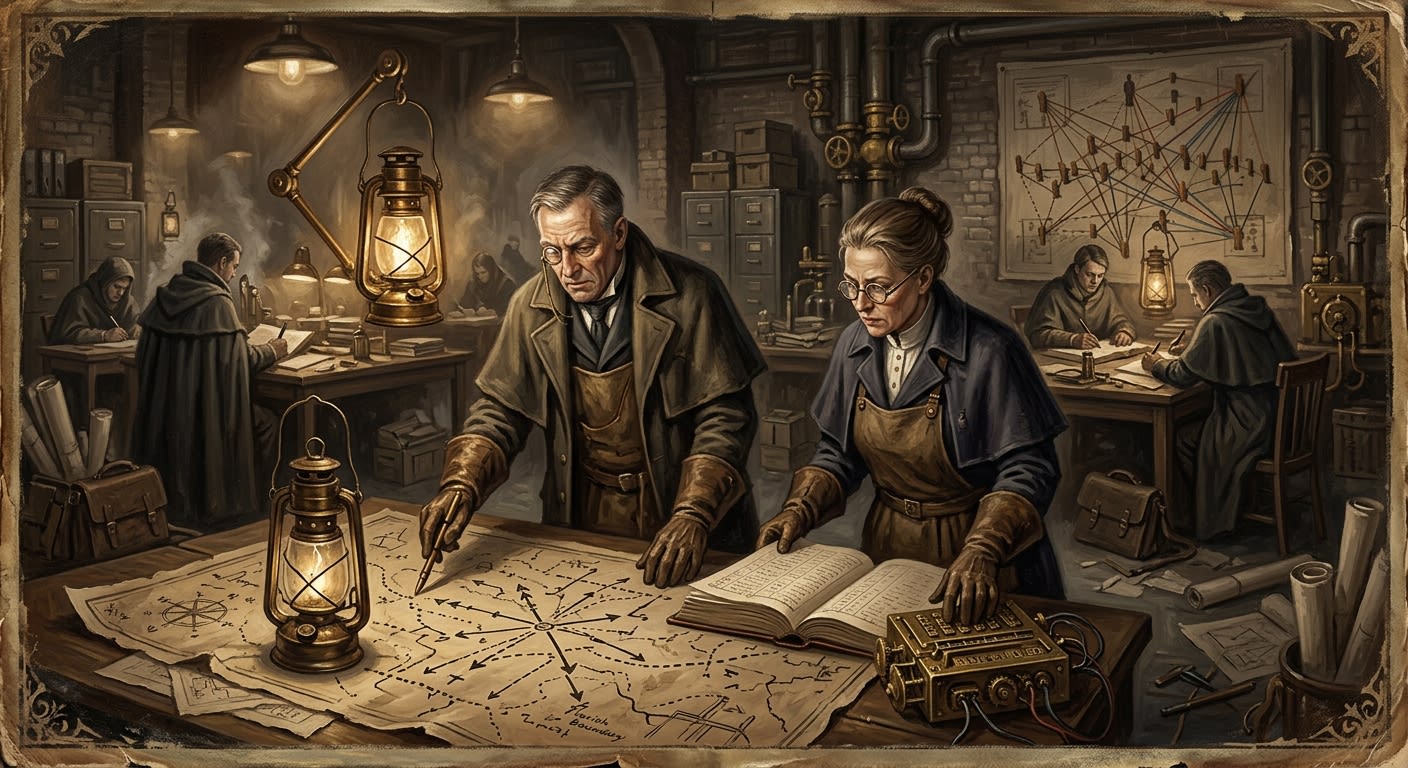
Mercy Architects are the senior planners of the Lantern Mercy Preacher apparatus: route-makers, safe-house coordinators, schedule falsifiers, parish-log adulterers, and quiet little blasphemers who arrange salvation with the manners of a clerk and the conscience of a smuggler. A Fog Preacher owns the throat. A Candle-Runner owns the small legs. The Mercy Architect owns the pattern that must never look like one.
They are known, when competent, by no name at all. The Bureau of Shadows calls this professional excellence. The Bureau of Records calls it a filing error. The Bureau of Purity calls it suspicious, which is Purity’s name for weather, dentistry, music, and every human action performed without its prior disgust.
The Architect does not preach. She does not carry the wax slip through a checkpoint. She does not hide a fugitive under her own stairs unless desperate, vain, or new to the profession. She sits above the visible work and below the invisible authorship of the Tongue-Smiths, translating human terror into movement: which lane is watched, which Brotherhood lamp will turn away, which widow can host a boy for one night, which sermon must sound warmer because the west ration queue is ready to crack.
#On the Desk Beneath the Street
The office began as an accident of the Curfew Ordinance of Quiet Hours in A.S. 94. Licensed Consolators gathered information because grief talks. A woman waiting for a missing son says where the patrol passed. A sickroom says which clerk can be bribed with soap. A queue says which name is about to be called. By A.S. 134, after the Warden Sermon Trials taught the Preachers that spoken mercy could be transcribed, the information required handling by someone who did not stand in the fog.
The desk beneath the street appeared in pieces: a kitchen table after midnight, a cellar board balanced over barrels, a chapel vestry where the saint-cloth hides maps from eyes too pious to lift linen. There the Architect marks turns, erases names, assigns Candle-Runners, balances Preacher circuits, and chooses which safe house may be burned to save three others. The work smells of lamp soot, onion skins, wet wool, old chalk, and the miserable holiness of practical arithmetic.
The title “Architect” is street-flattery. They build nothing in stone. They build gaps: a patrol gap, a witness gap, a ledger gap, the eight minutes between Curfew Second and the Brotherhood turn at Saint Gereon’s drain. The Synod builds cathedrals so men will look upward. Mercy Architects build absences so families can pass sideways.
Earlier Purity memoranda described Mercy Architects as “senior Preachers withdrawn from street duty.”
Corrected. Some are former Preachers; the better ones are failed clerks, exhausted widows, Brotherhood deserters, ossuary assistants, and one recorded parish cook whose route map was baked into pie crust. The pie was eaten before seizure. I admire the evidence management.
#On the Mechanics of Quiet Passage
An Architect works with three ledgers. The clean ledger records sanctioned consolations: who receives comfort, which ward receives a lantern, which corpse receives a name, which queue receives pacification. The working ledger records what the clean ledger means: Preacher routes, informant smell, safe stairwells, cough signals, chalk losses, children fit for errands, children too frightened to use, and households that can host without becoming proud.
The third ledger is carried nowhere. A good Architect keeps it in the room of the skull where ordinary citizens keep songs, grudges, and recipes. Written truth has edges. Edges catch.
Inputs arrive from everywhere. Candle-Runners bring saint calendars with missing feasts. Fog Preachers report crowd-temperature in the approved language of pastoral care. Lantern Brotherhood watch circles sell omission through cough, lamp angle, and sudden bladder. Queue women provide better intelligence than magistrates because magistrates hear petitions and queue women hear mutters. Ossuary clerks know which death-cart will pass without inspection. Tavern runners know which Warden has begun drinking early.
The Architect converts this into mercy that cannot be charged as mercy. One family walks west under cover of a funeral hymn. One levy-marked boy spends three nights as an “ill cousin” in a clean bed. One Fog Preacher changes a saint name and prevents thirty mothers from gathering in the same yard. One Candle-Runner carries a schedule whose true message is delay, wait, turn left, say nothing.
#On the Brotherhood Bargain
The Architect’s most dangerous instrument is the Brotherhood. Lantern Loyalists will sell a patrol omission as workload reduction and believe themselves clever. Ward-Soothe Purists will refuse all contact, then accidentally create useful rigidity by walking the same route every night at the same hour like moral donkeys. Soft Insurgents will help too eagerly and risk turning a route into a sermon with legs. The Architect must use all three without becoming any one of them.
The Cologne Schism of A.S. 178 hardened the craft. Before Cologne, many routes rested on habit and personal trust. After Cologne, trust required compartments. A Purist district could still be crossed if one knew which alleys became empty because Purists love visible enforcement. A Loyalist district could be crossed if one knew the price of the omission and the lie by which the Brother would describe it to himself. A Soft district could be crossed if one prevented the helpers from discussing virtue until everyone was already indoors.
SHADOWS INTERCEPT — COLOGNE AFTER-SCHISM ROUTE SHEET Three lamps marked: clear, ash, amber. Clear route: visible patrol; use funeral cover. Ash route: payment made; cough twice ignored. Amber route: ███████████████████████████████████ Architect note: “Do not let Brother M. speak to the mother. He will comfort her and ruin the timing.”
#On Sacrifice and Accounting
Mercy Architects are sentimental only in legend. The work demands sacrifice with clean fingernails. A safe house may be exposed to preserve a district. A decoy Preacher may be sent to a known audit so two better voices remain uncounted. A loud follower may be allowed to be arrested because he has begun calling himself indispensable, that fatal word by which amateurs volunteer for utility.
The profession’s cruelty is procedural. No Architect with three winters behind her believes everyone can be saved. She believes two can be moved before curfew, one can be hidden until dawn, one must be delayed in place, and one — the Creator receive the phrase with suitable bureaucratic discomfort — must become noise. The Synod calls this monstrous. The Synod practices the same arithmetic at scale and calls it governance.
The moral disease follows. Architects stop seeing faces and begin seeing transit values, risk weights, witness burdens, safe-night capacities, bell windows, food requirements, likely betrayals. A child becomes “small, fast, visible, expendable only after warning.” A widow becomes “two beds, weak lock, strong nerve.” A Fog Preacher becomes “voice steady, citation risk rising, remove from west ward before Purity notices her quiet.” Mercy becomes numbers wearing shawls.
The Bureau of Doctrine formerly classified this dehumanisation as evidence of rebel hypocrisy.
Clarified. It remains evidence of rebel hypocrisy. It is also evidence that they have learned from us with alarming care. Theft of method is still theft.
#On the Present Threat
As of A.S. 201, the Architect tier remains the hardest Lantern layer to seize intact. Candle-Runners can be frightened. Fog Preachers can be recorded. Tongue-Smiths can be betrayed by elegance. Architects vanish into function. Arrest one parish cook and three widows begin routing. Seize a cellar map and the next map becomes a rosary order. Burn a safe house and the smoke tells the district what not to use.
Purity’s District Seven surveillance found three hundred and twelve sermons with approved phrasing and no actionable variance. This should have comforted no one. Perfect Preachers indicate good Architects: someone has removed risk before sound occurs. The absence of variance is a worked surface, polished so thoroughly that the clerk sees his own stupid face in it.
The Architect’s final cost is the name. Not secrecy alone. Secrecy may be pleasant; ask any Bureau with a basement. The true cost is becoming unrememberable by design. The Preacher may be loved. The Runner may become legend. The Tongue-Smith may leave a phrase that survives him. The Architect leaves a route that worked once and must be destroyed before gratitude can attach.