
#On the Forge of the Throat
“A sentence may be lawful in ink and treasonous in breath.” — Bureau of Purity training slip, copied badly, which improves it.
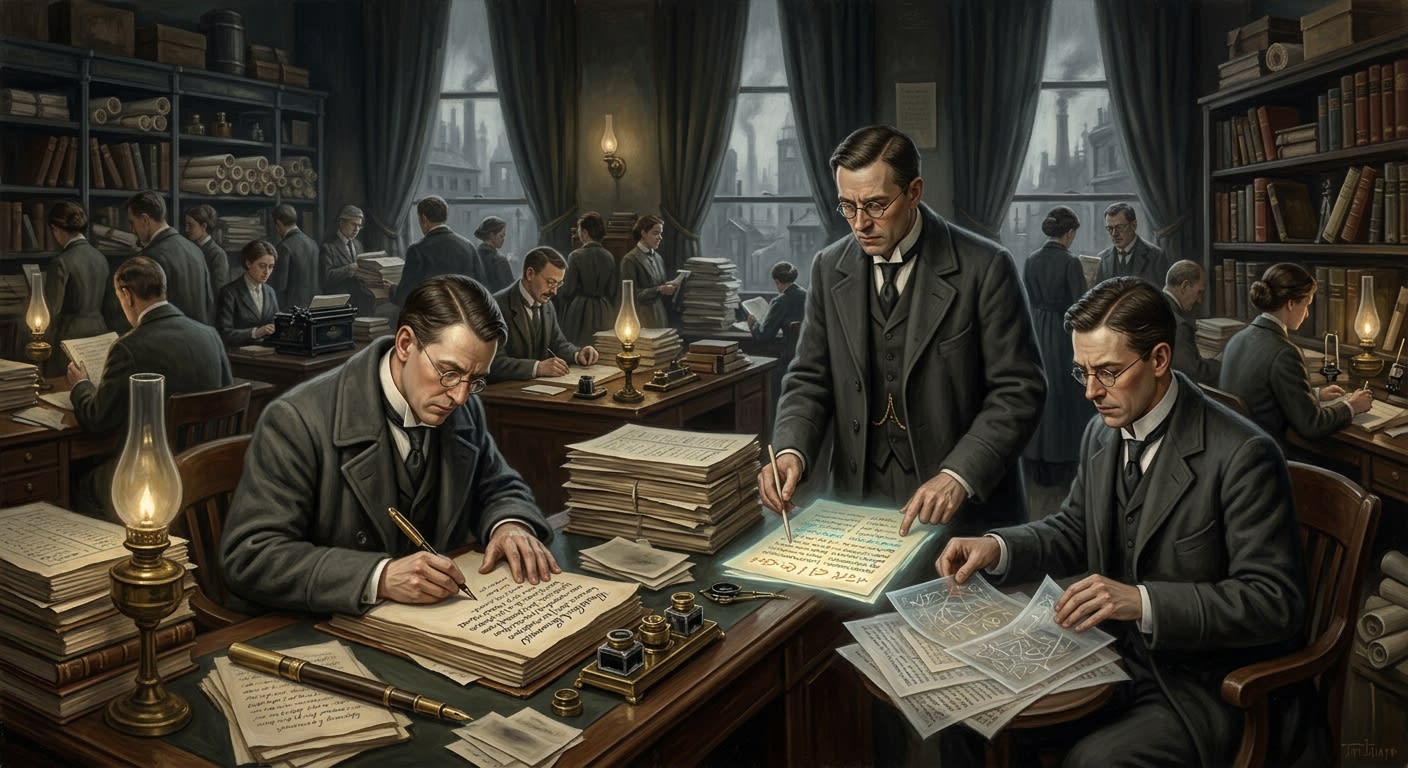
Tongue-Smiths are the invisible scribes of the Lantern Mercy Preacher apparatus: the elite writers who make catechisms obedient enough to pass a Bureau audit and crooked enough to save a life when spoken by a trained mouth. They work above the Mercy Architect and below whatever saint, ghost, or lie the Lanterns invoke when they need ancestry. A Fog Preacher risks the body. A Candle-Runner risks the legs. A Tongue-Smith risks language itself, which is to say he meddles with State property.
The name is vulgar craft slang and legally useful. Smiths make things. A Tongue-Smith makes phrases with heat, tongs, quenching, filing, and little scars no one sees until the blade enters. The Bureau of Rites calls their output “unauthorised pastoral variants.” Purity calls it “semantic evasion.” Doctrine, more accurately and more beautifully, calls it theft of interpretive jurisdiction.
They are rare because the craft requires three talents seldom found in one head: obedience to the approved text, contempt for its intended effect, and an ear fine enough to know where a comma may become a door. Most rebels shout. The Tongue-Smith edits.
#On the First Hammering
The office began when the Licensed Consolator office became dangerous to its own creators. The Curfew Ordinance of Quiet Hours in A.S. 94 supplied fourteen Approved Comforts to grey-stoled civilian calmers. The words were clean. They reduced disorder. They sat in the mouth like ration bread: dry, measured, sustaining only by threat of the alternative.
Then the Consolators began adding. First a kindness. Then a phrase. Then a line that sounded harmless until the listener found a second meaning tucked beneath the first like contraband under altar cloth. The Warden Sermon Trials of A.S. 134 taught the network the price of visible addition. Seven were taken, five sent to trench chaplaincy, two sealed behind masonry. The lesson was plain enough for even rebels to read: if an extra sentence can be transcribed, stop adding sentences. Alter the authorised one until it bleeds sideways.
From that warning the Tongue-Smith was born. Stable emphasis is a fantasy clerks invented because they have never listened to a widow decide whether to live until morning. Place the stress on sees and the sentence accuses the unseen. Place it on your and the listener hears possession. Place it on bell and the bell becomes merely loud, not holy. The ink stays clean. The air mutinies.
Early Purity lectures described Tongue-Smith work as “code hidden in prayer.”
Revised. A code can be broken by substitution. Tongue-Smith work is worse: meaning hidden in emphasis, pace, omission, local grief, and the listener’s already wounded knowledge. A cipher has a key. A wounded district has memory.
#On the Tools of the Craft
The Tongue-Smith’s workshop is indecently small. A prayerbook with sanctioned forms. A scrap roll of failed variants. Wax tablets for phrases that must die before dawn. A bowl of salt water for the throat, though most Tongue-Smiths speak less than the men they train. Parish idiom lists. Bell schedules. Trial transcripts. Children’s rhymes. Queue insults. Old women’s corrections. The whole filthy treasury of living speech, boiled down until a clerk cannot smell it.
The first tool is ambiguity with discipline. Cheap ambiguity produces confusion, and confusion produces crowds, and crowds produce cudgels. Good ambiguity gives one meaning to the clerk, another to the mother, a third to the Candle-Runner listening from the step. All three meanings must fit the same words without rattling. Rattle is evidence.
The second tool is local grammar. In Brest, mortar is never merely mortar. In Cologne, a lamp coughs politically. In Strasbourg, a reference to records may imply salvation, taxation, or doom depending on the arrondissement and the clerk’s shoes. The Tongue-Smith writes for the lane, not for mankind, because mankind is a category for philosophers and mass graves.
The third tool is failure. Every phrase must contain an official death: the harmless reading offered up if seized. “Rest until the bell calls” may mean sleep, delay, refuse the first signature, or hide the boy until Matins. If hauled before a tribunal, the Preacher produces the dead meaning, pious and limp, while the living meaning escapes through the witnesses’ mouths.
#On Old Faron’s Rule
The Tongue-Smiths claim Old Faron the Hush-Monger with the greedy fondness craftsmen reserve for founders who cannot contradict them. “Speak like water” is their favourite inheritance. Purity calls it Faronite variance. Fog Preachers call it survival. Tongue-Smiths call it elementary.
The Hush-Monger lesson, as reconstructed from bad reports and worse tavern songs, is brutal in its neatness: say the comfort once for the grieving, again for the clerk, a third way for the child who must carry it. If all three sound alike, you have endangered everyone. The exercise remains common among Tongue-Smith apprentices. They are given one approved sentence and three listeners: mother, auditor, runner. They must write one form that feeds each without naming food.
The Bureau attempted to teach counter-listening after A.S. 199 phrase-comparison review. Purity assessors learned to compare meanings across non-matching phrasing, which is clever in the way a dog is clever after eating three indictments and one boot. The Smiths answered by moving meaning out of phrase and into delivery: breath, glance, local saint order, the choice to say labour instead of service in a district where labour carts took sons the previous winter.
#On Lira Voss and the Scandal of Perfection
Every craft hates the miracle it did not manufacture. Lira Voss gave the Tongue-Smiths such a miracle in A.S. 197 when she told a Bastion-Brest levy queue, “They are taking your sons because your sons are cheaper than the mortar.” The sentence violated every rule the Smiths teach. It did not rotate. It did not hide. It supplied no official corpse-meaning for a tribunal to bury. It stood in public and made arithmetic audible.
Tongue-Smiths resent it because it cannot be improved without weakening it. Change taking to requisitioning and the sentence grows Bureau whiskers. Change sons to children and the queue loses its wound. Change cheaper than the mortar to any pious abstraction and the whole thing collapses into sermon-ash. The line is obscene to craftsmen: accidental, naked, exact.
PURITY LECTURE FRAGMENT — BREST PHRASE RECURRENCE Do not repeat the Voss sentence in training rooms. Do not allow trainees to complete it aloud. Do not ask why “mortar” remains stronger than “wall material,” “building costs,” or “defensive supply.” ████████████████████████████████████████████████████ Instructor note, later erased: “Because the wall ate them.”
The Smiths took what they could steal. They teach the Voss grammar without the Voss phrase: cost named plainly, Heaven excused from procurement, the Synod’s arithmetic exposed without providing a banner. Candle-Runners carry fragments: sons; cheaper; mortar. Fog Preachers borrow the edge. Mercy Architects mark walls where the chalk returned. The Tongue-Smith sharpens around the wound and pretends this is craft rather than envy.
#On Audit and Counter-Audit
A Tongue-Smith’s enemy is repetition. Repetition builds cases, trains informers, flatters mediocre rebels, and gives Purity a handle by which to drag the whole phrase into court. The Smith writes variants by ward, weather, feast, queue, bell hour, and recent grief. Too much variation looks designed. Too little looks repeated. The proper measure is vile and exact: enough kinship that the street understands, enough difference that the clerk cannot marry the witnesses.
District Seven initially reported “no actionable variance” in three hundred and twelve Consolator sermons during fourteen months of surveillance.
Clarified after Assessor’s marginal note. No actionable variance across that many sermons is itself worked language. Either obedience had become supernatural or a Tongue-Smith had sanded every edge before the file arrived.
The Smith must know the audit sheet better than the auditor. Approved phrasing. Forbidden exhortation. Local pronunciation. Supplemental instruction. Crowd effect. Witness consistency. The categories are bars on a cage; good writing slips between bars by becoming what the cage expected to contain. Bad writing rattles. Rattle summons Red Lanterns.
Their counter-audit begins before ink dries. Can a Confessor-Booth Clerk quote it? Can a child distort it safely? Can a hostile Brother hear politics in it and still lack proof? Can a grieving listener act without believing she was ordered? Can the Preacher survive the sentence? If any answer displeases the Smith, the wax tablet is scraped clean. Mercy has a draft graveyard.
#On the Loss of Private Speech
The cost is not the hand. It is the tongue. A Smith spends years making sentences mean several things while looking pious in one direction. The habit does not remain at the desk. At supper he answers his sister’s question with three plausible readings. At market she asks for turnips and receives weather, apology, and warning. Lovers leave. Friends stop asking. Children learn that every bedtime blessing may contain a route correction.
The old reports say they fall silent in company because every word is a risk. This is true as far as little truths go. They fall silent because they no longer trust the existence of one meaning. Ordinary speech becomes nakedness. A greeting has hinges. A joke has teeth. A prayer has contraband sewn into its hem. Silence, for them, is the last unedited text.
As of A.S. 201, Tongue-Smiths remain few, hunted, imitated, and badly understood by every official who thinks words stay where ink puts them. They are not the loudest Lanterns. They are worse. They make lawful language disobey before the law has finished reading it.