
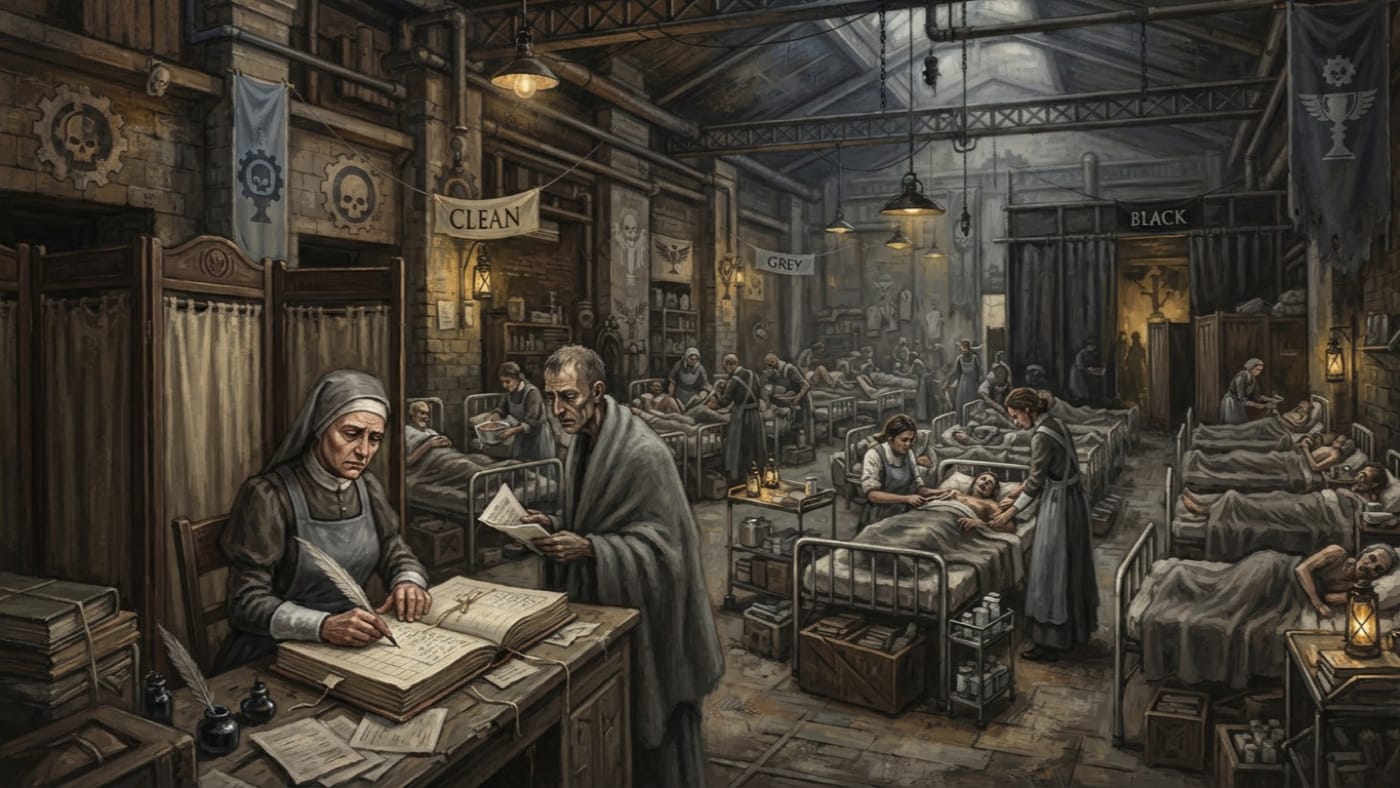
#On the Ward Threshold
"Papers in the left hand, wound in the right. Keep both where the clerk can see them." (Intake instruction, painted over many desks and obeyed at most of them)
A Mercy Ward begins at a desk. Before the cot, the broth or the first look at the wound, there is a plank table, a string-tied ledger, an inkwell gone tacky at the rim and a clerk who has heard every groan the Creator permits and has learned to rank them by how legible they are. Behind the desk the building might be a converted barracks, a cloister with its saints whitewashed over, a stone infirmary bolted to a bastion's flank, or a row of sheds that held grain until the grain ran out. The Bureau of Mercy has no rule about architecture. It has a rule about the desk.
The patient arrives by cart, by stretcher, on a neighbour's shoulder or on their own failing feet, and joins the queue. A ward-hand walks its length with a lamp and a pad of tags. Where a man is bleeding into the straw, they press first and write afterwards, and the form allows for this under the heading emergency deviation. Where a woman cannot speak, her companions speak for her, and their account is entered as reconstruction by witness. Everyone else waits. Waiting is the first treatment. It sorts the impatient from the dying with a precision no surgeon can match.
The Bureau keeps orphanages and asylums as well, but the wards are its houses of the sick: bastion infirmaries, quarantine annexes, trench intake halls and civic care rooms in the larger towns. The grey-aproned staff who run them are filed under Mercy Ward-Sister / Mercy Ward-Brother. The subject here is the house, and the order in which it takes a body apart and puts it back together on paper.
#On the Making of Counted Mercy
Mercy names Saint Sabina of Ghent as its ancestor. She tended the wounded at Saint-Malo in A.S. 10, eighty years before there was a Synod to claim her and longer still before any Bureau put her on its seals. The claim is retrospective. All the best ones are.
The wards came out of the Great Retreat after the Sundering, in the years from A.S. 48 to A.S. 65. Epidemic followed the refugee columns and care was improvised from kettles, crate-wood and whoever happened to be standing nearest. Nobody at the time called these places Mercy Wards. The name came later, the way wax is pressed onto a letter already written. Standing Order 22-C in A.S. 80 made terminal confession compulsory. The Bureau now lists that order among its own acts, although the formal Synod did not exist until the Concordat of Strasbourg in A.S. 90, and Mercy received its charter in A.S. 92.
The Broth Riots of A.S. 112 lasted eleven days by the Bureau's account. The Ledger Laws that followed did not found a single ward. They made every existing ward countable, and that is the more lasting kind of foundation.
#On the Three Zones
Each ward is divided into clean, grey and black. These are administrative divisions, and they overlap where the corridors do.
Clean holds those judged recoverable. A clean patient gets full allotment, decent linen, scheduled dressings and the attention of auditors, because recoverable bodies return to labour and to the levy lists. Grey holds uncertainty: the cough that may turn, the fever that may break, the wound whose smell is ordinary until the ninth bell. Grey patients are watched, reassessed and moved, and staff call this zone the hinge of the house. A full grey zone means the ward is still deciding. An empty one means somebody decided too fast.
Black holds the terminal, the contagious, the anomalous, the politically inconvenient and those beyond allotment. That is five conditions under one colour, and the Bureau considers this economical. A black tag does not send a patient to the Hospice, and it does not send them to a firing yard. It sends them behind a screen, into a reduced ration and a closer watch, and the staff behind the screen carry salt in their apron seams.
The sentimental reader will call this cruelty. The sentimental reader has not seen typhus cross a ward because a kind attendant let the black-zone cot sit beside the clean one. The zones save lives. They were drawn by a pen that also decides who is worth saving, and the Quarantine Reforms that drew them have mislaid their own date with a serenity I can only envy.
#On Broth, Linen, and the Register
The boil-kitchen is the real heart of the ward, and it runs on grain, water and boiler fuel. When any one of those fails, the ward becomes a room full of people waiting. Next come the linen room, the disinfectant stores and the locked cabinet of medicines, with morphine on the top shelf, nearest the hinge and farthest from hope. The last supply is space. No ward has ever had enough of it, and none has ever reported having enough. A report like that would invite inspection of how the space was used.
Every input has an entry. Bowls are reconciled against bodies, doses against signatures, linen issued against linen returned from the laundry, and deaths against tags. At shift's end the ledger string is sealed with wax. An unsealed ledger is a document. A sealed one is evidence.
Shortages arrive first in the margins. One week the soap is thinner. The next week grey patients receive clean-zone broth diluted to grey-zone strength. After that a ward-hand cuts a sheet in two and records two sheets. The auditor who comes to check counts the drops before the patients, because narcotics are where fraud gets interesting and where the paperwork is heaviest. When an audit falls during an outbreak, the auditors seize the ledgers, reorder the triage and demand silence, and the patients keep dying throughout, which spoils the silence somewhat.
The Bureau of Medicine issues opinions on all of this. It sends memoranda about tinctures and sanctioned procedure, and they are filed in the order received. Medicine advises. Mercy holds the keys, the ladle and the ledger.
#On Confession and Departure
Behind every intake desk stands a confession screen. Sometimes it is a carved partition and sometimes a sheet on a cord. The Church teaches that the body is mended more readily once the soul has been emptied. The Bureau teaches that the soul empties more readily on an empty stomach. A ward-hand dressing a wound will receive disclosures in passing, about a hidden coin, an unregistered child or a cousin who once said the wrong thing at a funeral, and will write them down as a matter of routine.
That is distinct from the work of the Deathbed Confession Harvester, who comes to the dying with witness, seal and a packet for the transcript. After the Mercy Ward Purge of A.S. 134, when Harvesters were found to have been selling last words, the double-witness rule was imposed on that trade. Caregivers resent Harvesters. Harvesters resent caregivers. Records receives the paper from both.
What happens next depends on what was said. A name may go to the Bureau of Records. A suspicion may go to the Bureau of Purity. A hidden coin may interest Tithes, and an unregistered boy may interest Conscription. Most confessions travel no further than the tray. Every family knows that some go further, so the families confess carefully, and the Bureau calls that piety.
A patient leaves by one of a few exits. They may be released with a recovery slip, kept in grey or isolated in black, or transferred to another ward, a bastion or an asylum. Terminal cases may be sent to the Hospices of Departure, where the bitter black elixir is administered under that house's own rules and not as an ordinary ward medicine. The dead are registered in the Book of Departures and carried down the corpse-transfer corridor toward the ossuary carts.
#On the Unentered Ladle
There are two registers in every ward. One is string-tied, sealed and available for audit. The other is kept in memory, in favours owed and in the reconciliations each ward-hand carries in their head.
Ghost bowls, ladled for patients who do not exist, feed patients whom the schedule has written off. Split signatures blur whose hand released a dose. Salt is diverted under the bandage cart. Clean cloth goes missing from the linen room and turns up in black-zone cabinets. Forged exemptions buy a family one more hour before the quarantine cordon closes. Some of the people in these beds are alive because of a lie written in a careful hand.
The same gaps let other things through. A night clerk holds back clean-zone tags until a family produces fuel chits. Morphine leaves by the service door and returns to the street at four times the price. A dying soldier's confession is sold to a gang before it reaches the tray. A grey tag becomes a clean one for anyone who can pay. When an auditor finds a discrepancy, it can be an act of mercy, a theft, or both on the same evening, and nothing in the ink tells you which.
#On the Present Register
As of A.S. 201, the Bureau of Mercy reports seven hundred and twelve registered Mercy Wards. Records disputes forty-three of them. Returns compiled for the Harvester service list forty-three as non-reporting. Whether these are the same forty-three, and what has become of them, nobody with a seal has said.
Seven hundred and twelve Mercy Wards stand in active service across the Synod's territory.
Corrected: seven hundred and twelve are registered. Records disputes forty-three of those entries, and Harvester returns describe forty-three as non-reporting. The Bureau of Doctrine declines to subtract one figure from the other until the parties agree on what is being counted.
Marrowgate is the largest case and an unusual one. Its Wagon Quays unload casualties in carts, its White Ward runs vinegar smoke through boiled linen, and its Sanitation Chapter and Civic Triage Tribunal each claim the final word on who gets a bed. In A.S. 199 the clean paper plague showed that healthy-looking certificates had been issued to people who were not healthy. The scandal was Marrowgate's own. The lesson was available to every ward.
Along the Sagittal Line, Brest receives trench-foot by the cartload, and the broth bound for Königsberg freezes on the road and is thawed, recorded and served all the same.