

#On the Former Command
The Prussian military was a state's army before it became anyone's inheritance. It drilled under a crown and answered to Berlin. For decades it kept the Baltic corridor working while the Church could barely keep its own minutes. It has not existed as an independent body since A.S. 95. Its methods, its school and a good deal of its metal remain in Synodal service. The Codex must record where each piece went, because the Synod has preferred to record only that the pieces arrived.
The piece you can hear hangs in the cathedral at Bastion-Königsberg. Forty-one bells there were once Prussian guns. The Bureau of Bells mentions this the way a bishop mentions that his vestments were a gift: proudly, and without asking what the donor thought.
Prussia the territory has its own folio. So does Kanzleiburg, the city that grew fat on that territory's habits. This entry covers the officers, the barracks, the dispatch tables and the guns. All four changed masters, and no file records any change in how they stood.
#On Service Before Incorporation
Prussia kept its sovereignty through the Atheist Wars, through the Sundering of A.S. 45, and through the frontier decades that followed, when the public Church was taking towns faster than it could staff them. The northern accounts credit the Prussian officer corps with holding the Baltic corridor together in those years. I call it the finest military establishment the north possessed, and I am right. No Bureau has ever measured it against a rival and published the score, so you have my word in place of a figure. My word is better than most figures.
The Ledger rarely mentions its service from that period, and never at length. In A.S. 65 the Northern Garrison marched from Berlin to Hamburg during nine days of rioting over bread the port did not have and tithes it was still paying. The record gives the force a name, a point of departure, a destination and a year. It gives no commander, no strength and no account of what the soldiers did in the streets. The famine file keeps its hangings under its own seal and names no hand on the rope. I have not supplied one.
Around A.S. 67, with the Sagittal Line defensible but incomplete, the Church's provisional frontier administration requisitioned Königsberg and began turning a university town into a fortress. That administration was taking a Prussian city while the Prussian army was still wholly Prussian. The files record no objection. They do not mention whatever conversation must have come first.
#On the Incorporation of A.S. 95
The formal Synod was constituted in A.S. 90. Five years later it absorbed the Prussian state by administrative decree. It renamed Berlin Kanzleiburg, the Chancellery Fortress, and kept the military apparatus and civil service that had made the state worth absorbing. No account records resistance. That proves only that whatever dissent existed never reached paper, and Prussian dissent rarely did.
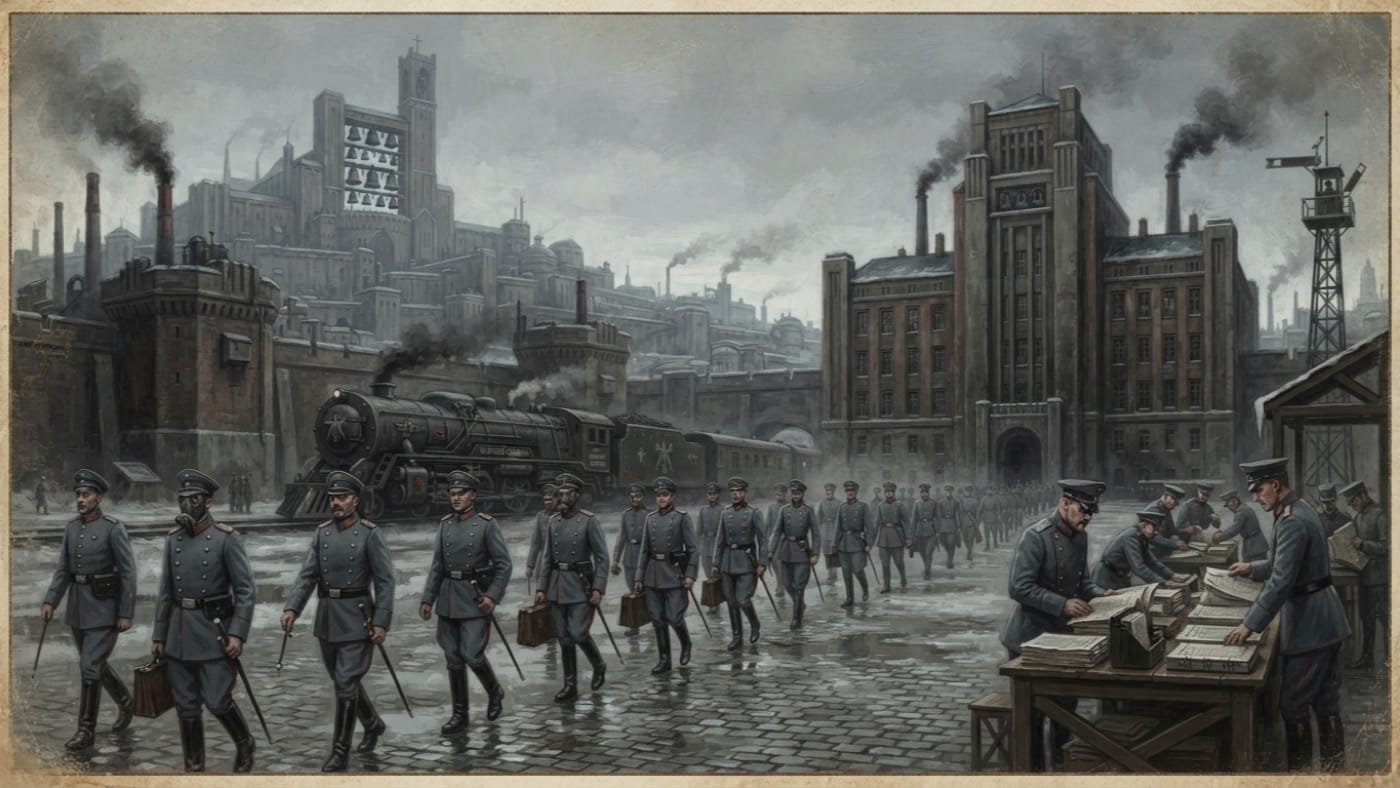
What changed was the address on the orders. Before A.S. 95 the officer corps answered to a Prussian crown. Afterward it answered to the Synod's military directorate, the command that preceded any chartered Bureau. Ranks were corrected into Synodal forms. Oaths were replaced. Uniforms were amended, which in a Prussian mess means new buttons on the old tailoring. The mess rules survived because men who can keep artillery fed through a Baltic winter are allowed their seating plans.
The Prussian military apparatus was absorbed into the Bureau of War in A.S. 95.
Struck. There was no Bureau of War in A.S. 95. The officer corps passed to the Synod's pre-charter military directorate. The Bureau of War was established by the Charter of Crimson Ink in A.S. 105, ten years later, and received the Prussians second-hand, already corrected and already in harness.
When the Charter came, the directorate's northern business passed to the new Bureau. The Prussian habits went with it, since nobody else in the north knew how the work was done. The Prussian Military Academy in Kanzleiburg became the Bureau of War's Northern Officer Seminary. The records I consulted give neither the Academy's founding year nor the date of its renaming, and I will not invent either. The building did not consult me about its history, and I return the courtesy.
#On the Methods Retained
The Synod did not want a Prussian army. It wanted the Prussian talent for moving one. That is rarer, and no decree can requisition it, because it lives in the hands of particular clerks.
Those hands now work in Kanzleiburg's Garrison Quarter, among dispatch rooms, barracks, parade grounds and officer messes. Kanzleiburg sits in Zone 2, well behind the front. Königsberg is the northern anchor of Zone 4. Officers, dispatches, procurement orders, reserve allocations and technical labour move between them along the Northern Corridor. The front survives because they arrive. The Northern Hierarchate on the Archonate Isle allocates and routes. The Bureau of War keeps its military domain. The two offices share a corridor and an understanding that neither will touch the other's files unless the front is collapsing. Readers who confuse them should spend a week in that corridor and see how quickly the confusion is corrected.
The rail habit came earlier, and its date is inconvenient. The Guild of Rails was chartered under the Codex Ferrum in A.S. 94, a year before the absorption. Prussian military rail battalions were among its founding groups, alongside civilian workers, surveyors and engineers. The Guild is not the Prussian army under another name. It is a guild that a Prussian battalion helped build, which is a different and more durable thing. Several summaries have tied themselves in knots over the order of those two years. I report both dates and leave the knots to the summaries.
The officer corps also kept the habit of working through channels instead of around them. In A.S. 140 the Bureau of Purity tried to enforce a curfew on the Old City beer-halls, and the halls closed for three days. On the second day the Garrison Quarter's officers petitioned the Archon. They did not mutiny or march. They filed. On the third day the curfew was withdrawn. A sabre would have taken longer.
#On the Guns Remade
Between A.S. 97 and A.S. 107, during the first decade of Königsberg's expansion, forty-one bells for the Northern Carillon were cast from recovered Prussian gun-bronze and tuned to Northern Standard Resonance. The casting followed the bell practice of its day, which was older than the current Bell Codex. That Codex was not ratified until A.S. 115, eight years after the last bell was hung. Calling the earlier tuning Codex-compliant gives a document credit for work it arrived too late to supervise.
I can establish that the bronze was Prussian and that it had been artillery. I cannot establish which arsenals gave it up, who owned the guns, who founded them, how they travelled or what quantities were assigned to which bell, because the records that would establish those things are not open to me. The Bureau of Bells calls the conversion devotional recertification. The quartermasters called it scrap. Both are accurate.
The bells face the Baltic, and beyond the Baltic is the Grey. The Carillon rings, and the Grey continues. Nothing in the files explains why, and nothing in this entry will. Old metal from a sovereign army now rings at an enemy that answers to no one, and the Bureau of Doctrine has asked that nobody draw a conclusion from this. I have drawn none. I have only noted the arrangement.
#On the Present Inheritance
As of A.S. 201 there is no independent Prussian military. There is no hidden royal regiment, no exempt mess and no officer whose loyalty runs past the Synod to a crown. The independent force ended in A.S. 95. Its methods did not. Generations of officers have since passed through the Northern Officer Seminary, each taught by the generation before. None of them served the old crown. All of them write dispatches the way it taught.
Königsberg's roughly twenty-two thousand military personnel are a Synodal garrison under Castellan-Warden Ingrid Halvorsen, and they are not a remnant of the Prussian army. The garrison is fed by Kanzleiburg routing. Its officers are drawn from the Seminary. Its hours are struck in Prussian bronze. Her command did not revive a sovereign force. She inherited a filing system, a supply line and forty-one bells.