
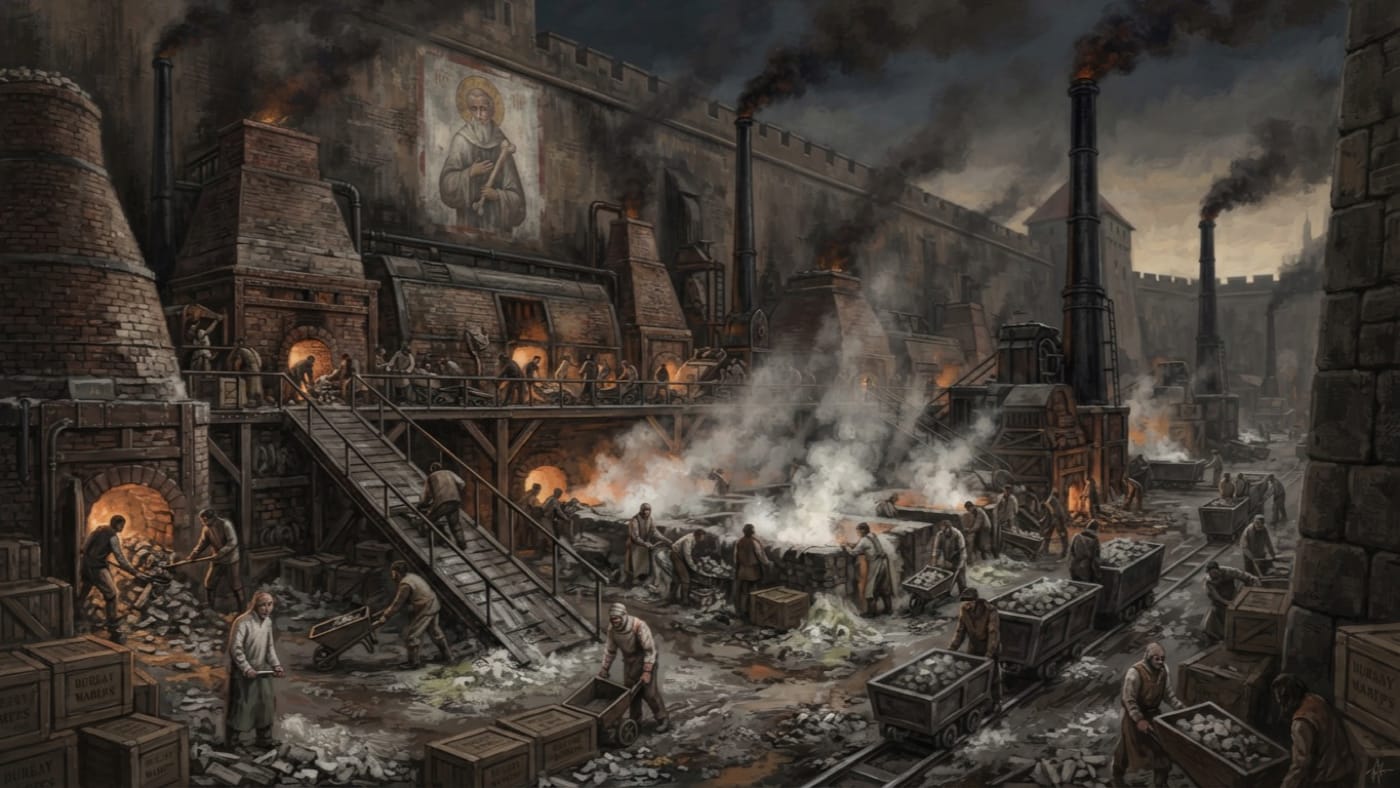
#On the Yard Behind the Wall
Every wall at Bastion-Przemyśl owes a debt to some kiln. The bastion holds the western Carpathian passes for the middle-northern reach of the Sagittal Line. Opposite it, Atheron crowns each ridge he takes with a spire taller than the last, and he has never once consulted the masons' schedule before applying pressure. Masonry cracks. Cracks want mortar. Mortar on the Line wants bone-lime, and bone-lime wants a yard where heat, water and the holy dead can be brought together behind brick and kept there until they agree to become useful.
The Przemyśl Kiln Yard was one such place. The record gives no founding date for it, names no builder, counts no kilns and identifies no curtain its barrels were meant for. It survives in the Codex because of a single confiscation in A.S. 149. Workplaces usually enter history this way. They run through a thousand batches without remark and get filed once, over a picture.
The rest belongs to the trade, and the trade is consistent. Kiln yards behind bastion walls smell of caustic lime over bone smoke and vinegar wash. The kilns roar, the slaking pits hiss and the seal press clicks, all of it under a chant that bounces off the brick until no one hears it as words any more. Carts come in light and leave heavy. The wall waits.
#On What Enters and What Leaves
Fragments arrive in crates from ossuary clerks, with their provenance written on the lid in a hand that ranges from careful to fraudulent. Intake comes first and decides everything after it. The yard may render damaged, surplus, disputed or unassignable fragments: teeth of doubtful ownership, cracked shards of femur, saint-dust swept from ossuary floors. It may not render a protected relic. A named fragment, venerated in some chapel and owned by some shrine house, goes back on the cart, and any Melter who forgets this does not keep his position long enough to forget it twice. The crates are sorted by risk of provenance. The lid is the Melter's first defence against the shrine-keeper.
Next comes cleansing, with its salt wash, its smoke pass and its quiet hour under the bell hush. Then calcination, when the kiln reduces bone to ash-lime. Then slaking, the most violent stage, when water hits quicklime, the pit boils, and the chant wheel keeps the pace by matching litanies to the stages of heat, so that a hymn and a burn happen at one and the same moment. A badly slaked pit can explode. Every Melter quotes the hymn, and most of them have watched a pit go.
Mixing follows. Aggregate goes in, sanctified lime goes in, and the ratio is logged. After that the paste is stamped, sealed in barrels under wax-red batch marks, and released against a certificate.
The paperwork at the outlet does the same work as the paperwork at intake, pointed the other way. The lid protects the Melter from the shrine. The stamp protects the Melter from the inspector, and protects the wall from the Melter. Batch records follow a barrel into the masonry because the masons have a saying, walls remember, and the clerks would like to know whom to blame when the memory comes back.
#On the Hands at the Pits
The trade's ladder starts at the pit's edge with the Ash-Hands and Slake Runners. Kiln Tenders and Batch Scribes stand above them, then the Master Melter, then the calibrators and containment specialists whose skills a quiet yard hopes it will never need. The roster of the Przemyśl yard has not survived. Its people can be described only the way all such people are described: by their marks.
Gloves crusted white. Knuckles split by lime. Burn scars climbing the forearm in the order of a career. Eyelashes gone chalky. A cough that lasts past retirement, for the few who live to retire. The masks are issued and inadequate, and the wraps that replace them are improvised and illicit. A good filter is a status symbol in a kiln yard because it is the only one you can breathe through.
Fuel governs everything. The heat comes from allotments, and the allotments come from clerks. Fuel buys faith, the Melters say, and they mean it as accounting. A yard that owes fuel has handed its kiln schedule to whoever holds the debt. Inspection governs the remainder. Purity inspectors check the seals, then the ratios, then the hymn logs, and scrape the mortar for unclean grain.
Around the yard stood the bastion, which supplied permits, ration tags and labour-hours. Its motto, No tag, no dawn, applies to Melters exactly as it applies to everyone else under the Wire Orchard. The men at the pits depended for bread and lodging on the offices that could ruin them with one signature. Then they went back to work, because the wall kept cracking whatever they thought of the offices.
#On the Offered Bone
The patron is Saint Aurel of the White Wall, whose image hangs over slaking pits wherever the Saint-Bone Melters work. In the authorised version he stands against a white wall with one hand holding out a femur and the other resting on stone, and his face is fixed in resignation. He gives his bone. That gesture is the whole of his usefulness. The yard has to receive what shrine-keepers would rather keep, and the image tells the yard that the first giver gave willingly.
His provenance is poor, and the Bureaus say so in writing. No independent attestation of Aurel exists before A.S. 91. His earliest secure image is a Strasbourg broadsheet printed some time after the Concordat settled the Synod into government. The Saint-Bone Melting Acts of A.S. 96 made rendering lawful policy under the arithmetic of the Bureau of Tithes. In A.S. 104 the Bureau of Relics recommended that his cult be tolerated under the supervision of the Bureau of Doctrine, judging his iconography stable and his occupational utility high. Tradition gives him a besieged tower somewhere in the decades after the Sundering. The Codex does not place that tower at Przemyśl, and neither should the reader.
Early chapel cards described the broadsheet as "popular devotion arising spontaneously among kiln workers."
Corrected: the paper was commissioned in Strasbourg, printed in a batch of six hundred, and distributed through licensed sermon stalls attached to Tithes collection queues.
Both of the trade's factions claim him. Purity Melters point to the offered femur as proof that rendering is a rite with rules. Siege Melters point to the same femur and say the wall cannot wait for anyone's rules. Neither faction is recorded as having had any part in what follows. Several kiln yards keep Aurel Eve on the eve of the first winter convoy, with a white line chalked on the kiln wall and a clean bone laid before the pit. Whether the Przemyśl yard kept it is not on file.
#On the Image Confiscated in 149
The notice in full:
UNREGISTERED ICON VARIANT — PRZEMYŚL KILN YARD, CONFISCATED A.S. 149 Aurel shown with both legs absent; wall behind him darkened; inscription altered to: "ASK HIM IF HE AGREED." Disposition: image burned; carver reassigned to silence labour; three apprentices questioned; one returned with white hair.
Somebody in that yard made three changes to the patron of their trade, and each change answers something in the authorised image.
Take the legs first. The canonical Aurel holds one femur out and keeps the other, so the offering is a single bone, freely given. The Przemyśl Aurel has neither leg. Nothing is offered because nothing is left. He has been taken whole, and once everything is gone the gesture of giving has no object. A crate sorted by provenance looks very much like that.
Next, the wall. In the authorised image it is always white and always unmarked, as walls never are. The carver darkened it. This is a fact of iconography, and I enter it as such. Readers who find black bloom in a darkened panel have stood too long beside the pits and should take their chemistry to the containment leads, who will be glad of the company.
Then the words. The canonical tradition gives Aurel a sentence of his own, Make me wall, which the Bureaus value precisely because a dead man cannot retract it. The carver took that sentence away and left an instruction in its place. Ask him if he agreed. The line is addressed to the viewer, so in a kiln yard it is addressed to the Ash-Hand at the pit, the Batch Scribe at the ledger and the inspector on his rounds. It tells them to put the question to the dead, which is the one inquiry no form exists for. The fragments in the crates cannot answer it. Aurel, if he lived, cannot answer it. The yard's entire liturgy exists so that no one needs to ask.
The medium is unknown, and so is the size. The notice records that the image was burned and does not say where. I decline to supply a kiln for that sentence, however obviously one suggests itself.
The carver was reassigned to silence labour. The notice gives no name, and it says nothing of the term or what came after. Three apprentices were questioned. The notice names neither the questioner nor the office, gives no method, and records nothing of two of the three. One came back with white hair.
That is where the notice ends, and the Codex ends there with it.
#On What Remains in the Record
What remains is one notice in the Aurel file and one sentence that the burning failed to reach. The variant persists in kiln gossip. Images get burned and their sentences outlive them; that is how such matters have always gone on the Line, and the Bureau of Rites has yet to compose a hymn that drowns a joke for good.
As of A.S. 201, images of Aurel hang in the kiln yards of Bastion-Przemyśl, alongside those at Irongate, at Sibiu, and in the southern annexes that feed Bastion-Constantinople. Whether one of them hangs on the same brick that held the confiscated variant, the record does not say. The yard's later history has not been filed. Its barrels went into a wall that has held since, more or less, and the wall has no opinion on the matter.