

#On the Measured Pull
Current practice survey — A.S. 201 / 1911 CE. The Hymnals' first codification and issue dates remain unrecorded.
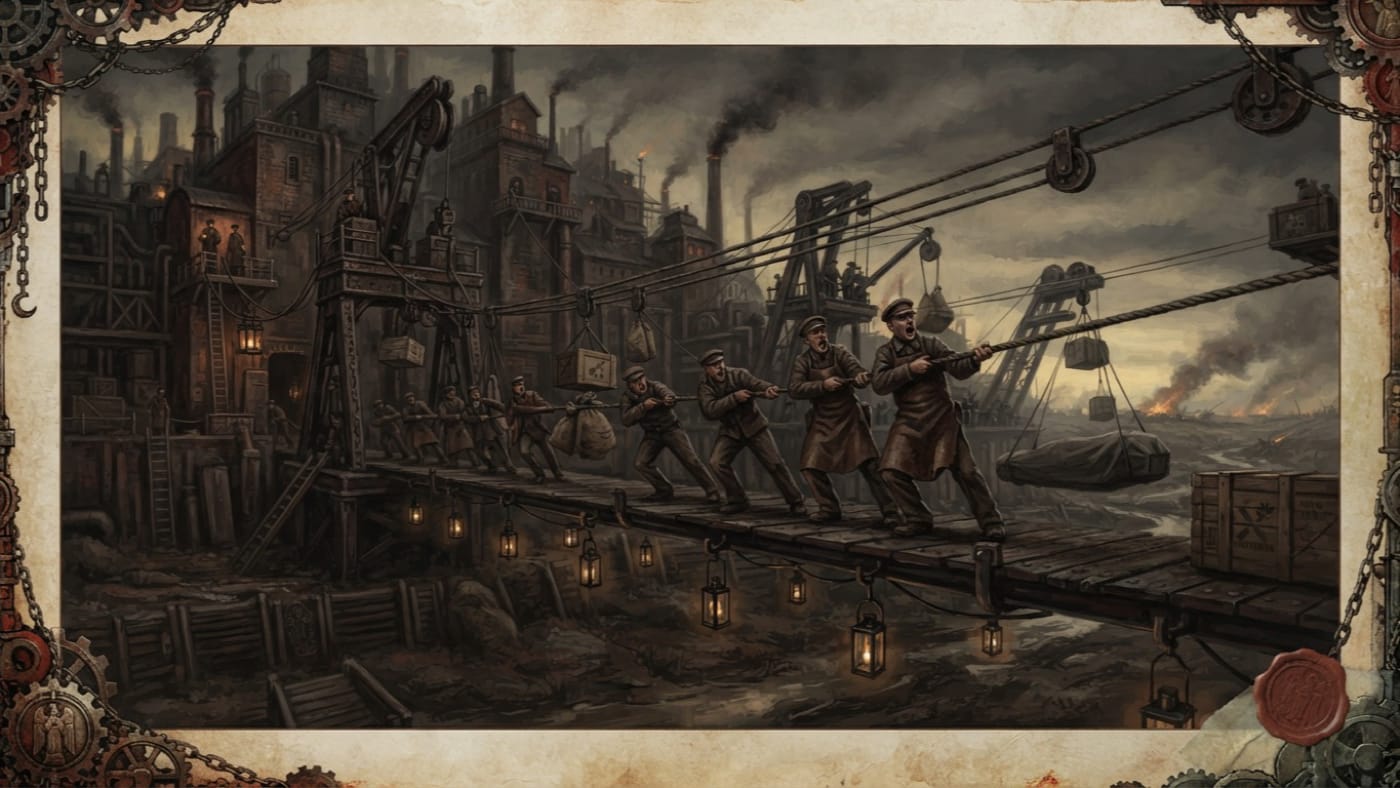
A rope-road is moved by men, and men pull badly. One heaves early and one heaves late. A third is thinking about his ration, a fourth about his wife, and between them the iron wheel stutters, the line jerks, and a coffin bound for the rear swings into a crate of salt pork bound for the front. Above mud and trench, a stutter is a fall. The Rope Road Hymnals exist to abolish the stutter.
They are chants, shouted rather than sung, codified by the Bureau of Orison and Song so that a crew lays its weight on the line in one instant and releases it in the next. The verse gives the count. The pulley takes it. Ration crates, reliquary chests, barrels of salt, coffins and the occasional conscript lashed like cargo all cross the gap at the pace of a refrain. A trench the roads fail to reach starves. The hymnal is the reason it usually does not.
The archives preserve no composer, no first edition and no year of codification. I have looked. The Bureau of Orison and Song does not find the question interesting. The hymns are required, and whoever first bellowed them has been absorbed into the requirement, which is the highest honour the Synod bestows on labour.
From one end of the Sagittal Line to the other, the Rope Roads chant the same verses: a single liturgy of the pull, carried north to south along one continuous cord of approved breath.
#On Authorized Voices
The Bureau of Orison and Song licenses hymnals, choirs and devotional broadcasts, and at the front it makes a weapon of sound. A choir assembled for industrial calibration works under an Orison writ as surely as a cathedral choir assembled for a feast day. A pulley crew is such a choir. It owns no surplices and its tenor has lost two fingers, but the Bureau has never required beauty of a choir, only licence.
The arrangement serves two masters with one mouth. The crew pulls together because the verse tells it when. The crew also sings what it has been given, at the volume it has been given, in the order it has been given, every working hour, until the words are as bodily as breath and as little examined. I find no decree stating that the hymnals were codified to teach obedience. I find no need for one. A man who has chanted the approved count ten thousand times does not improvise on the ten-thousand-and-first.
Variation is disliked. A crew that drifts into a refrain of its own, whether bawdy, mournful or merely faster, attracts the overseer, then a Bureau clerk, then the Bureau of Doctrine, which takes a professional interest in any song whose author cannot be named. The penalties differ by station and are not published. Their absence from print is itself a penalty.
#On the High Walks
Where the Rope Roads enter the cities they become high walks: pulley bridges, stacked walkways, elevated customs lanes. Here the chant has an audience. The Circle of Rope-Road Lanterns, that tolerated Circle of the Lantern Brotherhood, controls these crossings and counts what moves across them. The hymnals belong to the Bureau. The Circle only listens to them, as it listens to everything above street level.
A crew in full voice is a clock. A Lanternman at Pulley Station Hark can tell from the verse how far a sling-crate has travelled, when it will reach the far wheel, and how long the men below will keep looking up. When the chant falters without cause, he notes the bar. When it falters with cause, he notes the cause, and later sells it.
Behind the Rope Roads lies the Quarter of Widow's Light, whose memorial lamps hang beneath the lines during repairs and whose widow tithe buys the oil. The Bureau of Tithes receives the tithe, the Bureau of Orison and Song supplies the verse, and the crews supply the arms. Each party believes itself to be the one doing the singing. Soldiers say every Rope Road is paved with widows before it is paved with crates. Doctrine calls the joke heresy. Records files it as probable truth.
#On Working Without Hearing
The chant has an enemy that knows exactly what it is worth. The Pale Chanters wait across no man's land for the creak of rope under strain and the whistle of pulleys in the night air. Then they begin what soldiers call unhymns and the Bureau of Doctrine insists on calling counter-hymns, because the shorter word paid the enemy a compliment. The counter-hymn slips into a rope-man's ear and loosens the count. Workers forget knots. They miscount tugs. Some simply open their hands.
One lapse kills more than one man. A dropped pallet scatters food, ammunition and relics into the mud, and the trench waiting for them is left hungry as well as bereaved.
The repair crews, who crawl out along fraying lines under bombardment or ash-storm to splice them anew, are therefore trained to work deaf. Their ears are packed with reliquary wax and their eyes stay on the rope. They speak in tugs and gestures, a mute grammar of the hand, and they do it beneath the lamps of Widow's Light, each flame strung below them as a funeral courtesy paid in advance.
Two crafts share the roads. The hauling crew lives by the hymnal and dies when the hymnal is corrupted. The repair crew lives by silence and dies when the wax works loose. I have found no regulation governing the moment one becomes the other. That moment is left to the foreman, the weather and the enemy, in an order of precedence no Bureau has ever settled.
#On the Answer from the Pulley
Here the matter leaves the manual.
Soldiers on the roads say the ropes sing as they stretch and that the groaning lines are a choir. Crews report that the pulleys sometimes answer the verse: the chant goes out and something comes back from the iron, in time. I have read reports of ropes that "refused" to lower until they were addressed with the correct verse, and then lowered at once, as a clerk produces a file only when the form number is spoken.
The Bureau of Engineering denies all of this. It denies it with the exhausted dignity of men who have heard it. In its view, cordage under load makes sound, iron makes sound, and a crew trained to hear a verse will hear one. The Bureau of Orison and Song, asked about the wind-songs that rise from the roads at night, has ruled them wind and declines to comment further.
The Bureau of Records has archived fragments of those wind-songs. I have read them. By my own reading, they match hymns not yet composed. Records has not endorsed my reading, and Doctrine has not been asked.
The workers keep their own cant on the subject, unrecorded and therefore in perfect condition: the rope counts every hand it has held. Doctrine answers that memory resides only in record and relic. By the time the Bureaus have finished blessing a sanctified cord, it is very nearly a relic. Doctrine has not been asked about that either.
One account is told on every road and set on none. A line snapped during a Vigil Ark resupply and a company fell. Weeks later their helmets were found strung along a rope like beads, each inscribed with a name that no one had ever carried. The account has no date and no span. I give it as it is given.
#On Continued Use
None of this has stopped the pull, and nothing can. The roads carry bread to trenches that have no other bread. A crew without the hymnal hauls out of time, and a crew out of time drops coffins on the living. The Bureau of Orison and Song goes on licensing the verse. Engineering goes on denying the answer. Records goes on filing both. The Wardens take an interest in anyone who sings a variant loudly enough to be overheard, and the Circle overhears the ones who sing it quietly.
From one end of the Sagittal Line to the other, the Rope Roads chant the same verses: a single liturgy of the pull, carried north to south along one continuous cord of approved breath.
Corrected. No single span runs the length of the Line, and Records holds no census of verse by station. The Rope Roads are many roads. Whether they all sing one hymnal is a question the Bureau of Orison and Song considers settled and has never surveyed.
The crews go on shouting. Some, asked why they hold the last note a beat longer than the Bureau text allows, say they are waiting for the reply.