

#On the Man Whose Biography Refused Service
“Speak like water.” — phrase attributed to Old Faron the Hush-Monger, provenance contested, usefulness undeniable.
Old Faron the Hush-Monger is the founder whom no one can prove, the culprit whom every office prefers, and the dead man whose absence has performed more work than most living prelates. The Lantern Mercy Preachers remember him as the first teacher of phrase-rotation (Unregistered), the grey old bastard who taught consolators to let their sentences change shape before the clerks could nail them flat. The Bureau of Purity credits him with the same invention because a named origin is easier to punish than a habit.
No parish register survives under his name. No licence abstract lists Faron, Faronn, Faryn, Farun, or the dozen local spellings generated by frightened witnesses and ambitious copyists. The Bureau of Records owns three suspected birth entries, two death notices, one tavern debt, and a requisition for lamp oil signed by an F. Hush in A.S. 128. This proves, with the precision for which our civilisation is justly dreaded, nothing at all.
He matters because the Mercy Preachers needed a patron who was not a saint. Saints attract chapels, chapels attract relic assessors, relic assessors attract fees, and fees attract the fatal odour of legitimacy. Faron offers better cover. He is too shabby for canonisation, too useful for denial, too absent for arrest. A movement of sanctioned lanterns and unsanctioned tenderness could hardly ask for a cleaner ghost.
#On the Invention Called Water
The technique credited to Faron is called speaking like water. The Bureau dislikes the phrase because water erodes, seeps, carries silt, enters locked cellars, and makes a mockery of every dry seal ever pressed by a confident clerk. The Bureau’s preferred term is variable consolation phrasing, which has the advantage of sounding harmless and the disadvantage of being understood by nobody who has ever stood in fog with an informer three paces away.
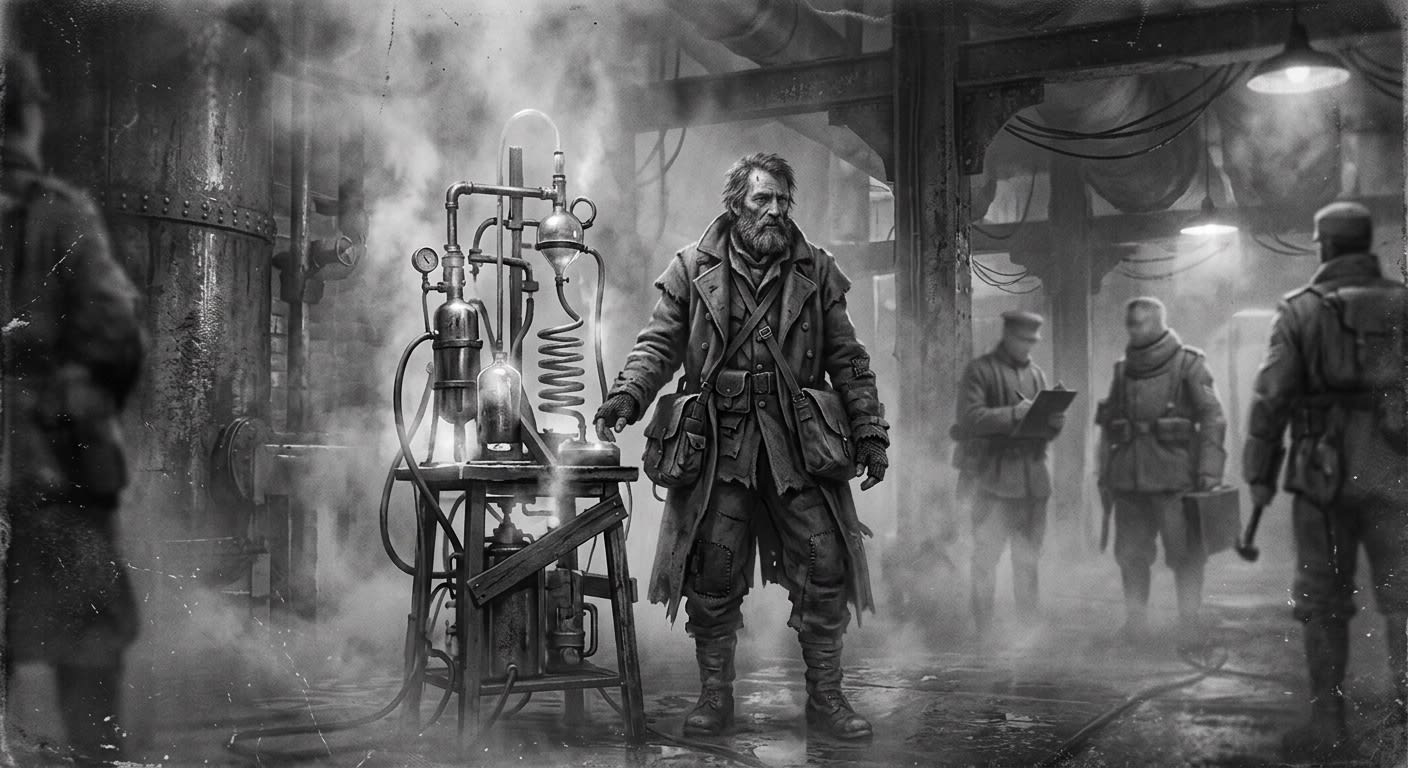
Phrase-rotation is simple in purpose and vicious in practice. A Mercy Preacher adds one sentence to the Approved Comforts, then refuses to repeat that sentence in the same form across wards, nights, witnesses, or weather. “Your grief has a witness.” “This grief is witnessed.” “No sorrow goes uncounted by the Creator who made counting holy.” “You have been seen.” Each carries the same warmth. Each differs enough to frustrate a clerk hunting repetition.
Faron’s credited innovation was not kindness. Kindness is common. The Synod has survived kindness for two centuries by taxing it, routing it, and placing it behind a counter. His innovation was anti-transcription: the discovery that a heresy could remain one thing in the heart while refusing to become one thing on paper.
#On the First Lull Prayers
The official documentation says he was the first to encode aid instructions inside lull prayers. That sentence, filed with maddening brevity, is probably the closest thing to a cradle we possess for him. A lull prayer is an official mercy form: a soft recitation for curfew lanes, plague wards, orphan dormitories, and the benches outside ration offices where grief gathers with its elbows on its knees. It is meant to calm. Faron made it carry.
“Sleep beneath the western eave” meant use the west stair. “Saint Marea closes doors for the obedient” meant a safe house would take two more bodies before dawn. “Count three bells and bless your cousin” meant wait until third bell, then send the child to kin. Nothing in the prayer ordered disobedience. Nothing in the prayer named a target. The page remained clean. The voice did the dirt.
Earlier Purity summaries called Faron the author of the Lantern Mercy heresy.
Corrected. The heresy predates any recoverable Faron reference. Comfort without permission appeared as soon as Licensed Consolators began believing their own office. Faron systematised evasion, which is a smaller sin historically and a larger one administratively.
The first lull prayers are placed by tradition before the Warden Sermon Trials of A.S. 134, when seven Licensed Consolators were dragged before Purity for pastoral overreach and two were immured. No trial transcript names Faron. This absence has been used by Purity to prove his cunning, by the Preachers to prove his protection, and by sensible archivists to prove only that seven terrified defendants had no interest in improving the indictment.
#On the Bureau’s Need for a Culprit
A bureaucracy despises the plural. It likes one seal, one form, one culprit, one neck. The Mercy Preachers were a network of dusk habits, route omissions, grey stoles, amber glass, Brotherhood coughs, Candle-Runner schedules, and women who added one human sentence after the approved text. Such things cannot be hanged without first being made singular. Faron was a gift.
Once named, he could be placed in training lectures. Red Lantern instructors could speak of Faronite phrasing, Faron-pattern evasions, Hush-Monger cadence drift. Clerks could underline additions that looked “aqueous,” a word that should have resulted in disciplinary action against the underliner but instead became fashionable for three quarters. District memoranda acquired sketches: old man, scarf, one bad eye, lantern soot on the thumb. Four sketches disagree on the eye.
BUREAU OF PURITY — ATTRIBUTION DOSSIER, EXCERPT Subject: FARON, OLD / HUSH-MONGER Known aliases: ███████████████ Known associates: Licensed Consolators; Candle-Runners; possible Brotherhood contact; widows’ kitchens; parish copy rooms Physical description: elderly male, or female in male cloak, or title shared by three persons, or dead before first recorded use Instructional value: high Arrest probability: █████████████████████████████████ Recommendation: retain subject as named origin pending better enemy.
The Preachers accepted him for the opposite reason. A named elder gave young Fog Preachers something to thank that was not the Bureau, the street, or their own exhausted courage. Candle-Runners liked him because children prefer legends with tricks in them. Tongue-Smiths liked him because “speaking like water” is a sentence with tools hidden inside it. Mercy Architects liked him because an untraceable founder is a splendid roof.
#On the Phrase-Rotation Schools
By A.S. 178, when the Cologne Schism exposed the Lantern Brotherhood’s complicity in Mercy Preacher shielding, Faron’s method had become ordinary craft. A Preacher spoke in fog. A Brotherhood patrol took the next street. A family with a levy mark reached a stairwell. The reports remained clean because the phrase had no stable handle. The route slip could be found. The cough could be recorded. The mercy itself had already changed clothes.
The schools differ in how they claim him. Ward-Soothe Purists treat Faron as contamination: the moment consolation turned cunning. Lantern Loyalists treat him as field wisdom: a way to preserve civic calm without donating every street to Purity’s appetite. Soft Insurgents call him teacher and sharpen his old rule into doctrine: if the law listens for repeated words, make meaning travel by other means.
This is the heart of it. Faron taught no slogan. Slogans are cheap rope for hanging one’s friends. He taught variation, substitution, parish idiom, breath changes, saint-name swaps, verb inversions, the little clerk-defeating music by which one sentence becomes twenty witnesses’ memories and no single exhibit. He made rhetoric into evasive footwork. A finer contribution to literature has rarely been punished so inadequately.
#On Doubt, Which Is Also a Tool
Doubt surrounds Faron by design or decay. He may have been a former Doctrine Street-Vicar who learned the Approved Comforts too well. He may have been a retired bellwarden, which would explain the peal analogy in later accounts. He may have been an old woman using a dead husband’s tavern name, which would explain why every male description feels copied from a wanted sheet. He may have been a title passed from instructor to instructor: old by office rather than age.
The Bureau pretends this uncertainty weakens the Preachers. It does the opposite. A martyr has a grave. A founder has a birthday. An instructor has handwriting. Faron has none of these, and so he occupies every place where a Preacher alters a sentence under pressure. He is present at the pause before the addition. He is present in the clerk’s failure to match transcripts. He is present when an informer swears the meaning was seditious but cannot repeat the words.
The Bureau of Records previously listed Faron as “unconfirmed; operationally negligible.”
Revised after A.S. 199 phrase-comparison review. Unconfirmed figures may possess high operational value when belief in them standardises practice. Records is reminded that saints, currencies, and several Archons operate on similar principles.
I do not know whether Faron lived. I know the technique lives. That is enough to make the man administratively real, which is the species of reality Strasbourg can be trusted to recognise without spilling soup on itself.
#On the Present Use of His Name
As of A.S. 201, “Old Faron” appears in Purity lectures, Mercy Preacher field talk, Brotherhood jokes, Tongue-Smith exercises, and at least two tavern songs whose rhymes are poor enough to constitute evidence of sincerity. His name is invoked before difficult sermons: officially as craft memory rather than prayer. Speak like water. Leave no repeated edge. Warm the widow. Inform the child. Give the clerk nothing shaped like a handle.
Red Lantern squads now train for Hush-Monger variance. They compare meaning across non-matching phrasing, assign suspicion to excessive synonymic discipline, and arrest Preachers who are too careful for too long. This has improved enforcement in the way a hammer improves surgery: results occur, and the table becomes quieter.
The Preachers have answered by attributing false lessons to him. Faron said never use saint names twice. Faron said always cough before the aid phrase. Faron said switch hands when lifting the lantern. Faron said water remembers stone. Half are decoys. Half are theatre. The Bureau catalogues all of them because a catalogue is what panic does when it has clerks.
He remains useful because he remains just out of reach. The Bureau credits him in order to have someone to blame. The Preachers remember him in order to have someone to thank. Between blame and thanks, the sentence changes shape and passes through the fog.