

#On the Receipt Reform
"Receipt is remembrance."
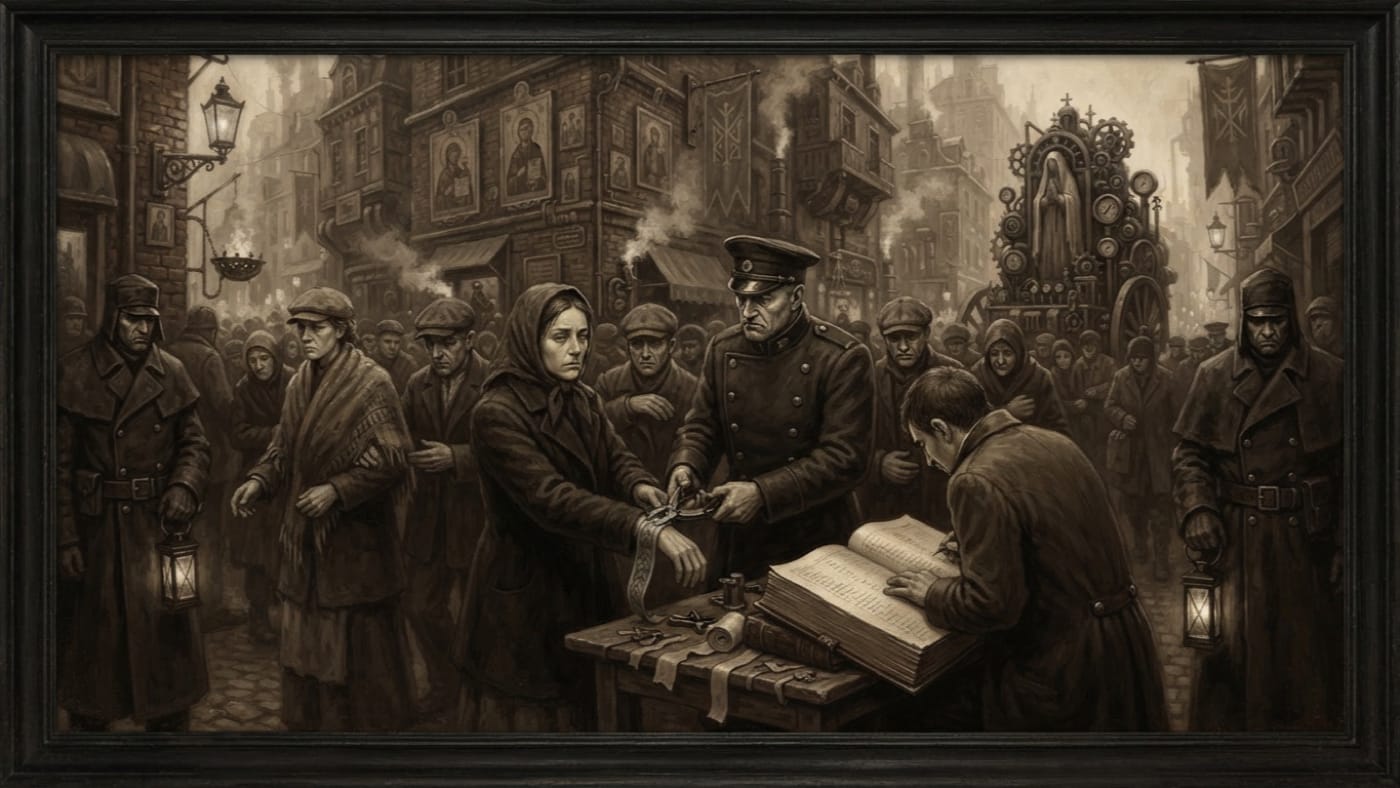
In A.S. 138 the Bureau of Festivals, acting under Synod Directive 88-F, abolished the paper receipt. Before the Reform, a citizen who walked in a sanctioned procession was handed a slip: a square of grey pulp, stamped and dated, pocketed and usually lost by the second hymn. After the Reform, the citizen was handed nothing. The citizen was fastened. A ribbon punched with the pattern of that procession, that district and that feast-day was set through the skin of the wrist. It stayed there until it frayed or was torn away, and a torn wrist tells its own story to any clerk who cares to look.
I set out the Bureau's distinction once more, for the benefit of the slow. The credential belongs to the citizen and travels on the citizen's arm. The record belongs to the Synod and never leaves the desk. The Reform changed the credential and multiplied the record.
#On the Failure of the Open Audit
"A riot taught us."
The Reform grew out of the Gray Week Famine. The Bureau of Records and the Bureau of Festivals still dispute its year, with the serene stamina of two offices that have never been made to share a filing room. The facts outside the dispute are these. Under famine conditions the Synod sent open audits into several cities at once. The auditors brought ledger-books, armed escorts, and demands for household tallies and granary inventories. The cities answered with cobblestones. Marseille rose. Munich rose. The lower wards of Strasbourg rose longest, within earshot of the Synod's own bells. A fourth city rose as well. I decline to name it, because the answer depends on which Bureau one happens to be bribing.
The audits proved something simple. A clerk who knocks on a door is an enemy. If the same clerk stands at the curb while that household walks past behind a painted saint, singing, the household no longer sees him at all.
The account the archive has kept gives the idea to a junior clerk of the Bureau of Festivals. The official record withholds his name. The Bureau of Heraldry supplies it as Caldrin of Essen, since honoured as Saint Caldrin the Jubilant Scribe. He is painted smiling, his hands black with ink, a ribbon-punch in one fist and a receipt-scroll in the other. As Heraldry tells it, his reasoning ran like this: the people would not stand still to be counted, so give them a reason to gather. Give them drums, floats and banners. Give them pauses in the route where the view of the saints is best. Then count whoever came. The profession's own register records that the first gratitude march was used to find hidden grain. How much grain it found, the register does not say.
#On the Instrument and Its Ratification
Directive 88-F carries the title On the Replacement of Paper Receipts with Wrist-Ribbon Stamps for All Sanctioned Public Celebrations. It is a generous title that promises more than the operative text delivers. In practice, and in every reconciliation ledger I have handled, the mandate binds Bureau-sanctioned processions. A guild supper is untouched. So is a nameday in a back kitchen, unless the Bureau of Festivals has licensed it, in which case the family has brought the consequences on itself.
The number is an identifier and nothing more. Readers who see the 88 and reach for the calendar should put the calendar down.
The Council of Prefects ratified the directive. The minute reads: dissenting votes, none recorded. I have read that phrase in enough minutes to know exactly what it certifies, which is that no clerk wrote a dissent down. Why none was written is a question for historians of the Council's seating plan. The Council employs no such historians.
Along with the mandate, the Reform made the Receipt-Procession Pageant Captain corps a licensed profession. Licensed is the word that matters. Route marshals, processional officers and men with counting beads had worked the streets long before 138, and Caldrin's method was in use at street level well before it reached the Council's table. The Reform added a licence, a ladder of ranks and a patron Prefect. It also added a standard of ribbon integrity by which a Captain could be judged and, where convenient, broken. The Bureau had always owned the parade. From 138 it also owned the officers who ran it.
#On the Wrist and the Ledger
"Joy leaves a trace."
Take a procession through an ordinary district on an ordinary feast. I name no one. The Bureau would not thank me, and the citizens concerned would thank me less.
The route comes first. Days earlier the Captain's office chalked the curbs and placed the pauses where the street narrows, where the floats slow and the cider is poured. At the gate a Ribbon Runner takes a woman's wrist, lays the ribbon across it and closes the punch. The tool goes through fibre and skin in one stroke. The grooves it leaves in the ribbon show procession, district and feast-day to anyone who knows the code. She flinches, and a drum covers the sound. Most people flinch. The Bureau has never needed them to do anything more.
At the curb station a tally-mate reads the grooves, then her face, then the parish roll clipped to the ledger board. Name, district, pattern, mark. The ribbon says where and when. Only the roll can say who, and the roll is only as honest as the last clerk who copied it.
Exceptions go in a separate column. A man arrives with no ribbon. A boy wears a ribbon whose district pattern belongs three streets east. An old man has a face that matches a name the roll lists as buried. All three go into the anomaly column, and some go on to the tent.
At night comes reconciliation. Totals are set against rolls, and the anomaly list is sealed in red wax. Corrected rolls go to Records and the reconciliation goes to the Bureau of Tithes. Households with clean attendance receive gratitude-proof certificates, and a household holding one tends to find the ration office more pleasant the following month. The ledger then serves offices the procession never meets: ration clerks, conscription boards, Lantern patrols, and inspectors of the Bureau of Purity.
The ribbon proves that she was there. About her gratitude it says nothing, and the Bureau has never asked it to. A week later she will cut it off, and the skin will tear where it was punched. The next inspector to see that wrist will record the tear as well.
In A.S. 138 the Bureau of Festivals, acting under Synod Directive 88-F, abolished the paper receipt.
The Bureau of Records advises that the paper receipt was abolished nowhere. Directive 88-F replaced the attendance slip at sanctioned processions. Parade permits, parish rolls, tally ledgers, tithe receipts and the gratitude-proof certificate are all still paper, and the Reform raised the Bureau's yearly consumption of it. The opening of this entry is corrected accordingly. The paper mills send their compliments.
#On Enforcement and Its Defects
The Lantern Accord of A.S. 139 is a separate instrument from the following year. It brought the tolerated watches of the Lantern Brotherhood into the procession as official crowd escorts. Their work was to keep the column moving past the counting stations and to inspect ribbons at choke points. With the Accord, the Brotherhood became the Reform's commissioned enforcing arm.
With the Accord, the Brotherhood became the Reform's commissioned enforcing arm.
The Brotherhood holds no Bureau commission and never has. The Accord recognised its watches as escorts inside the procession. Outside the route, their standing is what it was before 139: tolerated, local, and revocable whenever a Prefect or magistrate changes his mind. The Bureau finds this arrangement convenient. On most nights the Brotherhood does too.
A ribbon is harder to forge than a slip. Harder is a comparative. Captains keep blank ribbons in their coats so that a citizen who "lost" one can be re-stamped without a duplicate entry. There are counterfeit seals for permits that arrive late, and quiet ink for notes that must fade before the reconciliation. Punches go missing from float-yards and turn up in the hands of street forgers working three districts away. Some anomaly lists never make it into wax and leave the station as confetti, falling over the next procession. In my own reading of the ledgers, a tally that comes up forty short of quota has always balanced by morning. The forty are found. Nobody asks where.
The token is visible. The ledger it feeds still passes through tired hands at midnight, and those hands can be bought, frightened or simply sleepy.
You will not find the word census anywhere in Directive 88-F. I have looked. The Bureau of Festivals counts gratitude, and what other offices make of the count is their own business.
#On the Continuing Application
The ribbon is still in use in the present year, on every Bureau-sanctioned route from the western heartland to the port promenades, and so are the ledgers it was introduced to feed. Children grow up with parish-roll patterns punched into their wrists before they can read the patterns themselves. Parents give them the street's one piece of procedural advice: don't get counted twice. The licensed corps has lasted, and so have its costs. The Captains go home with ink in their nail-beds and confetti in their hair, unable to hear a drum without estimating the crowd. Their condition is set out elsewhere, in more detail than they would like.
The Reform itself has never been repealed, amended or seriously challenged in Council. Each feast-day the Bureau stamps another street's worth of wrists, and the reconciliation balances by dawn.