

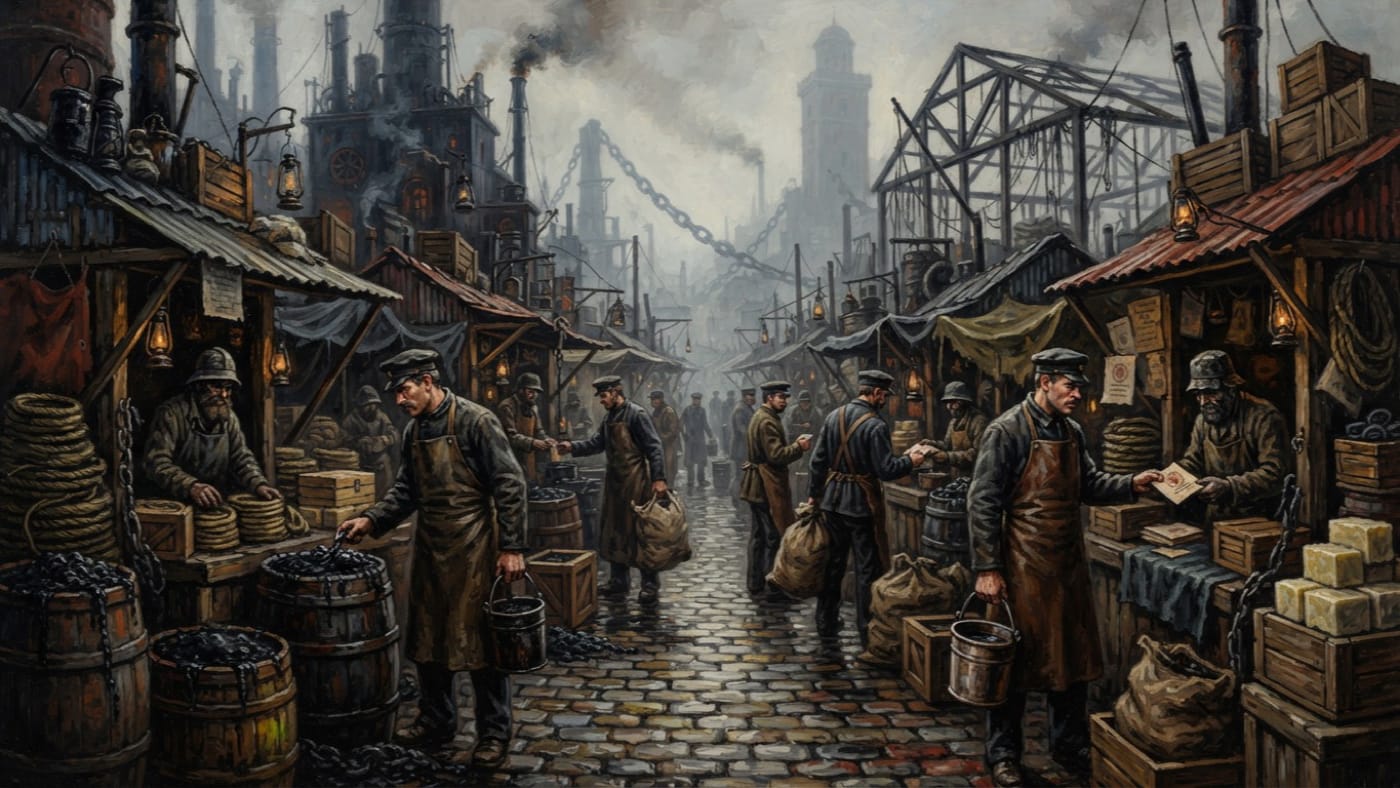
#On the Yard Within the Markets
Survey compiled A.S. 201 / 1911 CE for the Bureau of Doctrine. The year marks this compilation. It is not a founding, an inspection, or the date of any edition.
The Rope-Seal Yard is one of the named subdistricts of Thessaloniki's Pitch Markets, the chandlery quarter between the Chainward Quays and the Maskwright Lanes. The parent plate gives it one sentence. The yard sells grease, resin dust, tarred hemp, and splice wax to chain crews, and those crews pretend not to buy from vendors who are currently under investigation. Everything below grows out of that sentence. I have added no stall to it and paved no ground the record leaves unpaved.
This plate surveys the yard as it stands and trades in A.S. 201, 1911 of the Common Era. The record does not say where its edges fall, how many stalls it holds, which lane leads in, or how far it lies from the nearest bollard. I give no plan. Some offices like a map because it lets them lose the territory in comfort. The city's own description of the Markets says the district smells of resin, fish-guts, and smoke, and that is the map a buyer actually follows.
#On the Four Goods
The yard sells four goods by name, and each gets its own entry. The chandlers' first lesson holds here as everywhere in the Markets: pitch is not one substance, and neither is anything else black that is sold in this district.
Grease. The Markets' plate says chain-grease must cling under salt. Its inspection note adds that acceptable chain grease is heavy, safe on iron, and free of speaking bubbles. I report the last clause as filed and offer no comment. Grease that slides off in spray leaves bare iron in the harbour's mouth, and bare iron in salt water has a short and dishonourable career. The Younger Tower plate records greasers lowering stamped tallow buckets onto links as big as a man's torso. That is what the yard's grease is sold for. I have no recipe for it, and if I had one I would not print it.
Tarred hemp. This is rope tarred against rot. A harbour needs cordage wherever iron is hauled, lashed, slung or tested, and the sea eats untarred fibre the way the Bureau of Tithes eats a widow's arrears, slowly and with full documentation. The chain crews are the yard's attested customers. Whether any other office buys there is not on file.
Resin dust. It is named and it is sold, and the record says nothing more. I could invent a dozen uses for resin ground fine enough to sell as dust, and every one would sound like expertise. None would be evidence. The purpose of the purchase stays on the crews' side of the counter.
Splice wax. The name tells you which work it belongs to, since a splice is where two lengths of rope become one. Exactly how the wax is used in that work is not on file. The Younger's rope sheds buy it, which is enough to show it is a working good and no ornament.
#On the Buyers and the Wet Station
The chain crews are the yard's congregation. Thessaloniki's chains are kept by the Chainwrights, formally the Custodians of the Chain. They maintain the Elder Tower's primary chain on the western headland and the Younger's secondary chain on the eastern spit. The Markets' plate says Chainwrights buy directly and dare anyone to object. I have found no objection on file, and plenty of men who prefer to stay off it.
The Younger plate states the supply line most plainly. Its wet rope sheds buy grease that clings under salt, tarred hemp, splice wax, resin and lamp oil "from the Rope-Seal Yard and its neighbours." That phrase matters, and I will not let it blur. It names the yard as one seller among several. It does not say which item came from which counter. The eastern station's stone never dries, and the Younger plate records that the damp shortens the life of every rope and sealant brought onto the spit. A wet station uses up its stock and orders more. That explains the yard's trade better than any sermon on commerce.
This plate's first fair copy listed the Rope-Seal Yard's goods as "grease, resin dust, tarred hemp, splice wax, resin, and lamp oil, per the Younger Tower survey."
Corrected. The Younger survey's list describes what the sheds buy from the yard and its neighbours. Lamp oil is not named among the yard's goods, and the source assigns it to no particular stall. Four goods are attested to the yard. Four stand.
Keep the goods and the authority apart. The yard sells material. The Chainwrights tension the chain, the Bureau of Bells gives the hour, and the Harbor Ledger Office sells the window. A tub of grease grants no passage, though without it the iron would be in no condition to grant one. The chandlers never confuse supplier with sovereign. They know very well who signs the receipts and who only pays them.
#On Scrutiny and the Fiction of Ignorance
The parent plate names five authorities over the Markets: the Harbor Ledger Office, the Bureau of Tithes, the Bureau of Purity, the Bureau of War, and the Chainwrights. It describes their conduct across the whole district. Purity raids often enough to keep doctrine intact and gently enough to keep supply flowing. War buys through intermediaries. All of that is the district's weather. None of it is a warrant served in the Rope-Seal Yard, and I have no warrant to cite.
What the record does give the yard is a posture. Some of its vendors are under investigation. Which vendors, for what, by which office, and with what result are all missing from the file, and I will not fill the gaps. The crews buy anyway and pretend otherwise, and the pretence is the interesting part. An unlawful purchase would call for concealment. These purchases call for theatre. A buyer who pretends not to know his seller is under investigation is admitting that the seller is still open, still trading, and still the one whose grease holds in salt.
Being investigated is not the same as being guilty, and buying in the yard is not a crime. I state this for every Purity clerk who reads this plate hoping for a list of names. There is no list.
The crews' discomfort is as real as their grease. A Chainwright caught buying from a suspect vendor can claim he never knew, and the claim is his to make. He cannot claim the chain went ungreased, because the chain is the one witness in Thessaloniki that Purity cannot cross-examine. So the crews keep up the fiction on the iron's behalf, and the Bureaus allow it. A harbour chain grinding dry in the salt would put an end to everyone's investigations.
#On the Yard's Place in the District's Record
The Markets' chronology belongs to the Markets and should be handled with gloves. The Pitch Markets plate says the A.S. 72 harbour-chain works first called for rope-tar, caulking resin and wagon grease in quantity, and that the first sellers worked from barrels near the quays. The same plate says that by A.S. 93, the year the charter was re-ratified, the chandlers had spread into lanes behind the Chainward Quays, were supplying the Younger's rope sheds, and had been entered by the Bureau of Records as Auxiliary Maritime Supply, Third Register. Both claims concern the district. Neither year dates the Rope-Seal Yard, its first stall, or its first sale of hemp to a Chainwright. The yard has no founding on file, and I have not given it one.
Nor should the A.S. 72 harbour charter be called an act of the Synod. The formal Synod was constituted at A.S. 90. In A.S. 72 the harbour had a charter, a chain, four divers crushed in the tensioning, and a great deal of fresh pitch. That was enough business for one year.
#On the Silence and the Quiet Bells
During the Silence of Thessaloniki, which the narrative account runs from dusk on 14 Ashmonth to the fourth dawn in A.S. 198, the Markets went quiet without stopping work. The parent plate puts it plainly: chain crews needed grease. A harbour can lose its bells for three nights. It cannot leave its chains ungreased for one tide. The administrative abstract counts seventy-two hours and six missed peals, which does not match the narrative interval neatly. I leave the disagreement where I found it. No testimony from the yard itself survives for those nights, and I have invented none.
Since 14 Ashmonth A.S. 199 the city has kept the Night of Quiet Bells. The Markets close after the dusk peal and hood their fires. The yard lies inside the Markets and presumably keeps the district's custom, but no rite of its own is on file. The bells still sound in exchanged voices. The cause remains unresolved, and the grease is unbothered by it.
#On the Present Condition
As of A.S. 201 the Rope-Seal Yard trades. It sells grease, resin dust, tarred hemp and splice wax to the chain crews, and some of those crews buy from vendors whose files lie open on desks they prefer not to name. The Younger's sheds buy from the yard and its neighbours in quantities this office has not been shown. Strasbourg's external audit has listed the Pitch Markets as a whole under supply integrity, among other headings. Whether it reaches the yard by name, I cannot say.
This plate supplies no founding, no plan and no roster of guilty men, because the file holds none. What it records is a trade the harbour cannot do without, carried on under scrutiny the harbour will not withdraw.