
#On the Guild That Touches the Iron
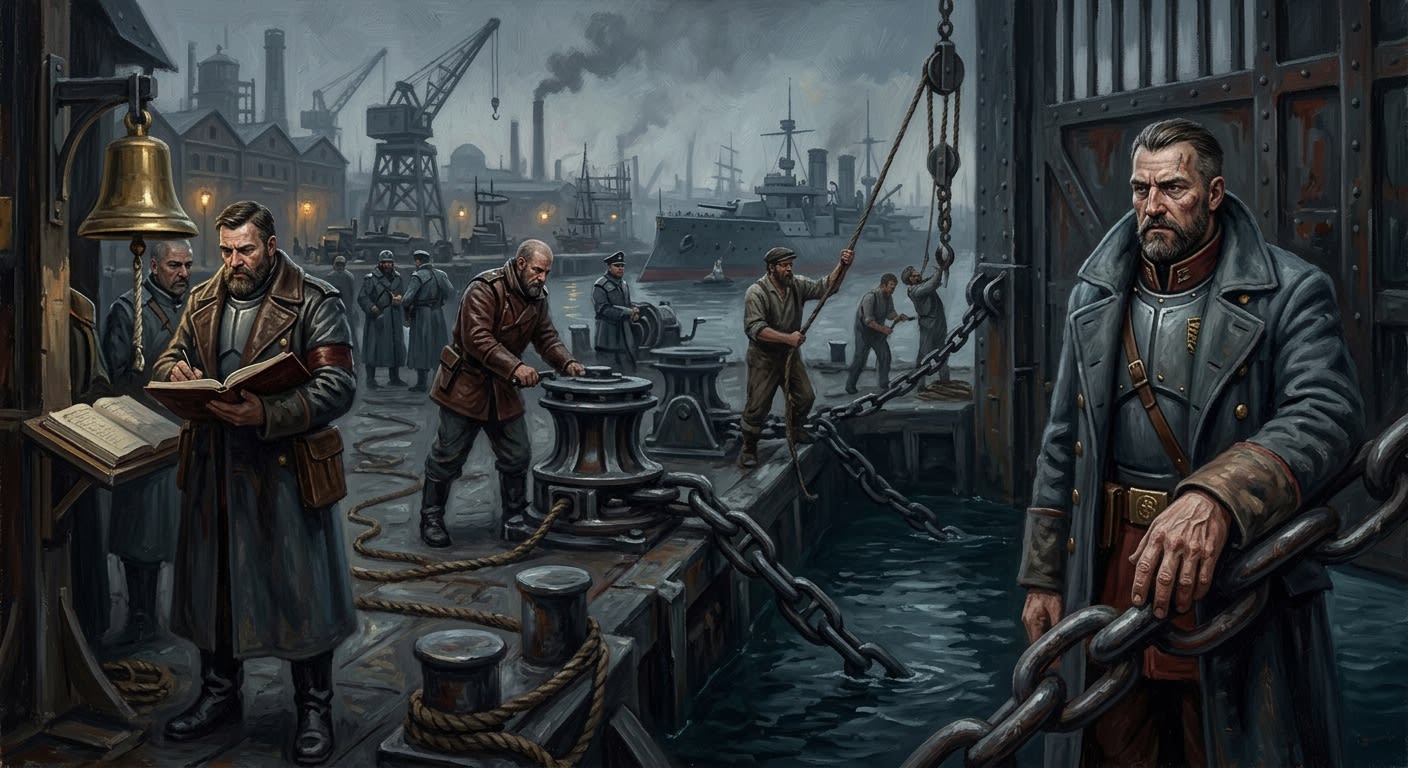
The Custodians of the Chain, called Chainwrights by dockmen, chain-monks by inland fools, and grease-fingered obstructionists by clerks who require more drowning in their education, are the guild-profession that maintains the Elder and Younger harbour chains of Thessaloniki. They occupy the Harbor-Chain Towers, forge piers, chain galleries, windlass rooms, rope-law sheds, diver lodges, flood arches, under-rigging stairs, and those narrow iron walks where even piety learns to keep both hands on the rail.
Their office descends from necessity rather than theory. After the Sundering made the Aegean coast a mouth through which the wrong dead came walking, Thessaloniki needed a hard gate: first rope, then iron, then reliquary iron inlaid with psalm-script, tensioned between towers and blessed by men who stood wisely away from the links after four divers had already proved the ceremony sincere. The formal harbour-chain charter was ratified in A.S. 72, backdated to A.S. 66 for theological convenience, and re-ratified in A.S. 93 after the first papers embarrassed their custodians by existing improperly. The chains outlived every signature.
The Custodians maintain what the Bureaus interpret. This distinction offends everyone who has never greased a link in winter. Records calls the chains a registration apparatus. Bells calls them acoustic extensions of tower authority. Rites calls them consecrated instruments. War calls them harbour defence. Tithes calls them fee-generating infrastructure. Sailors call them the difference between passage and collection. The Custodians call them work.
#On the Towers, Links, and Daily Labour
The chain-gate deserves no comparison to a door. Doors flatter human architecture. The gate at Thessaloniki is a contract in iron laid across water that refuses signatures and collects all the same. Every lawful passage beneath it requires bell, chain hum, permit, witness, tide mark, and the tacit consent of mechanisms older than the current manuals and less forgiving than their authors.
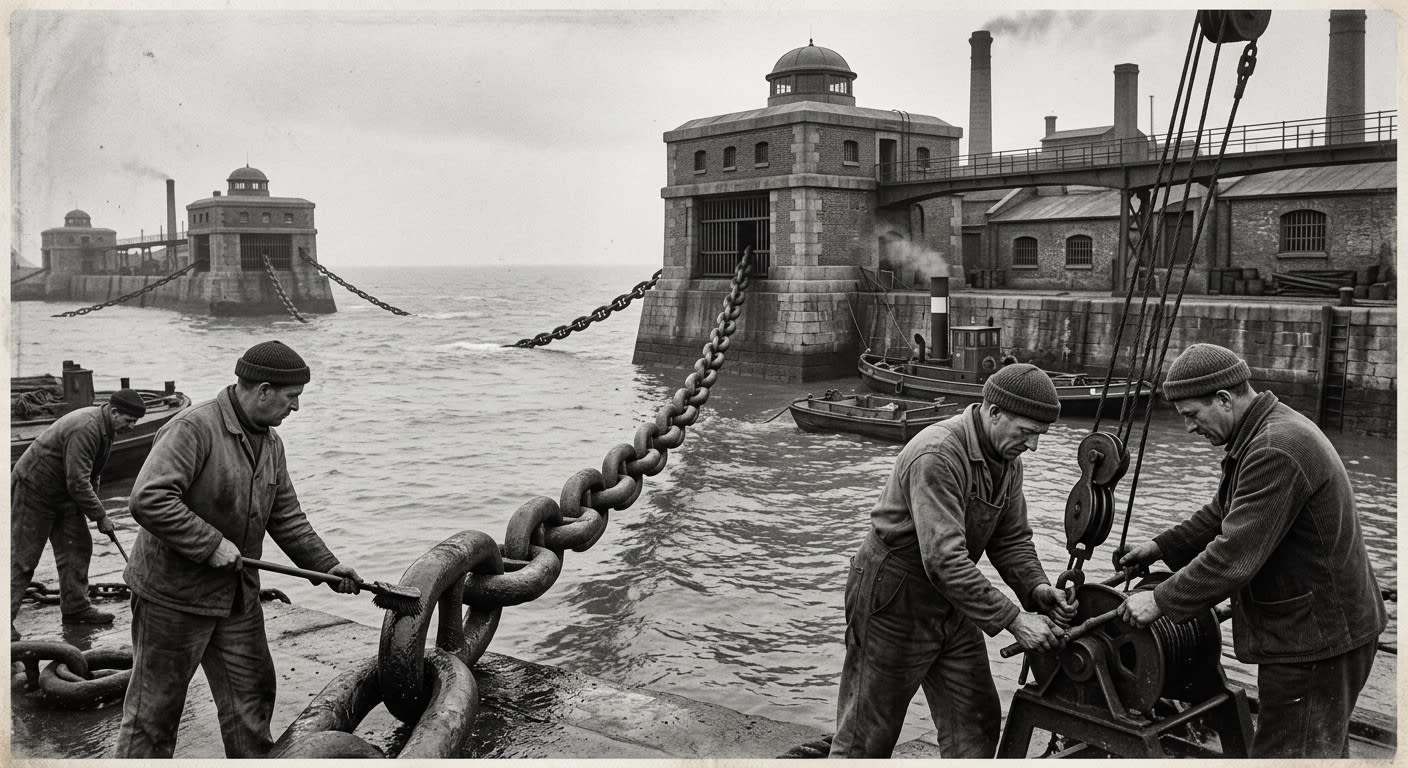
The Elder Tower anchors the western chain-head, heavy with salt-bronze, gull filth, old prayers, and the lower note that now emerges from the wrong throat since A.S. 198. The Younger Tower rises from the eastern spit, sharp and registry-minded, its base carved with refugee names in scripts most clerks cannot read and would not respect if they could. Between them, the chain arcs over and under the harbour: visible links above, submerged links below, each link large enough to smash a cart, each psalm-inscribed, corrosion-marked, and acquainted with more hands than many relics.
The Custodians' day begins before the harbour's does. Windlass men wake the gears. Rope-law clerks count lashings, splices, hawser claims, emergency ties, and the little municipal disputes by which rope becomes jurisprudence. Forge crews inspect pins, collars, hinge plates, replacement teeth, gear nests, and sacrificial bolts. Tower hands scrub salt from surfaces that will bloom again before supper. Watch crews walk the galleries with mallets, chalk, oil, and the facial expression of men who have learned that optimism is how a chain kills you.
Below the surface, the Diver-Matronate does the work that makes every dry-room theory possible. Divers descend to inspect submerged links by hand, scraper, lamp, slate, breath, and nerve. They test the psalm cuts for corrosion. They feel for stress before instruments admit it. They learn which vibration belongs to passage, which to tide, which to storm, which to the Drowned Choir, and which to nothing any sane office should name before breakfast. A diver's palm is a better instrument than half the Bureau of Bells' brasswork, as Sera proved to Strasbourg's lasting irritation.
The issued tools are simple because useful things become simple under salt: scraper hook, brass lamp, weighted line, palm slate, link gauge, oil rags, wedge hammer, song schedule, emergency knife, prayer bead sealed inside waxed leather, and the old instruction never to answer any voice that knows your childhood name. The final item is not metaphor. It is equipment.
#On Ranks, Apprentices, and Rope Law
The Custodians are not a monastery, though outsiders keep trying to turn them into one because outsiders prefer labour to look devotional from a safe distance. They are a guild with vows, bloodlines, apprenticeships, widow-rights, diver law, tower discipline, and an internal economy of scars more precise than heraldry. A forge boy with two clean hands is a child. A rigger with one crushed thumb is learning. A diver with white palm lines and no boast is to be obeyed at once.
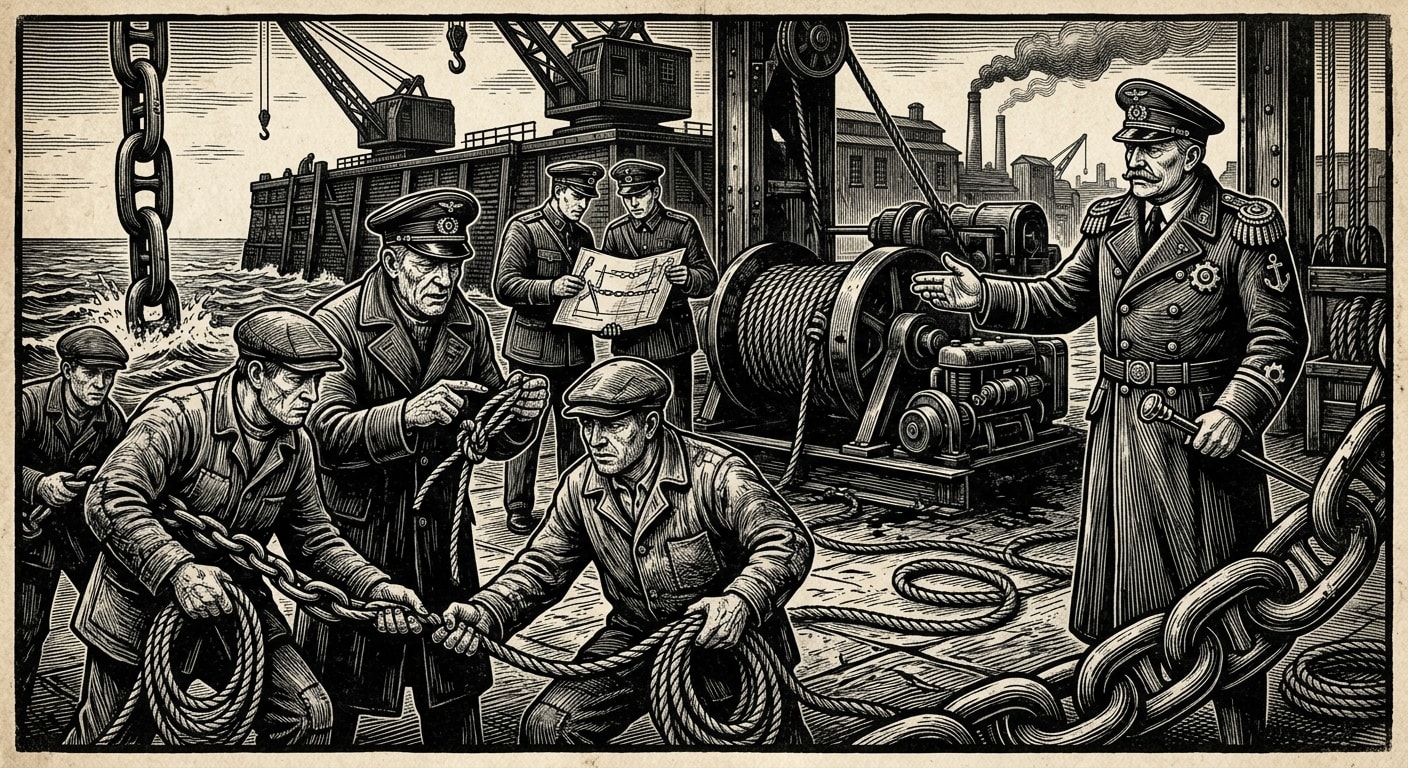
At the lower edge stand Link Boys and Oil Pages, who carry grease, fetch pins, sing count cadences, sleep badly, and absorb blows from masters who consider panic a flaw in the lungs. Above them stand Rope Hands, Windlass Men, Gallery Walkers, Forgewrights, Chain Singers, Diver Apprentices, Slate Keepers, and Tide Listeners. Senior rank divides into Chainmasters, Diver-Matrons, Forge-Priors, and Rope-Law elders. At the top of the working order sits the Chainmaster Superior, presently Kosta, whose authority derives from the magnificent credential of being correct when other men are still asking whether correctness has been authorised.
Rope law governs the social facts that official law arrives too late to understand. Who may cross a tension line. Who owns a line after a drowning. Which widow receives gear pension when the body is absent. Which apprentice inherits a dead man's gloves. Whether a snapped hawser is negligence, weather, sabotage, choir-pressure, or the rope expressing an old grievance. The decisions are kept in sheds where salt has made the papers stiff and the handwriting resembles accusation.
The Bureaus dislike rope law because it smells of local authority. The harbour likes it because it works. A rule that can be shouted over wind is worth six circulars in Strasbourg. A custom that prevents a young idiot from putting his foot inside a live loop has already justified its existence. A widow who receives her man's rope share before Records decides whether drowning occurred learns which law noticed her first.
A.S. 131 Records review described Chainwright customary law as “informal harbour superstition without standing.”
Clarified after three strike days, two delayed grain convoys, and one instructional winch failure. Rope law possesses standing wherever rope is standing between the city and catastrophe.
#On the Chain-Gate Protocol
The official chain-gate protocol is handsome on paper and wet in practice. Dawn peal: lower then higher, harbour opens. Dusk peal: higher then lower, harbour seals. Storm peal: both, dissonant enough to make gulls blaspheme. Chain-window peals regulate movement by vessel class, cargo urgency, quarantine state, war priority, pilgrim licence, and the secret category by which certain crates are allowed to hurry while everyone pretends not to see their haste.
The Custodians make these instructions survivable. They stand at windlasses when bells authorise motion. They read the chain hum as a second witness. They check tide against permit and permit against weather. They refuse captains whose papers are perfect and whose hulls sit wrong in the water. They open for vessels whose stamps are incomplete because medicine rots while clerks warm chairs. Each such act becomes a dispute afterward. The harbour continues meanwhile.
Records believes the Harbor Ledger Office governs arrival by recognising it. This is true in the way a seal governs wax after the wax has already been heated. Kosta's men can make recognition wait. If the chain does not open, the stamped ship remains a petition with sails. If the chain remains raised, the cargo, crew, confession, tithe, and passage hymn all become theory, and theory feeds no trench.
The passage itself has six witnesses: Bell, Chain, Ledger, Tide, Pilot, and Eye. Bell authorises the hour. Chain hums the weight. Ledger records the claim. Tide permits the physics. Pilot answers for route. Eye belongs to the Custodian stationed at the throat, who watches whether the vessel enters as the papers say or as the harbour knows. Eye is the least formal witness and the hardest to bribe twice.
During ordinary days this machinery looks like discipline. During crisis it becomes doctrine with its sleeves rolled. In storms, the Custodians shorten windows before Bells admits bad carrying. Under quarantine panic, they isolate mooring rings by rope colour. When Nenos says the sea is listening too hard, the wiser Custodians find reasons to slow the gate. Clerks call this superstition until the ships survive, after which the same clerks call it local expertise.
#On the Diver-Matronate and the Work Beneath
The Diver-Matronate arose because the chain required people able to disobey death before waiting for permission. Early harbour records speak of war-divers, penal swimmers, naval volunteers, and coastal sons with admirable shoulders and insufficient distrust. They died in quantities that made replacement inefficient. The Matronate introduced abort authority, touch doctrine, breath ledgers, deep-link seniority, and the salutary practice of slapping a supervisor who mistakes ceremony for tide.
A Diver-Matron may end an inspection. She may surface under contrary order. She may condemn a link from the water and force a harbour hold before a Chainmaster signs the reason. This has offended superiors eighteen recorded times and preserved the harbour in at least twelve of them. The remaining six arguments are filed in the old manner: the challengers learned, drowned, or married into better manners.
Sera is the present proof of the office. During the Silence of Thessaloniki in A.S. 198, when the bells above produced no sound through seventy-two hours of impact, Sera descended and felt the submerged links keeping the correct dawn-and-dusk schedule. Lower then higher. Higher then lower. No surface instrument detected it. Her palms did. The bronze lied. The iron counted.
DIVER-MATRONATE TRAINING SLATE — RESTRICTED COPY If link vibrates without bell: surface with witness. If link vibrates before bell: mark sequence, do not answer. If corrosion resembles writing: copy once, do not read aloud. If a dead voice offers your own breath back: cut the line and rise. If superior forbids rising: write superior's name clearly for widow.
Diving leaves the body altered. Salt cracks the tongue. Pressure thickens the ears. Knuckles swell. Palms scar into maps no inland clerk can read. Sleep becomes negotiation. Sera has not slept in four years because, by her own line, she sleeps when the iron stops counting. The Bureau of Medicine calls this persistent wakefulness. The Chainwrights call it exposure. I call it testimony with a pulse.
The Matronate's harshness is mercy with teeth. Apprentices are taught that bravery is useless below water; tasks are useful. Check lamp. Check line. Count breaths. Touch with palm, never fingers, because fingers lie when cold. Never follow a melody down-current. Never trust sudden warmth. Never bring up a loose scrap unless weighted twice and witnessed. Never let a child's song set your pace.
#On the Drowned Choir and the Chain's Other Listener
The Custodians do not control the Drowned Choir. They endure its proximity with the grim competence of people who must work beside a dangerous animal the Bureaus have classified as furniture. Since A.S. 121, Rites has kept the Choir under Category Three Harmonic investigation. Since before A.S. 121, Chainwrights have scratched little black circles beside water doors: do not sleep aboard.
The Choir travels by chain, fog, hull, dream, tooth, and name. It sings below the harbour, gathers names, repeats them in sleep, stains them into corrosion, and pulls the unwary toward water with the tenderness of a mother and the bookkeeping of a tax collector. The Crying Choir incident of A.S. 145 taught Thessaloniki the price of bad listening when refugee children quartered beneath tower stone sang in sleep and woke without tongues. The Custodians did not solve that wound. They built practices around it: communal hums, bell-timed countertones, hatch watches, no-sleep benches, palm signals for children who cannot speak, and the rule that prettiness in a night song is to be struck flat.
The chain itself is a counting instrument. Every ship that passes under the links sets a hum in motion. The Bureau imagines this hum entering Records by approved channels. The Custodians know the hum also goes downward. The public manuals decline to name the counter below, and the work assumes it with every watch. Passage hums are watched. Mis-hums are logged. A ship whose hum lags behind its hull is stopped if possible and remembered if lost.
Kosta's hidden sea-taken ledger belongs here, though no official Custodian charter admits it. The ledger records those taken by the sea, bodies absent and bodies recovered, names refused by captains, names given by families, and, since A.S. 198, names appearing before drowning. Records would seize it if seizure would not require explaining why a supposedly unlawful book knew fourteen deaths before the year did. The Bureau's restraint deserves applause. From a distance.
#On the Silence That Proved Them
The Custodians' modern authority was sealed, with every dry office grinding its teeth, during the Silence of Thessaloniki. On the evening of 14 Ashmonth, A.S. 198, Andros Pell struck the Elder and heard nothing. Katerin Liss struck the Younger and met the same occupied absence. Clappers moved. Instruments registered force. Air received no tone. Chain-gate protocol lost its throat.
Kosta held the gates open, sent runners to the Ledger Steps, placed men at windlasses, readied divers, and waited for no permission. This was insubordination only to those who prefer command after drowning. The harbour did not panic because the Custodians gave it tasks. Hold that gate. Hood that lantern. Clear that queue. No passage under silent chain without witness. Send for Sera. Keep the rope teams awake.
Sera descended while officials began the first of many conversations that improved nothing. The links below maintained the schedule the bells had abandoned. Dawn and dusk, through seventy-two hours, submerged iron answered a bell no air could hear. Seven acoustic distress patients in Quarantine reported correct bells under the harbour. Three children in the Refugee Sheds reached the shallows sounding the note from below. Nenos refused passage because the sea was listening too hard. His vessels survived.
When the bells returned on the fourth dawn, they returned exchanged: Elder ringing Younger's note, Younger ringing Elder's. The reversal persists into A.S. 201. Bureau plaques call the tones reassigned. The Custodians call the bells wrong and keep working. A craft that stops because official language has improved around danger is merely a sermon wearing tools. Thessaloniki has plenty of sermons. It requires chain hands.
Initial harbour summaries implied the Custodians awaited interpretive authority before acting during the Silence.
Corrected under witness review. The Custodians acted first, preserved harbour discipline, and received interpretive authority after the fact, as is customary when labour saves theology from embarrassment.
#On Money, Monopoly, and Municipal Hatred
Every indispensable guild becomes expensive. The Custodians are no exception, and only the sentimental would ask them to be. They hold repair monopolies, rope certification, diver rotation fees, emergency tension surcharges, gate-delay claims, apprentice dues, widow allotments, forge scrap rights, and a thousand little payments by which the harbour purchases its own continued throat. Tithes hates the untaxed portions and loves the taxable ones. Records hates the local ledgers and uses them when convenient. War hates gate delays unless its own cargo receives priority, at which point gate discipline becomes patriotic.
The monopoly survives because no office can replace the hands. Strasbourg can send auditors. Bells can send diagrams. Engineering can send calipers and men with immaculate boots. None of these will descend in black water, distinguish tide-stress from Choir-hum through a glove, or know by smell when a windlass room has lied about heat. Skill is a jurisdiction whose seal is scar tissue.
The Custodians are corrupt, naturally. Every human mechanism with gates acquires fees. A ship may pay for a kinder window. A captain may purchase a second inspection after a first one goes sour. A widow may bribe a rope clerk to record absence as drowning rather than desertion, because pensions prefer water to cowardice. A smuggler may rent a blind winch interval if he knows the right cousin. These sins are fragrant and ordinary. They differ from Bureau corruption chiefly by being faster and less self-flattering.
Their harsher crime is secrecy. The Custodians know more than they submit. They keep under-ledgers, apprentice songs, diver marks, black-circle tide notes, hatch names, and tonal warnings that no public manual prints because printing them would make them either doctrine or contraband. They know which links hum before certain ships pass. They know which children in the Sheds should not sleep near east walls. They know which fog shapes answer the reversed Elder note. They know which official inspections must be delayed until the chain stops muttering. They do not tell us everything.
I would condemn this more splendidly if telling us everything did not so often get people killed.
#On Present Suspicion
As of A.S. 201, the Custodians operate under audit, gratitude, distrust, dependence, and the revised acoustic wrongness that now defines Thessaloniki's hours. The bells ring in exchanged voices. The chains sag by small measurements that officials dismiss and Chainwrights dream about. Sera reports hum-pattern shifts. Kosta's sea-taken ledger has gained names in an unidentified hand. The Refugee Sheds maintain second-line hums no teacher supplied. The fog near the links holds shape on nights when clear air was promised by every respectable instrument.
External auditors will arrive with questions arranged like cutlery. They will ask whether the Custodians can prove the chain's behaviour during the Silence. They will ask whether rope law conflicts with Bureau authority. They will ask whether Kosta's unregistered ledger exists, though not so plainly that existence becomes an answer. They will ask whether Sera's sleeplessness affects reliability. They will ask why certain submerged corrosion copies are kept in locked boxes lined with lead. They will ask whether the guild's emergency command should be subordinated to the Harbor Ledger Office in future acoustic failures.
The correct answer to that final question is no. The answer filed may be longer.
The Custodians endure because every passage through Thessaloniki still needs them. Grain for Shipka, ammunition for the southern line, pilgrims from Marseille, medical freight, demon-glass masks disguised as optical supplies, refugees with salt in their papers, and dead men whose names have not yet caught up to their bodies all pass under links watched by Chainwright eyes. The Bureau may stamp the movement. The bells may announce the hour. The sea may count beneath. The Custodians touch the iron.