

#On the Eastern Station
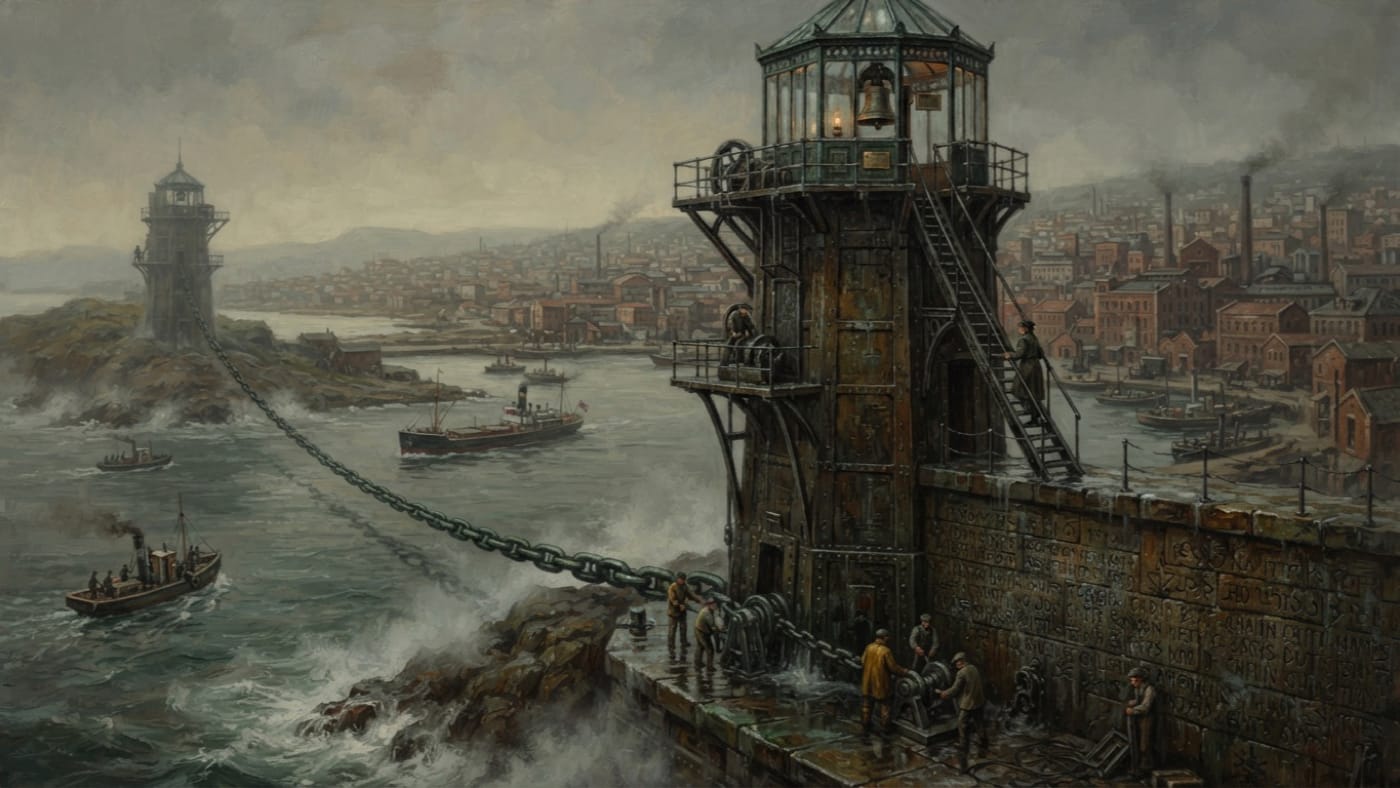
The Younger Tower stands on the eastern spit of Thessaloniki's Aegean inlet, across the water from the western headland where the Elder Tower holds the primary chain. The secondary chain runs from the Younger. Its crown-chamber is kept by Bell-Warden Second Class Katerin Liss. The stone at its base carries names that no clerk in the harbour can read. This plate surveys the installation as it stands and works in A.S. 201, 1911 of the Common Era, and was compiled for the Bureau of Doctrine while Strasbourg's auditors were still packing their calipers. It records a station in service. It records no founding, because no founding has been documented, and I will not make one up to fill a line of the index.
The pair is usually described as one machine. The paired-towers survey already does that work, and does it adequately. Here the Elder appears as a neighbour seen across the water. The two towers share a gate, but their duties differ. The Elder is the western harbour throat. It has the depth, the primary chain-head, the heavier load, and the old low authority by which the harbour opened and sealed. The Younger is where the harbour's arithmetic of persons can be seen. Every passage beneath the chains enters the public account as a registration event. Through its bell, its chain and its wall, the eastern tower is where Thessaloniki's habit of turning travellers into entries shows most plainly and is least admitted.
The Chainwrights put the difference more briefly than I can. In their account the Elder supplies depth and the Younger supplies height and registration cruelty. I have read Bureau memoranda of forty pages that said less and meant nothing.
#On the Approach, the Stair, and the Crown-Chamber
You know the Younger by its damp before you see it whole. The Elder is salt-bronzed, gull-fouled, scoured dry by western weather on its good days. The Younger's stone never dries. Spray, fog and the slow sweat of iron keep the lower courses dark in every month, and the paired survey records that persistent wet as a working condition, not an aesthetic one. Rope rots faster there. Tallow slides off. Lamp wicks gutter in the draught that comes up from the water.
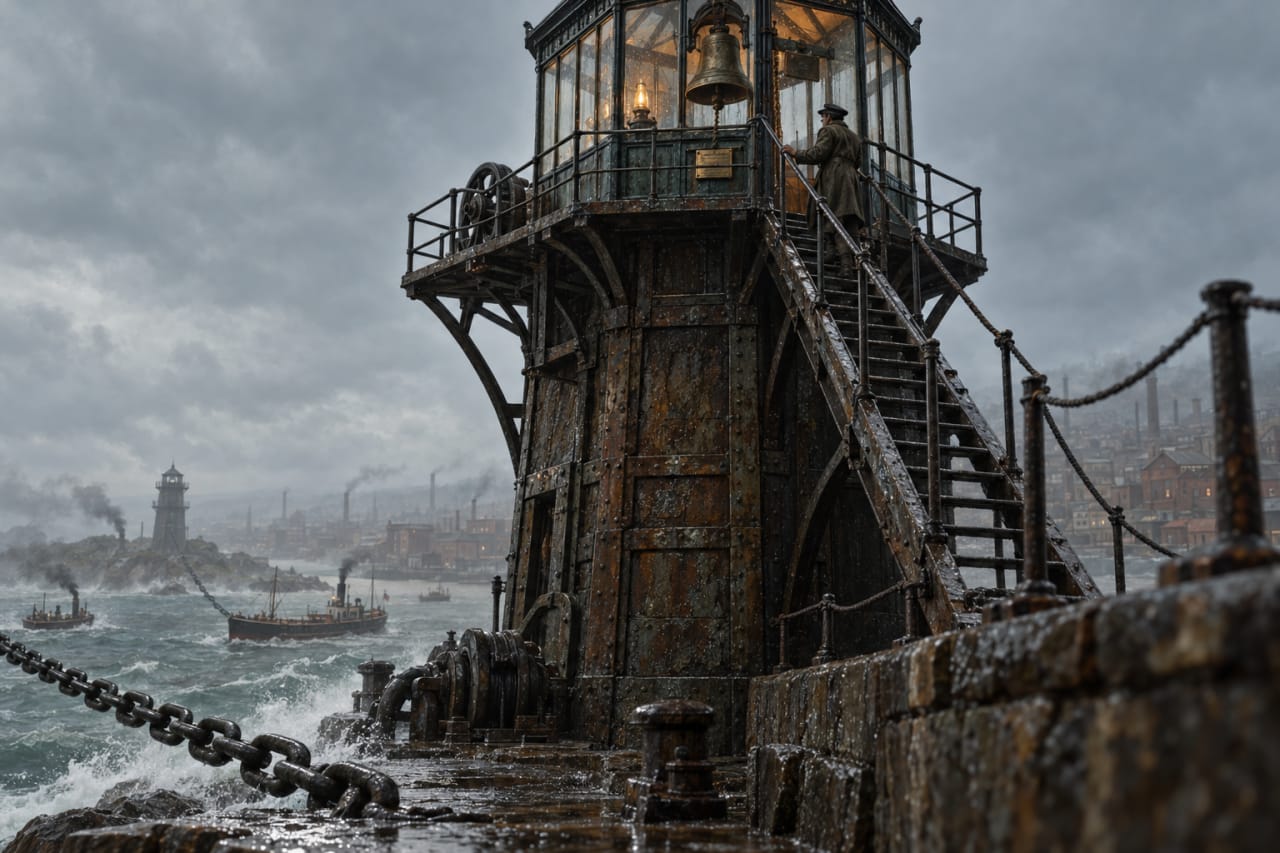
The undertow at the base is the first fact every Chainwright apprentice learns about the eastern station, and the one most often learned too late. The water off the spit pulls. Divers going down to inspect the Younger's footing rope themselves twice before entering, according to the paired survey. Matrons on the Diver-Matronate's roster set their own pace for the descent, and no clerk ashore can hurry them. Inspection there is slow, cold work, and much of it is done by touch.
Then there is the sound of the place. On the lower landing, strike a spanner against a collar plate and the tower answers from somewhere above you, late and slightly flat. That is the paired survey's observation, and Chainwrights confirm it with the shrug men give to a fact they have stopped finding remarkable. I record it as an acoustic property of wet stone and iron. Sailors record it as the tower listening. Neither record proves anything about the tower's intentions. I am not convinced that towers have intentions, and I am quite sure that sailors do.
The stair climbs from the damp base to the operating chamber. No measured count of its steps has reached this office. The Elder's famous number belongs to the Elder, and I will not lend it across the water. What the record does establish is wear: treads hollowed by wardens, riggers, runners and inspectors, and a handline polished black where generations of palms have trusted it more than their feet. Liss passes the base wall going down after the opening peal and going up before the sealing peal. That daily traffic is the best plan of the tower anyone has filed.
The crown-chamber holds the Younger bell, its rope, the schedule slate and the warden's station. That is the inventory the record supports, and it is the inventory that matters. Liss's dossier records that storm-swelling thickens the air in the chamber enough to change the force a pull requires. A warden who does not feel that change strikes a bruised peal. On the wall hangs the brass plaque the Bureau of Bells installed after the return of ringing: Tone: Elder (Reassigned, A.S. 198). I discuss its cowardice below. For now, note that a survey of the chamber finds plaque, slate, rope and bell in good order. The only thing out of place is the note.
#On the Wall of Names
At the Younger's base there is a wall of carved names. They are cut in the old refugee scripts of people who passed through Thessaloniki's harbour before the city's offices had finished grinding every arriving name into Latinate filing shapes. The clerks cannot read them. The clerks have not tried. The city plate states the reason plainly: translation would require admitting that the names existed before the stamps did, and no office in the harbour has a form for that admission.
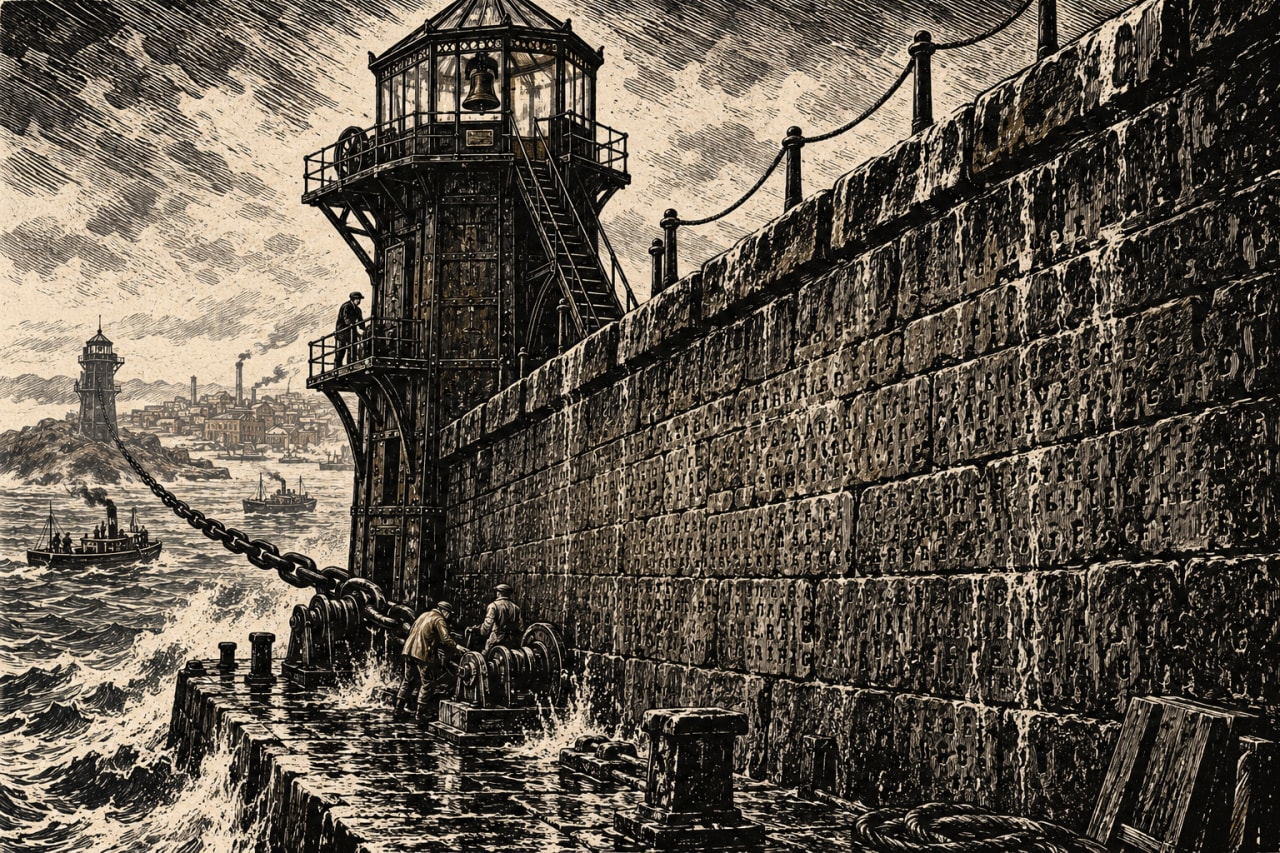
The paired survey also speaks of a small room within the tower walls, which the harbour calls the refugee-tongue memorial. Officials avoid it during processions, and the survey judges their reasons sound. I treat the room and the base wall as two descriptions of one memorial provision, written by men who stood in different places and noticed different stone. No measured plan has been deposited, and I will not draw one. A plate that invents a floor plan for a memorial has started composing an epitaph for the commemorated, which is more than it was asked to do.
What can be stated is this. The names are carved, not painted. They survive damp that eats rope in a season. They are in scripts the Bureaus do not teach. Nobody has deposited a reading, a count, a carving date, the name of a carver, or the identity of any one person commemorated. I therefore offer none. Any reader who wants a translation may go to the spit and learn the script from someone who still carries it. The Bureau of Records will not help.
The Chainwrights call the wall refugee tongue, and their phrase is closer to the truth. In this harbour the name a traveller brings and the name the ledger gives back are two different documents. At the Chainward Quays the first passes through the clerks and the second comes out, spelled for the convenience of whoever holds the pen, set in the order Records prefers, and frequently shorter than the original by the syllables that troubled the copyist. The person survives, mostly. The old name goes into a file nobody opens. The wall at the Younger's base is the one place on the harbour where the first document was cut in stone, where it stays and cannot be refiled.
The wall should not be confused with other inscriptions in the harbour. The Elder's inner wall carries the names of the four divers crushed during the chain tensioning of A.S. 72. Those names are readable, honoured, and attached to a widow's pension the Harbor Ledger Office has paid for over a century. They belong to the Elder and to that cruelty. The submerged links carry psalm-script, and Sera's lamp has found corrosion on them that resembles handwriting. That belongs to the iron and to the sea. The ledger of sea-taken names that Kosta keeps under his floorboards is in the Elder and stays there. None of these is the Younger's wall. The harbour already has too many unexplained writings, and I will not tie them together for the reader's comfort.
Refugee households keep a separate custom of their own, recorded in the Chainwrights' tract: a newborn's name is held back from filing for three days, to keep the water's attention elsewhere. It is a living practice, done by mothers and not by masons. It shares one conviction with the carved wall. A name belongs to the person before it belongs to the office. I record the conviction and leave its theology to the Bureau of Rites, which has been avoiding it for some time.
Liss passes the wall twice a day. Her dossier says that the wall shaped the character of the eastern bell, that the Younger did more than announce ships and announced the conversion of lives into entries. I would put it more plainly. The Elder told the harbour when it could move. The Younger, rung above that stone, told every arriving traveller that the counting had started.
#On the Secondary Chain and Lawful Passage
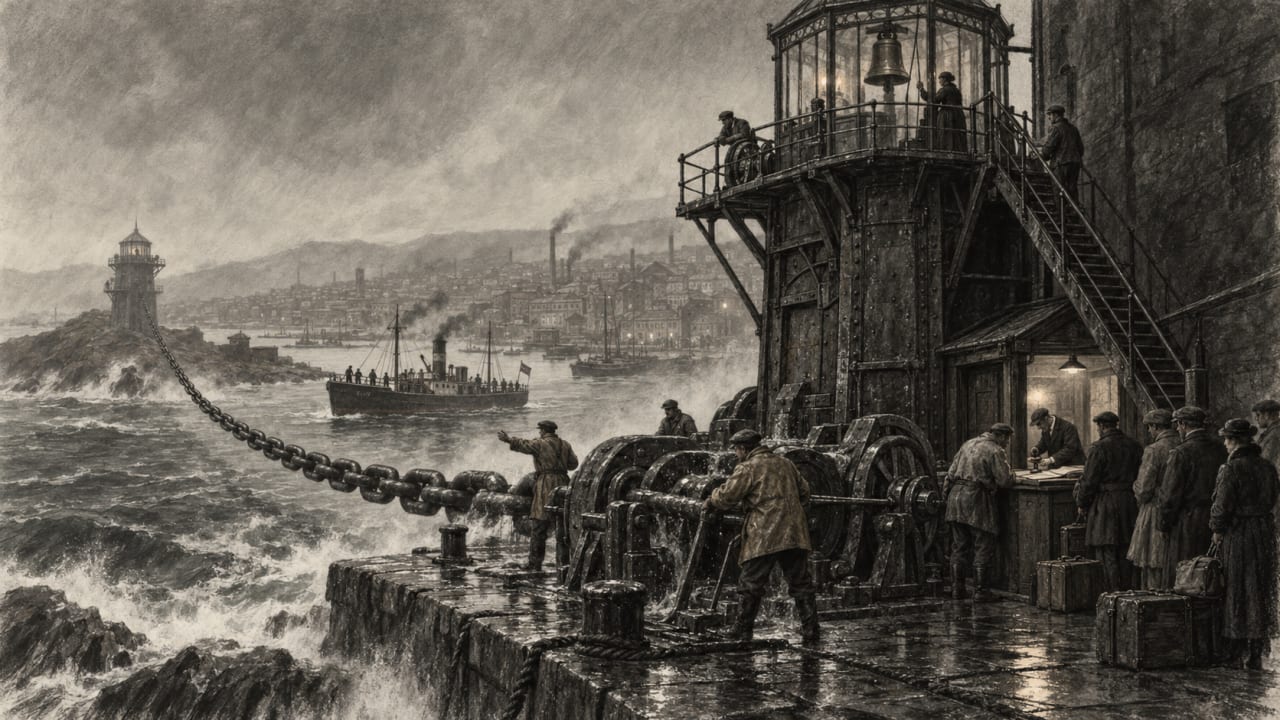
Lawful passage at Thessaloniki needs four things at once, and the Younger takes part in all four without commanding any of them alone. The bell gives the hour. The Harbor Ledger Office gives permission, sold by the window and stamped on the manifest. The crew gives the Passage Psalm, kept audible under the chains even if the only voice left aboard is a frightened cabin boy's. The Chainwrights give the iron. A warden can ring the harbour open. Whether the chain lets a ship through is a Chainwright's word, and the paired survey was right to keep those two offices apart.
Before A.S. 198 the order of the bells was fixed and public. At dawn the Elder's low note sounded first and the Younger's high note followed, and the harbour opened. At dusk the Younger led and the Elder answered, and the harbour sealed. Storm peals, chain-windows, quarantine releases and curfews were all reckoned from that sequence. The record does not support any claim about how the order is now arranged tower by tower, and I make none. The schedule slates were rewritten after the Silence to accommodate the exchanged tones. That is all I have been shown.
The secondary chain is maintained, like the primary, by the Custodians of the Chain under Chainmaster Superior Kosta, with the Diver-Matronate below the waterline. Riggers walk the galleries with lamp-hooks and calipers and test the sag against the tower marks. Windlass crews rehearse closures. Greasers lower stamped tallow buckets to links each the size of a man's torso. On the Younger side the work is complicated by the undertow at the footing and by the wet, which shortens the life of every rope and sealant brought onto the spit. The Chainwrights' tract records the city's view of the chain-hum under passage: a clean hum for a clean ship, a thin edge for a smuggler, a drag for a fever hull. The hum is a registration event in the public account. Records, Rites and Bells each have a different word for it. They agree that it counts.
The Younger's rope sheds buy from the Pitch Markets: grease that clings under salt, tarred hemp, splice wax, resin and lamp oil from the Rope-Seal Yard and its neighbours. The Markets' own plate lists the Younger's sheds among their customers from the early years after the harbour works. The relationship is the ordinary one between a wet station and a dirty supplier. Neither likes the other's prices.
All of this exists for the war. Thessaloniki is no bastion of the Sagittal Line. Constantinople anchors the southern end. Thessaloniki feeds that end. Grain, lamp oil, medicine, munitions and replacement soldiers pass under the chains on their way to the Sister Trenches, and each passage is rung, stamped, sung and hauled. The garrison claims it can close the harbour mouth in the time it takes to sing the Passage Psalm: about ninety seconds with a sober choir, by the city plate's count, and nearer a hundred and forty without one.
#On the Bell and Its Original Note
Bells and towers are separate subjects. The harbour's clerks confuse them for convenience, so a survey has to keep them apart.
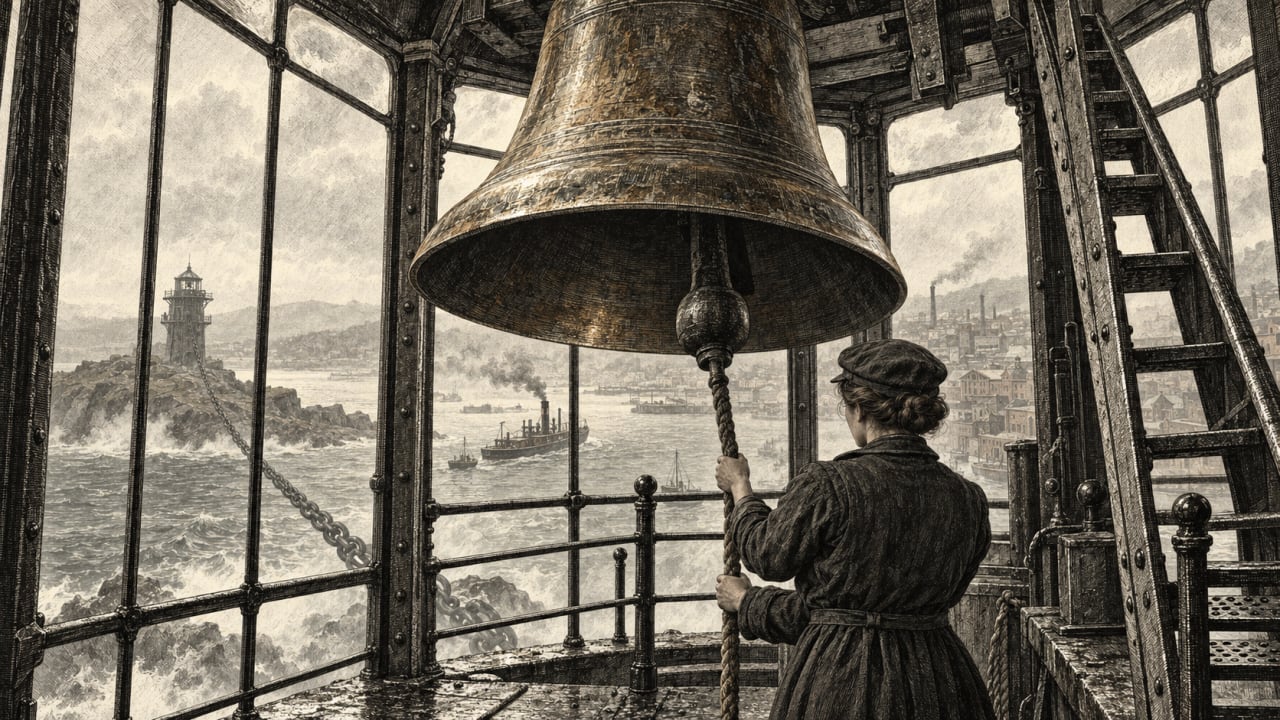
The event account dates the casting of the Elder bell to A.S. 72, the same year the harbour charter was ratified and the chain-consecration works were done. Those three facts share a year and nothing else. The same account says the Younger bell was cast nine years later. That gives A.S. 81 by subtraction. No independent casting record for that year has reached this office, so the figure stands on the account's interval alone. It dates the bronze and nothing more. It says nothing about when the stone around the bronze was laid. The harbour charter was backdated to A.S. 66 for precedent and re-ratified in A.S. 93 after the business with the invisible ink. Those dates mark legal paper, not masonry. The Younger's construction year is unknown, and this plate leaves it unknown.
The source of the metal is disputed. The Bureau of Records lists it as contributed. The Chainwrights say it was stolen. I have no authority to decide between them and no wish to try. Both accounts belong in the file, and no third should be added.
The original Younger note was high, sharp and coastal. It was a clean blade laid across the water, and it carried farther over the waves than the Elder's ground-deep tone. It told inbound ships that the harbour was alive, manned and counting. Liss's dossier records a narrower function as well: the eastern waterline's small craft took their bearings through fog by that note. When the Younger failed, those boats lost their landmark. A deep note announces authority. A high note gives a heading, and the eastern harbour steered by it.
The Younger rang that note from A.S. 81, by the derived date, until dusk on 14 Ashmonth, A.S. 198. Since the fourth dawn after that evening it has rung the Elder's low harbour note from the same bronze, the same clapper and the same rope. Historical pitch and present pitch must be kept separate in every docket, and since the Silence Records has printed tonal-reassignment forms so that captains can sign, unread, which bell gave which note at which hour. The forms are the only part of the matter that Records has handled competently, and it handled them by accident.
#On the Warden at Her Rope
Katerin Liss holds the Younger's rope as Bell-Warden Second Class in the Bureau of Bells. Her personnel file recorded eleven years of tower service by A.S. 198 and about six thousand rope-pulls before the Silence. Those figures describe her work. They do not give her age, her birth year or the day of her appointment, and I will not derive any of the three from them.
Her daily procedure is the procedure of the office, done exactly. She checks the rope for wear, wet and set. She checks the schedule slate against the hour. She receives the signal. She strikes under witness, holds the pull through the proper decay interval, and logs the result in her own hand. Storm days change the force required. Fog changes how the note returns up the stair. The sequence itself does not change. Competence is mostly repetition carried out well, and the Younger has had that from her for a long time.
Across the water, Bell-Warden First Class Andros Pell keeps the Elder. His warrant carries permissions hers does not, and the difference is set out in the Bells' schedule of grades. Their documented relationship is professional: two wardens keeping separate halves of one sequence, each confirming the other across the harbour. Anything beyond that is unrecorded, and in my view the clerks have earned no right to speculate about it.
This survey's first fair copy listed crown-chamber authority on the eastern spit as "under Bell-Warden Pell (First Class), with assistant at the Younger rope."
Corrected. Liss is the strike authority in the Younger crown-chamber and a principal witness to the Silence. She is no one's assistant. The Bureau already rescinded an A.S. 199 notice making the same error, so its reappearance in a Doctrine draft is a particular embarrassment to this office, and I have reprimanded the copyist, who was me.
She has refused transfer twice. The second refusal included the sentence: "A bell should not be left with strangers after illness." Records tried to classify the remark as personification. Bells intervened. I cite the sentence because it describes a station duty in the plainest terms available. A warden who knows how the Younger behaved before A.S. 198 and how it has behaved since is the only reliable instrument the chamber has, and the Bureau cannot requisition another.
As of A.S. 201 Liss remains Second Class and is serving under acoustic review. The Bureau of Bells gives grade stability, budget tiers and ongoing tonal review as its reasons for not promoting her. Promotion would take her off the rope. The Bureau has not said this, but the rope has evidently been reckoned the more valuable asset.
#On the Silence at the Eastern Rope
At dusk on 14 Ashmonth, A.S. 198, Liss checked her rope and slate, received the signal and pulled. The clapper struck bronze. The bronze took the blow and gave no sound. The chamber instruments registered the impact and no tone. The Bureau of Engineering later calculated that a strike of that force should have carried three nautical miles in ordinary conditions. Across the water Pell had struck the Elder into the same silence.
Liss pulled again under witness, with the same result. Her statement, retained under restricted circulation, is that the bell was not empty. She said it was full of something with no intention of moving. That is testimony, and it is the testimony of a woman with eleven years at that rope and no reputation for ornament. It is not proof that any named thing occupied the bronze, and this plate does not treat it as proof. It is a precise report of what a trained hand felt, and I have not seen anything better from that evening.
Her slate entries from the second night read: DUSK STRIKE: NIL. ROPE: TRUE. CLAPPER: TRUE. BELL: TRUE. AIR: FALSE. A reviewing clerk struck out the last entry and wrote NON-RESPONSIVE MEDIUM in its place. Doctrine preserved the original slate under Seal Amber. That clerk had in front of him the most exact record any office produced during the three nights, and his response was to make it vaguer.
The eastern waterline lost its fog note. The harbour as a whole lost its authorization signal, because chain-gate protocol requires the dusk peal. Kosta ordered the gates held open before permission arrived and put his men on the windlasses, runners on the galleries and witnesses at the gate marks. Holding the gates open did not keep traffic moving. No captain would pass under chains no bell had sounded, and docking queues froze in the roads. An open gate and a stopped harbour are compatible conditions. Thessaloniki demonstrated it for three nights.
Below the water Sera put her bare palms to the submerged links and found them vibrating in the correct bell sequence, on schedule, while the surface instruments registered nothing. Her report is sworn and has since been confirmed by the Bureau. It shows that something kept the count. It does not show what. The sailors have their explanation, which involves the Drowned Choir and is told in low voices after the second drink. I record that this is what sailors say. Doctrine does not endorse it. I have not decided whether I do.
The narrative account of the event puts the return of ringing on the morning of 17 Ashmonth and calls it the fourth dawn. Liss pulled, and the Younger rang the Elder's low harbour note. She held the pull through the full decay interval, logged the tone as Elder-present, asked for immediate cross-tower confirmation, and had the crown-chamber sealed until a Bells examiner arrived. Across the water the Elder rang the Younger's old high note. Examiners found the metal, clapper, rope and chamber within tolerance and found no material explanation for the exchanged pitches. That rules out what the examiners tested for. It does not rule out every possible cause.
Determination 198-K/7 classified the matter as "a test of fidelity administered by mechanisms beyond current doctrinal scope." I helped draft that sentence. It names no examiner and no mechanism, and it was written so that no later finding could contradict it. Bells has reported repeated recalibration attempts since then. None has restored the original voices.
#On the City That Kept Time by Throat
The bells serve one congregation that no budget lists. The Refugee Sheds stand against the city wall beneath Bellhouse Heights. Bellhouse Heights houses the bell administration and the choirs, not the great bells, which hang in the towers. The Sheds hold a communal hum through the night, low and rough and shared, as a defence against the sleep-singing that draws sleepers toward the water. The habit took firm hold after the Crying Choir of A.S. 145, when refugee children sleeping beneath tower stone sang through a night and lost their tongues by morning. The Sheds keep the hum in time with the bells. When the bells went silent, the hum had nothing to keep time by.
Aunt Velka, who holds no office and draws no stipend, set the time herself with three pot lids and a spoon. She split the night into throat-shifts: old women first, dock-lunged men second, and the frightened children placed between the singers to count breaths. The shifts held through the first night and frayed on the second. Three children were found standing in the shallows at the third dawn, and the paired survey records that all three lived. No Bureau directed this. The harbour summaries praised it later in language broad enough to take the credit without the liability.
Every year since A.S. 199, on 14 Ashmonth, the city keeps the Night of Quiet Bells. After the dusk peal, sounded in the exchanged voices, Thessaloniki stops talking. Taverns pour without argument. The Pitch Markets hood their fires. No decree created the observance, and the Bureau of Festivals files it as coincidence. The Sheds alone keep humming that night, because the danger they hum against keeps no anniversary.
The city therefore has two acts of memory, and they should not be confused. The wall at the Younger's base is carved and still, and nobody in office reads it. The Shed hum is breath, renewed each night by people who would not survive without it. Neither one began the other. The second has borrowed nothing from the first except a conviction both share: the harbour's own record of who passed through is incomplete.
Since A.S. 199 the paired survey and the Chainwrights' tract have reported a second line under the Shed drone, sung by children who were never taught it. Sera says the chain-hum recognizes it. Kosta listens and says nothing, which is his usual form of testimony. I record both reports as attributed and add nothing to them.
#On the Present Condition
As of A.S. 201 the Younger Tower is an active installation. The secondary chain is tensioned, inspected and greased. Windows are sold and passages stamped. Liss holds the rope, still Second Class and still under acoustic review. The original Younger bronze rings the Elder's low note from the eastern spit, and the Elder answers in the Younger's old high voice. The plaque says reassigned and does not say by whom. The wall at the base is still unread by any clerk in the city, and no office has asked for that to change.
Strasbourg's external audit is pending. It will come by sea and pass under the chains like any other cargo, with its clerks singing the Passage Psalm themselves. It will ask whether the exchanged tones are doctrinally supervised. It will inspect the wet stone, find the damp regrettable, and recommend drier weather.
A harbour circular of A.S. 199, reproduced in an early draft of this plate, stated that the Younger Tower "returned to its customary voice at the fourth dawn."
Corrected. Ringing returned at the fourth dawn. The Younger's customary voice did not return then and has not returned since. The circular confused service with restoration, and Records was quick to adopt the confusion.
The disposition of the eastern station follows the paired survey's instruction, which I see no grounds to improve. Ring as found, file as found, and do not try to correct the bells. The secondary chain is to be maintained by the hands that know it. The wall is to be left as carved.