
#On the Western Throat
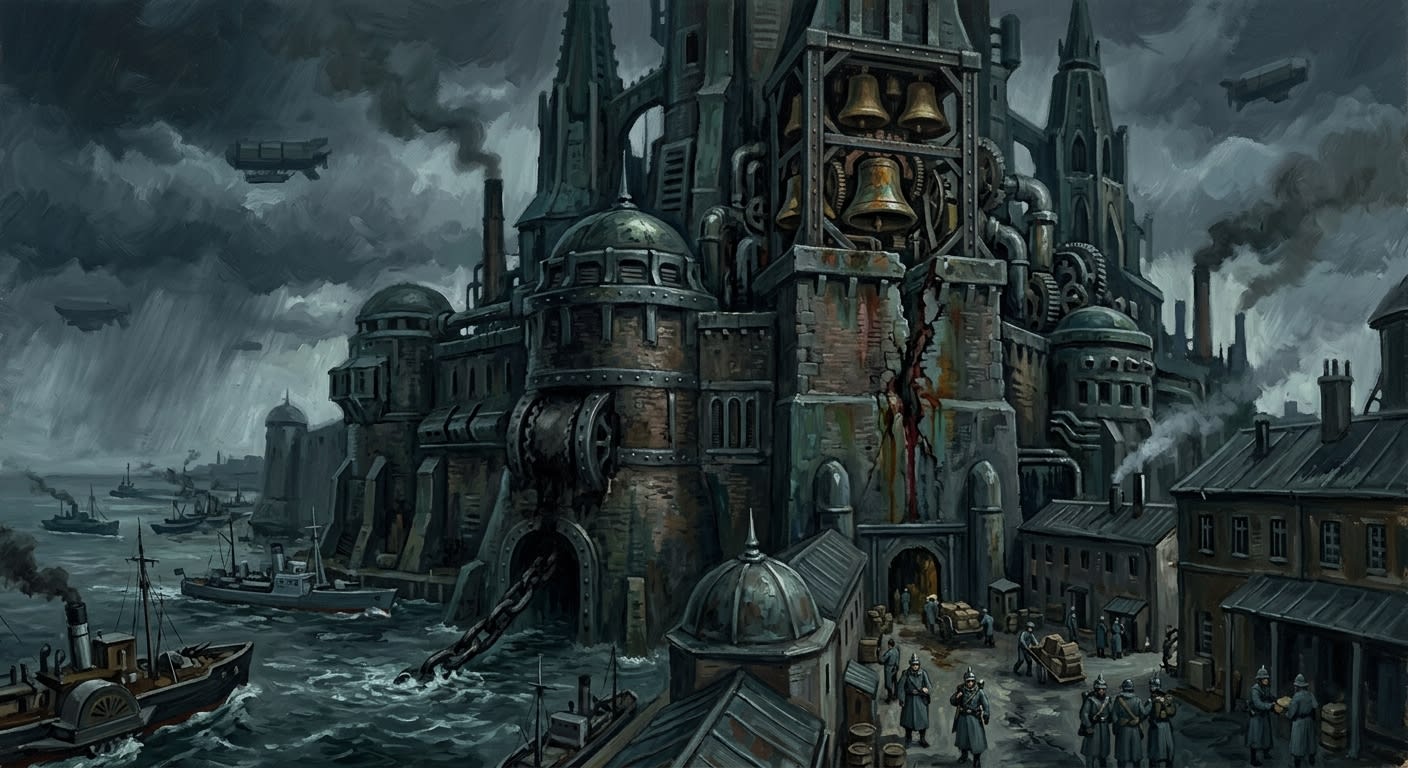
The Elder Tower stands on the western headland of Thessaloniki, salt-bronze above, reliquary iron below, gull filth everywhere, and a stair designed by men who believed salvation should hurt the knees. It anchors the primary harbour chain, houses the larger bell of the Harbor-Chain Towers, and supplies the deep tone by which the Aegean lock has opened, closed, warned, mourned, lied, and lately spoken in the wrong voice.
It is called Elder because it came first, because its bell was cast before the Younger, because its western chain-head bears the older load, and because human beings adore pretending that age and authority are the same sacrament. In this case, by accident, they nearly are. The tower’s stone sinks into the headland like a tooth into a jaw. Its lower courses are blackened by brine and smoke. Its upper gallery is bronze-stained. Its crown-chamber smells of rope grease, old wax, damp linen, and the particular fear produced when a city trusts one room to tell it what hour the sea is allowed to become legal.
The tower’s function is deceptively plain. At dawn, the Elder’s low note sounded before the Younger’s high note and the harbour opened. At dusk, the sequence reversed and the harbour sealed. Storm peal, chain-window, quarantine release, naval alarm, mortuary correction — every lawful rhythm of the port depended upon the bell’s obedience. A ship without the Elder’s permission remained cargo with ambition. A convoy without the Elder’s tone was a rumour wearing sails. A corpse arriving before the proper peal was a jurisdictional insult in wet clothes.
The Bureau prefers to describe the Elder Tower as infrastructure. The Chainwrights call it a throat. The sailors call it the old mouth. Andros Pell calls it his station and thereby says more than all three.
#On Stone, Chain, and Rope
The Elder Tower’s foundation descends into a web of chain vaults, choir cellars, tide chambers, rope-law sheds, and damp little maintenance hollows where sensible rats go to acquire theology. The visible tower is only the public portion. The true structure continues into iron: the great links passing from windlass to water, from water to submerged pylons, from pylon to the harbour floor where the Drowned Choir conducts its private litigation with every vessel that thinks passage is a matter of paperwork.
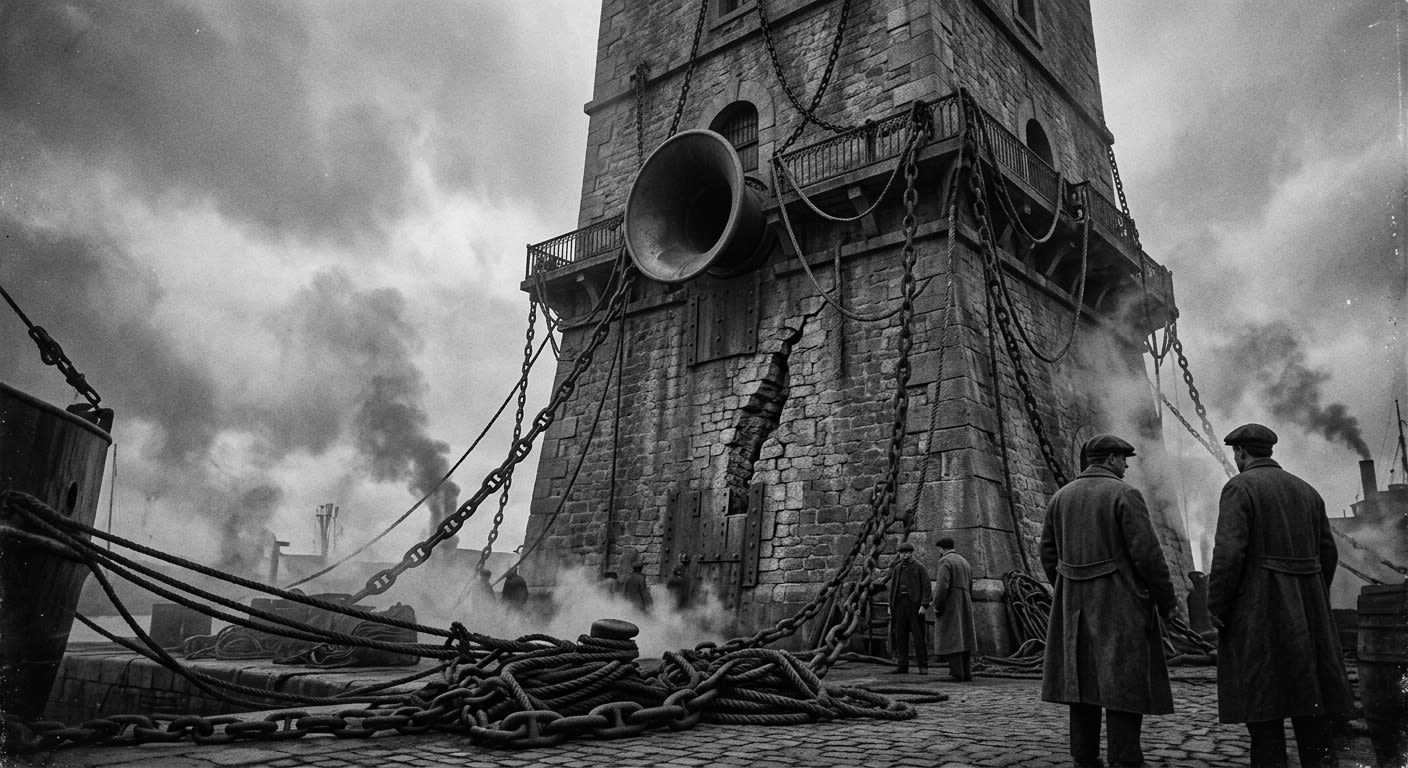
The stonework belongs to the old harbour expansion, hardened through the chain-consecration works of A.S. 72 and re-ratified in A.S. 93 when Thessaloniki stopped pretending the towers were temporary wartime apparatus and admitted they had become the city’s spine. Salt-limestone forms the lower shell. Bone-lime mortar binds the inner buttresses. Reliquary brass fittings mark the old inspection niches, most of them tarnished green-black despite annual polishing by boys who enter the service cheerful and leave it with the religious expression of men who have scrubbed gull-droppings from holiness.
Inside, the stair coils upward around a hollow shaft where bell ropes descend, inspection lines hang, and the tower exhales cold air even in summer. The walls bear the marks of rope burns, tool strikes, storm repairs, and a century of anxious hands. On landward levels, Chainwrights keep spare pins, collar plates, hawser coils, wedge hammers, oil rags, emergency lamps, and those little slate boards upon which practical men write truths that committees later improve into falsehood. The crown-chamber sits above this labour like a bureaucrat above a mine: dependent on everything below and inclined to forget it.
The bell itself is large enough to make a visiting clerk feel brief. Before A.S. 198, its registered tone entered through the boots before the ear, a low harbour sound that told chain, tide, ledger, ship, and stomach that order had acquired weight. Its clapper was balanced to a tolerance the Bureau of Bells considered exemplary. Its bronze had been tested against reference pitch, rite, metallurgy, and superstition. Its rope had worn itself into Pell’s hands.
An A.S. 187 maintenance guide described the Elder Tower as “a bell housing with attached chain control functions.”
Amended after review. The phrase reverses the truth. The Elder Tower is a chain-head, gate witness, harbour throat, acoustic court, and bell chamber. The bell is the loudest part, which explains why clerks mistook it for the whole.
#On the Warden and the Ordinary Miracle
The Elder Tower is not alive, though tower men speak of it that way because long service makes metaphysics economical. It accepts certain hands and punishes others. It dislikes hurried feet in rain. It answers storms through the rope before clouds arrive. It carries chain-hum upward on fog mornings, enough for a trained bell-warden to tell whether the submerged links are clean, fouled, tense, or sulking in the manner of old iron asked to perform without proper oil.
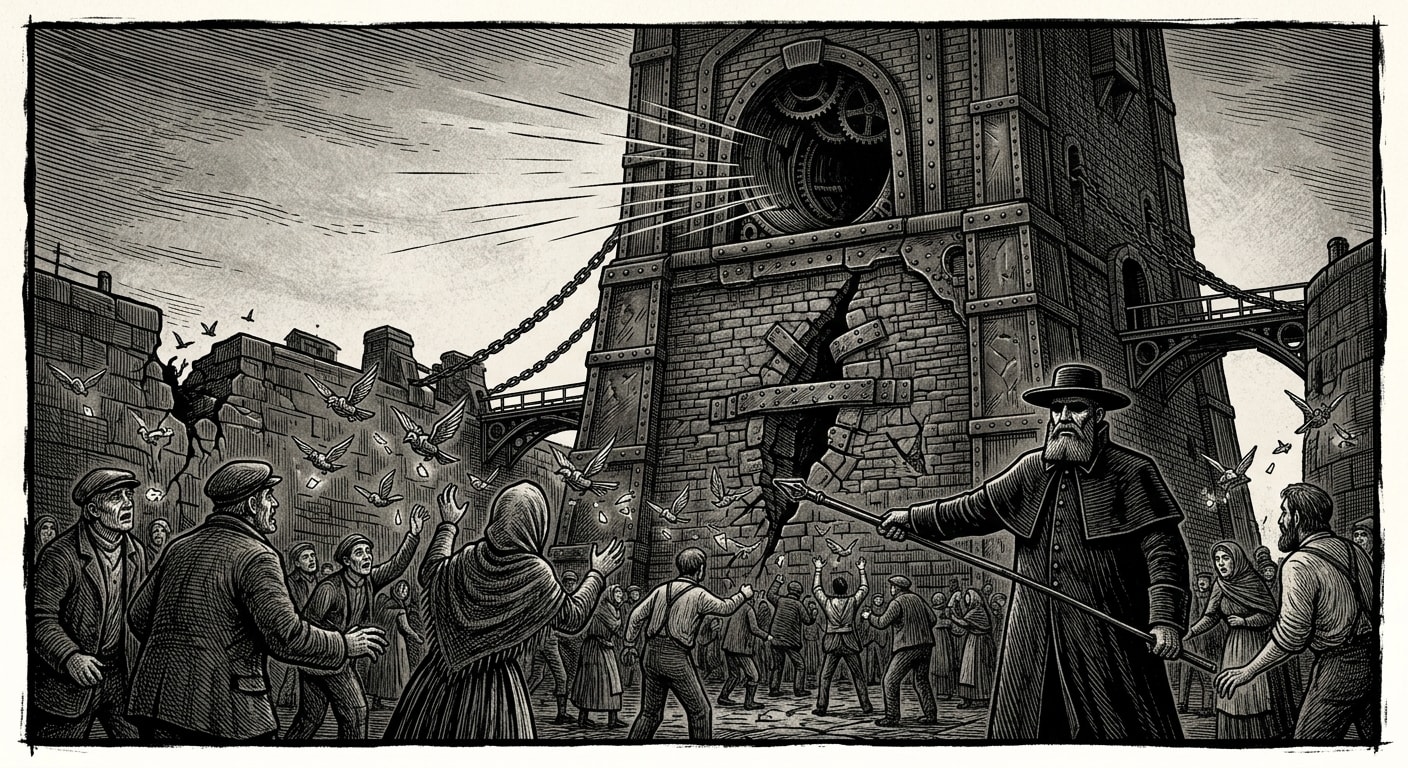
Bell-Warden First Class Andros Pell understood the tower before the city learned his name. He was forty-nine during the Silence, widowed, severe in handwriting, damaged in the right shoulder, regular in attendance, steady in the professional sense that makes heroism unnecessary until some fool in Heaven or under water decides to test it. He climbed the stair daily. He knew the crown-chamber lamp, counterweight tension, rope return, draft pattern, clapper kiss, and the small difference between the tower settling and the harbour listening.
The ordinary miracle of the Elder Tower was repetition. Dawn: lower tone, harbour opens. Dusk: in sequence, harbour seals. The Chainward Quays moved. The Harbor Ledger Office stamped. Pilot-King Nenos cursed. Chainmaster Kosta watched the links. Sera inspected what no dry office deserved to understand. The Custodians of the Chain held the windlasses and made doctrine survivable by greasing it.
Repetition is despised by poets because they mistake novelty for significance. Administrators know better. The world survives through repeated acts correctly performed by people too tired to be picturesque. The Elder Tower’s holiness was never grandeur. It was reliability rendered in bronze, rope, iron, hand, stair, slate, and ache.
#On the Silence of A.S. 198
On 14 Ashmonth, A.S. 198, at dusk, Pell climbed the Elder stair, checked the rope, checked the schedule slate, received the signal, and pulled.
The clapper struck.
The bell gave nothing.
This must be stated without ornament because ornament would be indecent. No cracked note. No dull misfire. No muffled tone. The bronze accepted force and refused sound. Pell felt the strike through hand, arm, jaw, boot, and stone. Instruments registered impact. The air received no tone. Below, the chain did not receive its surface witness. Across the harbour, in the Younger Tower, Katerin Liss struck the high bell into the same occupied absence.
ELDER TOWER INCIDENT SLATE — PRIVATE COPY, A.S. 198 Dusk strike: force registered. Sound: none. Rope return: altered warmth after fourth attempt. Warden note: “Absence moved downward.” Addendum excised by Rites: █████████████████████████████████
The Elder Tower became the most important silent room in Europe. Six peals failed across seventy-two hours: dusk, dawn, dusk, dawn, dusk, dawn. Chain-gate protocol lost its throat. Ships would not pass under unchristened links. Docking queues froze. The Pitch Markets traded low warnings. The Refugee Sheds began losing their protective hum against the Choir. Quarantine admitted patients who heard correct bells from beneath the harbour floor. Sera touched the submerged links and felt the schedule continue below water where the tower instruments detected nothing.
The Bureau of Engineering found no mechanical fault. Bells found no tuning cause. Rites found too much and said too little. Doctrine, with the poise for which I am rightly famous, drafted Determination 198-K/7 and called the event a test of fidelity administered by mechanisms beyond current doctrinal scope. This was accurate in the magnificent sense that it prevented worse accuracy from entering the minutes.
#On the Wrong Voice
On the fourth dawn, the Elder Tower spoke again. It spoke in the Younger’s voice.
The old lower tone did not return. The high coastal note came from the western bell, clean, exact, registered against the Younger’s pitch within a margin that made Bells examiners go pale in that lovely way men do when their instruments begin testifying for the Enemy. The metal had not changed. The clapper had not changed. The rope, stair, chamber, air, and tower geometry remained within approved tolerance. The sound had moved.
Across the harbour, Liss struck the Younger and heard the Elder’s deep note emerge from the eastern bronze. The city exhaled and then learned it had exhaled too early. Operation resumed under exchanged tones. The harbour opened and closed. Chain-windows returned. The Ledger stamped. Ships passed. The system functioned. Only the voice was wrong, and a system can tolerate wrongness once a plaque has been installed.
The crown-chamber plaque reads: “Tone: Younger (Reassigned, A.S. 198).”
Clarification. Reassigned by whom remains unstated. Reassigned under what authority remains unstated. Reassigned for what purpose remains unstated. The plaque is metal cowardice, neatly engraved.
The Elder Tower now performs a daily contradiction in public. Its body is western, older, lower by right, bearing the primary chain-head and the hidden ledger beneath Kosta’s floorboards. Its voice is eastern. The Bureau calls this revised acoustic parameter. The Chainwrights call the bell wrong. Sailors call it bad luck until the passage succeeds, then call it tradition with the speed common to practical cowards. Pell pulls the rope and waits through the decay interval as procedure requires. Witnesses report a pause afterward, short enough to evade discipline, long enough to ask whether anything below has answered.
#On the Hidden Ledger and the Night After
The Elder Tower contains a second authority no public diagram admits. Beneath a false floor in the crown-chamber, Kosta keeps the sea-taken ledger (Unregistered): drownings, near drownings, bodies recovered, bodies absent, names refused by captains, names given by families, and the old harbour practice of admitting that water may claim a person before Records has decided whether the person was administratively convenient.
On the night of the Silence, fourteen names appeared in that ledger in a hand Kosta did not recognise. Fourteen living persons. All fourteen drowned within the year. Records would like the book seized. Records would also like not to explain how an unlawful ledger predicted lawful deaths more accurately than its own blessed paperwork. This tension has produced admirable restraint.
The Night of Quiet Bells gathers around the Elder Tower because the city understands location better than policy. Each 14 Ashmonth since A.S. 199, after the dusk peal sounds in the wrong voices, Thessaloniki falls silent. Kosta sits in the crown-chamber beside the bell and listens. Pell believes he listens for the old note. Liss believes he listens for the chain-hum beneath the new one. Sera says he listens for names before they become ink. The Bureau of Festivals calls the observance coincidence, which is the official term for a rite that escaped before licensing.
The Elder Tower does not explain the Night. It hosts the wound. Its stair is oiled. Its crown-chamber lamp is hooded. Its plaque shines with official evasion. Its bell rings high over a city holding its tongue. Under the water, the chains keep their own counsel.
#On the Present Condition
As of A.S. 201, the Elder Tower remains operational, watched, mistrusted, necessary, and expensive to misunderstand. Bells reviews the tone quarterly. Engineering tests the structure and pretends structure is the problem. Rites monitors the Choir without naming the relationship too clearly. Records copies Pell’s slate entries, extracts Kosta’s public chain notes, and fails to acquire the ledger that matters. Doctrine receives summaries and turns them, with proper incense, into tolerable sentences.
The tower’s physical condition is stable: salt damage ongoing, gull contamination sacramental by endurance, rope wear acceptable, crown-chamber access restricted, lower chain vaults damp beyond polite description. Its theological condition is less tidy. A bell once defined by depth now speaks height. A tower built to command the sea now waits to hear whether the sea has answered. A city once governed by bell-time has learned that time may continue beneath the water when bronze refuses its office.
Pell remains at the rope. Kosta remains beside the ledger. Sera remains under the links. Liss answers from the east in the Elder’s old voice. The Elder Tower stands where it has stood: western headland, old mouth, wrong note, true hour.