
#On the Week the Food Learned Procedure
“The stores were lost on the fourth day. The forms were rescued on the eleventh.” — Port Court teaching gloss, anonymous and correct in the only way that matters.
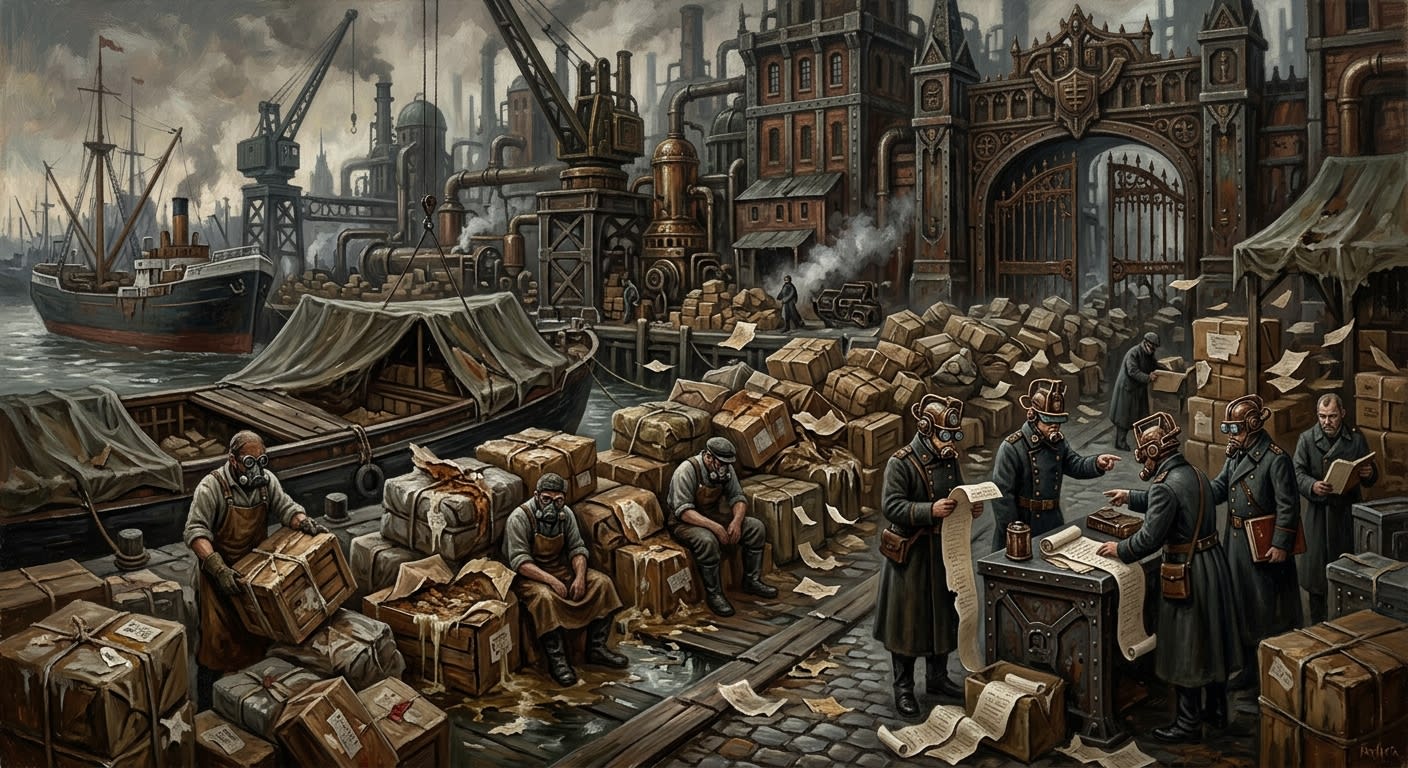
The Rot-Week of Saint Vellum is the founding paralysis of the Manifest Litigant profession: eleven days in an unnamed western dock district, traditionally assigned to Marseille and denied by Marseille with the fragrant panic of a whore discovering an auditor in the vestibule. One contested manifest became two objections, two objections became a Sanctity Stay, the Stay acquired counter-claims, the counter-claims required precedent access, and the warehouse contents obeyed a lower law than doctrine. They rotted.
The Bureau likes to call this a tragedy of unlicensed delay. It was, with better grammar, a famine rehearsal.
The date is conventionally placed before the A.S. 112 licensing codification, because by A.S. 112 the “Vellum tithe” appears in three port-court fee schedules and Saint Vellum's narrow distinction is already treated as professional inheritance. The event belongs to that lean post-Concordat generation when the Synod had discovered that paper could govern hunger faster than carts could feed it, and every port from Marseille to Hamburg was learning that the demon enters by the misnamed door.
#On the First Hold
The cargo was winter food: grain, salted beans, barrelled fruit, rendered fat, three crates of chapel flour, and a consignment of fish packed in salt that had already crossed two seas and one customs sermon. Its papers named the origin district with an uncertain vowel. The receiving clerk marked the vowel in black. A rival factor, whose own shipment waited in the outer quay and whose charity had been preserved by never being tested, observed the mark and filed a sanctity objection before Matins.
The objection should have taken an hour. The seal impression was shallow at the lower right edge, the origin mark showed weathering, and the clerk who wrote the manifest had used a regional contraction permitted in one tariff annex and condemned in another. A competent Port Advocate could have argued release under conditional correction. A cheaper advocate argued impurity. The difference between competence and price has killed more people than Maldrake, though Maldrake makes a better engraving.
By midday, the first Sanctity Stay Order was pinned to the warehouse door with brine-wax. By Vespers, a second Litigant filed a counter-objection claiming that release under the first petition would prejudice his client's claim to priority storage. By midnight, the warehouse keeper, discovering profit in stillness, submitted a condition report stating that the goods remained “stable under seal.” Stable is a magnificent word. It can mean preserved. It can mean unable to move. It can mean a horse-stall full of excrement. The Bureau chose the first two meanings and invoiced the third.
#On Days Two Through Seven
Day Two brought the merchant's counter-claim: the disputed vowel was a recognized field abbreviation under emergency supply usage. Day Three brought the Doctrine memorandum: emergency usage did not apply because the cargo had entered a civil port rather than a forward ration gate. Day Four brought smell.
Smell is not evidence until a clerk learns to price it. The warehouse registrar filed Form 14-M, “Emanation Under Dispute,” and the cargo remained sealed while the court determined whether the emanation proceeded from natural spoilage, demonic interference, improper packing, or false identity expressing itself through matter. The Bureau of Purity sent an observer. The observer sniffed once, wrote “warm,” and recommended no action until jurisdiction clarified. Purity excels at this: one nostril, no courage, perfect ink.
WAREHOUSE CONDITION LOG — DAY FIVE Door temperature elevated. Crate seams wet. Voices heard behind west stack by two dock hands; likely trapped rats, likely liquid shift, likely hunger in the listener. One child reached beneath the lower slat and withdrew fingers coated in sweet black paste. Child removed by wardens. Paste sample consumed by flies before sealing. Names of dock hands: █████████ and ████████. Child's later file: sealed under Mercy petition, denied.
Day Six belonged to witnesses. The original scribe could not be found. The porter who received the cargo remembered the seal as clean, then remembered it as cracked, then remembered that the questioner paid by the hour. The warehouse keeper produced three condition logs, all in his hand, each dated correctly, each describing different air. The rival factor's clerk testified that he had seen a red correction mark on the manifest; red ink “bleeds the cargo,” as any dock fool knows after sufficient tavern instruction. The court ordered the manifest inspected under chapel glass.
Day Seven brought archive delay. The precedent needed to settle the contraction lay in a tariff appendix stored in a chamber whose custody key had been removed for inspection. The inspector was attending a cousin's funeral. The cousin had not died. This was entered as “anticipated bereavement,” a category I admire for its efficiency and despise for its cowardice.
#On the Fire
The food failed before the case did. Barrels swelled. Grain heated. Fruit split and lacquered the floor with syrup that blackened where it touched the iron runners. The chapel flour acquired a grey skin and, according to one excised witness note, lifted under its own breath. Rats left the building in order. Dockworkers noticed this and crossed themselves. The court did not, having better chairs.
Saint Vellum enters here, or is inserted here, which is often the same thing after Records has finished sharpening the margins. He was then a clerk, a junior advocate, a lay confessor of cargo identity, or a man who happened to possess a quill and the correct instinct for catastrophe. He drew a line on the warehouse floor: goods under proved name to one side, goods under doubt to the other. The clean cargo was removed under bell. The doubtful cargo remained.
At dawn on the eleventh day, with the final ruling entered and all holds vacated by condemnation, Vellum ordered the rot burned.
The warehouse doors were sealed from outside. Officially, no persons remained within. Unofficially, the redacted witness annex in Saint Vellum's dossier records voices after ignition and manifest numbers recited from behind the west stack. Doctrine explains this as vapour. Commerce explains it as settlement noise. Mercy, in a rare lapse into usefulness, explains nothing and keeps a list.
The warehouse burned cleanly because the Bureau needed it to have burned cleanly. Smoke rose white for one hour, black for three, then green at the roofline. The green smoke is absent from teaching plates. So are the dockworkers who broke the outer cordon with hooks when someone inside beat the door. So is the merchant who knelt in the gutter and tried to eat ash. Iconography is not memory. Iconography has better supervision.
#On the Licensing That Followed
Licensing followed with the speed of a Bureau smelling revenue through incense. Unlicensed cargo-name disputes had proved too dangerous, too slow, too cheap, and too difficult to tax. A licensed Litigant corps, regulated and theoretically accountable, would bring method to the delay and fees to the method. The Rot-Week had starved a district; its lesson was that starvation required better administrators.
This is how civilisation advances under the Synod: first the accident, then the office, then the saint, then the surcharge.
The Port Court Division adopted time caps, witness forms, condition logs, archive priority requests, and the first rough hierarchy of Dock Litigant, Port Advocate, and Precedent Counsel. The caps were elastic. The forms multiplied. The priority requests acquired bribe etiquette within six months. The hierarchy endured. By A.S. 112, the Vellum tithe in three fee schedules made the saint profitable enough to be real.
Earlier Commerce primers state that licensing “prevented any recurrence of Rot-Week conditions.”
Corrected. Licensing prevented unbilled recurrence. Rot conditions continue under several names: Sanctified Spoilage, Conditional Condemnation, Storage Attrition, Emergency Fasting by Supply. The distinction is administrative, which makes it sacred.
The event also hardened the factions that would later define Manifest Litigation. Purists took Vellum's fire as proof that doubt must burn before hunger eats doctrine. Pragmatists took the district's partial starvation as proof that conditional release is preferable to a beautiful ash ledger. Shadow Counsel took note that a held warehouse produces profit for everyone positioned near the lock.
#On the Present Use of the Rot-Week
Every Manifest Litigant studies Rot-Week before receiving a seal satchel. The Purist lecturer dwells on the wrong vowel. The Pragmatist lecturer dwells on the smell. The Commerce lecturer dwells on the licensing reforms and skips the child with black paste on her fingers. Students remember the child anyway, if they possess imagination; if they do not, they are promoted faster.
At tariff-chapels, the Rot-Week is invoked whenever a merchant demands haste. “Haste burned Vellum's warehouse,” the clerk says, though the warehouse burned after eleven days of procedure and the sentence is a lie of such purity that Doctrine has considered adopting it. The merchant pays. The cargo waits. The court proceeds in the shadow of a fire whose lesson changes according to who holds the candle.
No one agrees where the dock district stood. Marseille denies. Genoa smirks. Hamburg laughs too loudly. Records maintains three location files and a fourth absence where the true file should be. The warehouse is gone, naturally. The fee survives.