
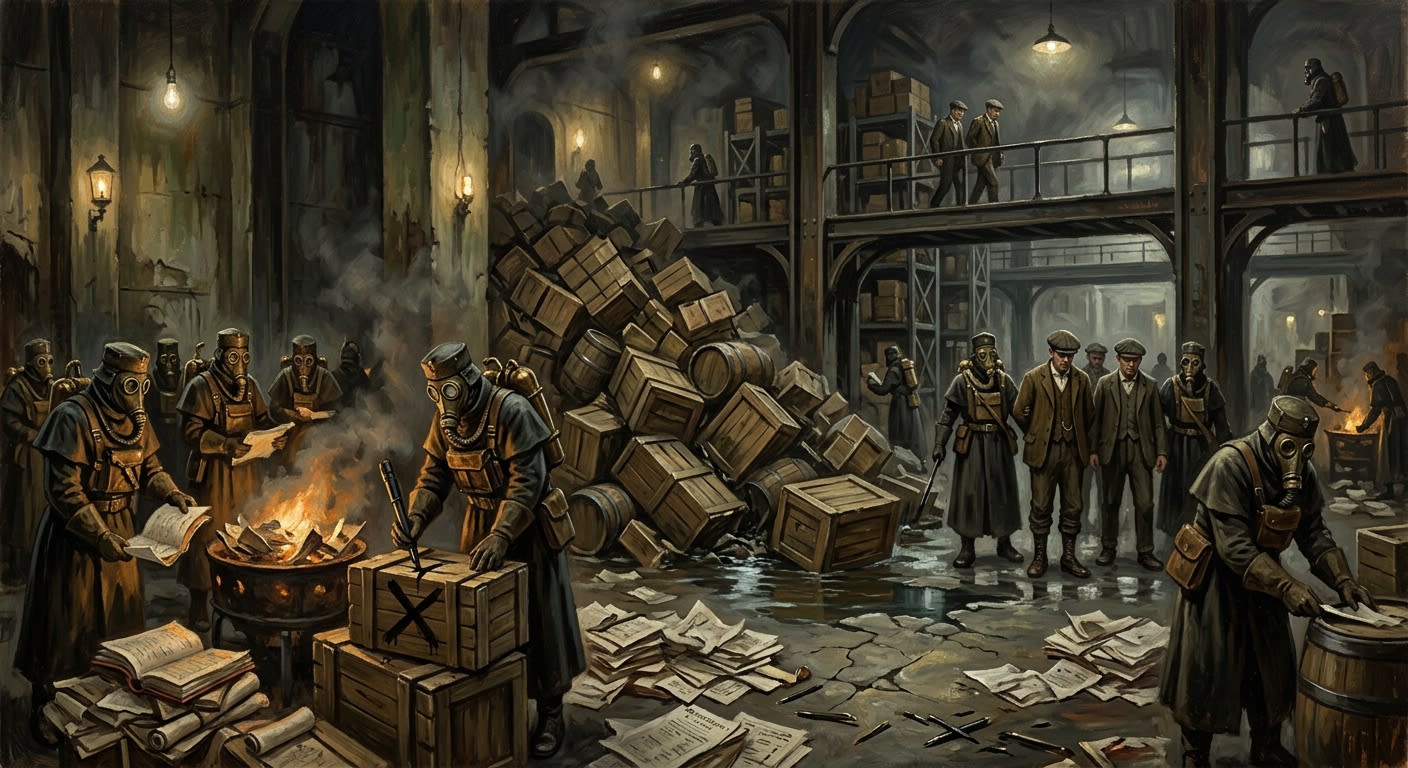
#On the Year Letters Were Tried
“A crooked letter is a corridor. A corridor, left open, belongs to the Enemy.” — Third Revised Catechism for Port Court Use (Unregistered), marginal approval disputed.
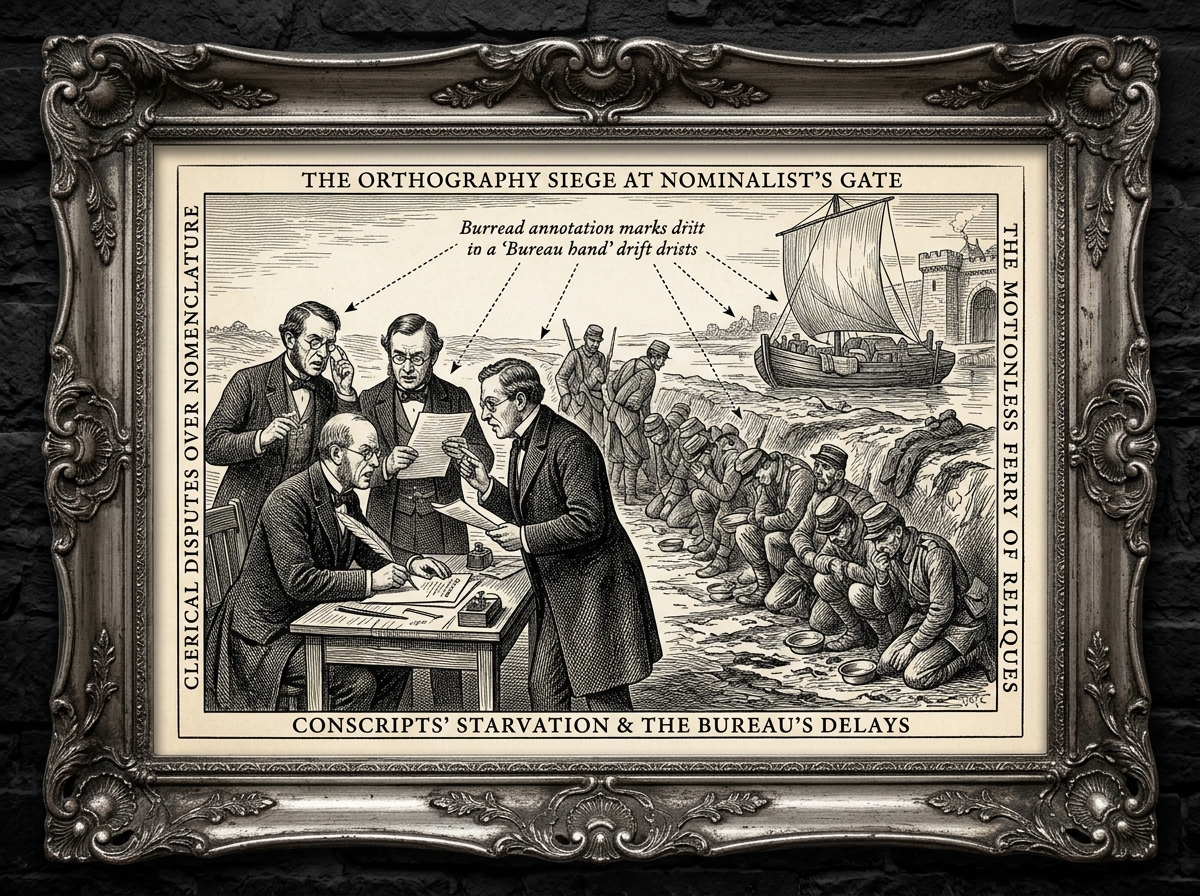
The Orthography Purge of A.S. 112 began as a doctrinal quarrel over letter-forms and became, with the obedient stupidity of a loaded stamp-press, a commercial amputation across the Rhineland and Moselle tariff districts. Four hundred and eleven cases were reopened. Eleven licensed Manifest Litigants lost practice rights. Thousands of manifests were erased, amended, refiled, or sealed into silence. The Bureau of Commerce spent three years repairing holes in its own tariff record with such delicate fraud that auditors from the Bureau of Records mistook it for devotion.
A generation that had survived the Rot-Week of Saint Vellum learned a colder lesson: cargo can rot from delay, but an invoice can be killed by typography. Saint Vellum acquired sharper teeth.
The Purge took place in A.S. 112, the same year Saint Vellum's fee-trace appears in three port courts and the same season in which the Quiet Purges of the Rhineland (Unregistered) were already teaching local scribes to lower their voices before touching ink. It belonged to the early Synodal hunger for harmonisation: one Creed, one seal, one schedule of approved vowels, one Europe folded into the Sacred Ledger until every province resembled Strasbourg's idea of a filing cabinet.
#On the Zealots of the Correct Stroke
The initiating sect called itself the Fellowship of the Correct Stroke. Their surviving pamphlets are tedious, which is the common proof of zeal: men who cannot write beautifully become obsessed with how others shape letters. They argued that several pre-Concordat mercantile scripts preserved Rationalist glyph habits, and that these habits, imported into cargo manifests, permitted heresy to pass beneath legal name.
The disputed forms were small. A hooked r used in Rhine invoices. A long-tailed s common in Moselle salt accounts. A broken ligature between c and t in older Rationalist print houses. The Fellowship claimed each carried apostate geometry. A sane court would have fined them for wasting wax. A Synodal court saw in their petition the intoxicating possibility of jurisdiction.
The first challenge was filed against a shipment of hymnsteel rivets bound from Essen-of-Hymnsteel to a forward bridge yard. The manifest used the old hooked r in the word Rheinscarp. A Purist Litigant argued that the hook bent eastward “in imitation of academy script.” The cargo was held for four days, released under letter penance, and then challenged again when a Doctrine clerk noticed the correction had been made in a hand whose e resembled the Amsterdam instructional plates seized during the old Age of Reason.
Three more petitions followed within a month. Then fourteen. Then the avalanche, except I am forbidden by my own taste from comparing paperwork to weather. Say instead that the in-tray became pregnant and gave birth to knives. The Thirty-Seal Index (Unregistered) began taking marginal notes in a hand nobody admitted.
#On the Four Hundred and Eleven Cases
The Bureau of Doctrine issued a circular requiring review of all manifests containing suspect Rhine-Moselle letter-forms entered within the previous nine fiscal years. Commerce received the circular with public gratitude and private screaming. Records supplied comparison plates. Purity supplied observers whose principal contribution was to stand near desks and make breathing feel indictable.
The reopened cases fell into categories. Released cargo whose papers now appeared impure. Condemned cargo whose condemnation might have rested on contaminated lettering. Tithe claims calculated from names now marked suspect. Seal autopsies performed against transcripts whose witness lines used forbidden ligatures. Eleven Litigants had signed objections, releases, or penance agreements without challenging the forms; these eleven became instructional corpses.
DISCIPLINARY ANNEX — ELEVEN LICENSED PRACTITIONERS Names withheld under Commerce petition. Five reassigned to tariff-copy labour. Three immured in document cells beneath Cologne for “contemplative correction of hand.” Two released after thumb-seal removal. One file contains only a blot, a fee balance, and the notation: “He corrected himself before sentence.” Further inquiry denied by Doctrine, concurrence attached in violet ink.
The number 411 survives because Commerce repeated it too often to retract. Four hundred and eleven cases involving disputed forms were retroactively challenged in fourteen months. Of these, one hundred and six produced revised tariff assessments, seventy-two produced cargo liability appeals, thirty-nine produced lineage-adjacent merchant scrutiny, and an unknown remainder vanished into Records rooms where “unknown” means “known by a clerk who enjoys having fingers.”
The worst damage lay in the manifests erased outright. A manifest is a legal body. Strike it from the record and the cargo becomes a ghost that once paid fees, occupied storage, travelled under escort, and now cannot be proved to have existed without resurrecting the suspect letter. The Bureau of Records calls this correction. Merchants call it ruin. I call it elegant vandalism, which is still vandalism, though better dressed.
Commerce instructional copies long claimed that no tariff revenue was lost during the Orthography Purge.
Corrected. No tariff revenue was admitted lost. Revenue entered under suspect forms was moved into provisional accounts, disputed, reassessed, and in several districts collected a second time from merchants too exhausted to prove they had already paid.
#On the Rhineland and Moselle Wound
The Rhineland and Moselle districts suffered because their scripts were old, local, and proud. Local pride is a form of unlicensed typography. Cologne clerks still wrote like men who had copied charters before Strasbourg learned to bully parchment. Metz tariff houses preserved letter-forms from episcopal ledgers and bridge toll books. Rheinscarp stair-ledgers used compressed marks designed for narrow account columns and impatient hands. Each local habit became, under the Purge, a little confession.
In Cologne, archive banks established correction stalls where merchants queued to have names rewritten into approved forms. In Metz, the ash vaults refused three consignments because the corrected manifests no longer matched sealed storage tallies. In Rheinscarp, a riot almost began when millers discovered that flour already delivered under old marks had been reclassified as “conditionally unnamed,” a phrase that should have been strangled in its cradle.
The Bureau of Commerce repaired the tariff gaps by cross-entry. Where a manifest vanished, a receipt could imply it. Where a receipt contained suspect letter-forms, a tithe roll could imply the receipt. Where the tithe roll failed, a warehouse condition log could imply the goods. Three years of this produced an archive so dense with implication that one needed a knife to read it. Commerce called the repair complete in A.S. 115. Records marked the declaration “acceptable pending future contradiction.”
#On the Litigants Who Survived
The surviving Manifest Litigants learned to watch Doctrine before they watched cargo. A spelling that pleased the court in Matins might condemn the same court by Vespers if a circular arrived between bells. The Purists pretended vindication; they had always said letters were borders. The Pragmatists began keeping alternate approved alphabets in their satchels. Shadow Counsel, those purchased little saints of utility, discovered that a rumour of pending orthographic review could hold a rival warehouse more cheaply than a filed objection.
This is where the profession acquired its true posture: one eye on the paper, one eye on the office that may reinterpret the paper, one finger ready to point at another man when the reinterpretation arrives.
The Purge also made Saint Vellum unavoidable. His Narrow Line, previously a useful devotional image, became a licensing principle. The line between clean and unclean name had narrowed from word to letter, from letter to stroke, from stroke to angle. By A.S. 112, the Vellum tithe did not look like piety. It looked like insurance.
#On the Present Use of the Purge
Every port court keeps Orthography Purge plates for instruction. Students copy the condemned forms until their fingers cramp, then copy the approved forms until the approved forms feel less like language than obedience. The exercise is called “retraining the hand.” Older Litigants call it “teaching the fingers to inform.”
The Fellowship of the Correct Stroke disappeared into the machinery it had awakened. Three members became Doctrine advisers. Two were censured for unauthorised theology. One founded a school of approved cargo script in Cologne and died rich enough to require three inheritance audits. The pamphlets remain proscribed in public and useful in training, a distinction that has nourished half the Bureau's libraries.
A.S. 112 remains the year the Manifest Litigant stopped asking whether a cargo's name was true and began asking whether truth had changed its handwriting overnight. The cargo moves when the letter permits. The letter permits when Doctrine is finished looking at it. Doctrine is never finished looking.